Service Support — Content Writing
Cheap Content vs Researched Content: The Cost Over 12 Months
Cheap content writing risks include stalled rankings and a rewrite bill within a year. See what researched content does differently, month by month.

Cheap content writing risks show up on a delay, not on delivery day. A ₹500 article and a ₹5,000 article can look almost identical in the first month — both indexed, both getting a trickle of traffic. The difference appears between month three and month twelve, when the cheap article’s rankings slide, its facts get questioned or ignored by AI answer engines, and someone has to pay to have it rewritten anyway. Researched content costs more upfront and less over a year. Cheap content costs less upfront and more over a year, once you count the rewrite.
Key takeaway
- Cheap content is usually a rewrite of whatever already ranks — it can’t say anything the source material didn’t already say, and often carries the same errors forward.
- The financial gap between cheap and researched content shows up mainly in months 3-12: rewrite costs, ranking losses, and lost AI citations, not in the initial invoice.
- Researched content is more expensive per article and cheaper per year, because it doesn’t need to be replaced once search engines and AI systems start checking sources more closely.
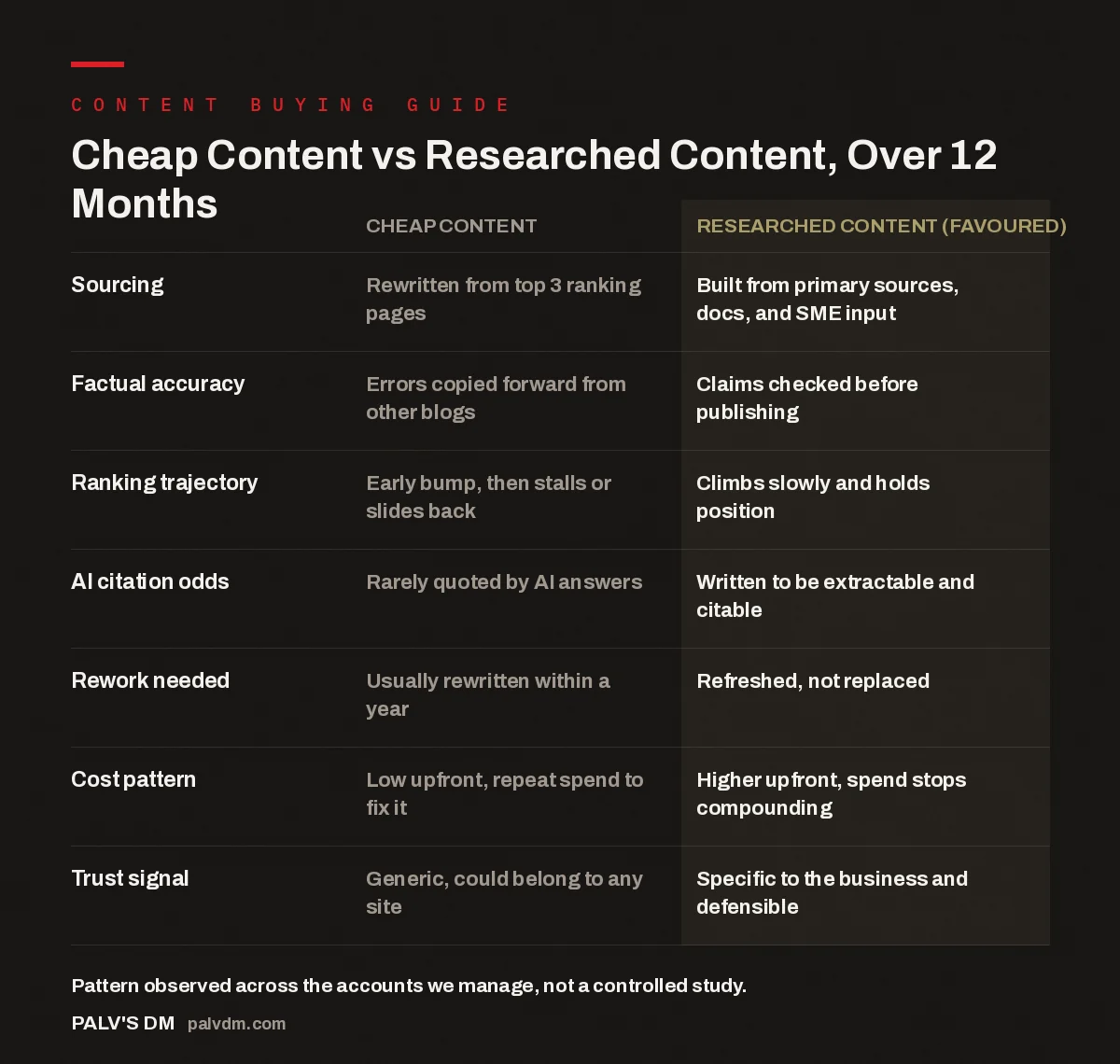
Cheap Content vs Researched Content, Over 12 Months
| Cheap content | Researched content (favoured) | |
|---|---|---|
| Sourcing | Rewritten from top 3 ranking pages | Built from primary sources, docs, and SME input |
| Factual accuracy | Errors copied forward from other blogs | Claims checked before publishing |
| Ranking trajectory | Early bump, then stalls or slides back | Climbs slowly and holds position |
| AI citation odds | Rarely quoted by AI answers | Written to be extractable and citable |
| Rework needed | Usually rewritten within a year | Refreshed, not replaced |
| Cost pattern | Low upfront, repeat spend to fix it | Higher upfront, spend stops compounding |
| Trust signal | Generic, could belong to any site | Specific to the business and defensible |
What does “cheap content” actually mean?
In practice, cheap content writing means an article assembled by reading the top few Google results and rephrasing them, without anyone checking whether the underlying claims are accurate or still current. It’s not a judgment on the writer — most freelancers paid ₹1-2 per word simply don’t have the time budget to verify anything. They have thirty to sixty minutes to produce 800-1,200 words, which is enough time to paraphrase three articles but not enough to check a single statistic, read a primary source, or ask someone who actually does the work described. The result reads fluently. It just doesn’t know anything the source pages didn’t already know, and it inherits their mistakes along with their structure.
Researched content starts from a different place: a brief built around what the searcher actually needs answered, source material that includes documentation, expert input, or direct experience with the topic, and a verification pass before publishing. It costs more per article because it takes longer to produce properly. That’s the entire difference — not better grammar, not a fancier vocabulary, just more accurate and more original input going in.
How does cheap content lose rankings after the first few months?
The pattern that shows up repeatedly in the accounts we manage is a fast rise followed by a slow decline. A cheap article often ranks reasonably well in the first four to eight weeks, because it’s freshly published, targets the keyword directly, and search engines give new content a temporary boost while they figure out where it belongs. Then the boost fades, and what’s left is a page that says the same thing as five competitors, with no additional depth, no unique examples, and nothing that makes it worth ranking above the pages it was rewritten from.
Search engines compare pages against each other on a topic, and a rewrite of the consensus view rarely beats the pages that established that consensus. So the article settles somewhere on page two, gets a trickle of impressions, and stops moving. At that point the business has two choices: leave it as dead weight, or pay again to have it rewritten with actual depth — which is the researched-content cost it was trying to avoid the first time, plus the sunk cost of the original.
What does researched content do differently from month one?
Researched content is built to say something the existing top-ranking pages don’t already say — a specific process, a real example, a number pulled from a primary source rather than copied from someone else’s blog. That’s what gives it something to hold its ranking on once the new-content boost wears off. It also tends to earn links and mentions more naturally, because other writers and site owners cite pages that add information, not pages that repackage it.
The trajectory looks slower at first. A well-researched article can take longer to climb because it’s competing on genuine merit rather than freshness, and Google needs a few crawl-and-recrawl cycles to register that the page is worth more than its rewritten competitors. But once it climbs, it tends to hold the position, because nothing about the page erodes with time the way a thin rewrite does.
The cheap article isn’t a discount. It’s a loan against next year’s content budget, and it comes with interest — you pay for the rewrite, plus everything the site lost while the wrong version was live.
Palash, Founder, PalV’s DM
Where does the extra cost of research actually go?
It’s worth being specific about what the higher price actually buys, because “research” can sound like a vague premium tacked onto an invoice. In practice it covers three things: time spent reading source material beyond the top search results, time spent checking any claim that appears in the draft against something more reliable than another blog, and a review pass where someone other than the writer reads the piece for gaps and inaccuracy before it’s published. None of that shows up as a visible feature in the final article — it shows up as the article being right, specific, and slightly harder for a competitor to casually replace.
Businesses buying content on price alone are usually comparing the invoice, not the outcome. A cheaper article that has to be rewritten in month eight didn’t save money — it deferred the real cost and added a delay before the site started ranking for real. Over a 12-month content calendar, the businesses that end up spending the least per article that actually performs are usually the ones that paid more per article up front and never had to touch it again.
Why does AI search punish cheap, rewritten content harder than Google did?
AI answer engines like ChatGPT, Perplexity, and Google’s AI Overviews pull from pages that state something clearly, back it with a source, and don’t hedge. A rewritten article that paraphrases the consensus view gives these systems nothing distinctive to quote — if five pages say roughly the same thing, an AI answer engine has no reason to cite the sixth, especially not the one with the least original input. This is a widely observed pattern in how these tools currently select and attribute sources, even without a precise figure attached to it.
Researched content tends to fare better here because it’s more likely to contain something quotable: a specific process, a named example, a clearly stated number with its source attached. That’s the same property that helps it rank in traditional search, and it compounds the gap between cheap and researched content further, because being invisible to AI answer engines is now a second channel of traffic a thin article is missing out on, not just a ranking position in classic search.
How do you tell if your current content is the cheap kind?
A few honest questions usually settle it. Does the article say anything the top three competing pages don’t already say? Could you swap the business name for a competitor’s and have the article still make sense? Does any claim in it trace back to something more specific than “studies show” or a number with no source? If the answers are no, yes, and no, the article was likely produced the cheap way, regardless of what it cost to commission — some agencies charge researched-content prices for rewrite-quality work, so price paid isn’t a reliable proxy either. The content itself, read critically, is the only test that matters.
- Check whether any statistic or claim in the article links to, or clearly comes from, a real source.
- Compare the article against the current top three ranking pages for the same keyword — look for anything genuinely new.
- Look at rankings six months after publish, not six weeks — the early bump hides the real trajectory.
Before you commission the next batch
If you’re not sure whether your existing content falls into the cheap or researched category, it’s worth finding out before you spend another rupee on more of the same. We can look at what you already have and tell you plainly which articles are worth keeping.
FAQ
Is cheap content ever the right call?
For pages that aren’t meant to rank or persuade — internal notes, low-stakes filler pages, or content you plan to replace within weeks anyway — cost matters more than depth. For anything meant to attract search traffic or convince a buyer over the next year, the rewrite cost usually exceeds what was saved.
How long before cheap content’s ranking problems show up?
In the pattern we see across client accounts, the first sign is usually between month three and month six, once the new-content ranking boost fades and the page has to compete on merit rather than freshness. By month twelve it’s typically clear whether the piece held its position or slid.
Can you tell cheap content apart from researched content just by reading it?
Usually yes, with a critical read. Cheap content tends to restate what competing pages already say, avoids specific claims, and could apply to almost any business in the category. Researched content includes details — names, processes, sourced numbers — that a rewrite wouldn’t produce because they weren’t in the source pages to begin with.
Does a higher price guarantee researched content?
No. Price is a weak proxy. Some agencies charge premium rates for content that’s still essentially a rewrite with better formatting. The reliable check is the process behind the article — where the information came from and whether anyone verified it — not the invoice total.
What should I do with cheap content that’s already published?
Not all of it needs a full rewrite. Articles with decent structure and a real keyword match can often be strengthened with added depth and verified facts rather than replaced outright. The ones worth abandoning are usually the ones with no distinct angle at all, competing against dozens of near-identical pages.
The short version
Cheap content writing risks are real but slow — the damage doesn’t show on invoice day, it shows up as a stalled ranking and a rewrite bill six to twelve months later. Researched content costs more per article and less per year, because it’s built to say something the top-ranking pages don’t already say, which is what keeps both search engines and AI answer engines willing to surface it. If you’re planning a year of content, it’s worth pricing the whole year, not the first article. For more on what a properly researched article actually costs in India, see our breakdown of SEO content pricing, our note on why we refuse to publish without verifying numbers, our piece on writing content that both ranks and gets cited, and our comparison of refreshing old posts versus writing new ones if you’re deciding what to do with content you already have.