Service Support — Content Writing
What Comes With Every Article: Schema, Meta, Images, Links
See the full seo content deliverables included in every article we write: schema markup, meta title, description, images with alt text, and internal links.
Every article we deliver comes with more than the words on the page. The seo content deliverables in a standard order from PalV’s DM include schema markup, a written meta title and description, at least one original image, internal links to relevant pages on your site, and — where the topic calls for it — an external link to a credible source. None of this is billed as an “extra.” It is what “an article” means in a brief that is actually built to rank and get cited, not just to fill a content calendar.
Key takeaway
- An SEO article isn’t just prose — schema, meta tags, images with real alt text, and internal/external links are part of the base deliverable, not paid add-ons.
- Skipping the technical package is the most common reason a well-written article still underperforms in search and gets ignored by AI answer engines.
- You should be able to ask any content vendor “what’s in the package besides the words?” and get a specific, itemised answer — if you can’t, you’re buying a document, not a search asset.
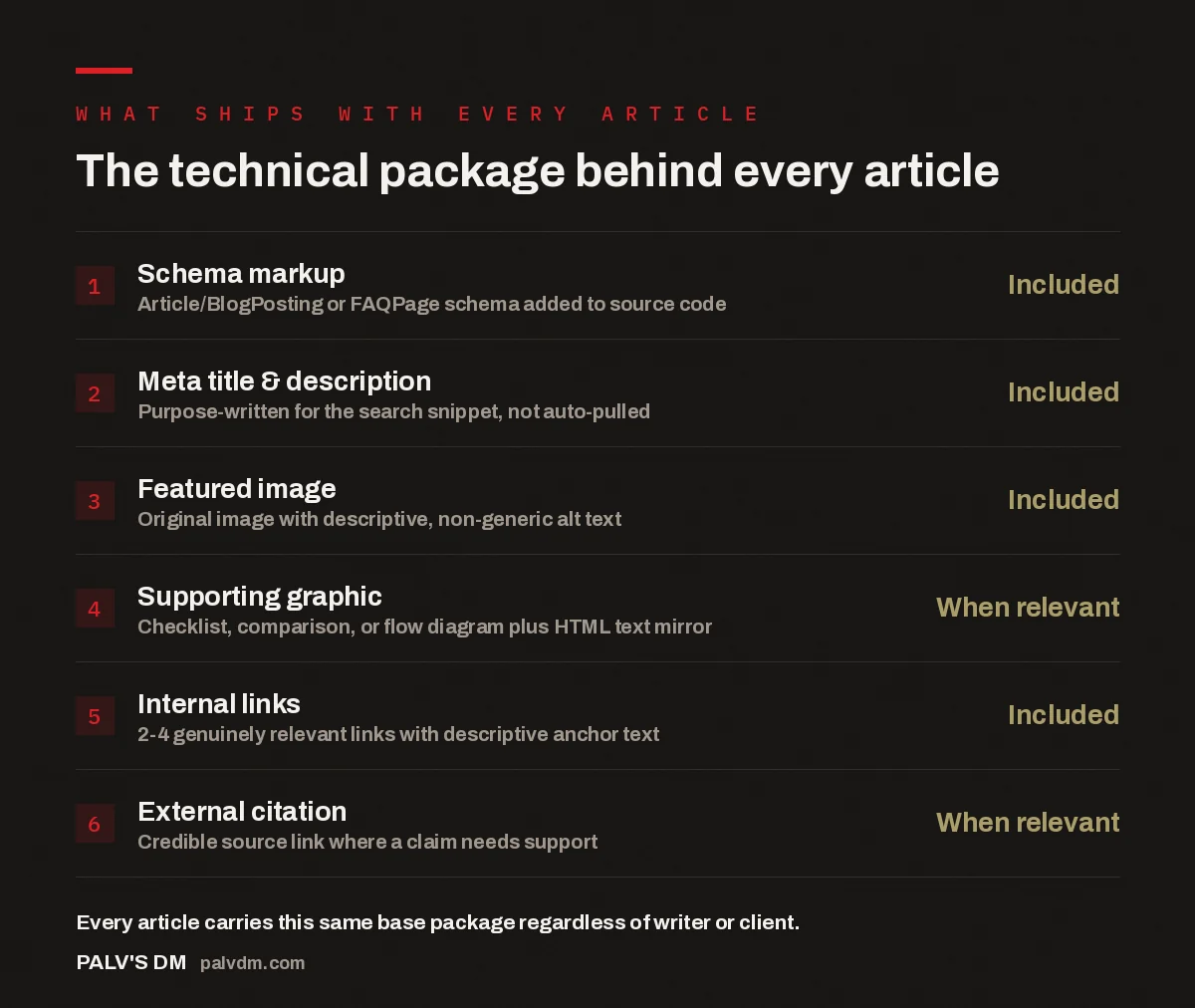
The technical package behind every article
- Schema markup — Included. Article/BlogPosting or FAQPage schema added to source code.
- Meta title & description — Included. Purpose-written for the search snippet, not auto-pulled.
- Featured image — Included. Original image with descriptive, non-generic alt text.
- Supporting graphic — When relevant. Checklist, comparison, or flow diagram plus HTML text mirror.
- Internal links — Included. 2-4 genuinely relevant links with descriptive anchor text.
- External citation — When relevant. Credible source link where a claim needs support.
What’s actually inside an SEO content deliverable?
Most freelance writers and content mills sell you a Word document. You get a headline, some paragraphs, maybe a couple of subheadings, and that’s it — the technical work of turning that document into something a search engine or an AI answer engine can actually parse, trust, and surface is left entirely to you. In our process, every article that goes out the door carries the same fixed set of components regardless of which writer worked on it or which client it’s for. That consistency is deliberate: it means nothing depends on someone remembering to add it later.
The package is the same whether the article is 900 words or 2,200 words, whether it’s a comparison piece or a how-to guide. What changes is the specific schema type used and how many internal links make sense for that particular page — the presence of the components themselves does not change.
Why does schema markup matter for a blog article?
Schema markup is structured code added to the page — invisible to a human reader, fully visible to a crawler — that labels what each part of the content actually is. An FAQ section gets marked up as FAQPage schema so a search engine knows those are questions with direct answers, not ordinary paragraphs. An article gets Article or BlogPosting schema carrying the author, publish date, and headline as distinct, machine-readable fields rather than text a bot has to guess at.
This matters more now than it did five years ago, and for a reason beyond classic search results. AI answer engines — the systems generating summarised answers instead of a list of blue links — lean heavily on structured, unambiguous signals when deciding which page to pull a fact from and which source to cite. A page with clean schema is easier for those systems to quote correctly and attribute properly. A page without it is easier to misread or skip in favour of a competitor’s page that made the structure explicit. In the accounts we work on, articles published with proper schema tend to pick up rich-result eligibility and citation mentions faster than versions of the same content without it — we don’t claim a fixed percentage lift, since that varies by niche and competition, but the direction of the pattern is consistent.
What goes into the meta title and description?
Every article ships with a purpose-written meta title and meta description, separate from the on-page H1 and intro paragraph. These are not auto-generated by pulling the first sentence of the article — they’re written specifically for how the page will appear in a search result snippet, which is a different writing job with different constraints. A meta title has to work within roughly 55-60 characters before it truncates. A meta description has to earn a click in one or two lines while including the actual keyword the page is targeting, not a vague paraphrase of it.
We write these to include the target keyword naturally, because both classic search and AI engines use the meta description as one input — among several — for understanding what the page promises to cover. A generic or missing meta description doesn’t just hurt click-through rate; it removes one more clear signal that a system could have used to match the page to a query.
What image work is included, and why does it matter for AI visibility?
Every article includes at least one original image — usually a featured/hero image, and for guides or process-driven pieces, a supporting graphic like a checklist, comparison table, or flow diagram rendered as an actual image rather than left as plain text alone. Both come with real, descriptive alt text: not “image1.jpg” or a keyword crammed in without regard for readability, but a genuine description of what the image shows.
Stock photography pulled without editing, with no alt text and no unique framing, does close to nothing for a page’s visibility — it’s decoration, not a signal. An image that visually represents the article’s actual content, captioned accurately, and paired with alt text that describes what it proves rather than what it depicts, gives search and AI systems a concrete data point about what the page covers and whether it’s trustworthy enough to cite. We also mirror any data-bearing graphic as plain HTML text directly beneath the image, so an AI crawler that can’t parse an image can still read the same information as text.
An article without schema, a real meta description, and internal links isn’t half-finished — it’s a different, weaker product wearing the same word count.
Palash, Founder, PalV’s DM
How many internal and external links does an article get?
Every article links internally to a small number of genuinely relevant pages already live on the site — typically two to four — using descriptive anchor text rather than “click here” or a bare URL. These links do two things at once: they help a search engine understand how pages on the site relate to each other and pass authority between them, and they give a reader (human or AI) a next step that’s actually useful, not a link placed to hit a quota.
Where the topic calls for it, we also add an external link to a credible, relevant source — a platform’s own documentation, a well-established industry reference, something that supports a specific claim rather than a generic “learn more” link to a random third-party site. External links are used sparingly and only when they add real evidentiary weight, because a page cluttered with unnecessary outbound links reads as unfocused rather than well-researched.
Do these components actually change how an article performs?
We won’t invent a precise number here, because the honest answer depends on the niche, the domain’s existing authority, and how competitive the target keyword already is. What we can say, directionally, from the accounts we manage: articles that ship with the full technical package consistently pick up impressions and rich-result features faster than articles that are just well-written prose with no supporting structure. The pattern shows up across clients repeatedly enough that we no longer treat schema, meta writing, image work, and linking as optional polish — they’re load-bearing parts of the deliverable, not decoration added after the fact.
The reverse is just as consistent. An article missing schema, with a lazily auto-generated meta description, no internal links, and a stock photo with blank alt text, tends to sit quietly on page two even when the writing itself is competent. The content isn’t the problem in those cases — the missing scaffolding around it is.
How do you check whether your current content vendor includes this?
Pull up three recently published articles from whoever writes your content today and check for five things: does the page have FAQPage or Article schema in its source code (view-source and search for “schema.org” will tell you); is the meta description unique per article and not a copy-paste of the same boilerplate; does at least one image have real, descriptive alt text rather than a blank attribute or the filename; are there internal links to other pages on your own site with descriptive anchor text; and is there any external citation where the article makes a factual claim that would benefit from one.
- If all five are present consistently, your vendor is already delivering a full technical package.
- If some are missing on some articles, the work is inconsistent — which usually means it depends on which writer happened to remember, not on a fixed process.
- If none are present, you’re paying for a document, and the SEO and AI-visibility value of that content is being left almost entirely on the table.
See it on your own content
If you want a straight answer on whether your existing articles have this technical package in place — and what it would take to fix the ones that don’t — we’ll look at a handful of your pages and tell you plainly.
FAQ
Is schema markup something I have to ask for separately?
No — with us it’s part of the standard deliverable for every article, not an add-on you have to request. The specific schema type (Article, FAQPage, HowTo) is chosen based on the article’s format, and it’s added before the piece is handed off, not bolted on afterward if someone remembers.
Do you write the meta title and description, or do I need to?
We write both as part of the deliverable. They’re drafted specifically for the search snippet format — character limits, keyword placement, and a reason to click — rather than copied from the article’s opening sentence, which is a common shortcut that produces weak, generic snippets.
What if my article doesn’t need a supporting graphic like a checklist or chart?
Not every article needs one — a straightforward comparison or opinion piece may only need a featured image. We add a structural graphic (checklist, comparison, or process flow) only when the content genuinely has that shape, because a graphic added just to have one adds clutter rather than clarity.
How many internal links does a typical article include?
Usually two to four, chosen because they’re genuinely relevant to what the article covers, not to hit a fixed quota. We’d rather ship an article with two well-placed, relevant links than five links stuffed in because a checklist said “add links.”
Can I get just the writing without the technical package, at a lower price?
We don’t offer that split, because a written page without schema, meta, images, and links isn’t really a finished SEO asset — it’s a draft. If budget is a factor, the better lever is article volume or frequency, not stripping the technical components that make an article actually perform.
The short version
An SEO article is more than its word count. Schema markup, a purpose-written meta title and description, at least one real image with descriptive alt text, and a handful of genuinely relevant internal (and where useful, external) links are part of what makes a page legible to search engines and citable by AI answer engines — not optional extras layered on top of “the real work” of writing. If you want to see how this compares with what you’re already publishing, read what you get when you order an article from us, or look at our content pipeline from brief to published to see where the technical package fits into the process. For a sense of how this affects results over time, cheap content vs researched content: the cost over 12 months lays out the longer-term trade-off plainly.