Service Support — Content Writing
Do You Need a Writer or a Content Strategist?
Content writer vs strategist: writers turn briefs into copy, strategists decide what to write and why. Here is how to tell which one your business needs.
If you already know exactly what to publish next, you need a writer. If you don’t know which topics matter, what order to publish them in, or why last month’s articles didn’t move traffic, you need a content strategist first and a writer second. The content writer vs strategist question isn’t really about skill level. It’s about which decision is missing from your content operation. Most businesses default to hiring a writer because it’s the visible, tangible role — someone hands over a document, and text comes back. A strategist’s output is less obvious: a plan, a priority order, a set of briefs. But without that plan, a good writer just produces well-written articles that sit on page four.
Key takeaway
- A writer executes a brief; a strategist decides what gets written, in what order, and why.
- Hiring only a writer works well if you already have a validated content plan — otherwise you get polished articles that don’t move rankings.
- In the accounts we work on, sites that publish consistently but stay flat are almost always missing the strategist role, not writing talent.
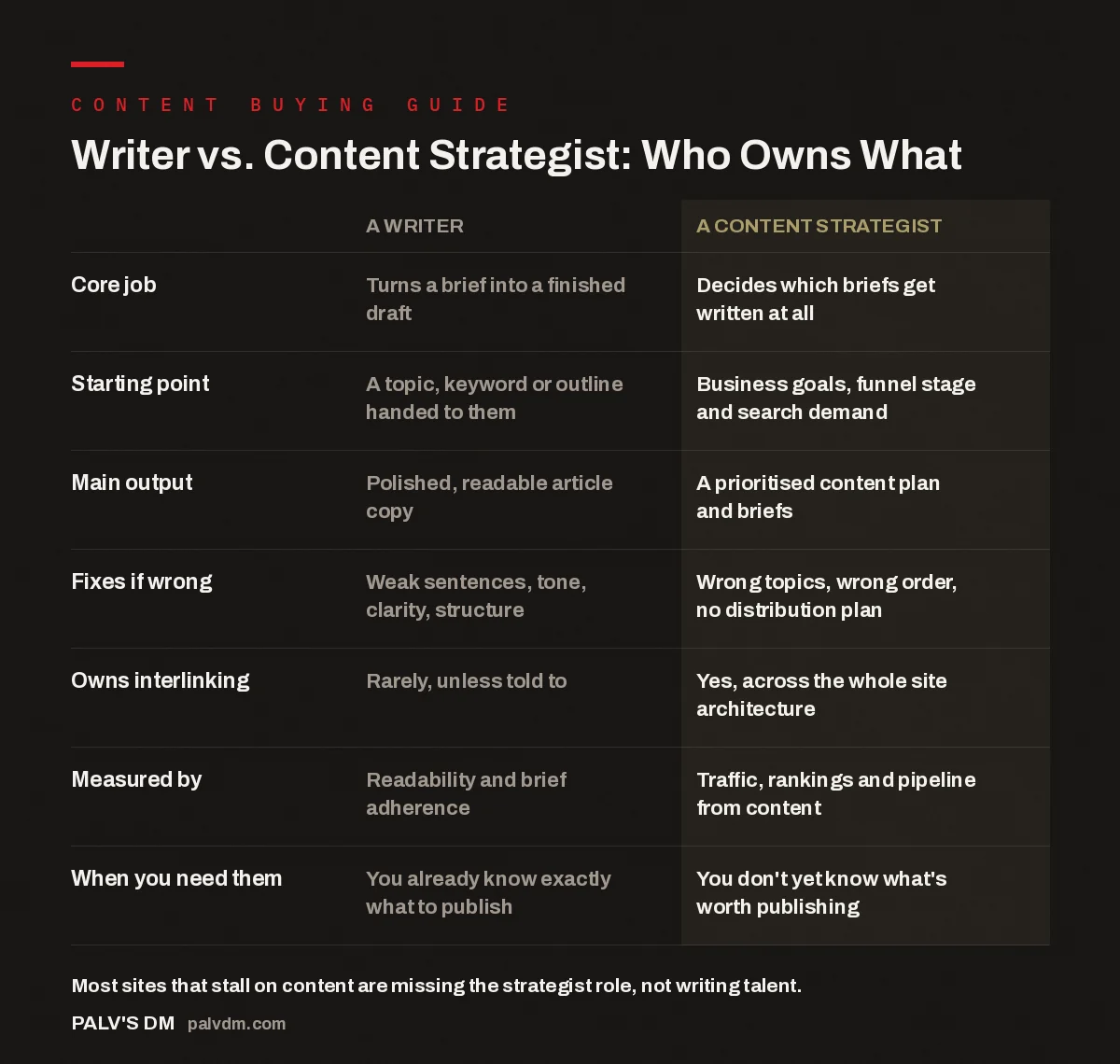
Writer vs. Content Strategist: Who Owns What
| A Writer | A Content Strategist | |
|---|---|---|
| Core job | Turns a brief into a finished draft | Decides which briefs get written at all |
| Starting point | A topic, keyword or outline handed to them | Business goals, funnel stage and search demand |
| Main output | Polished, readable article copy | A prioritised content plan and briefs |
| Fixes if wrong | Weak sentences, tone, clarity, structure | Wrong topics, wrong order, no distribution plan |
| Owns interlinking | Rarely, unless told to | Yes, across the whole site architecture |
| Measured by | Readability and brief adherence | Traffic, rankings and pipeline from content |
| When you need them | You already know exactly what to publish | You don’t yet know what’s worth publishing |
What does a content writer actually do?
A content writer takes a defined brief — a topic, a target keyword, a rough outline, sometimes a competitor example — and turns it into a finished, readable piece. Their job is craft: sentence structure, clarity, tone, pacing, and making sure the draft actually answers what the title promises. A strong writer can take a mediocre brief and still produce something readable. What a writer generally can’t do, because it isn’t their job, is tell you whether that brief should have existed in the first place. They’re not deciding whether this topic beats twelve other topics you could have chosen, or whether it fits where a reader is in their buying journey. That decision sits one layer up, and it’s the layer most businesses skip.
This is normal, not a failure of the writer. Most freelance writers and many in-house hires are hired against a job description that says “write blog posts,” with topics supplied by whoever is managing the calendar that week — often a founder or marketing generalist picking ideas from a spreadsheet or a competitor’s blog. The writing quality can be genuinely good. The problem shows up months later, when twenty well-written articles haven’t moved a single keyword, because none of them were chosen with search demand or funnel position in mind.
What does a content strategist actually do?
A content strategist works from the business side inward: what are you trying to sell, who is searching for it, and at what stage of that search are they ready to buy? From there they build a prioritised list of topics, grouped into clusters, mapped to funnel stage (top, middle, bottom), and sequenced so that early articles build the topical authority later articles need to rank. They write the brief the writer works from — target keyword, search intent, competing pages, internal links to include, and what the piece needs to prove or answer. They also own the parts a writer typically doesn’t: internal linking across the whole site, deciding when to refresh an old post instead of writing a new one, and tracking which published pieces are actually earning rankings versus sitting idle.
None of this shows up as a document you can point to the way you can point to a finished article. That’s part of why the role gets skipped — it’s harder to see the value of a decision than the value of a paragraph. But the decision is what determines whether the paragraph was worth writing.
Content writer vs strategist: why the confusion happens
Part of the confusion is language. Job boards and freelance marketplaces use “content writer” as an umbrella term that sometimes includes strategy work and sometimes doesn’t, so two people with the same job title can be doing entirely different jobs. Some agencies bundle strategy into the writer’s rate without naming it, which works fine until you try to hire a second writer and discover there’s no documented plan for them to follow — only one person’s implicit sense of what to write next.
The other part is that “we need better content” is the wrong diagnosis for a very common symptom. When traffic is flat despite regular publishing, the instinct is to hire a better writer, because writing quality is the thing you can read and judge. But if you go back through a stalled blog’s archive, the pattern that shows up repeatedly isn’t bad sentences — it’s topics that don’t map to anything anyone was searching for, published with no internal links tying them to money pages, in no particular order.
Nobody ever calls us because their articles are badly written. They call because they’ve published fifty articles and can’t explain why none of them rank.
Palash, Founder, PalV’s DM
How do you know which one you need right now?
Run through these four questions honestly and the answer usually becomes obvious.
- Do you have a documented, keyword-mapped content plan, or are topics chosen week to week? If topics come from whoever is free that week, you need a strategist before you need another writer — otherwise you’re just producing more of the same unfocused output, faster.
- Have you been publishing consistently for three to six months without traffic moving? That’s usually a strategy problem, not a writing-quality problem. Read how many articles it typically takes before traffic moves before assuming the volume is the issue.
- Do you already have one clear topic, a target keyword, and just need it turned into a well-written page? That’s a writer’s job — you don’t need a strategist for a single, already-defined brief.
- Are you scaling past one writer, or handing content to a freelancer with no SEO background? That’s the point where buying content without anyone to brief it starts costing you more than a strategist’s time would.
Can one person do both jobs?
At small volume, yes — a single senior writer with SEO judgment can plan a handful of topics and write them, and plenty of good blogs start that way. The split becomes necessary once you’re publishing regularly with more than one writer involved, because at that point someone has to own consistency across people: the same voice, the same linking logic, the same prioritisation, even though multiple hands are producing the drafts. That coordination is exactly what a documented process solves — see how we keep one voice across multiple writers for what that looks like in practice, and our content pipeline from brief to published for how the strategist’s plan and the writer’s draft actually connect end to end.
Cost is the other variable worth being honest about. Strategy work is harder to price by the piece than writing is, which is part of why so many buyers avoid it and default to paying per article instead. If you’re budgeting for content, it helps to look at what SEO content should actually cost per article in India so you’re comparing like for like — a cheap per-article rate that includes no strategic thinking is a different product from a slightly higher rate that includes a brief built around search demand.
Not sure which one you need?
We run content writing as strategy and execution together — every article starts with a brief built from real search demand, not a topic pulled from a spreadsheet.
Frequently asked questions
Is a content strategist more expensive than a content writer?
Usually, per hour, yes — strategy work commands a higher rate because it requires research into search demand, competitors and funnel mapping rather than just drafting. But it’s often cheaper overall, because it prevents paying for articles that never rank.
Can I hire both a writer and a strategist from the same agency?
Yes, and it’s usually simpler than managing them separately, since the strategist’s plan and the writer’s brief stay connected without you relaying information between two vendors. Ask any agency directly whether strategy is included or billed as an add-on.
What happens if I only hire a writer and skip strategy entirely?
You’ll usually get well-written articles on topics chosen without reference to search demand or funnel stage. In the accounts we’ve seen, this pattern produces a blog that looks active but stays flat on traffic, because the underlying topic choices weren’t validated against what people actually search for.
How do I brief a writer myself if I don’t have a strategist?
At minimum, give the writer a target keyword, the search intent behind it (informational, comparison, buying-ready), two or three competing pages already ranking for it, and which of your own pages it should link to. That covers the gap a strategist would normally fill, even if imperfectly.
Do small businesses actually need a dedicated content strategist?
Not a dedicated hire, no — a fractional or agency strategist doing a few hours of planning a month is usually enough at small scale. What matters isn’t the job title, it’s making sure someone is deciding what to write before anyone starts writing it.
Short version: a writer turns a brief into a finished article; a strategist decides which briefs are worth writing in the first place. If you can already name your next ten article topics with a keyword and a reason behind each one, hire a writer. If you can’t, that’s the gap to close first — no amount of writing talent fixes a plan that was never built.