When You Genuinely Don’t Need an SEO Agency Yet
Do I need an SEO agency? Not if your site, pricing or follow-up process is still unstable. Here's the honest checklist for when to wait and when to hire.
Do you need an SEO agency? Not always, and not yet in a lot of cases. If your site has fewer than ten real pages, your product or pricing is still changing month to month, or nobody on your team can respond to a new lead within a day, an SEO agency will mostly be billing you to wait. SEO compounds on top of a stable business — it doesn’t create one. Fix the business first; hire the agency once there’s something worth ranking and someone ready to catch the traffic.
Key takeaway
- An SEO agency needs a stable site, a settled offer and someone who can act on new leads — without those, you’re paying for motion, not results.
- Free tools (Google Search Console, Google Business Profile, on-page basics) can carry a small or early-stage site further than most owners expect before an agency adds real value.
- The right moment to hire is when the business is stable enough to hold a ranking, and busy enough that nobody has time to do SEO by hand anymore.
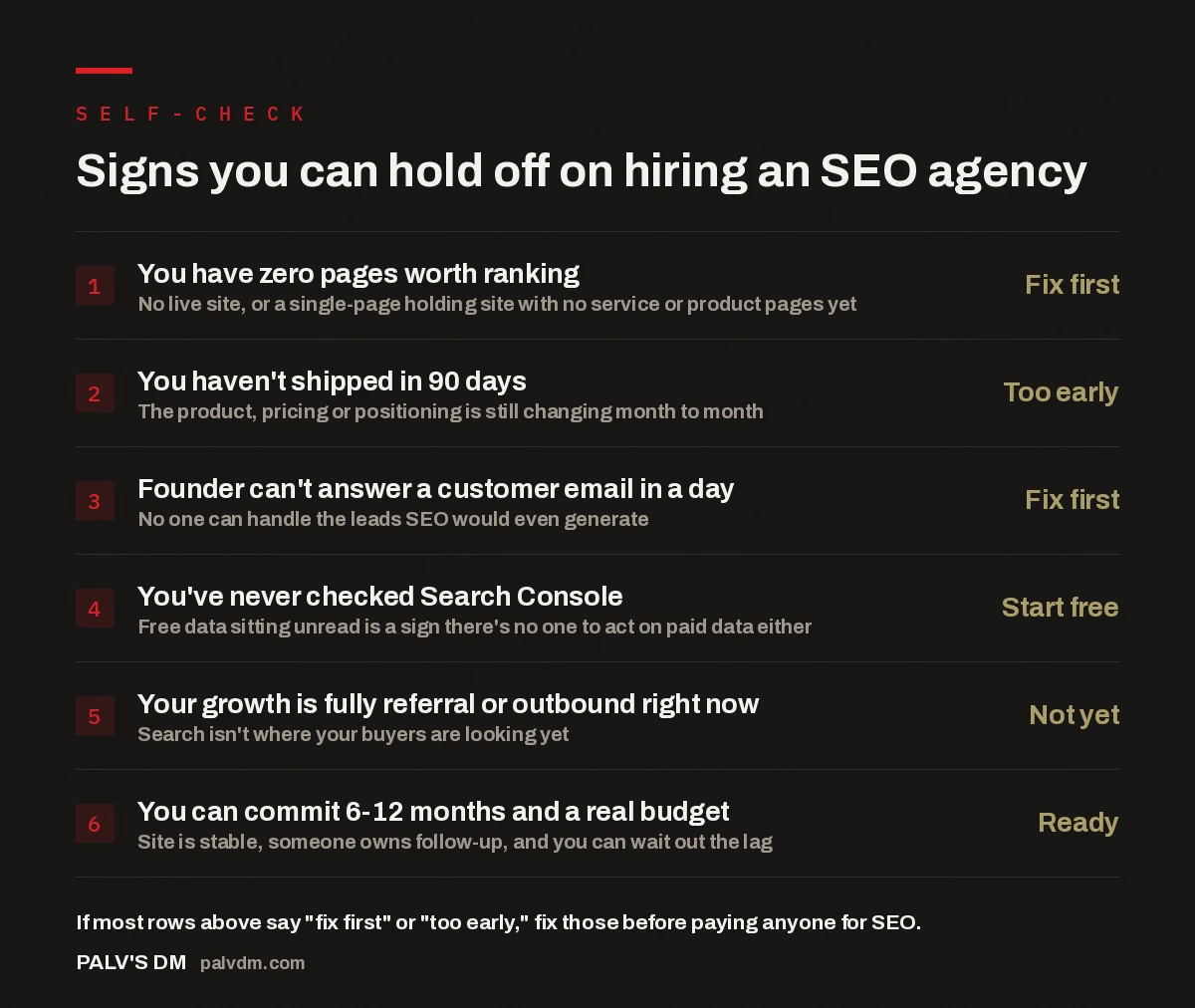
Signs you can hold off on hiring an SEO agency
- You have zero pages worth ranking — Fix first. No live site, or a single-page holding site with no service or product pages yet.
- You haven’t shipped in 90 days — Too early. The product, pricing or positioning is still changing month to month.
- Founder can’t answer a customer email in a day — Fix first. No one can handle the leads SEO would even generate.
- You’ve never checked Search Console — Start free. Free data sitting unread is a sign there’s no one to act on paid data either.
- Your growth is fully referral or outbound right now — Not yet. Search isn’t where your buyers are looking yet.
- You can commit 6-12 months and a real budget — Ready. Site is stable, someone owns follow-up, and you can wait out the lag.
Myth: any business with a website should be running SEO
This is the pitch most agencies lead with, and it isn’t wrong so much as incomplete. SEO works on businesses that already have a working offer, a reasonably stable site, and a way to handle the demand it generates. It doesn’t build any of those things for you. We’ve had discovery calls with founders who wanted a retainer before they’d published a single service page, before pricing was final, and before anyone on the team had a plan for what happens when a form gets submitted. In each of those cases, the honest answer was: not yet.
The reality is that SEO is a multiplier, not a foundation. It takes whatever conversion rate, offer clarity and follow-up speed you already have and gradually sends more traffic at it. If that traffic hits a broken checkout, a stale price list, or an inbox nobody checks, the agency’s work doesn’t fail — it just gets wasted downstream, and it’s the client who ends up out the retainer with nothing to show for it.
What has to be true before an SEO agency actually helps?
Three things, roughly in this order. First, the site has to exist in a form worth optimising — a handful of real pages describing what you sell, to whom, and why, not a single-page placeholder waiting on a “proper website” later. Second, the offer has to be stable enough that a page written today is still accurate in three months, because that’s roughly the minimum time before organic rankings start moving in a competitive category. Third, someone on your side has to be able to close the loop on whatever demand shows up — reply to enquiries, quote jobs, ship orders — without SEO traffic becoming a queue nobody clears.
None of these are agency problems. They’re operational readiness problems, and they’re yours to solve before anyone starts building backlinks or rewriting title tags. A useful gut check: if you got twenty extra qualified enquiries next month, would that be a good problem or a bad one? If it’s a bad one, SEO isn’t your bottleneck right now.
The founders who get the most out of an SEO agency are the ones who were already busy before they hired one. SEO doesn’t create capacity — it exposes whatever capacity you already have to more people.
Palash, Founder, PalV’s DM
How far can free tools take you before you need to pay for SEO?
Further than most owners assume, especially for a small or single-location business. Google Search Console tells you, for free, which queries are already sending you impressions and clicks, which pages are indexed, and which have crawl or mobile issues — most of that dashboard sits unopened in accounts we later inherit. Google Business Profile, kept current with accurate hours, categories, photos and a habit of replying to reviews, does a large share of the work for any business that depends on local search. Basic on-page hygiene — a clear title tag, a real meta description, one H1 per page, internal links between your own service pages — costs nothing but a few focused hours.
Where this runs out is competitive volume. Once you’re chasing keywords with genuine commercial competition — several agencies in your city targeting the same phrase — free tools tell you what’s happening but not what to do about it. That’s the point where structured keyword research, a content calendar tied to buyer intent, and consistent technical maintenance outpace what one person can sustain in spare hours. For where that line sits across different site sizes, see which SEO plan fits a 10-page site vs a 500-page site.
What if you’re already running Google Ads — do you still not need SEO?
Running ads doesn’t automatically mean you’re ready for SEO, and it doesn’t mean you should skip it either — the two questions are separate. Ads can validate that an offer converts before you invest months waiting for organic rankings to catch up, which is genuinely useful if you’re still testing positioning. But ads spend also masks the same readiness gaps SEO would expose: if leads from Google Ads are already sitting unanswered for two days, adding organic traffic on top just widens the backlog. We’ve written a longer breakdown of how the two channels actually interact in do you need SEO if you already run Google Ads — worth a read if that’s your situation.
What does “not ready yet” actually look like in practice?
A few recurring patterns, drawn from the shape of conversations we have on discovery calls rather than any precise count. A founder building a new product category where the pricing model is still being tested month to month — an SEO page written around this month’s pricing is often wrong by the time it starts ranking. A local service business that hasn’t claimed or updated its Google Business Profile in over a year — that’s free inventory sitting idle, worth fixing before a single rupee goes toward a retainer. A team of one where the founder is already the salesperson, delivery lead and support desk — adding a lead-generation channel doesn’t help if there’s no time to work the leads it produces.
In each of these, the fix isn’t “wait forever” — it’s “fix the specific gap, then revisit.” A pricing model that’s been stable for even a full quarter changes the calculus. A Business Profile brought current changes it. Hiring a part-time person to own enquiry follow-up changes it. None of these require an agency; all of them are prerequisites an agency will ask about anyway during a proper first call.
How do you know when the timing has flipped?
The honest signal isn’t a calendar date, it’s a workload signal: SEO stops being premature the moment doing it properly yourself becomes the thing you don’t have time for, not the thing you haven’t gotten around to. If you’ve fixed the fundamentals above — stable offer, functioning site, someone who can handle new demand — and you’re still not publishing content or fixing technical issues because there’s no spare afternoon in the week, that’s the actual trigger. Founders searching “do I need an SEO agency” are often looking for permission to wait; the honest answer is to wait only as long as the fundamentals are missing, and move the moment they’re not.
It’s also worth being honest about budget at this stage. SEO takes months to compound, so a retainer you can only sustain for six weeks before cash gets tight is a worse bet than spending those same weeks on the free-tool basics above. Startups weighing this exact trade-off might find SEO for startups: the realistic first-year path useful for sequencing it properly, and if budget is genuinely tight, what Rs 8,000 a month of SEO buys you lays out what a lean entry point actually covers.
What should you do instead while you wait?
Use the waiting period productively rather than passively. Set up Google Search Console and Google Analytics if they aren’t already connected — even a few months of baseline data makes the eventual SEO work faster, because there’s history to compare against. Write the core pages your business actually needs regardless of SEO: what you do, who it’s for, what it costs, how to reach you. Fix the operational gap, whether that’s response time, checkout friction, or a follow-up process that doesn’t currently exist. None of this requires an agency, and all of it makes the eventual engagement more productive because it starts from a working business instead of one still finding its shape.
- Claim and fully complete your Google Business Profile if you serve a local market
- Connect Google Search Console and check it monthly, even if you’re doing nothing else yet
- Write the handful of core pages your site is missing, with plain, accurate descriptions of what you sell
- Put a real process in place for responding to enquiries within a day
- Revisit the question in one quarter, once pricing and positioning have held steady
For a sense of what a first engagement actually covers once you do reach that point, how we decide what goes into a client’s first 90 days walks through the sequencing, and what we do in month one that most agencies skip covers the groundwork that separates a real start from a template.
When you are ready
- Your offer and pricing have held for at least a quarter
- You have someone who can respond to new enquiries within a day
- You’ve outgrown what free tools and spare hours can maintain
See what our SEO plans include and get a straight answer on fit
FAQ
Do I need an SEO agency if I’m a brand new business with no website traffic yet?
Usually not immediately. Get the core pages of your site live, make sure your offer and pricing are settled, and set up free tracking through Google Search Console first. An agency adds the most value once there’s a stable site and business to build on, not while both are still being figured out.
Can I do SEO myself before hiring an agency?
Yes, for the basics. Claiming your Google Business Profile, writing clear on-page content, fixing obvious technical issues, and checking Search Console regularly are all things a founder can do without specialist help. Where it gets harder is sustained content production and competitive keyword targeting, which is where most owners run out of spare time.
What’s the risk of hiring an SEO agency too early?
The main risk is spending months of retainer fees on content and rankings built around an offer or site structure that changes before it ever gets traction. Pages built on unstable positioning need rewriting later, which effectively means paying twice for the same ground.
How do I know if my business is stable enough for SEO to work?
A reasonable test is whether your core offer, pricing and site structure have stayed the same for at least a full quarter, and whether you currently have someone able to respond to new enquiries within a day. If both are true, you’re in a position for SEO investment to compound rather than get rewritten.
If I already run Google Ads, do I still not need SEO?
Running ads and needing SEO are separate questions. Ads can validate an offer while you’re still testing it, but they don’t fix the same readiness gaps SEO exposes — slow follow-up or a thin site will limit both channels equally. Decide on SEO readiness independently of whether ads are already running.
Short version: you don’t need an SEO agency the moment your site goes live — you need one once your offer has held steady for a quarter, your site has a real handful of pages, and someone on your team can actually handle the leads it would bring in. Until then, free tools and a few focused hours cover most of what matters. Once those fundamentals are in place, that’s the point to have a straight conversation about what an SEO plan would actually look like for your business.