Credentials, Registers and Third-Party Verification
A credential only counts when someone else can confirm it. Which registers, licences and listings actually corroborate expertise, and how to link them up.
A credential only counts when someone other than you can confirm it, which is why a register entry, a licence number or an independent listing is worth more than any claim on your own website. Every expertise claim made on your own domain is circular: the site asserting the expertise is the site being assessed. Third-party verification breaks the circle. Google’s Search Quality Rater Guidelines instruct human assessors to research the reputation of a website and its creators using independent sources outside the site itself, which makes off-site corroboration the mechanism by which any credibility claim is actually tested.
The practical version of that is unglamorous. It is not about collecting badges. It is about making sure that when someone searches your name, your company name or your registration number, they land on records maintained by somebody with no incentive to flatter you — a statutory register, a professional body, a conference programme, a publication masthead.
Why do self-asserted credentials carry so little weight?
Because they cost nothing to fabricate. Anyone can write “certified expert with 10 years’ experience” into a bio field. Nothing about the sentence can be tested, which means it adds no information to a trust assessment, and the reader who was already sceptical stays sceptical.
A verifiable credential has three properties a claim lacks: it exists somewhere you do not control, it can be found by someone who only knows your name, and it carries an identifier — a registration number, a member ID, a licence, a dated listing. Where a claim on your author page cannot be checked, it is decoration. Where it links to a record that confirms it, the page becomes evidence.
What kinds of third-party verification actually exist?
They are not equal. The list below runs roughly from strongest to weakest in terms of how hard the signal is to manufacture.
| Type | Examples | Why it is hard to fake |
|---|---|---|
| Statutory registers | Company registration, tax registration, MSME registration | Maintained by government, publicly searchable, carries a unique identifier |
| Licensing bodies | Medical, legal, accountancy and engineering councils | Entry requires assessed qualification and can be revoked |
| Published work you did not publish | Bylines on other people’s sites, journals, industry press | An editor made an independent decision to publish you |
| Speaking and programme listings | Conference agendas, podcast archives, webinar pages | Dated, hosted by the organiser, hard to remove or invent |
| Vendor certifications | Platform and analytics certifications with a verification URL | Verifiable only if the issuer hosts a public record |
| Directories and listings | Business directories, marketplaces, association member lists | Weakest tier — many accept anyone who pays |
The bottom row is where most businesses concentrate their effort and where the least value sits. A paid directory listing corroborates that you exist, which is worth something, but it does not corroborate competence. The middle rows do.
Which registers matter for an Indian business?
An Indian buyer assessing a supplier is usually trying to establish that a registered legal entity exists behind the website. Several public records serve that purpose and cost nothing to reference.
- Company or LLP registration. Companies and LLPs registered with the Ministry of Corporate Affairs carry a unique identification number that appears on the public register. Publishing it on your site lets a buyer check it in a minute.
- GST registration. A GSTIN can be verified against the official GST portal. Displaying it also settles the invoicing question a B2B buyer is about to ask anyway.
- MSME or Udyam registration. Relevant for procurement processes that give preference to registered small enterprises.
- Professional council registration. Regulated professions — medicine, law, accountancy, architecture — maintain public registers, and for those fields the register entry is the credential.
None of these are ranking signals and none should be presented as such. They are answers to the question a cautious buyer is already asking, and putting them on an about page built for verification and a contact page carrying real business details removes the objection before it is raised. Building trust in the Indian market covers the wider pattern.
Are vendor certifications worth anything?
Sometimes, and less than the badges suggest. A certification is worth displaying when three conditions hold: the issuer maintains a public verification page for your specific credential, the assessment was non-trivial, and the certificate has a visible issue or expiry date. If all three are true, link the badge to the verification URL.
If the issuer does not publish a checkable record, the badge is a graphic. A wall of unlinked logos is a common tell on low-quality sites, and a sceptical reader reads it as filler rather than proof. Which marketing certifications are actually worth it goes into which ones carry weight with buyers rather than only with algorithms.
The general rule: two verifiable credentials linked to their issuers beat fifteen unlinked badges, and the fifteen actively cost you credibility with the readers you most want to convince.
How do you connect off-site records to your site?
Verification only works if someone can travel between the claim and the record, in both directions where possible.
- Link outward from the claim. Every credential stated on your site should link to the record that confirms it. An unlinked claim is an assertion.
- Use consistent naming everywhere. One canonical form of your personal name and one of your business name across the site, the registers, the profiles and the schema. “P. Sharma” in one place and “Priya Sharma” in another fragments the entity and makes the records harder to associate.
- Declare the relationships in schema. The
sameAsproperty on yourPersonandOrganizationmarkup is the machine-readable version of the corroboration list. How sameAs actually works covers the syntax and the common mistakes. - Keep the details identical across listings. Name, address and phone number should match everywhere they appear, for the same reason that NAP consistency matters in local search — inconsistent records are harder to reconcile into one entity.
- Ask for the link back where it is natural. Conference speaker pages, association member lists and publication author pages will usually link to you if asked at the time.
How much corroboration is enough?
It scales with the stakes of the topic. Google’s rater guidelines set a higher bar for what it calls money-or-your-life subjects — health, finance, legal, safety and civic information — where a page can cause real harm if it is wrong. On those topics, an unverifiable author is a serious deficiency rather than a missed opportunity.
For a hobby blog, a real name and one professional profile is proportionate. For a marketing consultancy, expect a registered entity, a named founder with an independent profile, and some published work elsewhere. For a clinic, a law practice or a financial adviser, the relevant council or regulator registration is not optional and should be visible on the page rather than buried in a footer.
The useful mental model is asymmetry of consequence. The more a reader stands to lose by trusting you wrongly, the more independent evidence the page needs to carry. That is also the reason a thin credentials section hurts a professional services site far more than it hurts a recipe site.
Where does this usually go wrong?
- Unlinked badges. A logo grid with no verification URLs reads as filler. Link each one to the issuer’s record or remove it.
- Expired credentials still displayed. A certification with a 2019 issue date and no renewal is worse than none, because it invites the question of what else is out of date.
- Name drift. Different spellings or forms of your name across the site, the register and your profiles, which stops the records associating with each other.
- Claims in schema that are not on the page. Structured data must describe visible content. Marking up a qualification that appears nowhere in the rendered page is a trust problem, not a shortcut.
- Client logos without permission or context. A logo wall proves nothing about scope. One named engagement with a describable outcome beats twenty logos.
How does third-party verification affect AI answers?
Generative engines assemble a picture of an entity from multiple sources, and the sources they weight most are usually not the entity’s own website. A business described consistently across a statutory register, an industry publication, a conference programme and a professional profile is easy to describe confidently. A business that exists only on its own domain is not, and the resulting description tends to be thin or wrong.
That is the practical reason third-party sources get cited about your brand more often than your own pages, and why structured entity records such as Wikidata matter more than their traffic suggests. Peer-reviewed work on generative engine optimisation (Aggarwal et al., KDD 2024) found that citing authoritative sources raised a page’s own visibility in generated answers by up to around 40% — a finding about outbound citation, but one that reflects the same underlying preference for claims that connect to something checkable.
What to do this week
Open a private browser window and search your own name and your business name. Write down what a stranger would learn in sixty seconds. If the only results are pages you control, you have a corroboration problem regardless of how good those pages are.
Then fix it in order: publish your registration details, link every credential to its issuer’s record, add sameAs to your schema, and get one genuinely independent listing this quarter — a byline elsewhere, a talk, an association membership, a professional register entry. None of this is fast, and none of it is a ranking tactic. It is the difference between claiming expertise and being able to prove it, which is what the E-E-A-T framework is describing and what demonstrating experience on the page depends on having behind it.
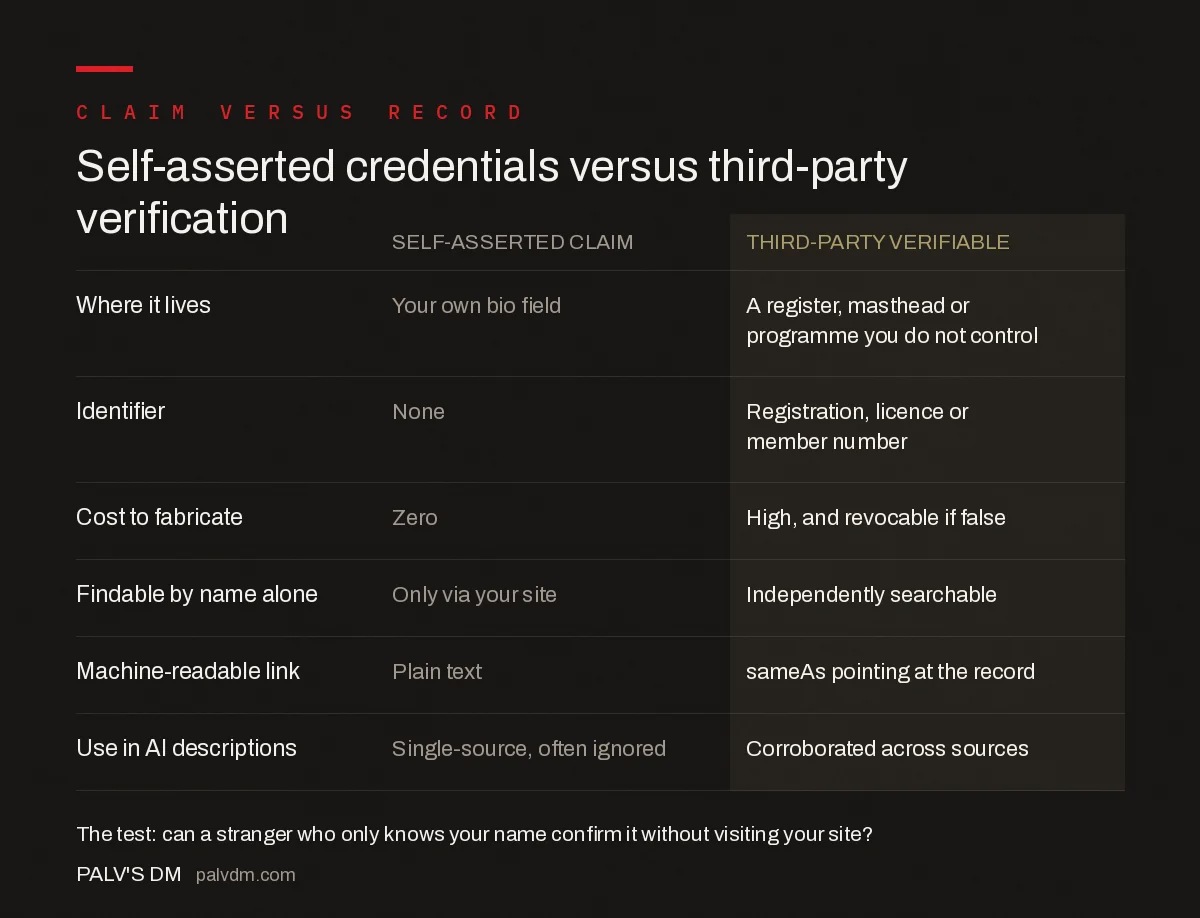
Self-asserted credentials versus third-party verification
| Self-asserted claim | Third-party verifiable | |
|---|---|---|
| Where it lives | Your own bio field | A register, masthead or programme you do not control |
| Identifier | None | Registration, licence or member number |
| Cost to fabricate | Zero | High, and revocable if false |
| Findable by name alone | Only via your site | Independently searchable |
| Machine-readable link | Plain text | sameAs pointing at the record |
| Use in AI descriptions | Single-source, often ignored | Corroborated across sources |
Frequently asked questions
How do you verify someone's credentials online?
Start with records the person does not control: statutory company or tax registers, professional licensing bodies, publication bylines, conference programmes and certification issuers that host a public verification page. Search the name in isolation and see what appears from sources other than their own website. A credential with no independent record behind it is a claim rather than a qualification.
Do certification badges improve SEO?
No. There is no ranking factor for displaying badges, and a wall of unlinked logos is a common signal of a low-quality site. Certifications are worth displaying when the issuer maintains a public verification page for your specific credential, the assessment was substantial, and you link the badge to that record. Two linked credentials beat fifteen unlinked graphics.
What business registration details should an Indian website display?
The registered entity name and structure, the company or LLP identification number where one exists, the GSTIN if registered, the registered office address, and any professional council registration for regulated fields. These are publicly checkable records that let a cautious buyer confirm a real legal entity sits behind the website, which is the most common objection in the Indian SME market.
Does Google check credentials?
Not automatically, and there is no credential ranking factor. Google’s Search Quality Rater Guidelines instruct human assessors to research the reputation of a site and its creators using independent sources outside the site, and those ratings inform how Google evaluates its ranking systems rather than affecting the rated sites directly. Off-site corroboration matters because it is how any claim gets tested.
What is sameAs schema used for?
The sameAs property lists URLs of other pages that unambiguously refer to the same person or organisation — professional profiles, register entries, publication author pages, association listings. It is the machine-readable version of a corroboration list, telling search and AI systems which off-site records describe the same entity as your site does.
What if I have no formal qualifications in my field?
Formal qualifications are one form of corroboration, not the only one. Published bylines on sites you do not own, conference or podcast appearances, open-source contributions, tools you built, and documented work with named clients all function as independent records. The requirement is that somebody other than you made a decision to associate their name with your work.
Sources
- Google Search Quality Rater Guidelines — reputation research using independent sources
- Creating helpful, reliable, people-first content — Google Search Central
- Organization structured data — Google Search Central
- GEO: Generative Engine Optimization (Aggarwal et al., KDD 2024)
Want this done on your site?
Every PalV’s DM engagement starts with a free audit of your actual website — a 12-point
crawl covering what is blocking indexation, on-page gaps against your primary keywords, speed
findings, and the three to five fixes worth making first. Delivered in two working days. No
payment details, and the findings are yours whether you hire us or not.