Zero-Click Search: How to Win When Nobody Clicks Through
Zero-click searches end on the results page. Here is which queries still send clicks in 2026, how to spot the pattern in Search Console, and what to change.
A zero-click search is a search that ends on the results page — the user reads what they needed from a featured snippet, a knowledge panel, a People Also Ask box, a local pack or an AI Overview, and never clicks through to a website. Zero-click results are not new. Google has answered “what time is it in Tokyo” without sending a click for more than a decade. What changed is the scope: AI Overviews and AI Mode extended the pattern from simple lookups to the explanatory, multi-part questions that used to reliably send traffic to blog posts. The response that works is not fighting for clicks that no longer exist. It is moving your keyword mix towards queries that still require a visit, and becoming the source the answer is assembled from on the queries that do not.
Most coverage skips the other half: a zero-click result is not automatically a loss. A restaurant whose hours, phone number and directions are read straight off the results page has just been contacted without paying for a session. The businesses that genuinely lose are the ones whose model depended on renting attention against questions Google can now answer itself.
What counts as a zero-click search, and what does not?
A zero-click search is a property of a search session, not of a page. Your article cannot be a “zero-click page” — a query ends without a click, and your page may or may not have been on screen while that happened. Getting the unit of analysis right decides what you can measure and what you can change. The definition also has edges that different studies draw differently:
- Clicks on ads. A search ending in a paid click did send a visit, just not an organic one. Some measurements class that session as zero-click, others do not.
- Clicks to Google’s own properties. Tapping through to Google Images, Maps, Flights or YouTube keeps the user inside Google. Counted as a click by some methodologies, as zero-click by others.
- Query refinements. Someone who reads the AI Overview then immediately searches something narrower has produced a zero-click search — and has also signalled that the first answer was not enough.
- Abandoned sessions. A user who got distracted mid-search is, in almost all datasets, indistinguishable from a user who was satisfied.
Those edges are not pedantry. They are why headline zero-click percentages differ from each other by tens of points, and why no single figure belongs in a board deck without its methodology attached.
Which SERP features produce zero-click results?
Not every result-page feature is equally responsible for zero-click behaviour, or equally influenceable. The table sorts the common ones by how much control a site owner has.
| Feature | What it answers without a click | How much you can influence it |
|---|---|---|
| Featured snippet | A direct answer lifted from one ranking page | High. Google says you cannot mark a page as a featured snippet, but it elevates pages it can extract cleanly — the point of structuring a page for featured snippets. |
| AI Overview | A synthesised answer drawn from several sources at once | Medium and indirect. Eligibility still runs through ranking, then selection happens separately. See how to appear in Google AI Overviews. |
| People Also Ask | A stack of related questions with expandable answers | Medium. Question-shaped headings with tight answers underneath are what gets pulled. Targeting People Also Ask is a distinct exercise from ranking first. |
| Knowledge panel | Entity facts about a person, company, product or place | Medium. Driven by how the entity is described across the web and in structured data, not by one page. |
| Local pack | Hours, ratings, directions, phone number, booking | High for local businesses, and often commercially positive. Ranking in the local pack frequently converts without a website visit at all. |
| Instant answers | Weather, currency conversion, sports scores, calculators | None. Google uses its own or licensed data. These queries are not a market you are in. |
The high-influence rows have something in common: featured snippets and local packs are surfaces where Google displays your content or your business data directly. AI Overviews and knowledge panels synthesise across many sources, so influence is slower. Instant answers are not addressable at all, and a keyword list full of them will never convert however impressive the volume looks.
Why can nobody agree on the zero-click percentage?
Every few months a new figure circulates claiming some large share of Google searches ends without a click. Published figures disagree with each other by wide margins, and the reason is methodological rather than dishonest.
Clickstream panel studies measure a sample of real browsers, which captures behaviour Google never reports but represents a small, non-random slice of searchers. Search Console measures only queries where your own site appeared, so it is structurally blind to searches you were never eligible for. Neither source separates a satisfied user from an abandoned session, and any desktop-weighted panel understates mobile — exactly where zero-click behaviour is most pronounced.
A further contaminant is specific to recent data. In September 2025 Google removed support for the &num=100 parameter that rank trackers had used to pull 100 results in one request. A large volume of tracker-generated impressions vanished from Search Console overnight. Any click-through rate or zero-click ratio calculated across that boundary is comparing two different measurement regimes. If you are building your own series, start it after that date. For which published studies measure what, see what the zero-click search data actually counts.
Treat any single zero-click percentage as a statement of direction rather than a number to plan against. Your own Search Console data, segmented by query type, says more about your business than any industry average will.
Which searches still send clicks?
The loss was not distributed evenly. Some query types are almost untouched, and they are where a limited budget belongs.
- Transactional queries. Buying, booking, applying, downloading, signing in. The action lives on a site, so the search has to end somewhere other than the results page.
- Commercial investigation. “Best CRM for field sales teams”, “SEO agency pricing in Ahmedabad”. A summary can list options; choosing between them means visiting them. These are the bottom-of-funnel keywords worth defending first.
- Queries whose answer is site-specific. Your price, your availability, your delivery window, your return policy. No engine can synthesise these from someone else’s page, because they exist nowhere else.
- High-stakes decisions. Health, money, legal, hiring — anything where a user wants to see who is telling them and why. A two-sentence summary tends to increase the desire to verify rather than satisfy it.
A blunt test covers most cases: if a competent writer could fully answer the query in two sentences, assume an AI Overview will. That single filter, applied across a keyword list, reshapes a content plan faster than any tool. Understanding the split between commercial and informational keywords is the underlying skill, because zero-click exposure tracks intent far more closely than it tracks volume.
How do you tell whether zero-click search is what hit your traffic?
Zero-click loss has a specific signature in Search Console, and it looks nothing like a ranking loss. Work through the following in order before concluding anything.
- Separate impressions, clicks and average position. Zero-click compression shows up as impressions flat or rising while clicks fall and position holds. A ranking problem shows position falling first. Reading impressions, clicks and position as three separate series is the whole diagnosis.
- Check the September 2025 boundary. A vertical cliff in impressions at that point is the
&num=100removal, not a change in human behaviour. - Segment by query, not by page. Filter your informational queries and your commercial queries separately. If clicks fell on the first group and held on the second, that is zero-click displacement rather than a site-wide problem.
- Compare click-through rate at a fixed position. Take queries where average position barely moved and compare their CTR across a long window. Falling CTR at stable position is the cleanest available evidence of AI Overviews compressing click-through rate.
- Isolate Discover and News from Search. They move on their own schedules and their own systems. Discover had a dedicated core update in February 2026 that had nothing to do with Search results.
- Rule out your own deployments. A theme change, a migration, a plugin, a stray
robots.txtedit. This is still the most common cause of a drop that gets blamed on Google, and working through the full traffic-drop checklist catches it faster than speculating about AI.
How do you win a query that will never give you a click?
On queries that end on the results page the return is not a session. It is one of three other things, each measurable if you decide in advance to measure it.
Being the source the answer is built from. AI Overviews and assistants cite. A cited brand is read in a context of authority, by a user at the exact moment of their question. Peer-reviewed work on generative engine optimisation (Aggarwal et al., KDD 2024) tested content changes against generative engine responses and found that adding relevant statistics, quotations from named sources and citations to authoritative sources lifted a source’s visibility in AI answers by up to around 40%, while keyword stuffing performed worse than making no change at all. That is the practical brief: be specific, be sourced, be attributable. Citations that arrive without clicks are still distribution.
Brand impression at scale. Appearing repeatedly in the answer box for a category question is closer to category advertising than to classic SEO, and it does not show in a sessions report at all. The downstream evidence usually surfaces as growth in branded search and direct traffic weeks later, which is why splitting branded from non-branded search is the honest way to see whether zero-click visibility is doing anything.
Structural readiness. Generative retrieval extracts passages, not pages. Two habits carry most of the weight. First, every section should make sense to someone who lands on it cold — kill orphan pronouns like “this approach” and restate the noun, because an engine lifting that passage has no memory of the heading above it. Second, any figure shown inside a chart must also exist as text on the page, because retrieval cannot read images.
Measurement has to change to match. Tracking AI visibility means logging citations manually across ChatGPT, Perplexity and AI Overviews on a fixed prompt set at a fixed cadence, and segmenting AI referral traffic in GA4 so the trickle that does arrive is not buried in “direct”. In India that is not a fringe surface: TechCrunch reported in February 2026 that weekly ChatGPT users had passed 100 million, making India OpenAI’s second-largest market.
What should change in your next quarter?
Five moves, in the order they pay back.
- Re-weight the keyword list towards intent, not volume. Score every target for whether an answer box can close it. Demote the ones it can, however good the volume looks.
- Rewrite your highest-value pages to be extractable. Answer-first opening, question-shaped H2s, self-contained sections, a real FAQ block. One structure serves featured snippets, People Also Ask and generative citation at once.
- Add something that cannot be synthesised. Original data, a documented first-hand test, transparent pricing, a named expert’s view. This is the one input an AI summary cannot assemble from the existing corpus, because it is not in the corpus yet.
- Build assets that answer site-specific questions. Live pricing, availability, a configurator, comparison tables against named alternatives. Assets of that kind force a visit by construction.
- Report three layers instead of one. Classic rankings and SERP features, AI citations logged over time, and branded search plus direct traffic as the downstream proxy. A brand cited constantly but clicked rarely is being measured with the wrong instrument.
The short version
Zero-click search is a permanent change to click economics, not the end of organic search. It hits informational queries hardest and transactional queries barely at all, which makes intent the variable that matters most in a 2026 keyword plan. Diagnose it by looking for falling clicks at stable impressions and stable position, not by reading industry averages. Then split the effort: compete for the visit where a visit is still required, and compete to be the quoted source everywhere else. Search in the age of AI answers rewards the same work it always did — being the most specific, best-sourced, most clearly authored page on the topic — but it now pays out on two surfaces instead of one.
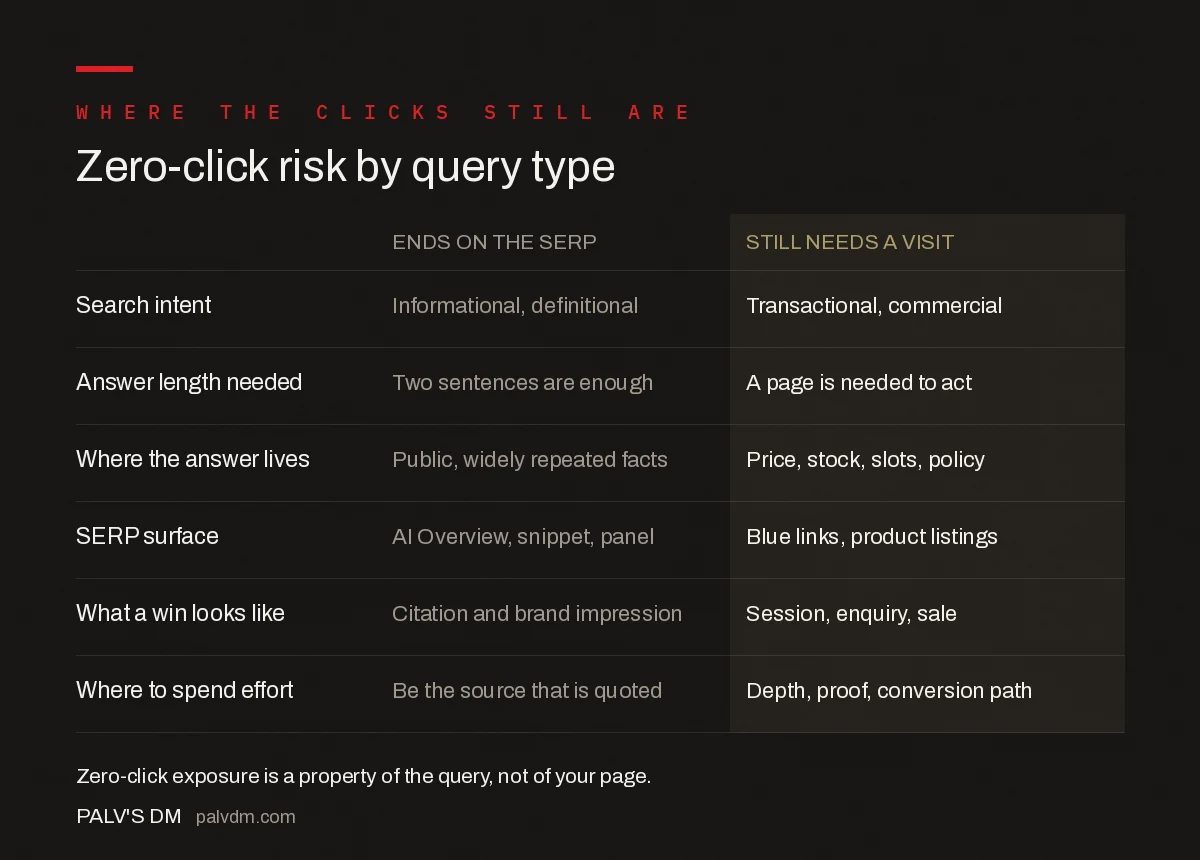
Zero-click risk by query type
| Ends on the SERP | Still needs a visit | |
|---|---|---|
| Search intent | Informational, definitional | Transactional, commercial |
| Answer length needed | Two sentences are enough | A page is needed to act |
| Where the answer lives | Public, widely repeated facts | Price, stock, slots, policy |
| SERP surface | AI Overview, snippet, panel | Blue links, product listings |
| What a win looks like | Citation and brand impression | Session, enquiry, sale |
| Where to spend effort | Be the source that is quoted | Depth, proof, conversion path |
Frequently asked questions
What is a zero-click search?
A zero-click search is a search that ends on the results page without the user clicking any result. The answer comes from a featured snippet, People Also Ask box, knowledge panel, local pack or AI Overview. It is a property of the search session rather than of any single website, so a page can be visible during a zero-click search and still receive no visit.
Are zero-click searches bad for SEO?
Not uniformly. Informational and definitional content loses real traffic to zero-click results. Local businesses often gain, because a searcher who reads the hours and taps the phone number in a local pack has converted without a session. The businesses hurt most are those whose model depended on traffic from questions Google can now answer itself on the results page.
What percentage of Google searches are zero-click?
No single reliable figure exists. Published estimates differ by tens of percentage points because they count differently: some treat ad clicks or clicks to Google Images and Maps as clicks, others do not, and none can separate a satisfied user from an abandoned session. Use your own Search Console data segmented by query type rather than an industry average.
Do AI Overviews reduce click-through rate?
The available evidence is directional rather than precise. The clearest signal a site owner can produce is its own: take queries where average position stayed stable over a long window and compare click-through rate across that period. Falling CTR at stable position on informational queries is the strongest practical indication of AI Overview displacement.
Which keywords still get clicks in 2026?
Transactional queries, commercial investigation queries, and any query whose answer is specific to one business. Prices, availability, booking, sign-in, delivery windows and return policies cannot be synthesised from other sites because they exist nowhere else. A useful filter: if a competent writer could answer the query fully in two sentences, expect an answer box to do so.
How do you measure zero-click impact in Search Console?
Track impressions, clicks and average position as three separate series rather than one blended view. Zero-click compression appears as steady impressions and steady position with falling clicks. Start any click-through rate series after September 2025, because the removal of the &num=100 parameter stripped tracker-generated impressions and makes comparisons across that date unreliable.
Sources
- Featured snippets and your website — Google Search Central — Google confirms you cannot mark a page as a featured snippet
- AI features and your website — Google Search Central
- GEO: Generative Engine Optimization (Aggarwal et al., KDD 2024) — peer-reviewed source of the ~40% visibility finding
- Debug drops in Search traffic — Google Search Central
Want this done on your site?
Every PalV’s DM engagement starts with a free audit of your actual website — a 12-point
crawl covering what is blocking indexation, on-page gaps against your primary keywords, speed
findings, and the three to five fixes worth making first. Delivered in two working days. No
payment details, and the findings are yours whether you hire us or not.