Getting Into the Top Stories Carousel
The Top Stories carousel is open to any indexed page that meets Google News content policies, not just news publishers. What actually determines eligibility, and what determines placement.
Getting into the Top Stories carousel doesn’t require AMP, a Google News registration, or a media company’s editorial budget — it requires compliance with Google News content policies, a genuinely timely angle on a real news event, and the technical basics that let Google confidently attribute the article, its author, and its publish date. Any indexed page is eligible in principle. What actually separates sites that show up from sites that don’t is how consistently they publish fresh, accurate coverage tied to real events, not a single technical checkbox.
This surprises people who assume Top Stories is reserved for major outlets. It isn’t, structurally — but it does favour publishers who treat news coverage as a sustained practice rather than an occasional post, because freshness and update frequency are load-bearing parts of how the carousel ranks what it shows.
What are the actual eligibility requirements for Top Stories?
Every page, AMP or not, is eligible for Top Stories consideration regardless of page-experience score — Google made this explicit when it removed the earlier AMP requirement. Page experience now functions as a ranking signal within Top Stories rather than a gate that excludes non-compliant pages entirely. The hard requirement that remains is compliance with Google News content policies: no deceptive practices, clear authorship, no undisclosed sponsored content presented as news, and accurate representation of the story.
Beyond policy compliance, eligibility is less about a checklist and more about content type. The carousel surfaces coverage of active, developing news events — a product launch, a regulatory decision, breaking coverage of an incident. An evergreen how-to guide, however well-optimised, isn’t the kind of content Top Stories displays, regardless of technical correctness.
What technical setup actually helps you get into Top Stories?
| Element | Requirement | Why it matters |
|---|---|---|
| Article structured data | Not mandatory, but strongly recommended (Article, NewsArticle, or BlogPosting) | Helps Google confirm author, publish date, and headline confidently |
| Representative image | At least 696px wide (non-AMP), 1,200px wide (AMP) | Below this, the article can still index but is less likely to show with an image |
| Clear, visible publish/update date | Present in both visible page content and structured data | Freshness is a core ranking factor inside the carousel |
| Named author | Present in byline and structured data | Supports the content-policy requirement for clear authorship |
| Fast, mobile-friendly page | No hard AMP requirement, but page experience is a ranking signal | Slower, less usable pages rank lower within the carousel even if eligible |
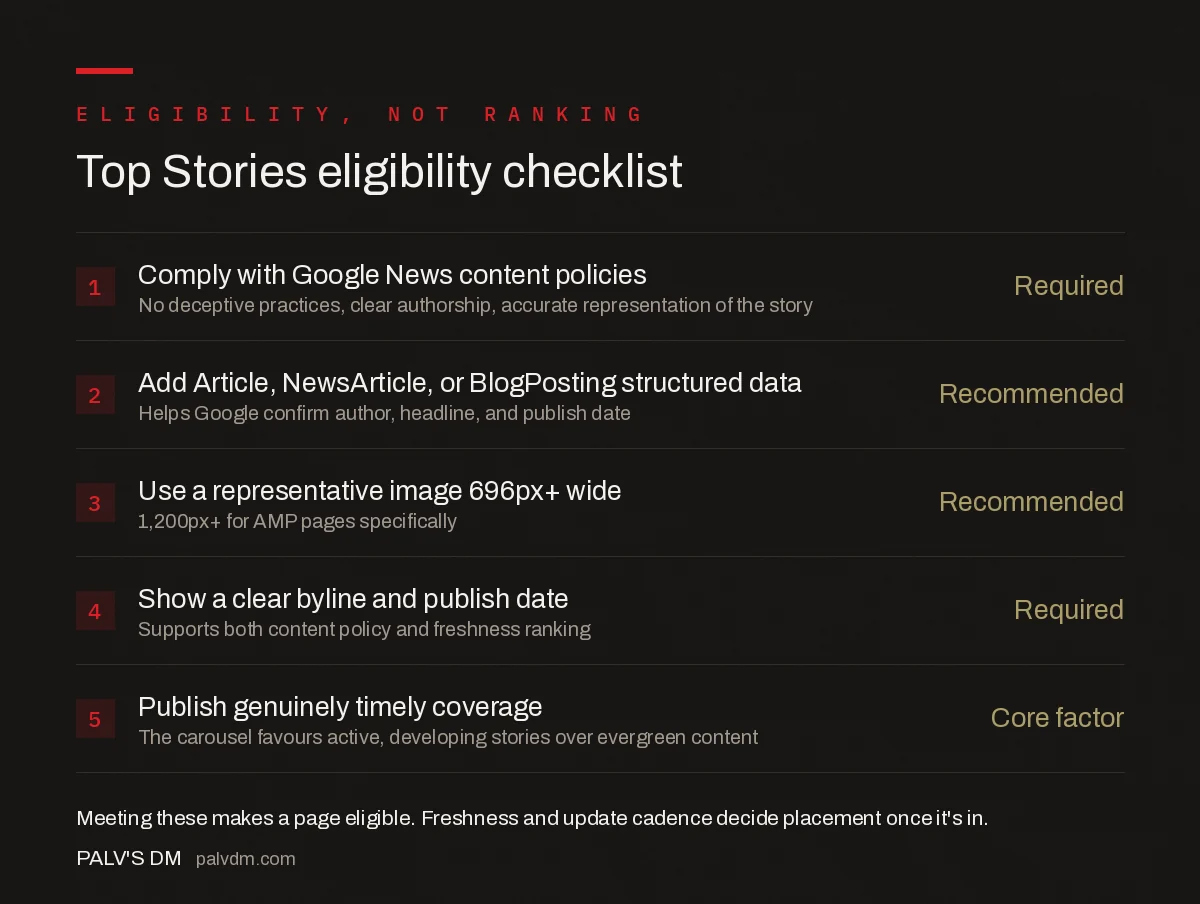
Top Stories eligibility checklist
- Comply with Google News content policies — Required. No deceptive practices, clear authorship, accurate representation of the story.
- Add Article, NewsArticle, or BlogPosting structured data — Recommended. Helps Google confirm author, headline, and publish date.
- Use a representative image 696px+ wide — Recommended. 1,200px+ for AMP pages specifically.
- Show a clear byline and publish date — Required. Supports both content policy and freshness ranking.
- Publish genuinely timely coverage — Core factor. The carousel favours active, developing stories over evergreen content.
How does Google decide which stories get top placement within the carousel?
Once a story is eligible, placement inside the carousel is a separate, ongoing competition. Stories on a breaking or developing topic are frequently updated — sometimes every five to fifteen minutes during the most active phase of a story — and publishers who keep pace with that update cadence hold their position longer than those who publish once and move on. Prominence also matters: a story linked from a publication’s homepage and included in a dedicated news or fresh-content sitemap signals to Google that the publisher itself considers it a priority, which factors into how quickly and confidently Google surfaces it.
This is why single-article optimisation has limits here. A publisher with a consistent, fast-updating news operation will out-compete a site that occasionally publishes one well-optimised news-style post, even if that single post is technically flawless.
How long does a story stay in Top Stories?
Typically a narrow window — most coverage moves from the carousel into standard organic results within 48 to 72 hours as the story ages and newer coverage of the same or related events takes its place. This is a structural feature of the carousel, not a penalty: Top Stories exists to surface what’s currently developing, and an article’s relevance to “currently developing” has a short half-life by design. Evergreen value from that same article continues through normal organic rankings after it drops out of the carousel.
What common mistakes keep otherwise-good content out of Top Stories?
- Treating a how-to or evergreen guide as news content. Even flawless technical setup doesn’t make non-timely content eligible for a carousel built around developing events.
- Missing or inconsistent publish dates. A date shown on the page but absent from structured data, or a date that doesn’t update on genuine revisions, undermines the freshness signal.
- Sub-696px images. A visually appealing image that falls short of the minimum width still won’t display properly in the carousel format.
- No dedicated news or fresh-content sitemap. Relying solely on the standard XML sitemap can slow discovery of time-sensitive content relative to publishers who maintain a separate, fast-refreshing feed.
- Sponsored or affiliate content presented without disclosure. This is a direct content-policy violation and disqualifies the article outright, independent of technical quality.
How is Top Stories different from Google Discover and the News tab?
The three surfaces overlap in the content they draw from but rank it differently. The News tab is a dedicated search results view a user actively navigates to, listing a broader set of matching articles ranked mostly on relevance and recency, with less pressure to be in the single-digit slots. Top Stories is a carousel embedded directly inside a regular web search results page, competing for a handful of visible slots against every other eligible publisher for that query — a much narrower, more contested placement. Discover is different again: it’s a personalised, query-less feed shown in the Google app and Chrome’s new-tab page, driven by a user’s past interests rather than an active search, and it rewards evergreen and visually strong content more than Top Stories does. A publisher optimising specifically for Top Stories should not expect the same tactics to move the needle in Discover, since the ranking inputs — active query relevance versus personalised interest — are fundamentally different.
What should a content operation look like if you’re pursuing this consistently?
Sites that hold Top Stories placements over time typically run three things in parallel: a fast-publish workflow that gets a first version of a developing story live within minutes rather than hours, a revision habit where the same article is updated in place as new details emerge rather than replaced with a new URL, and a dedicated news or fresh-content sitemap that gets pinged or resubmitted immediately on publish rather than waiting for the next scheduled crawl. None of this is exotic tooling — it’s an editorial and technical workflow decision, and it’s the actual differentiator between sites that occasionally land a Top Stories slot and sites that hold one through an entire news cycle.
Is Top Stories worth pursuing if you’re not a news publisher?
For most businesses, no — the carousel rewards a sustained editorial operation built around covering developing events, and chasing it with the occasional news-style post rarely produces a durable result. It becomes worth the investment specifically when a business genuinely produces newsworthy coverage on a recurring basis: product or industry announcements, regulatory changes in a niche, or original reporting relevant to a specific sector. For everyone else, the same structured-data and freshness practices that support Top Stories eligibility are still worth having, because they improve how confidently Google understands and displays any article, carousel or not.
Frequently asked questions
Do you need AMP to appear in Top Stories?
No. Google has confirmed AMP is no longer a requirement for Top Stories inclusion; both AMP and standard non-AMP pages are eligible as long as page experience and content policy requirements are met.
Does my site need to be a registered news publisher to appear in Top Stories?
No formal registration is required. Any indexed page that complies with Google News content policies is eligible, though the carousel favours timely, newsworthy content over evergreen articles, which naturally limits it mostly to publishers who cover current events.
Is Article structured data required for Top Stories?
It is not a strict requirement, but Google recommends adding Article, NewsArticle, or BlogPosting structured data because it helps Google understand key details like author, publish date, and headline, which supports eligibility for the enhanced Top Stories appearance.
How fresh does content need to be for Top Stories?
Very fresh for breaking coverage. Stories competing for the top slots are frequently updated every few minutes during a developing event, and pages older than roughly 48-72 hours typically drop out of Top Stories into standard organic results.
What image size does Google require for Top Stories?
Non-AMP articles need a representative image at least 696 pixels wide; AMP articles need at least 1,200 pixels wide. Below these thresholds, the article can still be indexed but is less likely to display with an image in the carousel.
Sources
- Article schema markup guide — Google Search Central
- On-Page SEO Checklist: Everything That Actually Matters
- Video Carousels: Getting a Page Into Them
- Above-the-Fold Content: Answering Before Scrolling
- Table Snippets: Structuring Data Google Will Lift
Want this done on your site?
Every PalV’s DM engagement starts with a free audit of your actual website — a 12-point
crawl covering what is blocking indexation, on-page gaps against your primary keywords, speed
findings, and the three to five fixes worth making first. Delivered in two working days. No
payment details, and the findings are yours whether you hire us or not.