How Long Before New Content Ranks? Real Timelines (2026)
New blog posts typically take 3-6 months to rank, longer for competitive terms. See real timelines by keyword difficulty and what to check at each stage.

Published: August 2026
Most new blog posts take three to six months to reach a stable position on Google, and six to twelve months or longer if the keyword is competitive. Indexing happens fast – often within a few days on an established site – but indexing is not ranking. The gap between “Google knows this page exists” and “this page shows up on page one” is where most content plans go wrong, because teams measure the wrong milestone and panic at week four.
What’s the difference between indexing and ranking?
Indexing is Google adding your URL to its database after crawling it. Ranking is where that URL lands in results for a given query, and the two run on completely different clocks. A well-linked page on an established domain can get indexed within one to seven days. Ranking for anything with real competition takes months, because Google needs to see the page hold up over time – through user behaviour, external links, and comparison against everything else already ranking for that query.
If you check Google Search Console and see a post indexed but stuck beyond position 50, that’s normal at the two-week mark. It’s a problem at the four-month mark.
How long does it actually take for a new post to rank?
Timelines vary by competition level, but the pattern holds across most niches:
| Keyword competition | Typical time to first page-one appearance | Typical time to stable top-10 |
|---|---|---|
| Low (long-tail, low search volume) | 4-8 weeks | 2-3 months |
| Medium (moderate volume, some competing content) | 2-4 months | 4-6 months |
| High (competitive, high commercial intent) | 4-6 months | 6-12+ months |
Research aggregating ranking-position data has found that pages sitting in position one average roughly 950 days old – close to three years. That doesn’t mean a new post can’t rank fast for an easier term. It means the very top spots for competitive queries are usually held by content that’s had years to accumulate links, updates, and trust signals. Don’t set a three-month deadline for a keyword that the data says takes three years to dominate.
Why do some posts rank in weeks and others take a year?
Five variables explain almost all of the variance:
- Domain authority – an established site with existing topical relevance ranks new pages faster than a brand-new domain starting from zero trust.
- Keyword competition – a long-tail question with three weak competing pages ranks in weeks; a head term with ten well-resourced competitors takes months.
- Content depth relative to what’s already ranking – if the current top 10 are thin, a genuinely more complete answer can leapfrog faster than average.
- Internal linking – an orphan post with zero internal links from other pages on the site takes noticeably longer to get crawled, understood, and trusted.
- Backlinks – even one or two relevant external links can move a post from position 25 to position 10 faster than months of waiting would on its own.
Two posts published the same day, targeting similar difficulty keywords, can land three months apart in results purely because one got internal links from day one and the other sat as an orphan page for six weeks.
What should you check at each stage?
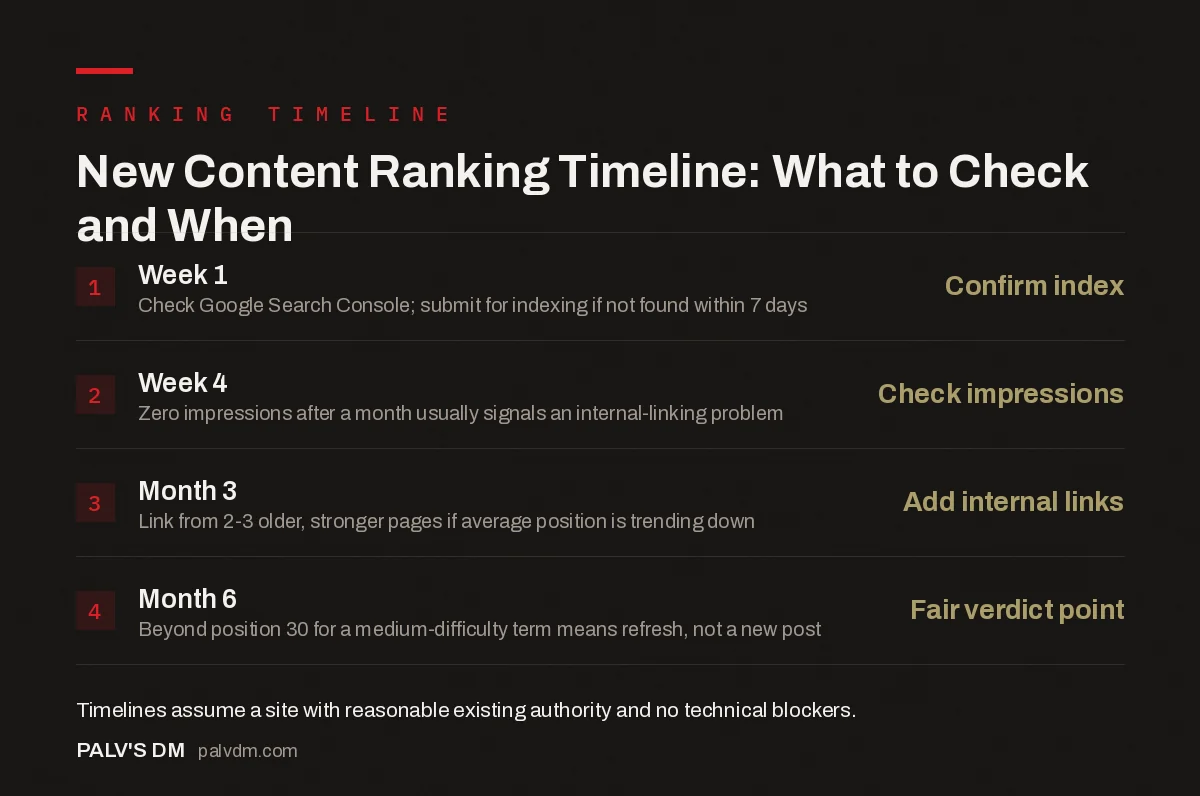
New Content Ranking Timeline: What to Check and When
- Week 1 — Confirm index. Check Google Search Console; submit for indexing if not found within 7 days.
- Week 4 — Check impressions. Zero impressions after a month usually signals an internal-linking problem.
- Month 3 — Add internal links. Link from 2-3 older, stronger pages if average position is trending down.
- Month 6 — Fair verdict point. Beyond position 30 for a medium-difficulty term means refresh, not a new post.
Should you rewrite a post that isn’t ranking yet?
Not before the three-month mark, and usually not before six. Rewriting too early throws away the trust signals Google is still in the process of building around the URL. The exception is a post with a fundamental problem – wrong search intent, thin coverage compared to what’s already ranking, or a title tag that doesn’t match what people are actually searching. Those are worth fixing at any stage, because no amount of waiting corrects a mismatch between what the page offers and what the query wants.
If the post covers the topic properly and simply hasn’t had time to earn trust, the fix is patience plus internal links, not a rewrite.
How does site authority change the timeline?
A domain that’s been publishing consistently for two or three years, with a healthy backlink profile and no technical debt, gets new posts crawled faster and trusted sooner than a six-month-old site starting from scratch. This is why the same article can behave completely differently depending on where it’s published. On an established site, a solid post on a medium-difficulty term might see meaningful traffic by month three. On a brand-new domain, expect that same post to take twice as long, because Google is still deciding how much to trust anything published there.
This isn’t a reason to avoid publishing on a young site. It’s a reason to set realistic internal expectations and to prioritise the internal linking and technical basics that partially offset the authority gap – clean site architecture, fast page speed, and a clear topical focus rather than scattered, unrelated topics.
What actually moves the needle faster than waiting?
Three actions consistently shorten the gap between publishing and ranking, based on how search engines describe their own crawling and indexing behaviour:
- Internal links from existing indexed pages. A brand-new post linked from three or four established, well-trafficked pages gets discovered and re-crawled faster than one sitting with zero inbound links.
- A sitemap that’s actually current. If your XML sitemap doesn’t include the new URL, or hasn’t been resubmitted, discovery slows down regardless of how good the content is.
- Matching the dominant format on the SERP. If the top-ranking pages for your keyword are comparison tables and yours is a narrative essay, no amount of waiting fixes a format mismatch. Check what’s actually ranking before publishing, not after.
None of these are shortcuts around Google’s evaluation process. They remove the artificial delays – slow discovery, poor internal signals, format mismatch – that stack on top of the normal evaluation timeline and make a post take longer than it should.
Does posting frequency speed up ranking for individual posts?
Indirectly, yes. Publishing consistently builds topical authority across a cluster of related pages, which helps every post in that cluster rank faster than it would in isolation. But frequency doesn’t override the fundamentals above – a weak, thin post published every week still won’t outrank a genuinely complete answer to the query. Consistency helps the site; it doesn’t substitute for quality on the page. For a full breakdown of how much volume actually matters, see our guide on how many blog posts per month you actually need.
What mistakes make a post take longer to rank than it should?
Most delayed-ranking cases trace back to one of a small set of avoidable problems, not bad luck:
- Publishing without a target keyword decided in advance. A post written first and optimised after the fact often ends up straddling two or three related queries without fully satisfying any of them, which slows how confidently Google can match it to a specific search.
- Zero internal links at launch. A new post added to the sitemap but not linked from any existing page sits in a discovery queue longer than one that’s referenced from day one. This is the single most common, most fixable delay in practice.
- Ignoring what’s already ranking. A narrative post competing against a SERP full of comparison tables or numbered lists is fighting the format as well as the competition, and format mismatches are invisible until you actually check the top 10 before publishing.
- Treating publish day as the finish line. Teams that move on immediately after publishing miss the two- to four-week window where an early nudge – an added internal link, a Search Console index request – has the most effect on how fast the page gets crawled again.
A worked example: two posts, same day, different outcomes
Two posts published on the same site in the same week make the timeline difference concrete. Post A targeted a medium-difficulty keyword, got linked from three existing high-traffic pages within 48 hours of publishing, and was submitted for indexing manually through Search Console. Post B targeted a similarly difficult keyword but was left as an orphan page, discoverable only through the XML sitemap, with no internal links added until week six.
Post A was indexed in four days and showed its first page-one appearance at week seven. Post B took eleven days to index and didn’t reach page one until week nineteen – more than four months later, for comparable keyword difficulty and comparable content quality. The gap was internal linking and how quickly each page got re-crawled, not content quality or luck.
FAQ
Why is my blog post indexed but not ranking?
Indexing just means Google has added the URL to its database; ranking is a separate process that can take months. If a post has been indexed for over 8-10 weeks with zero search impressions, check for weak internal linking, a mismatch between the title and actual search intent, or content that’s thinner than what currently ranks.
Can a blog post rank in one week?
It’s possible for very low-competition, long-tail keywords on an established site with strong internal linking, but it’s the exception, not the rule. Most posts targeting terms with any real search volume take at least 4-8 weeks to appear anywhere on page one, and longer to stabilise.
Does content length affect how fast a post ranks?
Length itself isn’t a ranking factor, but depth relative to competing pages is. A 900-word post that fully answers the query can outrank a padded 2,500-word post that doesn’t. Match your coverage to what the current top-ranking pages address, then add what they’re missing.
Do older posts always outrank newer ones?
Not automatically, but age correlates with accumulated links, updates, and behavioural trust signals that Google factors in. A newer post with sharper coverage and better internal linking can and does outrank older, thinner content – it just usually takes longer to get there.
How long should I wait before giving up on a post?
Six months is a reasonable checkpoint for a fair verdict on medium-difficulty keywords. Before that point, check for and fix structural issues (indexing, internal links, intent match) rather than assuming the content itself has failed.
If you’d rather not track all this manually, PalV’s DM’s content writing service builds internal linking and topical clustering into every post from day one, which is the single biggest lever for shortening this timeline. For the full framework this post sits under, see our content strategy guide. Related reading: how many blog posts per month you actually need, publishing volume vs content quality, and how long a blog post should actually be.