How Many Blog Posts Per Month Do You Actually Need?
There's no universal number. See recommended posting frequency by blog stage, why volume alone doesn't drive rankings, and how to calculate your own.

Published: August 2026
Most small and mid-size businesses need 4-8 blog posts a month to build topical authority within a year, though the honest answer is “enough to fully cover your topic clusters, published on a schedule you can sustain for at least six months.” Volume alone has never been a ranking factor. What Google’s helpful content systems actually reward is consistent coverage of a topic area, and consistency is easier to break with an ambitious posting schedule than a modest one you can actually keep.
How many blog posts per month is realistic?
It depends on where the blog stands today, not on a universal number:
| Blog stage | Recommended posts/month | Reasoning |
|---|---|---|
| New blog (under 12 months old) | 6-8 | Needs to build a topic cluster and establish crawl patterns fast |
| Established blog (1-3 years) | 4-6 | Authority is building; focus shifts to filling content gaps and updating older posts |
| Mature blog (3+ years, strong authority) | 2-4 | Fewer new posts needed; refreshing existing content often returns more than net-new |
| Niche B2B or highly technical topic | 2-4 | Research-heavy content takes longer to produce well; quality per post matters more than count |
None of these numbers are a ceiling. A business with genuine capacity to research and publish 12 well-researched posts a month, sustainably, will build topical authority faster than one publishing 4. The number that matters is whatever you can keep doing for six months without cutting corners on research or editing.
What does “topical authority” actually require in practice?
Topical authority isn’t a metric Google publishes a number for, but the pattern behind it is consistent across case studies and SEO practitioner reporting: a site needs to comprehensively cover a subject area from multiple angles – definitional posts, how-to guides, comparisons, common mistakes, and edge cases – before search engines treat it as a trusted source on that topic. A single 3,000-word pillar page doesn’t achieve this alone. It needs the surrounding cluster of supporting posts that answer the specific, narrower questions a pillar page can only touch briefly.
This is why publishing frequency questions almost always trace back to a cluster-mapping exercise rather than a raw number. Once you know a topic needs 15 supporting posts to be genuinely complete, the “how many per month” question becomes a scheduling problem, not a strategy problem.
Does publishing frequency actually affect rankings?
Not directly. Google has stated plainly that it doesn’t require a specific publishing cadence and instead evaluates whether each page is relevant, useful, and trustworthy on its own. What frequency does affect is two indirect things: how fast a domain builds topical authority across a keyword cluster, and how consistently a site signals active maintenance to both crawlers and readers.
A site that published 20 posts in January and nothing since April sends a worse signal than one that has quietly published 4 posts a month, every month, for a year. Google’s crawlers learn a site’s publishing rhythm and adjust crawl frequency accordingly – irregular publishing means irregular, less frequent crawling.
What happens if you publish too much, too fast?
- Editorial quality drops. Teams under volume pressure cut research time first, which is the one input that actually differentiates a post from its competitors.
- Site-wide quality signals suffer. Google evaluates sites holistically. A site where a large share of pages are thin or generic drags down how the whole domain is assessed, including your genuinely strong posts.
- Internal linking gets sloppy. New posts published faster than anyone can properly interlink them become orphan pages that take longer to rank.
- The team burns out mid-cluster. An ambitious 15-post-a-month plan that collapses to zero by month three does more damage than a steady 4-post cadence that never stops.
Does the type of business change the ideal number?
Yes, meaningfully. A D2C brand selling a narrow product range in a well-defined category can often reach strong topical coverage with 20-30 well-targeted posts total, published at 2-3 a month. A B2B service business with a broad range of use cases, industries, and buyer questions often needs 50-100+ posts to cover the topic space properly, which argues for a steadier 4-6 a month over a longer runway. E-commerce catalogues with many product categories sometimes justify higher frequency because each category needs its own supporting content, but only if the team can maintain research quality at that pace.
There’s no universal multiplier here. The right test is whether the topic space is actually that large, not whether a higher number feels more ambitious.
What happens if you publish too little?
Publishing 1 post a quarter rarely builds enough topical density for Google to recognise the site as authoritative on a subject. Topic clusters work because they demonstrate depth – one comprehensive pillar page plus a dozen supporting posts covering adjacent questions signals real expertise. A single isolated post, however well written, competes alone against sites that have built out the entire cluster.
The practical minimum for most competitive B2B or D2C categories is 2 posts a month, sustained for at least a year, before topical authority becomes a meaningful advantage.
How do you calculate the right number for your business?
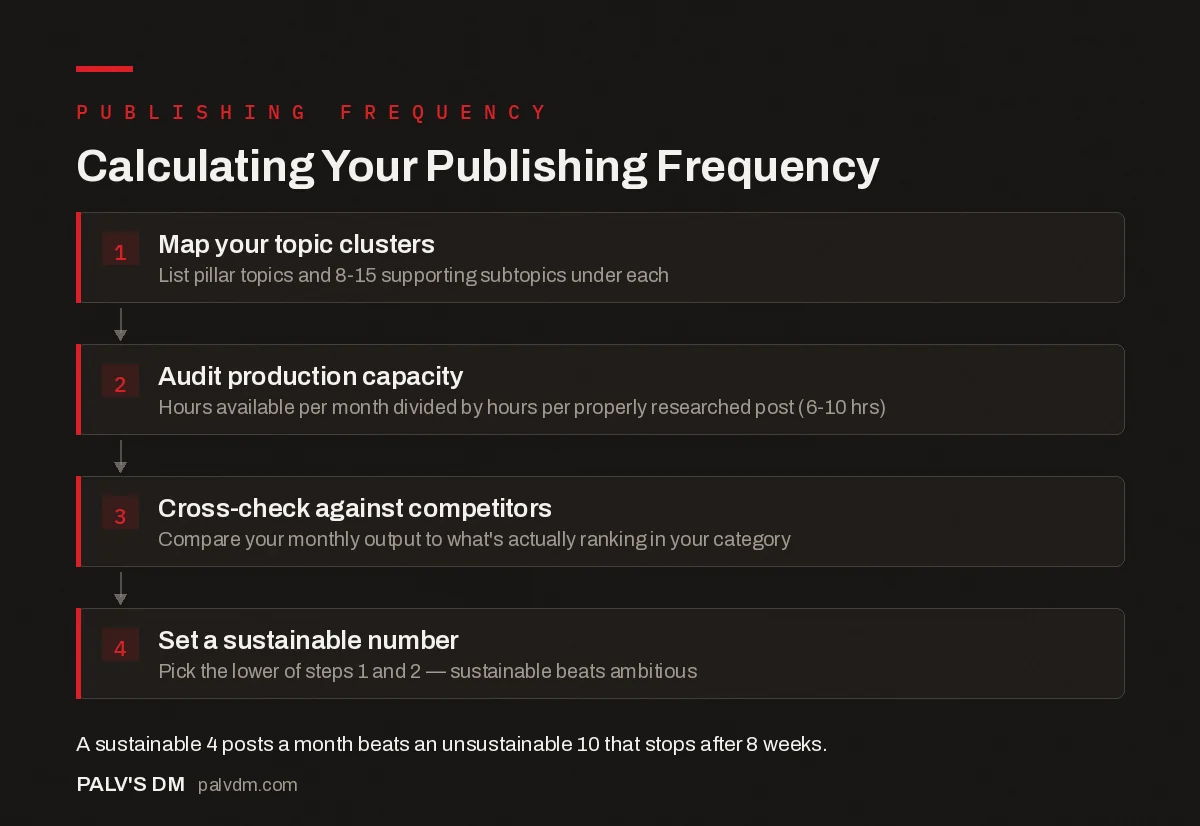
Calculating Your Publishing Frequency
- Map your topic clusters. List pillar topics and 8-15 supporting subtopics under each.
- Audit production capacity. Hours available per month divided by hours per properly researched post (6-10 hrs).
- Cross-check against competitors. Compare your monthly output to what’s actually ranking in your category.
- Set a sustainable number. Pick the lower of steps 1 and 2 — sustainable beats ambitious.
How does frequency interact with team size?
A solo founder writing part-time realistically produces 1-2 solid posts a month without outside help, and pretending otherwise leads straight to the burnout-and-collapse pattern described above. A dedicated in-house writer can typically sustain 4-6 well-researched posts a month once briefs and templates are in place. An agency or freelance team with parallel writers can push past that, but coordination overhead – briefing, editing, fact-checking – grows non-linearly, so doubling headcount rarely doubles safe output.
The honest planning move is to size the publishing calendar to actual capacity, not to a target borrowed from a competitor with a bigger team. A 12-post-a-month plan built for a 3-person content team but run by one person alone doesn’t produce 12 thinner posts – it produces 4 posts and a missed plan.
Should every post be the same length and depth?
No. Matching depth to competition is more efficient than a blanket word count target. A definitional post answering a simple question might fully satisfy the query in 800 words. A comparison post competing against in-depth guides might need 2,500. Publishing frequency plans that assume uniform length per post usually either waste time padding easy topics or under-serve hard ones. For more on setting length by topic rather than by rule, see our post on publishing volume vs content quality.
What tools actually help you track and hit your publishing number?
A publishing cadence only holds up if it’s visible somewhere other than someone’s memory. Three tools do most of the work:
- A shared content calendar (a spreadsheet is enough for teams under four people) that tracks status beyond done/not-done – briefed, researching, drafting, editing, scheduled, published – so a slipping post is visible in week one, not discovered at the deadline.
- Google Search Console’s coverage report, checked monthly, to confirm new posts are actually being indexed at the pace you’re publishing them. A gap between posts published and posts indexed usually points to a crawl budget or internal linking problem worth fixing before adding more volume.
- A simple capacity tracker – hours available per writer per month, divided by hours per properly researched post – reviewed quarterly. This is what turns “we should publish more” into a number grounded in what the team can actually sustain.
None of these need to be complicated. The point of tracking isn’t the tool, it’s catching the gap between planned cadence and actual output before three months of drift becomes obvious in a traffic report.
A worked example: sizing the number for a real business
A mid-size B2B services company selling to a narrow industry maps its topic space and finds 45 distinct questions and subtopics worth covering – pillar pages, comparison posts, how-to guides, and common objections. The team has one dedicated writer working roughly 25 hours a week on content, and each properly researched post takes about 7 hours from brief to final edit, including one revision round.
That’s roughly 3-4 posts a month at full capacity, which means covering the full 45-topic map takes 12-15 months if the writer works on nothing else. Rather than compressing that into 6 months by rushing research, the honest plan sequences the highest-priority pillar and its closest supporting posts first, accepts the longer timeline for the full cluster, and revisits the plan if headcount changes. This is the calculation almost every “how many posts per month” question resolves to once you replace the abstract target with actual hours and actual topic count.
FAQ
Is 4 blog posts a month enough for SEO?
For most established blogs with 1-3 years of history, yes – 4 well-researched posts a month, sustained consistently, builds meaningful topical authority over a year. New blogs or highly competitive categories often need 6-8 to build the same authority in the same timeframe.
Is it better to publish daily or weekly?
Weekly, sustained, beats daily that collapses after a month. Google rewards consistency over raw frequency, and daily publishing at genuine research quality is unrealistic for most teams, which leads to thin content that drags down site-wide quality signals.
How many blog posts should a small business publish per month?
Most small businesses do well with 2-4 posts a month focused tightly on a specific set of topic clusters relevant to what they sell, rather than spreading thin across unrelated subjects. Depth within a focused niche beats breadth across a scattered one.
Does Google penalise infrequent blog posting?
There’s no direct penalty for infrequent posting. The indirect cost is slower topical authority building and less frequent crawling, both of which delay how fast new content gets discovered and trusted.
Can you catch up by publishing a lot at once after a slow period?
It helps some, but consistent moderate output outperforms bursty publishing in most cases. A steady 3 posts a month for a year builds more sustained authority than 20 posts in one month followed by six months of silence.
If figuring out the right cadence and then actually hitting it every month is the bottleneck, PalV’s DM’s content writing service handles both the planning and the production. This post is part of our content strategy guide. Related reading: how long new content takes to rank, publishing volume vs content quality, and building an editorial calendar that survives contact with reality.