Writing an Introduction That Doesn’t Waste the Reader’s Time
Weak blog introductions restate the headline and stall before the point. Here is how to open a post that answers fast and keeps readers scrolling.
Published: August 2026
A blog introduction that doesn’t waste the reader’s time answers the core question, or states clearly what the post will answer, within the first 50 to 150 words — no “in today’s fast-paced digital world,” no restating the headline as a sentence, no three paragraphs of scene-setting before the actual content starts. Readers decide whether to keep reading within seconds, and search engines and AI summarisers increasingly extract the opening paragraph as the answer itself, so a slow introduction costs you both audiences at once.
Most weak introductions aren’t badly written sentence by sentence — they’re just doing the wrong job. They’re written to sound like an introduction rather than to deliver the thing the reader came for. This post covers what an introduction actually needs to accomplish and the specific habits that get in the way.
What is an introduction actually for?
An introduction has one job: confirm to the reader, fast, that this page answers their question, and give them a reason to keep reading past the first screen. Everything else — setting a scene, building suspense, establishing tone — is secondary to that and should never come before it.
This is a different job than an introduction serves in a novel or a magazine feature, where slow-building context is part of the experience. Blog readers, especially ones arriving from a search query, have already told you what they want by the words they typed. The introduction’s job is to confirm you understood, not to make them wait for it.
What makes an introduction waste the reader’s time?
| Habit | Why it wastes time |
|---|---|
| Restating the headline as a sentence | The reader already read the headline; repeating it in prose form adds nothing |
| “In today’s digital landscape…” | Generic scene-setting that could open literally any article on any topic |
| Three paragraphs before the first useful sentence | Most readers have already left by paragraph three if nothing useful has appeared yet |
| Rhetorical questions with obvious answers | “Have you ever wondered how to grow your business?” adds words, not information |
| Burying the actual scope of the article | Reader can’t tell if this post answers their specific question until much later |
What does a strong introduction include?
- The direct answer or the article’s scope, stated plainly, in the first one to three sentences.
- A reason the answer matters, or a stake for the reader, in the next sentence or two.
- A preview of what’s ahead, if the post covers multiple distinct things, so readers can judge relevance fast.
That’s it. A strong introduction rarely needs more than 100 to 150 words to do all three. Padding beyond that point is usually the writer warming up, not the reader getting more value.

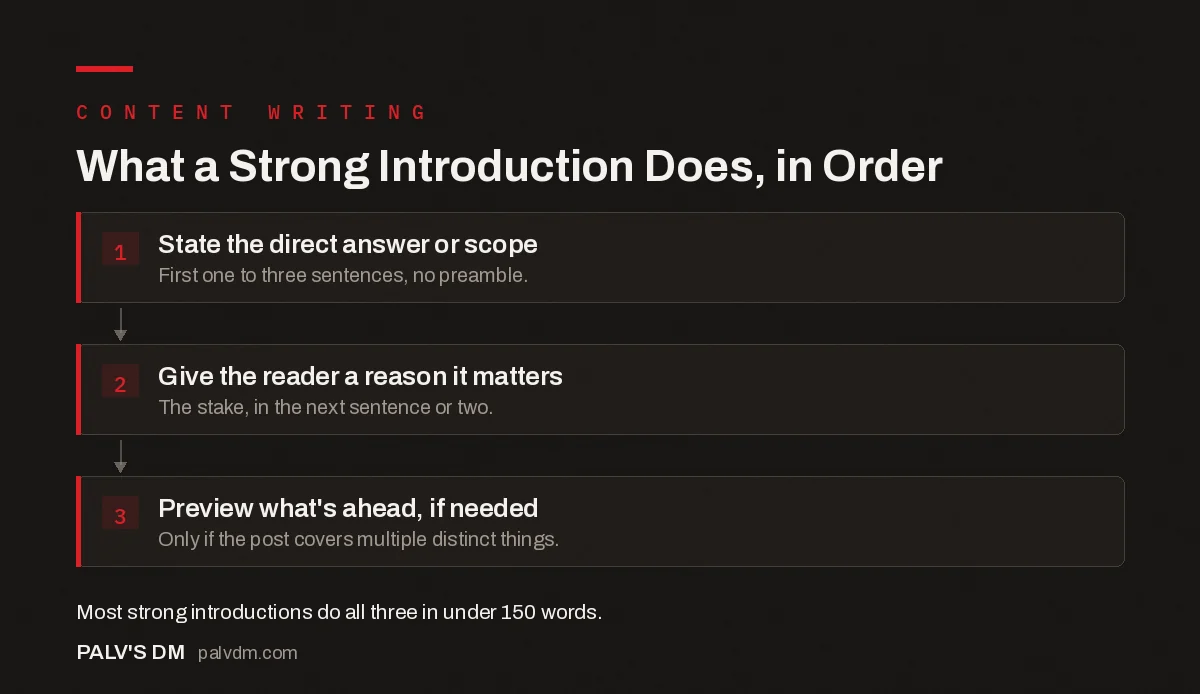
What a Strong Introduction Does, in Order
- State the direct answer or scope. First one to three sentences, no preamble.
- Give the reader a reason it matters. The stake, in the next sentence or two.
- Preview what’s ahead, if needed. Only if the post covers multiple distinct things.
Do different post types need different introductions?
Broadly, yes, though the “answer fast” principle holds across all of them:
- How-to posts should state what the reader will be able to do by the end, plus any prerequisite worth flagging immediately.
- Definitional posts should open with the definition itself — the introduction and the answer are effectively the same paragraph.
- Listicles should state the number and scope of items and who the list is for, so readers can judge relevance before scanning headers.
- Comparison posts benefit from a quick verdict in the introduction, with the detailed reasoning to follow.
- Opinion or myth-buster posts can open with the claim being challenged, stated plainly, before the rebuttal begins.
The common thread: readers should be able to tell from the first paragraph, without scrolling, whether this specific page answers their specific question.
How do hooks fit into a fast, direct introduction?
A hook and a fast, useful opening aren’t opposites, but a lot of writing advice treats “hook the reader” as license to delay the actual point. A statistic, a specific example, or a sharply stated claim can open a post and still deliver the core answer within the first couple of sentences — the hook and the answer don’t have to be sequential, they can be the same sentence.
For example: “Comparison posts convert well and get abandoned often, usually for the same reason: the writer decided the verdict before doing the research.” That’s a hook (a specific, slightly provocative claim) and a scope-setter (tells the reader what the post is actually about) in one sentence, with zero throat-clearing before it.
How do you rewrite a slow introduction without losing what worked?
Start by identifying the single sentence in the current introduction that actually does useful work — the one that states the answer, the scope, or the stake. In most weak introductions, that sentence exists somewhere in paragraph two or three; it just arrived too late. Move it to the front, then evaluate everything that came before it: if it adds context the reader needs, compress it into a clause. If it’s pure scene-setting, cut it entirely.
A useful discipline for teams editing at scale: read only the first sentence of every post in a content library, one after another. Any introduction where that first sentence could belong to a dozen other articles on the same general topic needs a rewrite. Any introduction where the first sentence is specific enough that it could only belong to this article is probably doing its job.
What’s a worked example of turning a slow introduction into a fast one?
Take a common opening for a post about email deliverability: “In today’s digital marketing landscape, email remains one of the most powerful channels available to businesses. However, many marketers struggle to get their emails delivered to the inbox instead of the spam folder. In this article, we’ll explore the various factors that affect email deliverability and provide actionable tips to improve your sender reputation.” That’s 62 words and zero information — a reader finishes it no closer to an answer than before they started.
A direct rewrite: “Email deliverability drops off fast once your sender reputation score falls into the 70s and below, and the two fastest fixes are cleaning your list of bounced addresses and adding SPF and DKIM records if you haven’t already. This post covers both, plus four longer-term habits that keep your domain reputation stable.” That’s 55 words, shorter than the original, and it states a concrete threshold, two immediate fixes, and the scope of what follows. Nothing about tone changed — both versions are professional and readable. The difference is entirely about what work each sentence does.
How does introduction length interact with post length?
Longer posts don’t earn longer introductions by default. A 2,000-word guide and a 600-word explainer both need their opening to land inside roughly 50 to 150 words, because the reader’s patience at the top of the page doesn’t scale with how much content follows. What changes with post length is how much the introduction needs to preview.
A short, single-answer post can skip the preview step entirely and go straight from answer to reason-it-matters. A long guide covering six or seven distinct subtopics benefits from a one-sentence roadmap so readers with a narrower question can jump to the right section instead of reading linearly. The mistake to avoid is using post length as an excuse to slow the opening down — “this is a comprehensive guide, so let’s start with some background” is the same wasted-time problem dressed up as thoroughness.
FAQs
How long should a blog introduction be?
50 to 150 words in most cases. Enough to answer or scope the article and give the reader a reason to continue, not so long that it becomes its own mini-article before the real content starts.
Is it ever fine to open with a story or anecdote?
Yes, if the story is short and gets to the point fast, and especially if the post’s format rewards it (a case study or an opinion piece, for instance). It becomes a problem when the anecdote runs several paragraphs before connecting to what the reader actually searched for.
Should the primary keyword appear in the introduction?
Naturally, yes, since the introduction is answering the query the keyword represents. Forcing the exact keyword phrase in awkwardly reads worse than using natural variations that cover the same intent, and modern search systems don’t need exact-match keyword stuffing to understand relevance.
Do AI summarisation tools actually use the introduction specifically?
Often, yes. AI Overviews and similar systems tend to favour content near the top of a page when generating a summary, because it’s the most likely place to find a direct, self-contained answer. A slow, vague introduction reduces the odds of being the source quoted.
What’s the fastest way to spot a wasteful introduction?
Delete the first paragraph and check if the post still makes complete sense starting from paragraph two. If it does, the first paragraph wasn’t doing real work and can likely be cut or replaced with something more direct.
Where strong introductions fit in a content programme
A well-written opening only matters if the format underneath it delivers on the promise — that’s why introductions pair closely with documented post structures by intent type and with how-to content specifically, where a slow start is especially costly because readers are trying to complete a task, not browse. Introduction quality is also one of the easiest things to standardise across a writing team through a shared content style guide, rather than leaving it to individual habit.
Fixing weak introductions across an existing content library is often the single highest-leverage edit a content team can make, since it affects every post’s bounce rate at once. PalV’s DM’s content writing service audits and rewrites openings as a standalone pass when a client’s content isn’t converting despite decent rankings.