A/B Testing SEO Changes: Methods That Aren’t Guesswork
SEO tests split pages, not users. Here is what makes a test valid, what you can test, and how big the sample needs to be.

Published August 2026. Written by the SEO team at PalV’s DM.
A valid SEO A/B test splits similar pages into a control group and a variant group, applies one change to the variant group only, runs both concurrently for the same time period, and compares organic performance using a pre-registered metric and a minimum sample size set before the test starts. This is fundamentally different from standard CRO testing, which splits users. SEO tests split pages, because search engines index pages, not individual visitor sessions, so the test has to operate at the level Google actually evaluates.
Why can’t SEO tests split traffic the way CRO tests do?
A typical conversion rate optimisation test shows version A to half of visitors and version B to the other half, then compares conversion rates. That works because the test unit, an individual user, sees only one version and Google never indexes either variant as a real page.
SEO doesn’t work that way. Google crawls and indexes actual pages, and a single page can only have one ranking at a time. Showing different content to different visitors on the same URL, commonly called cloaking when done to manipulate rankings, creates a real risk of a Google Search Console manual action if it looks like an attempt to show search engines different content than users see. A valid SEO test needs a different unit of measurement entirely: pages, not sessions.
How does page-splitting SEO testing actually work?
The method, pioneered commercially by platforms like SearchPilot and adapted by many in-house teams, works like this: identify a group of pages that share the same template and similar characteristics, such as a set of category pages, product pages, or blog posts using the same layout. Split that group into two: a control group that stays unchanged, and a variant group where the test change is applied. Both groups keep their real, distinct URLs and get indexed normally. No visitor-level splitting and no cloaking risk, because every page shows the same content to everyone, including Googlebot.
After running both groups concurrently for a set period, compare organic performance, typically clicks or impressions from Google Search Console, between the variant group and a statistical model of what the control group’s performance predicts the variant group would have done without the change.
What requirements make a test valid?
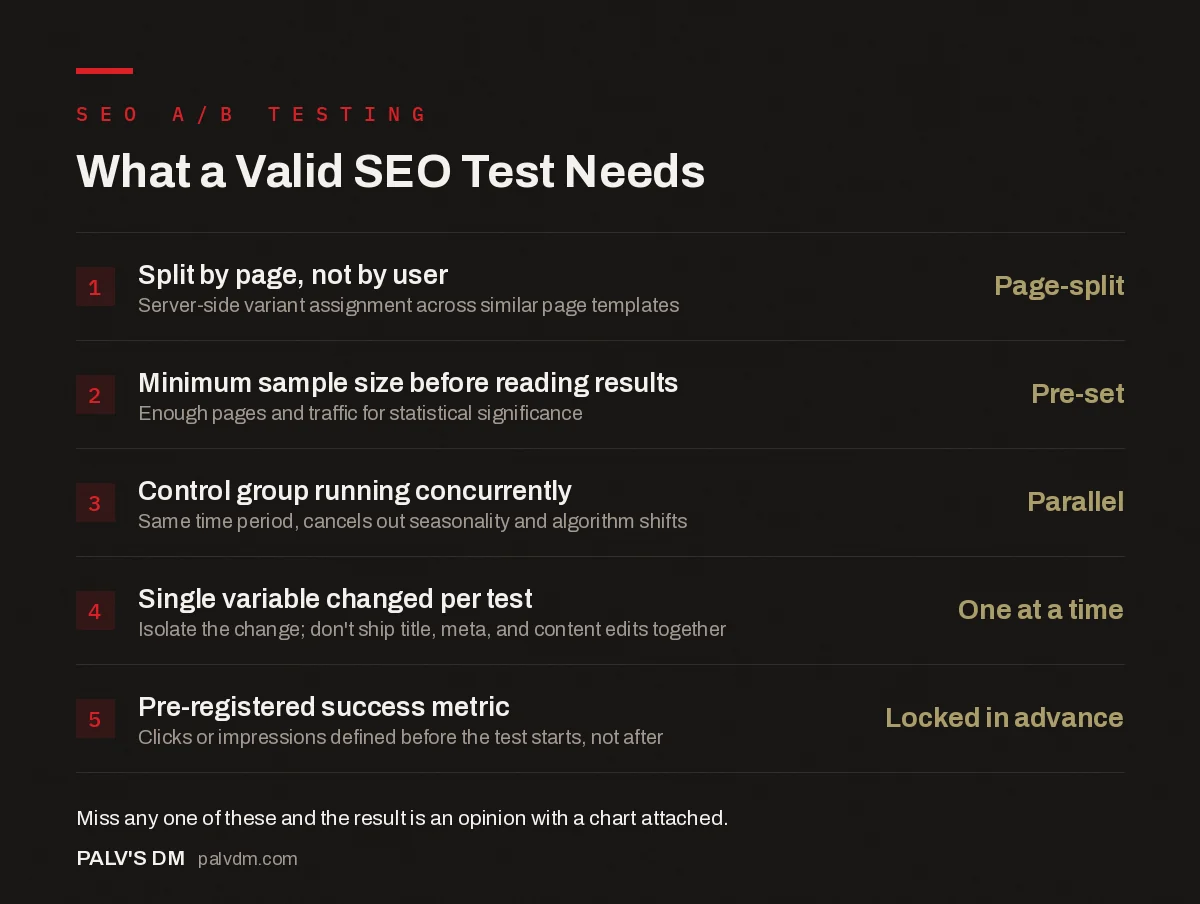
What a valid SEO test needs
- Split by page, not by user. Server-side variant assignment across similar page templates.
- Minimum sample size before reading results. Enough pages and traffic for statistical significance.
- Control group running concurrently. Same time period, cancels out seasonality and algorithm shifts.
- Single variable changed per test. Isolate the change; don’t ship title, meta, and content edits together.
- Pre-registered success metric. Clicks or impressions defined before the test starts, not after.
Miss the concurrent control group and the test can’t distinguish the change’s real effect from a Google algorithm update, a seasonal shift, or a competitor’s content push that happened to land during the same window. Miss the pre-registered metric and there’s a strong temptation to pick whichever metric moved favourably after the fact, which isn’t a test result, it’s a story built backward from the data.
What kinds of changes can actually be tested this way?
Page-splitting SEO tests work best for changes applied consistently across a template, not one-off edits to a single unique page. Common valid test candidates:
| Change type | Example | Why it fits this method |
|---|---|---|
| Title tag structure | Adding price or rating to product page titles | Applies uniformly across a page template |
| Meta description format | Testing a question-format vs statement-format description | Same structural change, many pages |
| Internal linking pattern | Adding related-content links to category pages | Consistent structural addition across the group |
| Schema markup | Adding FAQ schema to a support article template | Binary presence/absence, clean to isolate |
| Content length or structure | Adding a comparison table to product pages | Applied consistently, measurable engagement change |
A single, unique, high-value page, like a homepage or a flagship pillar post, generally isn’t a good fit for this method, because there’s no comparable control group of similar pages to test against. Sequential testing (before and after, on the same single page) is the fallback there, though it’s weaker evidence since it can’t cancel out external factors the way a concurrent control group can.
How big does the sample size need to be?
There’s no single number that fits every site, since the required sample depends on existing traffic volume, the expected size of the effect, and how much natural variance the page group already shows. As a practical starting point, most page-splitting tests need at least 30-50 pages per group and several weeks of data to reach a reliable read, and low-traffic page groups may need a longer running period to accumulate enough clicks and impressions for the comparison to be statistically meaningful rather than noise.
Running a test for too short a period is the most common way a real effect gets missed or a false effect gets reported. SEO changes typically take one to three weeks to be fully crawled, indexed, and reflected in ranking and click data, so a test read after only a few days is measuring mostly noise, not the actual effect of the change.
What’s a realistic first test for a smaller site to run?
Start with a change that’s easy to isolate and apply consistently: a title tag format change across a group of 20-40 similar pages, such as adding a specific benefit or number to the front of the title. Title changes are low-risk to roll back, take effect relatively quickly once recrawled, and produce a clean click-through-rate signal in Search Console without needing to wait for a full ranking shift to show up.
Avoid starting with a content-length or structural test as a first attempt. Those changes take longer to show an effect, are harder to isolate from other simultaneous site changes, and require a larger page group to produce a statistically clean read. Build confidence in the method with a simple, fast-feedback test first, then move to more structural changes once the team has a working process for splitting, running, and reading results.
Frequently asked questions
Do I need a dedicated platform like SearchPilot to run SEO A/B tests?
Not necessarily, though dedicated platforms simplify the statistical modelling considerably. Smaller teams can run a simplified version manually: split a page group, apply the change to half, and compare organic clicks and impressions from Google Search Console between the two halves over a matched time period, using a spreadsheet-based statistical significance calculation. It’s more manual and less statistically rigorous than a dedicated platform’s proprietary model, but it follows the same core method.
How is this different from just making a change and watching what happens?
The concurrent control group is the entire difference. Making a change and watching rankings afterward can’t distinguish the change’s effect from an algorithm update, a seasonal shift, or a competitor’s move happening at the same time. A concurrent, unchanged control group experiences all of those same external factors, so subtracting the control group’s performance from the variant group’s performance isolates the change itself.
Can I test multiple changes at once to save time?
Testing one variable at a time is strongly preferred, because a test with two simultaneous changes, say a title format and a new internal linking pattern, can’t tell you which change (or which combination) actually drove any observed effect. If time pressure makes a multivariate test necessary, be explicit that the result attributes to the combined change, not to either element individually, and don’t roll out just one of the two changes based on that result alone.
How long should an SEO A/B test run before reading results?
A minimum of three to four weeks for most page groups, and often longer for lower-traffic templates, to allow enough time for crawling, indexing, and ranking to stabilise after the change, and to gather enough data for statistical significance. Reading results early, before the pre-set sample size or duration is reached, is one of the most common ways teams draw a conclusion that doesn’t replicate once the test runs its full course.
The bottom line
SEO A/B testing that actually produces evidence, not guesswork, splits by page rather than by user, runs a real concurrent control group, isolates one variable, and reads results only after a pre-registered metric and sample size are met. Skip any of those four requirements and what’s left is an opinion with a chart attached, not a test.
PalV’s DM’s SEO Growth service includes structured testing for template-level changes before they roll out sitewide, rather than shipping changes on instinct alone.
For the reporting layer that captures test results, see our Google Search Console guide. To turn a validated test win into a broader forecast, read our SEO forecasting model post. For measuring the downstream revenue impact of a winning test, see identifying which pages drive revenue. Our cohort analysis for content performance post covers a complementary method for measuring change over time without a formal split test.