Website Trust Signals That Actually Work in the Indian Market
Generic SSL badges barely move conversions. See which website trust signals actually work for Indian shoppers: UPI, COD, GST display, WhatsApp.

The trust signals that actually move conversions for Indian shoppers are specific and verifiable, not decorative. A generic padlock icon does almost nothing. A visible GST number, UPI and cash-on-delivery at checkout, a real phone number, and recent Google reviews with more than a handful of entries do the actual work. Most Indian business websites still lean on the decorative version and wonder why bounce stays high at the checkout step.
India’s fraud numbers explain why this matters more here than in a lot of “trust signal” advice written for Western markets. An Experian report found that a large share of Indian consumers have already been affected by online fraud, and separate research puts the number of consumers who’ve fallen victim to a scam or know someone who has above 60%. Visitors arrive primed to look for reasons not to trust a new website. That changes what actually counts as a trust signal.
Why do generic trust badges barely move the needle?
Baymard Institute’s long-running research on site seals found that recognition drives everything: Norton and McAfee seals measurably increase perceived security because people actually recognise them, while unbranded “Secure Checkout” text over a padlock icon tests close to statistically indistinguishable from zero. Users don’t evaluate the underlying technology. They pattern-match against seals they already trust.
Stack six different unrecognised badges near your checkout button and the effect turns negative. It starts reading as a business trying too hard to convince you of something, which is its own red flag. One or two recognisable, verifiable signals beat a wall of decoration every time.
The trust signals worth actually building
1. A visible GST number and registered business details
A GSTIN on your footer or About page signals a real, tax-registered business, not an anonymous storefront that could disappear tomorrow. It costs nothing to display and it’s one of the fastest checks a wary buyer can make before entering payment details.
2. UPI and cash-on-delivery at checkout
Card-only checkout quietly filters out a meaningful share of Indian mobile shoppers who either don’t trust entering card details on an unfamiliar site or simply prefer to pay on delivery. Offering COD, even with a small surcharge, functions as a trust signal in its own right: it lets a first-time buyer verify the product before money changes hands.
3. A real, working phone number, not just a contact form
A form with no visible number reads as a business that doesn’t want to be reached. A landline or mobile number in the header, one that actually gets answered, is one of the oldest trust signals and still one of the strongest, particularly for service businesses and higher-ticket purchases where a buyer wants to talk to a person before committing.
4. A WhatsApp contact button
This is close to India-specific as trust signals get. WhatsApp is already the default messaging app on most Indian phones, so a WhatsApp button feels lower-friction and more human than a contact form that disappears into an inbox. It also lets a hesitant buyer ask one question before committing, which a static FAQ page can’t replicate.
5. Recent Google reviews, not just a high average
A 5.0 rating with four reviews reads as unproven. Research on review trust suggests buyers start placing real confidence in a rating once it’s backed by twenty or more reviews, and recency matters almost as much as volume: reviews older than a few months carry noticeably less weight than fresh ones. Reply to reviews, including the occasional negative one professionally, since an unanswered bad review reads worse than a handled one.
6. Specific delivery and return policy details
“Easy returns” is decoration. “7-day returns, pickup arranged from your address, refund in 5-7 business days” is a trust signal, because it’s specific enough to hold the business accountable to. Vague promises read as vague precisely because they’re easy to write and hard to verify.
7. Real team and office photos, not stock images
Stock photography of generic “office workers” is instantly recognisable and does the opposite of building trust once a visitor clocks it. A real photo of your actual team, storefront, or workspace, even a slightly unpolished one, reads as more credible than a perfectly lit stock alternative, because it’s the one thing a scam site can’t easily fake at scale.
8. Fast, working site performance
A slow, glitchy site subconsciously reads as an unreliable business before a visitor consciously registers why. Speed itself functions as a trust signal: it’s the first thing every visitor experiences, before they’ve read a word of your copy or seen a single badge.
Does this apply to B2B and service websites, not just ecommerce?
Yes, and arguably more, because the purchase decision usually runs through a longer, higher-stakes evaluation. We audit a lot of B2B and manufacturing sites in Gujarat, and the pattern repeats often enough to call it a pattern: the site with the better underlying product regularly loses enquiries to a visibly weaker competitor whose site simply looks more reachable, a GST number in the footer, a landline that gets answered, case studies with named clients instead of “a leading company in the FMCG sector.” None of that shows up in a product comparison. It shows up in whether someone actually picks up the phone.
Service businesses selling anything above a small ticket size, consulting, agency work, B2B supply, benefit from named case studies with real client names (with permission) over anonymised language. Specificity is the actual trust signal. Vagueness, even unintentional vagueness born from an NDA or a shy client, reads the same to a visitor as a business with nothing real to show.
Which of these matter most for a first-time visitor versus a returning one?
First-time visitors lean hardest on GST visibility, payment options, and phone number, the signals that answer “is this a real, reachable business” before anything else. Returning visitors care more about consistency: did the site work the same way last time, did the delivery promise hold up, is the WhatsApp number still answered. Trust, once earned, gets maintained by different signals than the ones that earned it in the first place.
Quick trust signal audit
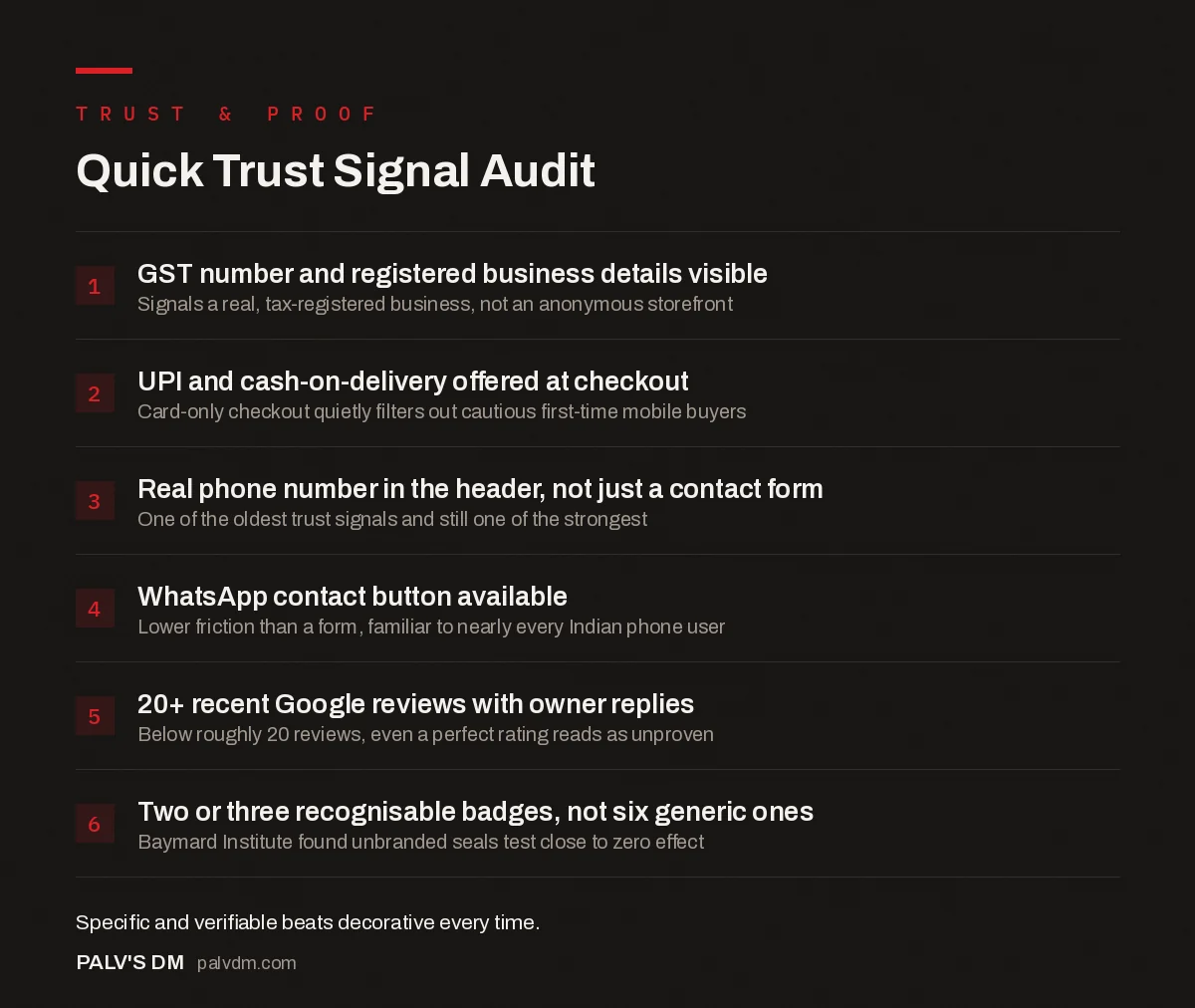
Quick Trust Signal Audit
- GST number and registered business details visible. Signals a real, tax-registered business, not an anonymous storefront.
- UPI and cash-on-delivery offered at checkout. Card-only checkout quietly filters out cautious first-time mobile buyers.
- Real phone number in the header, not just a contact form. One of the oldest trust signals and still one of the strongest.
- WhatsApp contact button available. Lower friction than a form, familiar to nearly every Indian phone user.
- 20+ recent Google reviews with owner replies. Below roughly 20 reviews, even a perfect rating reads as unproven.
- Two or three recognisable badges, not six generic ones. Baymard Institute found unbranded seals test close to zero effect.
What should you cut if your site is over-badged?
If your checkout currently displays more than two or three security badges, cut it down rather than add another. Keep the ones buyers actually recognise (a payment gateway’s own badge, a well-known certificate authority) and drop the rest. A cleaner checkout with fewer, more credible signals reads better than a cluttered one trying to compensate for a weak core offer with visual noise.
The same instinct applies past the checkout page. A homepage that stacks a “featured in” bar, three trust badges, a live chat widget, an exit popup and a cookie banner all fighting for attention in the first screen isn’t building trust, it’s building noise the visitor has to work to ignore. Pick the two or three signals that are actually true and actually verifiable for your specific business, and let the rest of the page breathe. A calmer page reads as a more confident, more established business than a busier one making the same claims louder.
Frequently asked questions
Do generic SSL and security badges actually increase conversions?
Barely, if the badge is generic and unrecognised. Baymard Institute’s research found that widely-known seals like Norton and McAfee move trust perception, while unbranded padlock icons and text reading Secure Checkout with no verifiable certification behind it show close to zero measurable effect.
Does showing a GST number actually build trust with Indian buyers?
Yes, more than most business owners assume. A visible GSTIN signals a registered, legally accountable business rather than a fly-by-night operation, which matters directly in a market where a large share of consumers report having been a target of online fraud or knowing someone who has.
Is WhatsApp really a meaningful trust signal for Indian websites?
Yes. A WhatsApp contact button offers something a contact form doesn’t: the ability to see a real business number, message before committing, and get a response from an actual person. For buyers wary of online transactions, that immediacy closes a trust gap a form can’t.
Should a small business display cash-on-delivery even if it costs more to fulfil?
Consider it for at least a subset of products, especially early on. COD is as much a trust signal as a payment method in India: it lets a cautious first-time buyer verify the product before paying, which lowers the barrier to that first purchase far more than any badge on the page.
How many Google reviews does a business need before ratings feel trustworthy?
Research on review trust puts the threshold around 20 or more reviews before customers place real confidence in a star rating. Below that, even a perfect 5.0 score reads as unproven rather than reassuring, since a handful of reviews is too easy to dismiss as friends and family.
Sources
- Which Site Seal Do People Trust the Most, Baymard Institute
- Fraud is affecting a large section of Indian consumers, Experian
- Digital Marketing in India: The Landscape in 2026
- Testimonials and Proof: Making Them Believable
- Should You Publish Your Prices? The Data and the Trade-Offs
- WhatsApp as a Conversion Channel for Indian Businesses
Want this done on your site?
Every PalV’s DM engagement starts with a free audit of your actual website — a 12-point
crawl covering what is blocking indexation, on-page gaps against your primary keywords, speed
findings, and the three to five fixes worth making first. Delivered in two working days. No
payment details, and the findings are yours whether you hire us or not.
Get your free SEO audit
See Web Development plans and prices