Keyword Research Tools Compared on Indian Search Volume Accuracy
Keyword tools compared on Indian search volume accuracy: why Ahrefs, Semrush and Keyword Planner disagree, and how to use them together.
No single keyword tool gets Indian search volume right on its own. Google Keyword Planner is the closest to ground truth because it comes straight from Google’s own query logs, but it hides exact numbers behind broad ranges unless the account is actively spending on ads, and third-party tools like Ahrefs, Semrush, and Moz run on clickstream panels that are thinner and more English-skewed outside the US and UK. The honest answer is to use more than one tool and treat any single number as directional, not exact.
I’ve pulled the same keyword across three different tools for an Ahmedabad client and watched the estimates disagree by several multiples on the same month, same location setting, same device filter. That’s not one tool being broken. It’s what happens when none of them have an India-sized panel to draw from, and each fills the gap with a different modelling assumption.
Which tool should you actually trust?
None of them alone, and that’s a genuinely different answer than what most comparison posts give. For finding keyword ideas, checking competitor gaps, and estimating relative difficulty, the global platforms are still worth paying for, they’re built for exactly that workflow. For deciding whether a keyword is worth targeting at all in an Indian market, Google Keyword Planner’s numbers, however clunky the range display, come from the same system that actually serves the search results, which no third-party estimate can claim.
Why do keyword tools disagree so much on Indian search volume?
Ahrefs states plainly that its search volume estimates are powered by clickstream data, meaning behaviour sampled from a panel of real user sessions, modelled and extrapolated across the wider web. That approach works well where the panel is large and representative. Clickstream panels have historically been built and sold predominantly out of US and European data brokers, and while none of the major tools publish exact country-level panel sizes, the pattern is consistent enough across the industry that Indian SEOs raise it constantly: volume confidence drops noticeably once you’re outside the US, UK, and a handful of other large English-speaking markets.
Google Keyword Planner doesn’t have this panel problem, since its data comes directly from Google’s own search logs rather than a sampled clickstream. The trade-off is access. Google’s own help documentation confirms that basic Keyword Planner features require completing account setup with billing information, and in practice, accounts without active spend frequently see volume shown as a wide bucket, something like “1K to 10K,” rather than a specific figure. That’s frustrating when you’re trying to compare two similar keywords, but it isn’t the tool being wrong, it’s Google limiting precision for non-advertisers.
Global tools vs Keyword Planner for India
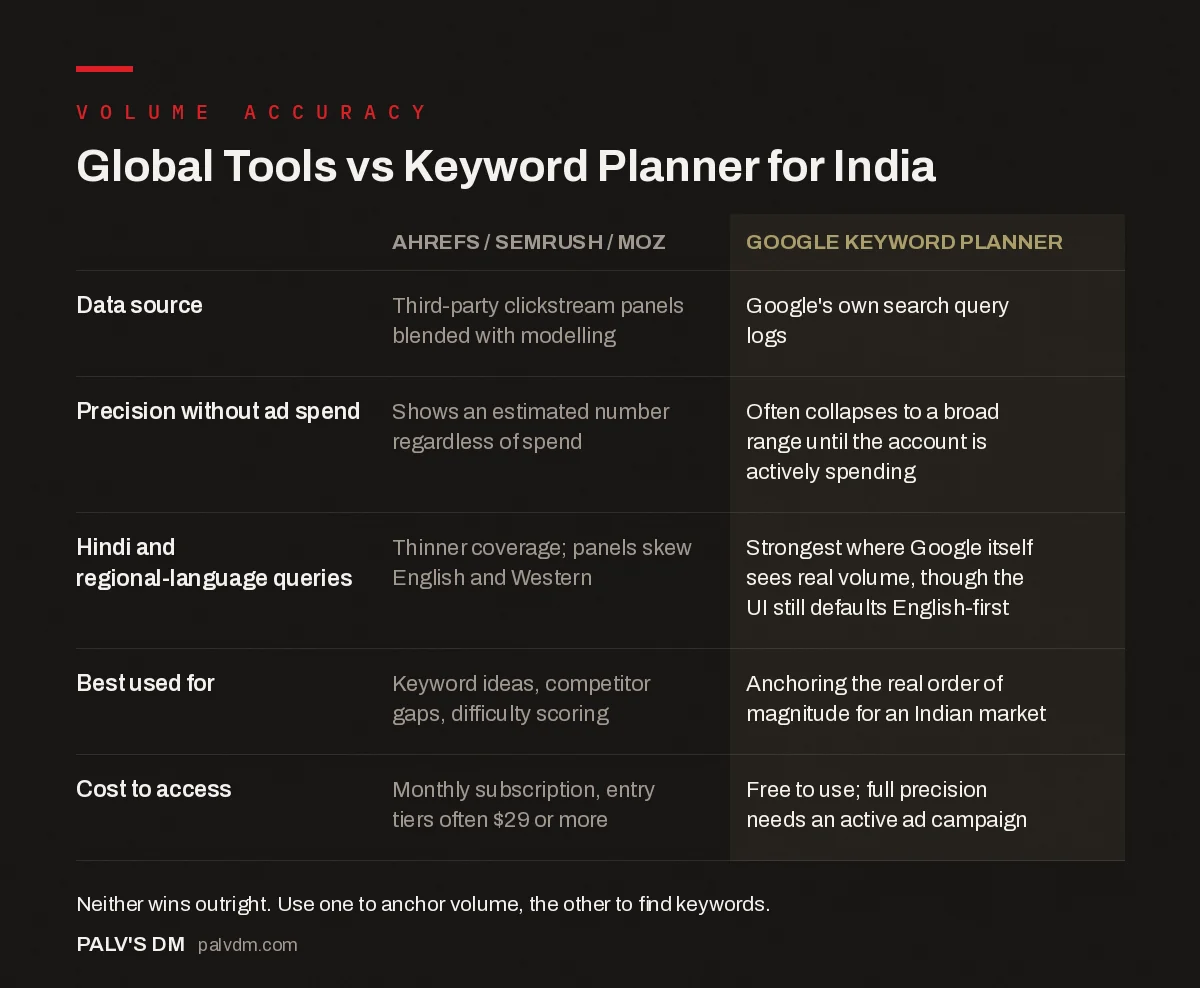
Global Tools vs Keyword Planner for India
| Ahrefs / Semrush / Moz | Google Keyword Planner | |
|---|---|---|
| Data source | Third-party clickstream panels blended with modelling | Google’s own search query logs |
| Precision without ad spend | Shows an estimated number regardless of spend | Often collapses to a broad range until the account is actively spending |
| Hindi and regional-language queries | Thinner coverage; panels skew English and Western | Strongest where Google itself sees real volume, though the UI still defaults English-first |
| Best used for | Keyword ideas, competitor gaps, difficulty scoring | Anchoring the real order of magnitude for an Indian market |
| Cost to access | Monthly subscription, entry tiers often $29 or more | Free to use; full precision needs an active ad campaign |
What does Google Keyword Planner actually get right?
The order of magnitude. Even with ranges instead of exact figures, Keyword Planner tells you reliably whether a keyword sits in the tens, hundreds, or thousands of monthly searches for a given Indian city or state, because it’s reading the same query stream Google Search itself runs on. Running a small ad campaign, even a minimal one, produces exact figures instead of ranges, and for a client where keyword prioritisation decisions carry real budget weight, that’s often worth the modest ad spend just to get clean numbers for a week.
Where do Ahrefs, Semrush, and Moz fall short for India?
Mainly on confidence at the tail end, the long-tail, lower-volume, and hyper-local keywords that make up most of an actual content plan. These tools are genuinely strong for head terms with enough global search activity to model reliably. Where they get shakier is a city-specific service query or anything phrased the way Indian users actually type it, including Hinglish variations that don’t map cleanly onto a single canonical keyword the way a purely English query does. None of the major platforms have solved this well yet, and it shows up as volume estimates that look suspiciously round or suspiciously low for keywords a client swears are common in their inbox and phone enquiries.
What about Hindi and regional-language keywords?
This is where the gap is widest. Coverage for Hindi, and more so for other regional Indian languages, is thin across every major tool, global or Google’s own. Our piece on building a repeatable keyword research process covers how we fold non-English variants into a research pass, but the short version here is that Google Trends becomes more useful than any volume tool at this stage. It won’t give you an absolute number, but it will show you the relative popularity of two regional-language phrasings against each other, which is often the decision that actually matters: not “how many searches” but “which of these two ways of asking do more people actually use.”
Does Search Console data solve this instead?
Partly, and it’s the one data source in this whole conversation that isn’t an estimate. Search Console shows actual impressions and clicks for queries your site already ranks for, pulled straight from Google’s logs with no modelling in between. The catch is obvious once you say it out loud: it only covers keywords you’re already visible for. A brand-new content idea with zero current rankings won’t show up there at all, so it’s a validation tool for existing content, not a discovery tool for new keyword ideas.
Where this earns its place in the workflow is cross-checking. If Keyword Planner shows a keyword sitting in the “100 to 1K” range and your Search Console data shows a related, already-ranking query pulling real impressions in a similar band, that’s two independent signals agreeing, which is worth more than either number alone. I check this before recommending a client shift budget toward a new keyword cluster, because a modelled estimate matching an actual logged number is about as close to confirmation as this gets without buying ad inventory to test it directly.
How should you actually use these tools together?
- Start broad with a global tool. Use Ahrefs, Semrush, or a free option to generate the keyword list and see competitor gaps. Our free SEO tools guide covers what’s usable without a subscription at this stage.
- Anchor volume with Keyword Planner. Cross-check your shortlist against Keyword Planner’s ranges, or run a small ad campaign for a week if the decision has real budget riding on it.
- Use Google Trends for relative comparison. Especially for regional-language variants where no tool has confident absolute numbers.
- Don’t trust a single tool’s difficulty score in isolation. Our post on verifying a tool’s data before you trust it walks through spot-checking methods that catch modelling errors before they shape a content plan.
- Weight local knowledge over the dashboard. If a client’s own enquiry volume and phone logs disagree with what a tool reports, believe the client’s data. Tools model behaviour; the business has the actual behaviour.
Frequently asked questions
Which keyword tool is most accurate for Indian search volume?
None is fully accurate on its own. Google Keyword Planner is closest to ground truth since it draws from Google’s own query logs, but it shows broad ranges rather than exact numbers unless the account is actively spending. Third-party tools are better for finding keyword ideas than for precise Indian volume.
Why do Ahrefs and Semrush show different numbers for the same keyword?
They rely on clickstream panels, sampled user behaviour data modelled and extrapolated to estimate volume, and each tool sources and models that data differently. Confidence in these estimates tends to drop outside large English-speaking markets where the underlying panels are strongest.
Do I need to run Google Ads to get exact search volume numbers?
Not strictly, but Google’s own documentation confirms full Keyword Planner access requires completing account setup with billing information, and accounts without active spend commonly see volume as a wide range rather than a specific figure.
How do I research Hindi or regional-language keywords?
Volume tool coverage is thin for Hindi and other regional languages across every major platform. Google Trends is useful here for comparing the relative popularity of different phrasings, even without an absolute search volume number attached.
Is it worth paying for more than one keyword tool?
For serious keyword decisions in the Indian market, yes. Using a global tool for keyword discovery alongside Keyword Planner for volume anchoring catches disagreements a single tool would hide, and that disagreement is often the most useful signal in the whole exercise.
Sources
- Ahrefs Free Keyword Generator, data sourcing notes
- Refine your new keywords in Keyword Planner, Google Ads Help
- Keyword Research: A Complete, Repeatable Process
- Rank Tracking Tools Compared for Indian SERPs
- Free SEO Tools That Replace Paid Ones (Mostly)
- How to Verify a Tool’s Data Before You Trust It
Want this done on your site?
Every PalV’s DM engagement starts with a free audit of your actual website — a 12-point
crawl covering what is blocking indexation, on-page gaps against your primary keywords, speed
findings, and the three to five fixes worth making first. Delivered in two working days. No
payment details, and the findings are yours whether you hire us or not.
Get your free SEO audit
See One-Time SEO Services plans and prices