Free SEO Tools That Replace Paid Ones (Mostly)
The free SEO tools that genuinely replace paid ones, where they fall short, and what still needs a paid index like Ahrefs or SEMrush.
You can run a genuinely capable SEO practice on free tools for almost everything except one thing: seeing what a competitor’s backlink profile or keyword rankings look like at scale, which still requires a tool with its own crawled web index. Crawling your own site, checking page speed, validating schema, tracking your own Search Console data: all of that has a free option that’s good enough for a small business, not a watered-down consolation prize.
The “mostly” in the title is doing real work. Free tools cover the majority of routine SEO tasks convincingly. Where they fall short is specific and worth naming honestly instead of pretending a free stack replaces everything a $100-plus-a-month subscription buys.
What does Google Search Console actually give you for free?
More than most people use. Search Console shows exactly which queries bring clicks and impressions to your site, your indexing status page by page, mobile usability issues, and Core Web Vitals data pulled from real Chrome users, not a lab simulation. It’s first-party data straight from Google, which makes it more accurate for your own site than anything a third-party tool estimates by crawling and modelling from the outside.
What it won’t do: show you a competitor’s data, or reveal search volume for keywords you don’t already rank for. That’s the boundary where Search Console’s usefulness stops and a paid keyword tool’s usefulness starts.
What can Screaming Frog’s free tier actually handle?
A genuine amount. The free version of Screaming Frog SEO Spider crawls up to 500 URLs in a single crawl, no sign-up or email capture required, and finds broken links, redirect chains, duplicate titles and missing meta descriptions the same way the paid version does. For most small business sites, five to fifty pages, that limit is never a real constraint.
What the free tier restricts: crawl configuration options, saving crawls to revisit later, JavaScript rendering for sites built on frameworks like React, and integrations with Google Analytics, Search Console and PageSpeed Insights APIs. A £199 per year licence removes the 500 URL cap entirely and turns those on. If you’re crawling a 2,000-page ecommerce catalogue monthly, that’s when the licence earns its keep. If you’re auditing a twelve-page brochure site twice a year, it doesn’t.
How do you check page speed without paying for anything?
- PageSpeed Insights runs both a lab test (Lighthouse) and shows real-world Chrome User Experience Report data for Core Web Vitals, free with no account needed.
- Chrome DevTools has Lighthouse built in directly, useful for testing changes locally before they go live.
- GTmetrix’s free tier adds waterfall charts that make it easier to spot exactly which resource is slowing a page down.
None of these cost anything, and together they cover diagnosis thoroughly. What they don’t do is fix the problem for you, that part still takes actual development work regardless of which free tool flagged it.
What replaces paid keyword research tools?
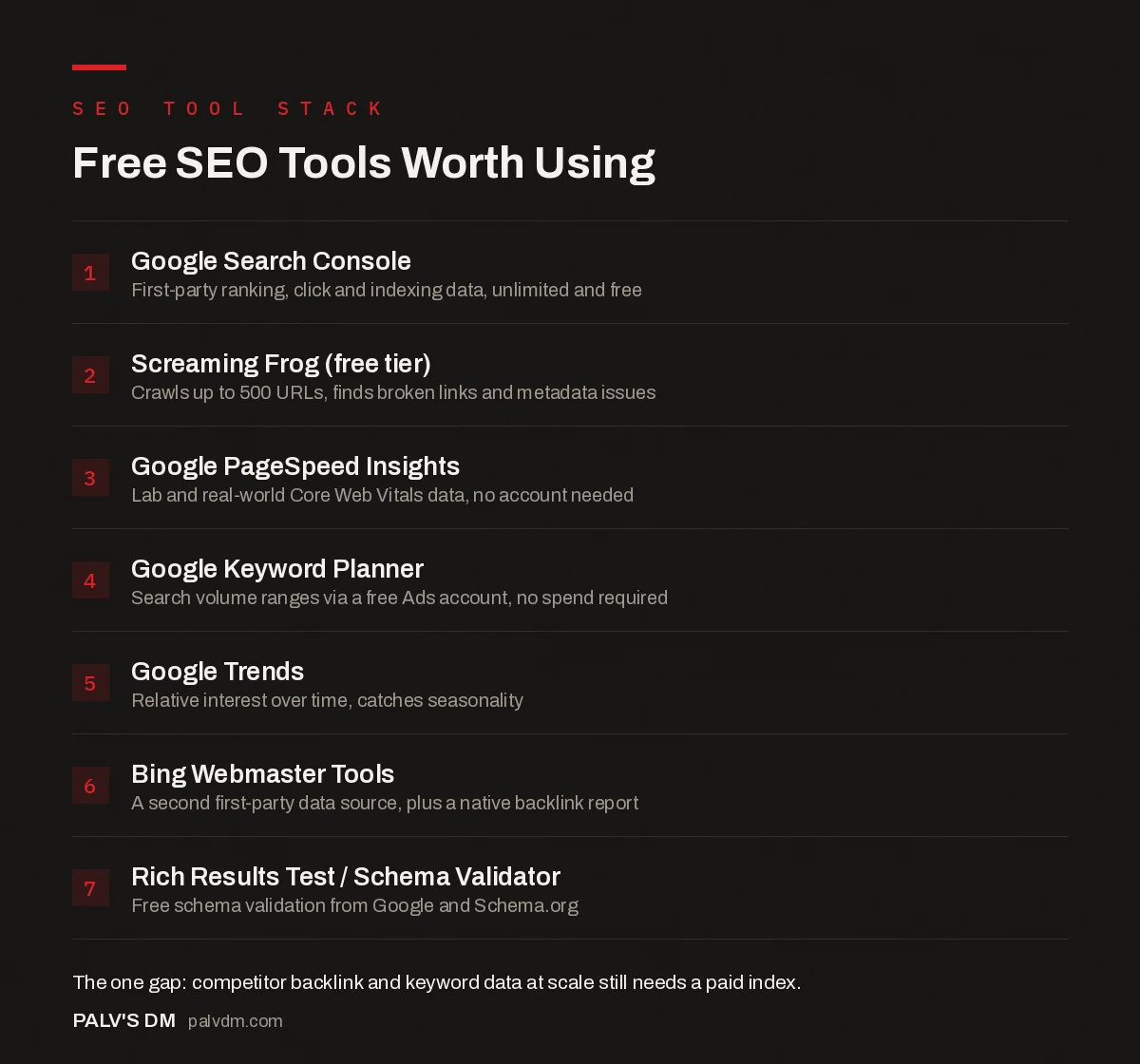
Free SEO Tools Worth Using
- Google Search Console. First-party ranking, click and indexing data, unlimited and free.
- Screaming Frog (free tier). Crawls up to 500 URLs, finds broken links and metadata issues.
- Google PageSpeed Insights. Lab and real-world Core Web Vitals data, no account needed.
- Google Keyword Planner. Search volume ranges via a free Ads account, no spend required.
- Google Trends. Relative interest over time, catches seasonality.
- Bing Webmaster Tools. A second first-party data source, plus a native backlink report.
- Rich Results Test / Schema Validator. Free schema validation from Google and Schema.org.
Google’s own Keyword Planner remains the most direct free option, tied to a free Google Ads account that doesn’t require active spend to pull volume data, though the ranges it returns are wider than a paid tool’s exact estimates. Google Trends fills a different gap: relative search interest over time, useful for catching seasonal patterns a static volume number hides completely.
What about rank tracking, the weakest spot for free tools?
This is the honest gap. Search Console shows average position, but it’s an average across all the ways a query appeared, which can mask genuine day-to-day ranking movement for a specific keyword. Manually checking rankings in an incognito browser works for a handful of keywords tracked occasionally. It falls apart fast past ten or fifteen keywords tracked weekly, both because it’s tedious and because your own search history and location still bias results even in incognito mode.
Paid rank trackers solve this with distributed checks from clean, location-specific vantage points, run automatically on a schedule. There’s no honest free equivalent at real scale. If rank tracking across dozens of keywords is core to how you report on SEO work, this is where the free stack’s limits show up first.
Where do free tools genuinely fall short?
Backlink data, and it’s not close. Paid tools like Ahrefs and SEMrush maintain their own web crawlers running continuously, building an index of links across the entire web that took years and significant infrastructure spend to assemble. Free tools have no equivalent, because there’s no way to replicate that index without the same crawling investment. Google Search Console shows some of your own site’s backlinks, but only a partial slice of them, and it shows nothing about a competitor’s link profile at all.
If competitive link analysis or scaled rank tracking is central to what you’re doing, that’s the one area where a paid tool isn’t a luxury, it’s the only way to see the data at all. Everything else on this list, I’d genuinely recommend the free option first and only pay once you’ve hit a specific, named limit, not because a subscription feels like the more serious choice.
What about AI chat tools for SEO research?
Worth a mention since they’ve become part of most people’s actual workflow, even if they don’t fit neatly into a “tools” list. A general-purpose AI assistant is genuinely useful for drafting title tag variations, summarising a competitor’s page structure you paste in, or explaining an unfamiliar Search Console metric. It is not a replacement for any of the tools above, because it doesn’t crawl your site, doesn’t have live rank data, and will confidently state a wrong URL structure or an outdated schema property if you don’t check its output against a real source. Treat it as a drafting assistant sitting alongside the tools in this list, not a tool that replaces them.
The mistake I see most with newer SEOs: asking a chat assistant for a competitor’s current keyword rankings or backlink count, then reporting whatever number comes back as if it were fetched live. It wasn’t. Verify anything with a real number attached against Search Console, a crawl, or a tool actually built to measure it before you put that number in a client report.
What tool stack would you actually recommend starting with?
Google Search Console and Screaming Frog’s free tier, installed on day one, no exceptions. Add PageSpeed Insights and the Rich Results Test to your bookmarks for anything you’re actively changing. Use Google Trends and Keyword Planner for content planning. That combination costs nothing and covers technical audits, on-page checks, speed diagnostics and rough keyword direction. Add a paid tool only once you can name the specific data gap it fills that the free stack genuinely can’t, competitor backlinks or scaled rank tracking being the two most common reasons that actually hold up.
Frequently asked questions
Can free SEO tools really replace paid ones?
For most of what a small business needs, yes: crawling your own site, checking page speed, validating schema, tracking your own Search Console data. The gap opens up around competitor backlink and keyword intelligence at scale, which requires a tool with its own crawled web index, something free tools don’t maintain.
What’s the best free alternative to Ahrefs or SEMrush?
There isn’t a direct one for backlink index size, and pretending otherwise sets false expectations. Google Search Console gives you accurate first-party data about your own site’s rankings, clicks and impressions, which covers most day-to-day decisions without needing a third-party index at all.
Is Google Search Console enough on its own?
For understanding how your own site performs in Google Search, largely yes. It won’t show you a competitor’s rankings or backlinks, and its keyword data groups queries in ways that can obscure some detail, but for your own site’s indexing status, click data and technical issues, it’s the most accurate source available, free or paid.
What are the limits of the free Screaming Frog version?
The free version crawls up to 500 URLs per crawl and restricts crawl configuration, saved crawls, and advanced features like JavaScript rendering and API integrations. For a small site under that limit, it’s a fully capable crawler. The £199 per year licence removes the URL cap and turns on those advanced features.
When is it worth paying for an SEO tool?
When you need to see data you don’t own: a competitor’s backlink profile, keyword rankings across a large site tracked automatically, or historical ranking trends over time. Those require an index built by crawling the wider web continuously, which is exactly what paid tools like Ahrefs and SEMrush are selling.
Sources
- Screaming Frog SEO Spider, Free vs Paid
- Google Search Console, About Page
- The SEO Tool Stack a Small Agency Actually Needs
- Screaming Frog vs Sitebulb: Which Crawler to Learn
- The Minimum Viable SEO Stack for Under Rs 5,000 a Month
- Chrome Extensions Worth Installing for SEO
Want this done on your site?
Every PalV’s DM engagement starts with a free audit of your actual website — a 12-point
crawl covering what is blocking indexation, on-page gaps against your primary keywords, speed
findings, and the three to five fixes worth making first. Delivered in two working days. No
payment details, and the findings are yours whether you hire us or not.