Trends & Industry Developments
Zero-Click Search Data: How Much Traffic Really Disappeared
Zero click search statistics get exaggerated. Here's how much traffic actually disappeared, which query types are hit hardest, and how to read your own data.
Zero-click search statistics get thrown around a lot, usually as a single headline number meant to signal that organic search is dying. It isn’t that simple. Some of what gets counted as “zero-click” was always zero-click — weather, conversions, quick definitions never sent traffic anywhere, AI Overviews or not. What has genuinely changed is that AI Overviews and AI Mode now insert a full answer above the organic results for a much wider set of informational queries, and that does suppress clicks on queries that used to convert into visits. The honest answer is: traffic loss is real, uneven, concentrated in top-of-funnel informational queries, and smaller than the scariest numbers circulating in marketing content suggest.
Key takeaway
- A large share of “zero-click search” was already baked into how people use search engines long before AI Overviews existed — the honest question is how much of the recent shift is new versus relabeled.
- The traffic pressure from AI-generated answers concentrates on informational, top-of-funnel queries; transactional and commercial-intent queries have held up far better in the accounts we work on.
- Reading your own Search Console data correctly — pairing impressions with clicks, separating branded from non-branded, re-baselining regularly — tells you more than any industry-wide zero-click percentage ever will.
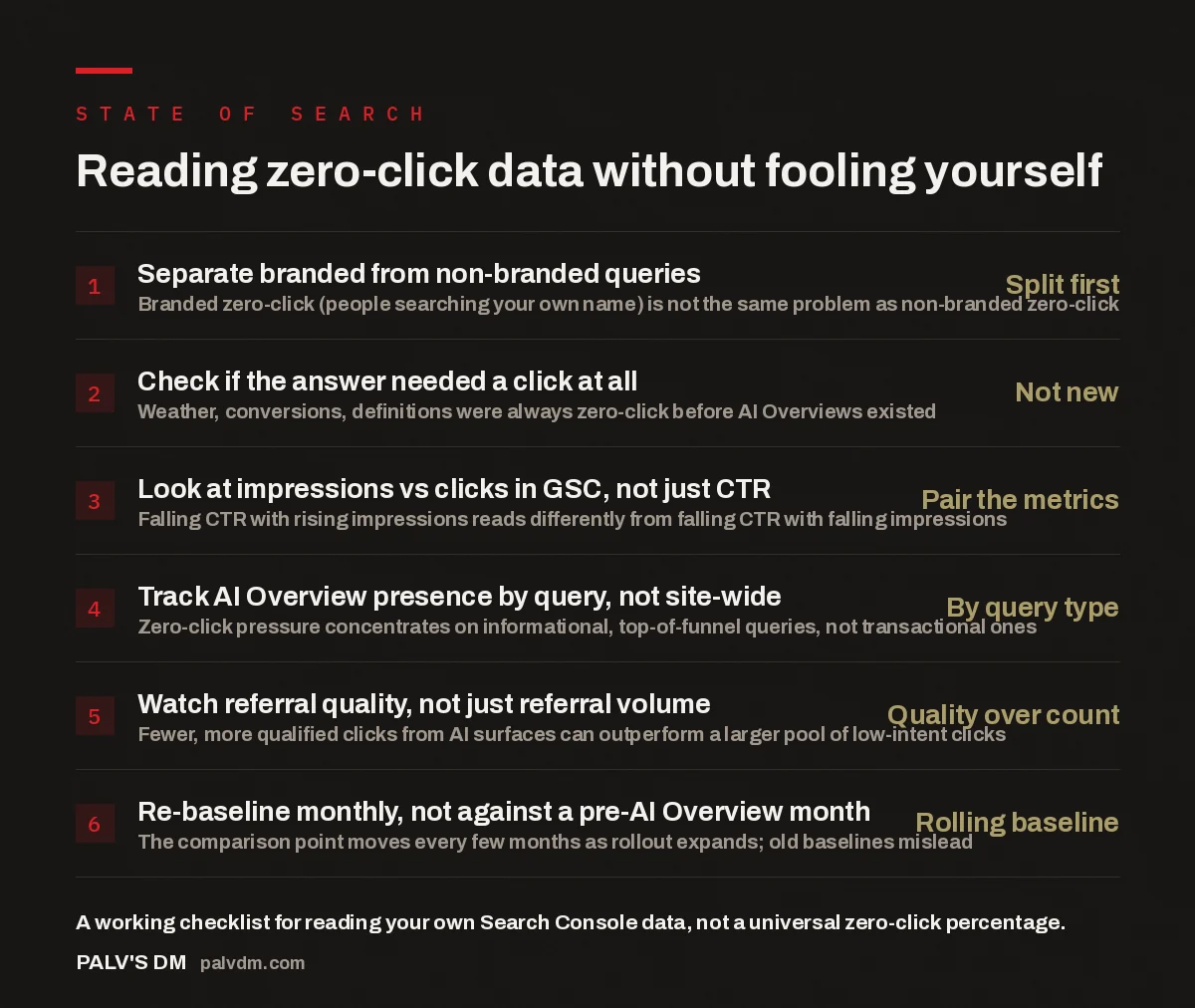
Reading zero-click data without fooling yourself
- Separate branded from non-branded queries — Split first. Branded zero-click (people searching your own name) is not the same problem as non-branded zero-click.
- Check if the answer needed a click at all — Not new. Weather, conversions, definitions were always zero-click before AI Overviews existed.
- Look at impressions vs clicks in GSC, not just CTR — Pair the metrics. Falling CTR with rising impressions reads differently from falling CTR with falling impressions.
- Track AI Overview presence by query, not site-wide — By query type. Zero-click pressure concentrates on informational, top-of-funnel queries, not transactional ones.
- Watch referral quality, not just referral volume — Quality over count. Fewer, more qualified clicks from AI surfaces can outperform a larger pool of low-intent clicks.
- Re-baseline monthly, not against a pre-AI Overview month — Rolling baseline. The comparison point moves every few months as rollout expands; old baselines mislead.
What do zero-click search statistics actually measure?
“Zero-click” describes any search where the user gets what they needed on the results page itself and never clicks through to a website. That covers a wide range of behaviour: someone checking a currency conversion, someone reading a one-line definition in a featured snippet, someone glancing at a knowledge panel for a company’s opening hours, and — now — someone reading a multi-paragraph AI Overview that synthesises several sources into a single answer. The problem with most zero-click search statistics you’ll see quoted is that they collapse all of this into one percentage, as if a currency conversion and an AI-generated buying guide put the same kind of pressure on a publisher’s traffic. They don’t. A conversion query was never going to send a click to your site regardless of what generated the answer. An AI Overview summarising your comparison article for a commercial-intent query is a genuinely different event — that’s a click your content would have earned two years ago and doesn’t earn today.
This distinction matters because it changes what you should actually do about the number. If most of your site’s “zero-click exposure” sits on queries that were never going to convert to traffic anyway, chasing that number is wasted effort. If it sits on queries that used to be reliable traffic sources for your commercial content, that’s a real strategic problem worth solving — and worth solving with AI visibility work, not just more blog posts optimised for a results page that no longer rewards them the same way.
How much of the “zero-click crisis” predates AI Overviews?
A meaningful chunk of it. Featured snippets, knowledge panels, the “People Also Ask” box, direct answer cards for sports scores and unit conversions — all of these existed and suppressed clicks for years before AI Overviews launched. Anyone who has run a Search Console account for an informational site has watched impressions climb while clicks stayed flat, long before generative answers were part of the conversation. What AI Overviews changed isn’t the existence of zero-click behaviour; it’s the scope of query types where a full, synthesised answer can now appear instead of a snippet. A definitional query getting a one-line answer is old news. A “best X for Y” comparison query getting a multi-paragraph AI-generated summary that pulls from five sites, including possibly yours, is the newer shift — and it’s the one worth tracking separately, because it hits exactly the informational content that TOFU strategies are built around.
The practical implication: if you’re benchmarking your own traffic against a headline “X% of searches are zero-click” statistic, you’re benchmarking against a number that mixes decades-old search behaviour with an eighteen-month-old shift. It will always look worse than what’s actually happening to your specific content, because most of that aggregate number was never clickable traffic to begin with.
Every client who comes to us worried about “zero-click search” is really worried about one specific thing: their commercial and comparison content stopped earning clicks it used to earn. That’s a real, narrow, solvable problem. It gets lost the moment you frame it as a single industry-wide percentage.
Palash, Founder, PalV’s DM
Where does the traffic actually go instead?
Not to a single destination — that’s part of what makes zero-click data hard to summarise cleanly. In the accounts we audit, the pattern that shows up repeatedly is a three-way split. Some of the traffic simply disappears: the user got their answer and had no reason to visit any site, which is the same outcome a featured snippet always produced. Some of it moves inside the same search results page to a different kind of visibility — being cited as a source inside the AI Overview itself, which doesn’t generate a click but can still build brand recognition and, anecdotally, influences whether a user searches your brand name directly afterward. And some of it shifts to AI chat interfaces entirely, where the user starts the research phase in a conversational tool instead of a search box, and only lands on a website once they’re closer to a decision.
That third bucket is why AI referral traffic converts differently from classic organic traffic once you do get the click — a visitor arriving from an AI answer has usually already done more of their research than someone arriving from a plain blue link, which is a pattern worth tracking separately if you want to understand what the traffic decline actually costs you in revenue terms rather than just in raw session counts. It’s also worth checking how often AI Overviews actually appear for your query types before assuming every informational page is equally exposed.
Does zero-click pressure hit every query type equally?
No, and this is the part most “traffic disappeared” headlines skip. The pressure is heavily concentrated by query intent. Here’s the pattern that holds up consistently across the informational and commercial content we track:
| Query type | Typical AI Overview presence | Click behaviour |
|---|---|---|
| Pure definitional (“what is X”) | Very common | Was already near-zero-click; little real change |
| Comparison / “best X for Y” | Common, growing | Clicks down noticeably; the newest source of real loss |
| How-to / process queries | Common | Mixed — clicks survive when the answer needs a full walkthrough, not a summary |
| Branded / navigational | Rare | Largely unaffected; user already knows where they’re going |
| Transactional / “buy,” “price,” “near me” | Uncommon | Most resilient; users still click through to act |
The strategic takeaway from this pattern isn’t “abandon informational content.” It’s that informational content now has to do two jobs at once: earn a citation inside AI-generated answers for the queries where a click was never realistic anyway, and hold onto genuine click-through for the comparison and how-to queries where a full page still beats a summary. Treating every informational article as equally at risk wastes effort on content that was never a meaningful traffic driver and under-invests in the comparison content that’s actually losing clicks. This is also where click-through benchmarks are being rewritten — the old CTR curve by ranking position no longer applies evenly across these query types, so comparing your CTR against a pre-AI Overview benchmark will mislead you in exactly the queries that matter most.
How should you actually read your own zero-click numbers?
- Pull impressions and clicks by page from Google Search Console over a rolling 12-month window, not a single before/after comparison — AI Overview rollout has happened in waves, not one cutover date.
- Segment queries into the five types in the table above before you calculate any decline percentage. A blended number across all query types will always overstate the damage to your commercial content.
- Check whether impressions are flat or rising for the pages with falling clicks. Rising impressions with falling CTR usually means you’re showing up for more queries but losing the click within the results page — a citation or visibility problem, not a rankings problem.
- Cross-reference against whether your content is actually being cited inside AI Overviews for those queries. Losing the click while gaining the citation is a different outcome — and a different fix — than losing both.
- Set the expectation with stakeholders that some decline on pure informational queries is permanent and was arguably overdue, so the conversation can focus on the comparison and commercial queries where recovery is actually possible.
Publishers have been the loudest about this shift, and for good reason — see the broader pattern in what happened to publisher traffic since AI Overviews rolled out, which tracks the same query-type split at a larger scale. For a wider view of what’s actually changed across search as a whole this year, our state of search in 2026 overview covers the trends this zero-click shift sits inside.
This is also where the two disciplines split. Classic SEO work — technical health, on-page optimisation, backlinks — still matters for the queries where a click is the goal. But for the queries where an AI-generated summary is now the default outcome, the work shifts to making sure your content is structured, sourced, and specific enough to be the thing that summary cites. That’s a distinct skill set, and it’s the reason AI visibility (GEO/AEO) work has become a separate line item rather than a subset of traditional SEO.
Next step
- Get your own zero-click exposure segmented by query type instead of relying on an industry-wide percentage.
- Find out which of your comparison and how-to pages are losing clicks versus which are earning AI citations.
- Build a plan that covers both surfaces — traditional rankings and AI answer visibility — instead of choosing one.
Frequently asked questions
What’s a reliable zero-click search statistic I can quote?
There isn’t one universal number worth quoting, because the figure depends entirely on which query types, geography, and time window a study used, and those methodologies vary widely between sources. The more reliable move is to pull your own Google Search Console impressions and clicks, segmented by query type, and treat that as your real zero-click statistic instead of an industry average that doesn’t reflect your content mix.
Is zero-click search the same thing as an AI Overview taking my traffic?
No. Zero-click search is the broader, older category that includes featured snippets, knowledge panels, and direct answers that existed long before AI Overviews. AI Overviews are one contributor to zero-click behaviour, and the one that’s expanded the category to cover more comparison and commercial-intent queries than before — but they’re not the sole cause of every zero-click search.
Should I stop writing informational content because of zero-click search data?
No — but you should expect pure definitional content to earn citations more than clicks, and plan for that outcome instead of measuring it against a click-through target it was never going to hit. Comparison and how-to content, where a full page still beats a short summary, remains worth investing in for clicks directly.
How often should I re-check my zero-click numbers?
Monthly, using a rolling comparison rather than a single fixed baseline from before AI Overviews existed. Rollout has happened in waves across query types and markets, so a baseline set even six months ago can already undercount current exposure. A rolling view also makes it easier to spot whether a decline is stabilising or still accelerating.
Does losing the click but gaining an AI citation still have value?
It can, though it’s harder to measure than a click. Being cited by name inside an AI-generated answer builds brand exposure to users who never visit your site directly, and in the pattern we see repeatedly, it correlates with more branded searches afterward. It doesn’t replace lost traffic, but it isn’t worthless either — it’s a different metric that needs its own tracking rather than being folded into a traffic report.
Short version: Zero-click search statistics as usually reported blend decades-old search behaviour with an eighteen-month-old shift, which makes the aggregate number look scarier than what’s actually happening to most sites. The real exposure concentrates on comparison and how-to content in the informational funnel, while transactional and branded queries have held up. Read your own Search Console data segmented by query type before reacting to any industry-wide zero-click percentage, and build a plan that covers both traditional click-through and AI answer visibility — because increasingly, both are needed.