Service Support — AI Visibility
What an AI Visibility Engagement Actually Involves
AI visibility services combine an audit, prompt research, technical crawler access, citation engineering and monthly citation tracking across AI engines.
An AI visibility service — sometimes called GEO or AEO — is the work of getting your business named, described and recommended correctly inside AI answers like ChatGPT, Perplexity, Gemini and Google’s AI Overviews. In practice that means an audit of where you currently show up, research into what buyers are actually asking these engines, rewriting and structuring your content so it can be extracted and cited, technical access work so crawlers can read your site, and monthly tracking of citations across engines. It is not traditional SEO with a new label on it, though the two overlap.
Key takeaway
- AI visibility services combine an audit, prompt research, content re-engineering, technical crawler access and monthly citation tracking — not a single deliverable.
- The unit of success is a citation inside an AI answer, not a keyword rank, so reporting and process both look different from a classic SEO retainer.
- Most of the early work is structural — making your existing pages extractable — before any new content gets written.
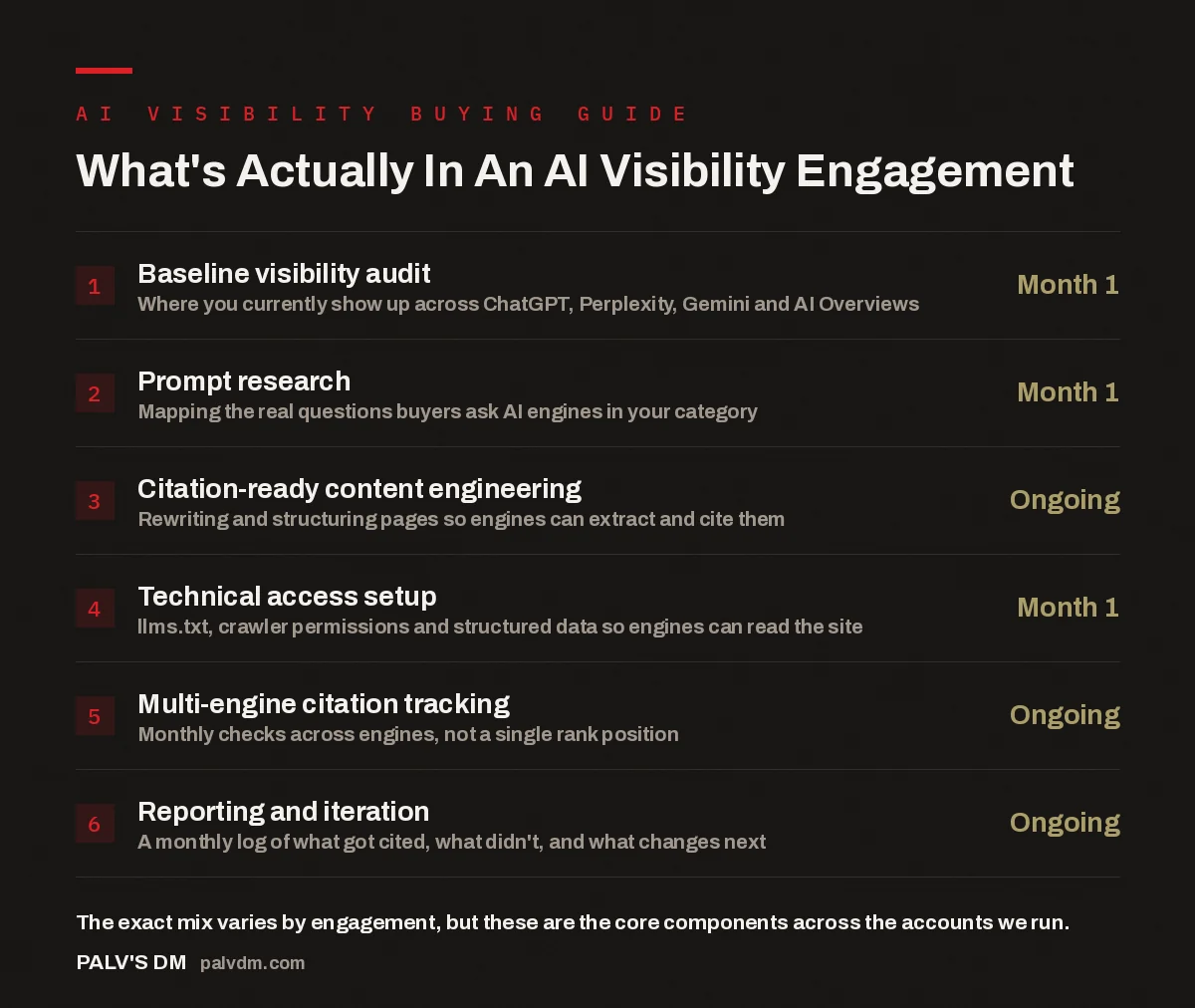
What’s Actually In An AI Visibility Engagement
- Baseline visibility audit — Month 1. Where you currently show up across ChatGPT, Perplexity, Gemini and AI Overviews.
- Prompt research — Month 1. Mapping the real questions buyers ask AI engines in your category.
- Citation-ready content engineering — Ongoing. Rewriting and structuring pages so engines can extract and cite them.
- Technical access setup — Month 1. llms.txt, crawler permissions and structured data so engines can read the site.
- Multi-engine citation tracking — Ongoing. Monthly checks across engines, not a single rank position.
- Reporting and iteration — Ongoing. A monthly log of what got cited, what didn’t, and what changes next.
What happens in the first month of an AI visibility service?
The first month is almost entirely diagnostic, and it should be — you cannot fix visibility you haven’t measured. We start by running a structured set of prompts through the major AI engines: the questions a real buyer in your category would type or speak, not generic head-term keywords. We log whether your brand appears, whether it’s cited with a link, whether it’s named without a link, or whether it’s absent entirely and a competitor fills the answer instead. This baseline becomes the reference point every later report gets measured against.
Alongside the audit, we check the technical layer: whether AI crawlers (GPTBot, PerplexityBot, Google-Extended, and others) can actually reach your pages, whether there’s an llms.txt file pointing engines to your most authoritative content, and whether your structured data (schema markup) is giving engines clean, parseable facts about who you are and what you offer. It’s common to find a site ranks fine in classic Google search but is functionally invisible to AI crawlers because of a robots.txt block, JavaScript rendering issue, or missing schema — that gets flagged and fixed in month one, before any content strategy work starts.
How does content get rewritten for AI citation?
AI engines don’t reward the same writing patterns that used to win rankings. They favour content structured for extraction: a direct answer near the top of the page, clearly labelled sections, definitions stated plainly rather than implied, and claims that are specific enough to quote in isolation. A paragraph that only makes sense in the context of three paragraphs before it is a paragraph an engine is unlikely to lift and cite.
Practically, this means an engagement spends real time on existing pages before writing anything new. A page that ranks well but buries its actual answer under three paragraphs of preamble gets restructured — the direct answer moves up, supporting detail moves down, and the page keeps working for human readers while becoming far more citable to a machine parsing it for facts. Only after the highest-opportunity existing pages are fixed does new content production usually start, targeted at prompt gaps the audit identified.
Most businesses that think they need a pile of new AI-optimised content actually need their existing twenty best pages rewritten so an engine can quote them. New content is usually the third step, not the first.
Palash, Founder, PalV’s DM
What does ongoing monthly work look like?
Once the baseline is fixed, an AI visibility retainer settles into a monthly cycle rather than a set of one-off projects. Each month typically includes: re-running the prompt set across engines to see what changed, publishing or revising a small number of pages targeted at prompts where you’re still absent or losing to a competitor, checking that technical access hasn’t regressed (site migrations and CMS updates break llms.txt and crawler permissions more often than people expect), and compiling a citation log that shows movement over time.
The pace of visible change is slower and noisier than classic rank tracking, because AI answers aren’t static — the same prompt can return a different answer from the same engine on different days, and engines update their underlying models and retrieval methods without warning. That’s a reason to track patterns across a rolling window rather than react to any single day’s result, and it’s also why a monthly citation log matters more here than a weekly rank check ever did in traditional SEO.
Is AI visibility a standalone service or part of SEO?
It can run either way, and which one makes sense depends mostly on how much foundational SEO work already exists. If your technical SEO is solid, your site has decent existing content, and search rankings are already reasonable, AI visibility work can run as a focused standalone engagement layered on top. If the underlying site has technical debt, thin content, or no real topical authority yet, AI visibility work bundled with core SEO tends to produce faster, more durable results — because a lot of what makes a page citable (clear structure, genuine expertise, clean technical access) is also what makes it rankable.
Where a service provider draws that line is worth asking about directly before signing anything, since “AI visibility service” gets used loosely across the industry to describe everything from a single technical audit to a full content and tracking retainer.
Ready to see where you stand
If you want a concrete picture of what an engagement would involve for your specific site before committing to anything, start with an audit rather than a proposal.
FAQ
What’s the difference between AI visibility services and traditional SEO?
Traditional SEO optimises for ranking positions in a search results list. AI visibility work optimises for being named, cited, or recommended inside a generated answer from engines like ChatGPT or Perplexity. The two share a technical and content foundation, but the unit of success, the tracking method, and often the writing structure differ.
Do I need new content, or can existing pages be reused?
Most engagements start by restructuring existing pages rather than writing from scratch. If a page already covers the right topic but buries the actual answer in dense paragraphs, restructuring it for a direct, extractable answer is usually faster and more effective than producing new content, and it’s typically where the first month of work concentrates.
How is progress measured in an AI visibility engagement?
Progress is measured through a recurring citation log: the same set of prompts run against multiple AI engines on a fixed schedule, logging whether your brand appears, whether it’s linked, and how that compares to the previous check. Because AI answers vary from day to day, the log tracks patterns over weeks rather than single snapshots.
Does technical setup like llms.txt actually matter?
Yes — it’s a prerequisite, not an optional extra. If AI crawlers can’t reach your pages because of a robots.txt block, aggressive JavaScript rendering, or missing crawler permissions, no amount of content rewriting will help, because the engine never retrieves the page in the first place. This is usually checked and fixed in the first month.
Should AI visibility be bought as its own service or bundled with SEO?
It depends on your starting point. Sites with solid existing SEO and content can often run AI visibility as a focused standalone add-on. Sites with technical debt or thin content generally see faster, more durable results when the two are bundled, since the underlying fixes largely overlap.
The short version
An AI visibility service is an audit of where you currently stand across AI engines, research into the prompts your buyers actually use, technical work to make sure crawlers can reach your site, restructuring of existing content so it can be extracted and cited, and a monthly cycle of tracking and iteration. It isn’t a single deliverable you buy once — it’s an ongoing process, closer in shape to an SEO retainer than to a one-time audit. If you’re evaluating providers, ask specifically which of these components are included and which are extra, because the label “AI visibility services” covers a wide range of actual scope. For a deeper look at whether you need this work at all right now, see Do You Need GEO Yet? A Straight Answer by Business Type, and if you’re weighing how it should be structured against your existing SEO, Standalone AI Visibility vs Bundled With SEO walks through that decision in more detail. If you want to see what the monthly tracking output actually looks like once an engagement is running, What a Monthly AI Citation Log Looks Like shows a real example, and The AI Visibility Audit We Run Before Anything Else covers the month-one audit in more depth than this article does.