Service Support — Consulting & Audit
Consulting for a Founder Doing SEO Themselves
SEO help for founders doing their own SEO: what a good consulting session covers, when it's worth booking, and what to bring to make it worth the price.

SEO help for founders who are already doing the work themselves usually means one thing: a single consulting session where an outside expert audits what you’ve built, tells you what’s actually wrong (versus what a tool flagged), and gives you a prioritised list you can execute yourself. It’s not a takeover of your SEO — it’s a second, more experienced set of eyes on it, and it works best when you bring a specific stall or a specific decision to it rather than a vague “how am I doing?”
Key takeaway
- A DIY founder gets the most out of consulting when they bring evidence of a specific stall — flat traffic, an unclear technical warning, a strategic fork in the road — not a request for a general grade.
- The session should end in a written, prioritised list of what to fix and in what order, not a verbal opinion you have to reconstruct from memory afterwards.
- Consulting for a solo founder is different from consulting for a team with an SEO hire — the advice has to account for the fact that you’re the one implementing it, on top of everything else you run.
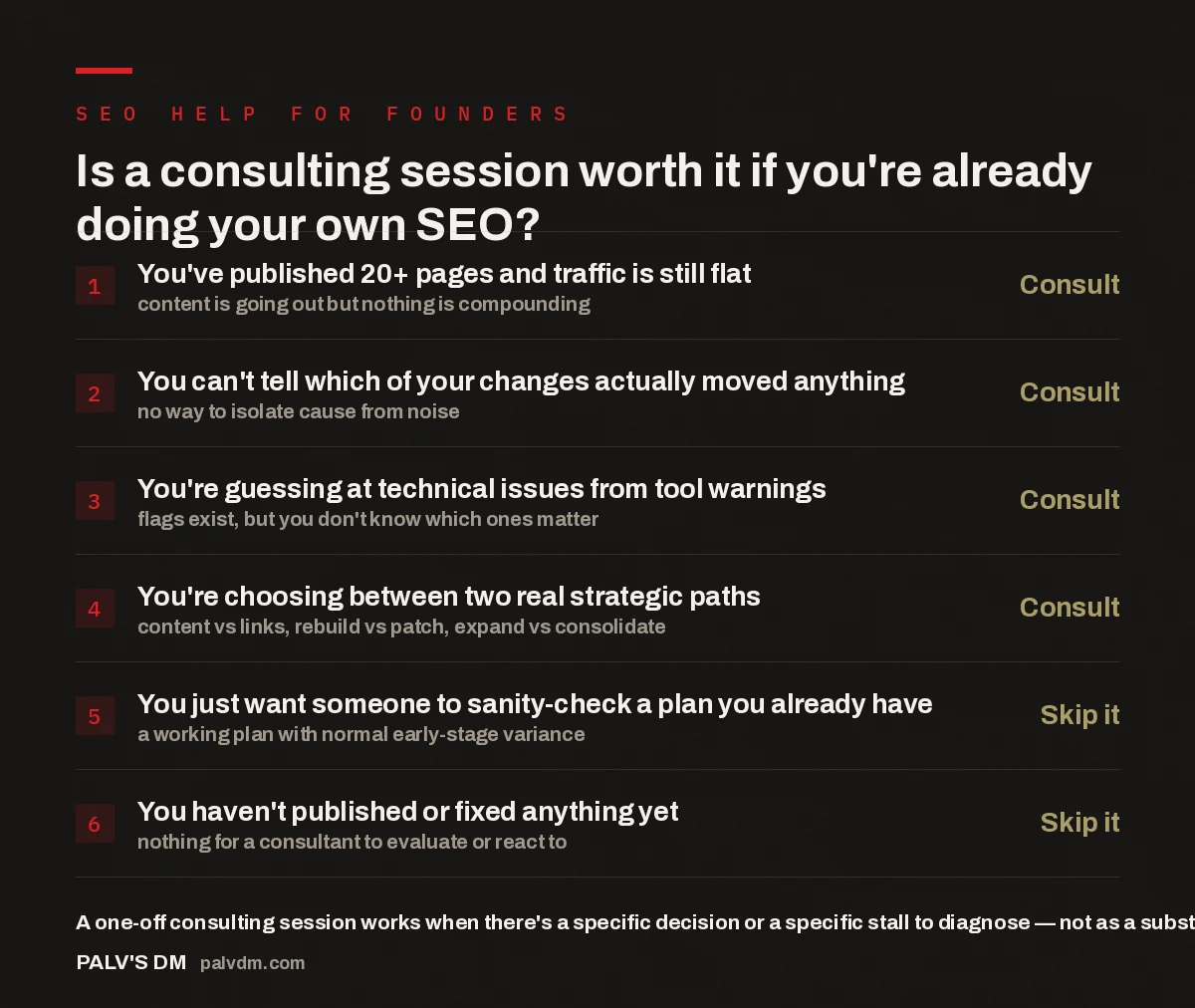
Is a consulting session worth it if you’re already doing your own SEO?
- You’ve published 20+ pages and traffic is still flat — Consult. content is going out but nothing is compounding.
- You can’t tell which of your changes actually moved anything — Consult. no way to isolate cause from noise.
- You’re guessing at technical issues from tool warnings — Consult. flags exist, but you don’t know which ones matter.
- You’re choosing between two real strategic paths — Consult. content vs links, rebuild vs patch, expand vs consolidate.
- You just want someone to sanity-check a plan you already have — Skip it. a working plan with normal early-stage variance.
- You haven’t published or fixed anything yet — Skip it. nothing for a consultant to evaluate or react to.
What does SEO consulting look like for a founder doing it yourself?
It looks like a working session, not a pitch. You send over site access, analytics access, and whatever you’ve already tried; the consultant spends time in the account before the call, not during it; and the call itself is spent walking through findings and arguing about priorities, not being sold a retainer. For a founder who already writes the content, fixes the technical issues, and makes the calls, the value isn’t in someone else doing SEO for you — it’s in someone who has seen this exact stall pattern across many accounts telling you which of your five open questions actually matters and which three don’t.
The format that works best for this situation is usually a single paid strategy session plus a written summary, not an ongoing retainer. A retainer implies someone else is doing the execution. If you’re doing your own SEO by choice — because you’re early-stage, because you enjoy it, because the budget isn’t there yet — what you actually need is periodic outside judgment, not a monthly bill for work you were already going to do yourself.
When does a DIY founder actually need outside help?
The pattern that shows up repeatedly in accounts we look at is this: founders who are technically capable and genuinely putting in the hours still get stuck at the same handful of points. Traffic plateaus around the same time content output does — you’ve published a reasonable volume, but nothing new is ranking and nothing old is climbing. A tool starts throwing warnings you don’t have the background to triage, so you either ignore all of them or spend a weekend chasing the wrong one. Or you’re facing a decision with real trade-offs — rebuild the site or patch it, keep writing content or start building links, consolidate ten thin pages into one or leave them — and you don’t have anyone to argue the other side of the decision with you.
None of these situations mean you’ve been doing SEO wrong. They mean you’ve hit the point where the next improvement requires judgment that comes from having watched this specific pattern play out many times before. That’s the actual gap a consulting session fills — not effort, judgment.
How is this different from hiring an agency?
An agency engagement assumes someone other than you is going to do the ongoing work — write the content, build the links, monitor the technical health, report on progress. Consulting assumes the opposite: you’re still the one implementing everything, and what you’re buying is direction, not labour. If you hand a DIY founder an agency-style retainer proposal, you’re paying for capacity you don’t need and won’t use, because you were never going to stop doing the work yourself.
The practical difference shows up in what gets delivered. An agency sends you monthly reports on work it did. A consultant sends you a prioritised list of work for you to do, ranked by what will actually move the needle versus what’s merely correct-but-low-impact. If you’re evaluating whether to bring in a consultant instead of an agency more broadly, the same logic applies: the right choice depends on whether you want someone doing the work or someone telling you which work to do.
What should you bring to the session to make it worth the price?
The single biggest driver of whether a consulting session is worth the money is how much homework you’ve done before it starts. A founder who shows up with analytics access, a list of what’s already been tried, and a specific question (“why did traffic flatten after the redesign in March?”) gets a session focused entirely on diagnosis and next steps. A founder who shows up asking for a general audit gets a session that spends half its time gathering context that could have been sent over in advance.
- Grant read access to Search Console, analytics, and the site itself before the call, not during it.
- Write down what you’ve changed in the last six to twelve months and roughly when, even if you’re not sure it mattered.
- Name the one or two decisions you actually need help making — not “review everything.”
- Bring your current traffic and ranking trend, even a rough screenshot, so the conversation starts from evidence instead of memory.
This preparation step is worth treating seriously enough that it deserves its own answer — what to bring to a consulting call to make it worth it goes into more detail on exactly how to package this before you book anything.
The founders who get the most out of a single consulting session aren’t the ones with the biggest sites — they’re the ones who show up with one clear question instead of ten vague ones.
Palash, Founder, PalV’s DM
What should you actually walk away with?
A useful session ends in something you can read again in three weeks, not just something you remember from the call. That means a written summary: what’s working, what’s actively holding you back, and a ranked list of fixes — not a flat list of forty things, but an order to attack them in and a rough sense of why that order. If the consultant found a technical issue that’s actively suppressing pages from being indexed, that should be flagged as urgent and separated from the “nice to have eventually” items, because founders doing their own SEO have limited hours and need to know where those hours matter most.
What you walk away with in writing matters more here than in an agency relationship, because there’s no one else holding the plan for you afterward. If the deliverable is vague, or lives only in your notes from the call, it tends to get deprioritised the moment something else in the business demands attention — which, for most founders, is every week.
Where do most DIY-SEO founders get stuck after the session?
The most common failure mode isn’t bad advice — it’s advice that never gets fully implemented because there’s no one holding the founder accountable to the plan after the call ends. The list gets three items checked off in the first week, then life happens, and the list sits untouched until the next stall shows up six months later. A consultant can flag this risk during the session by making the plan realistic for someone who is also running the rest of the business — fewer items, clearer sequencing, and a note on which single item to do first if nothing else gets done that month.
The second common stuck point is treating the consultant’s list as a permanent audit rather than a snapshot. A plan built for where your site stood in a given month starts to go stale after a quarter or two of active work. Founders who get durable value from consulting tend to treat it as a periodic check-in — once when something feels off, again after they’ve worked through the first list — rather than a one-time verdict that’s supposed to hold forever.
Key takeaway
- Come with a specific stall or decision, not a request for a general grade.
- Expect a written, prioritised list — not a verbal opinion you have to reconstruct later.
- Treat it as a periodic check-in for a solo operator, not a one-off verdict or a substitute for a team.
Frequently asked questions
Is a one-off SEO consulting session actually enough, or do I need a retainer?
If you’re going to keep doing the implementation yourself, a one-off session is usually enough — you need direction, not extra hands. A retainer only makes sense once you want someone else executing the work, which is a different problem than the one most DIY founders are trying to solve.
How long should an SEO consulting session take for a founder?
Most useful sessions run 60 to 90 minutes once the consultant has already reviewed your site and data beforehand. Shorter sessions tend to only cover surface-level observations; the value is in having enough time to actually argue through the two or three decisions you brought in.
What if I can’t afford ongoing SEO help but still want expert input?
This is exactly the situation a single paid consulting session is built for — you pay once for judgment, then implement it yourself over the following weeks or months. It’s a fraction of the cost of a retainer and doesn’t lock you into anything ongoing.
Will a consultant judge me for doing SEO myself instead of hiring it out?
A consultant worth booking won’t — plenty of founders do their own SEO well, and the session should be built around helping you do it better, not around convincing you to stop. If a session feels like a sales pitch to hand everything over, that’s a sign to look elsewhere.
How often should a DIY founder book a consulting session?
There’s no fixed schedule — book one when you hit a genuine stall or a real decision, not on a calendar cadence. In practice that tends to work out to somewhere between once and twice a year for a founder actively working on their own site.
The short version
SEO help for founders doing the work themselves works best as a single, well-prepared consulting session rather than an ongoing retainer — you’re buying judgment on a specific stall or decision, not extra hands. Show up with access, a record of what you’ve already tried, and one or two real questions, and insist on a written, prioritised deliverable you can still act on weeks later. Related reading on this: what to bring to a consulting call to make it worth it, when you need a consultant instead of an agency, what you walk away with in writing, and training your team versus outsourcing forever if you’re weighing what comes after this stage.