Service Support — Consulting & Audit
When You Need a Consultant Instead of an Agency
Wondering when to hire an SEO consultant instead of an agency? Here is how to tell if you need one decision made or ongoing monthly execution delivered.

You need an SEO consultant instead of an agency when the work in front of you is a decision, not a production line — a stalled strategy, an agency proposal you can’t evaluate, a migration you don’t want to get wrong, or a team that already has hands to execute but no one senior enough to point them in the right direction. If what you actually need is content written, links built, and pages shipped every month, that’s an agency’s job. If what you need is judgment applied to a specific problem, that’s a consultant’s.
Key takeaway
- Hire a consultant for a decision (migration, strategy, second opinion, proposal review) — hire an agency when you need sustained monthly execution.
- Consultants are the right call when you already have execution capacity in-house or through vendors and just need direction applied to it.
- The two aren’t mutually exclusive — a lot of the sites we consult on later become agency clients, and the reverse happens too.
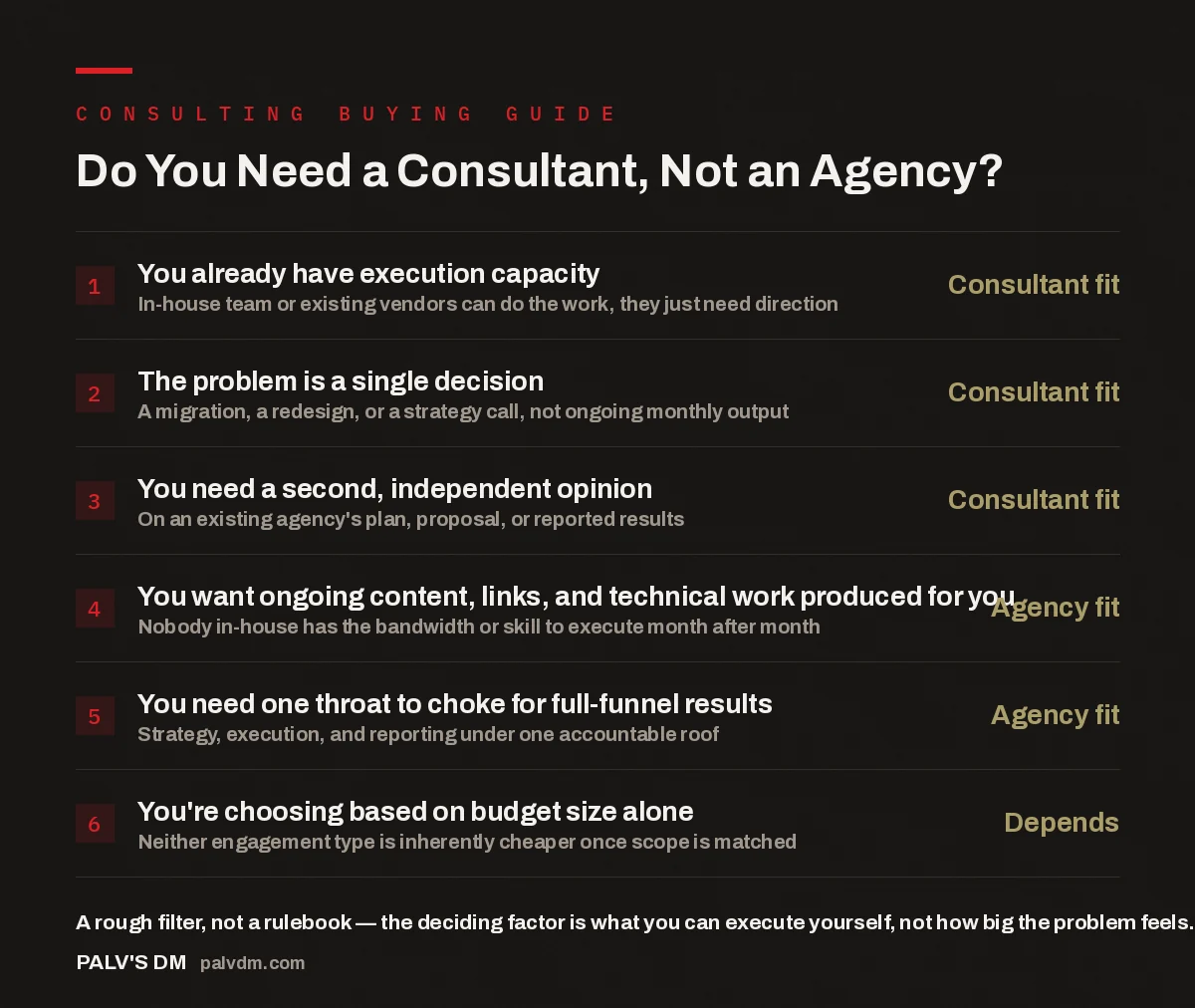
Do You Need a Consultant, Not an Agency?
- You already have execution capacity — Consultant fit. In-house team or existing vendors can do the work, they just need direction.
- The problem is a single decision — Consultant fit. A migration, a redesign, or a strategy call, not ongoing monthly output.
- You need a second, independent opinion — Consultant fit. On an existing agency’s plan, proposal, or reported results.
- You want ongoing content, links, and technical work produced for you — Agency fit. Nobody in-house has the bandwidth or skill to execute month after month.
- You need one throat to choke for full-funnel results — Agency fit. Strategy, execution, and reporting under one accountable roof.
- You’re choosing based on budget size alone — Depends. Neither engagement type is inherently cheaper once scope is matched.
What’s the actual difference between a consultant and an agency?
An agency sells ongoing execution: content production, link building, technical fixes, reporting, and a team of people whose job is to keep that work moving every week. A consultant sells judgment, usually against a fixed scope and a fixed timeline — an audit, a strategy session, a migration review, a second opinion on someone else’s plan. The consultant hands you a decision and, in most cases, a written plan for acting on it. What happens after that is on you or on whoever you hire to execute it.
The confusion usually starts because both roles can be filled by the same person or the same firm at different times. We’ve run strategy sessions for founders who later signed on for full execution, and we’ve done full-scope work for clients who later just needed a consultant to sanity-check a decision without engaging us for a retainer again. The engagement type follows the problem, not the vendor’s preference for one over the other.
When should you hire an SEO consultant instead of an agency?
The pattern that shows up repeatedly across the accounts we’ve consulted on is that consultant engagements make sense when the constraint is direction, not labour. Here are the situations where that’s usually true.
- You have an in-house team but no senior SEO strategist. A marketing manager or content team that can write, publish, and manage a CMS doesn’t necessarily know how to prioritise keywords, diagnose a ranking drop, or plan a site architecture. A consultant fills that gap without adding headcount or handing execution to an outside team.
- You’re about to make a decision you can’t undo cheaply. A domain migration, a platform change, or a full redesign are the classic cases — get the SEO plan wrong and you’re recovering lost rankings for months. A consultant reviewing the plan before it ships is far cheaper than an agency fixing the fallout after.
- You already have an agency and want an independent check. Whether that’s evaluating a proposal before you sign, or reviewing the results an existing agency is reporting, this needs someone with no financial stake in the answer.
- You’re a founder doing your own SEO and you’re stuck. You don’t want to hand the whole thing off, you want someone to look at what you’ve built, tell you what’s working, and point out the two or three things that are quietly costing you traffic.
- You need to train a team, not outsource a function. If the goal is for your own people to own SEO going forward, a consultant who teaches the reasoning behind decisions is a better investment than an agency that makes those decisions for you indefinitely.
Notice what these all have in common: execution capacity already exists somewhere, or execution isn’t actually the bottleneck yet. That’s the tell. If you’re asking “who’s going to do the work,” you probably need an agency. If you’re asking “is this the right work,” you probably need a consultant.
The question we get wrong most often isn’t “consultant or agency” — it’s “do I actually have someone to execute this, or am I about to hire a strategist and then discover nobody’s free to act on the strategy.”
Palash, Founder, PalV’s DM
When is an agency still the better call?
An agency earns its retainer when the honest answer to “who executes this” is nobody currently on your team, or nobody with the bandwidth to do it consistently. Content that needs to publish every week, technical fixes that need a developer’s time reserved, link outreach that takes months of grinding — these are labour-intensive and ongoing, and a consultant engagement isn’t built to cover that. You’d be paying consulting rates for what is effectively execution work, and you’d still be short a team to actually ship it.
An agency also makes more sense when you want accountability for the outcome, not just the plan. A consultant can tell you what to do and why; an agency, structured well, owns doing it and reporting on whether it worked. If you want one point of contact responsible for both the strategy and the results, that’s the agency model, not the consulting one.
| Situation | Consultant | Agency |
|---|---|---|
| You need a plan reviewed before acting on it | Right fit | Overkill |
| You need monthly content, links, or technical fixes produced | Not built for this | Right fit |
| You have an in-house team needing direction | Right fit | Redundant unless team is stretched thin |
| You want someone accountable for the ranking outcome | Advises, doesn’t own outcome | Right fit |
| You’re weighing an existing agency’s proposal | Right fit (independent view) | Conflict of interest if it’s the same agency |
What does a consultant engagement actually look like?
A well-run consulting engagement is scoped and time-bound, not open-ended. It typically starts with a diagnostic pass over the site and its data — analytics, Search Console, crawl behaviour, current content — followed by a working session where the findings get discussed against your actual constraints (budget, team size, timeline, platform). It ends with something in writing: a prioritised list of what to fix, in what order, and why, specific enough that someone on your team or a vendor you hire separately can pick it up and execute without needing to ask what was meant.
What it shouldn’t look like is a vague strategy deck with no execution detail, or an engagement that quietly turns into a retainer without you deciding that’s what you wanted. If a “consultant” is billing you every month indefinitely with no defined end point or deliverable, check whether you’re actually paying for consulting or for execution dressed up as advice.
If your team can execute but needs the direction, our advisory model for in-house teams is built exactly for that gap. And if you’re weighing training your people up against outsourcing the function permanently, it’s worth reading how that trade-off plays out in training your team vs outsourcing forever before you commit either way.
How do you know the consulting engagement was worth it?
Judge a consulting engagement by what you can do with it afterward, not by how it felt in the room. A good one leaves you with a document you could hand to a new hire or a different vendor and have them pick up the work without a re-briefing call. We’ve written specifically about what you should walk away with in writing from any consulting engagement, because the deliverable is the part that gets skipped most often when engagements are rushed.
If you’re currently comparing agency proposals and want an outside read before signing, that’s also squarely consultant territory — an independent consultant has no stake in which agency you pick, which is the whole point. We’ve covered how that review process works in vetting an agency proposal with an independent consultant.
Not sure which one fits your situation?
Tell us what you’re deciding — a migration, a stalled strategy, or a proposal you’re not sure about — and we’ll tell you honestly whether that’s a consulting problem or an execution problem before you commit to either.
FAQ: hiring a consultant vs an agency
When should I hire an SEO consultant instead of an agency?
Hire a consultant when the problem is a decision rather than ongoing production — reviewing a migration plan, getting a second opinion on an agency’s work, or directing an in-house team that already has the hands to execute but not the strategic experience to prioritise correctly.
Can a consultant do everything an agency does?
No, and a good consultant will tell you that upfront. A consultant advises and hands you a plan; an agency executes that plan on an ongoing basis with dedicated people and reports on the results. If you need monthly content, technical work, or link building actually produced, that’s an agency’s job, not a consultant’s.
Is hiring a consultant cheaper than hiring an agency?
Not inherently — it depends on scope. A consultant engagement is usually a smaller, fixed cost because it’s bounded in time and deliverables, while an agency retainer covers ongoing execution. Comparing the two on price alone misses the point; compare them on whether you need a decision made or work produced.
Can I hire a consultant to review my current agency’s proposal?
Yes, and it’s one of the more common reasons businesses bring in an independent consultant. Since the consultant has no financial interest in which agency you choose or whether you sign at all, the review tends to be more candid than feedback from a competing agency pitching for the same work.
What happens after a consulting engagement ends?
You should walk away with a written plan specific enough for your team or another vendor to execute without further clarification. What happens next is your call — implement it in-house, hire an agency for execution, or come back for a follow-up review once the work is underway.
Short version: pick a consultant when you need a decision made — a migration reviewed, a proposal checked, a strategy set for a team that can already execute. Pick an agency when the actual gap is labour — nobody to write the content, fix the technical debt, or build the links month after month. Most businesses need one or the other at any given time, rarely both at once, and matching the engagement to the actual constraint is what makes the money spent on either one worth it.