Service Support — Consulting & Audit
What Happens in a Strategy Session
What actually happens in an SEO strategy session: data review, honest walkthrough, constraint mapping, priority sequencing, and a written plan you keep.
An SEO strategy session is a structured, one-to-two-hour working call where a consultant reviews your actual site data — Search Console, analytics, current rankings — before you ever speak, walks you through what’s actually holding your rankings back, maps that against your real budget and team capacity, and ends with a written, prioritised plan you can act on with or without hiring the person on the call. It is not a sales pitch dressed up as advice, and it is not a generic audit read aloud from a template. The data review happens beforehand specifically so the session itself gets spent on judgment calls — what to fix first, what to ignore, what’s actually worth engineering time — instead of someone discovering your traffic graph live on screen.
Key takeaway
- A good SEO strategy session works because the data review happens before the call, not during it — the hour gets spent on decisions, not on someone discovering your numbers live.
- The useful sessions map problems against your actual constraints — budget, team size, CMS limitations — rather than reciting a generic best-practices checklist that ignores what you can realistically do.
- If nothing arrives in writing within a couple of days of the call, it was a conversation, not a strategy session — the document is the deliverable, not the talk.
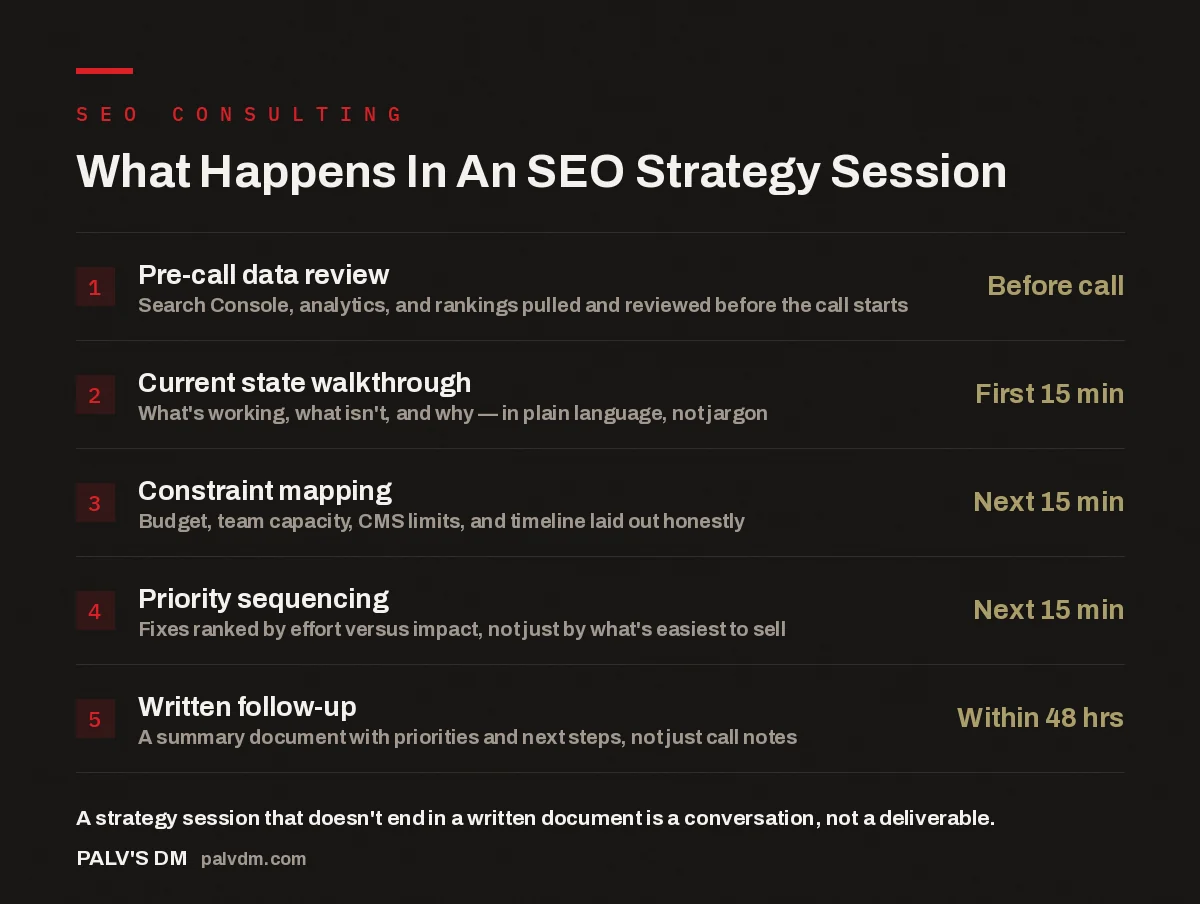
What Happens In An SEO Strategy Session
- Pre-call data review — Before call. Search Console, analytics, and rankings pulled and reviewed before the call starts.
- Current state walkthrough — First 15 min. What’s working, what isn’t, and why — in plain language, not jargon.
- Constraint mapping — Next 15 min. Budget, team capacity, CMS limits, and timeline laid out honestly.
- Priority sequencing — Next 15 min. Fixes ranked by effort versus impact, not just by what’s easiest to sell.
- Written follow-up — Within 48 hrs. A summary document with priorities and next steps, not just call notes.
What actually happens before the call starts?
The useful part of the work happens before anyone opens a calendar invite. A consultant worth paying for pulls Search Console, analytics, and current rankings ahead of time, crawls the site, and forms an actual point of view on what’s likely wrong — not a full audit, but enough of a pass to walk in with informed questions instead of open-ended ones. This is the same discipline behind what we look at in the first 30 minutes of any audit: the fastest way to waste an hour with a client is to spend it reading their own dashboard back to them.
Skipping this step is the single biggest difference between a strategy session that produces a plan and one that produces a vague, pleasant conversation. If the person on the call hasn’t looked at your data before you join, the first thirty minutes get burned on discovery questions you could have answered in an intake form. That’s not a strategy session — it’s an unpaid discovery call wearing a strategy session’s name.
What gets covered in the first 15 minutes?
The opening block is a walkthrough of where things actually stand — what’s working, what isn’t, and why — delivered in plain language rather than SEO shorthand. Not every founder or marketing manager on the call knows what “crawl budget” or “index bloat” means, and a session that assumes they do is optimising for sounding smart, not for being useful. The walkthrough usually covers three things: which pages or query groups are actually earning traffic today, where the site is technically leaking value (slow templates, thin category pages, orphaned content), and how the current trajectory compares with where the business needs to be.
This is also where an honest session diverges from a sales-y one. A session built to close a retainer tends to overstate the problem and understate the effort. A session built to actually help you tends to say things like “this part is fine, leave it” as often as it flags a problem — because half the value of an outside opinion is telling you what doesn’t need touching.
How do real constraints shape the plan?
A recommendation that ignores your budget, your team’s bandwidth, or your CMS’s limitations isn’t a strategy — it’s a wish list. The middle stretch of a strategy session is where those constraints get laid out plainly: how much internal development time is actually available this quarter, whether content gets written in-house or needs to be outsourced, whether the CMS can even support the technical changes being proposed without a developer’s help. Some of the sharpest, most useful moments in these calls come from a consultant saying “that fix is correct in theory, but with your team’s current capacity it’s an 8-month project, not a 2-week one” — and adjusting the plan accordingly rather than pretending the constraint doesn’t exist.
This is also where the conversation naturally surfaces whether you need an ongoing relationship or a one-off push. Some businesses genuinely need an independent consultant rather than a full agency retainer — a smaller site, a capable in-house team that just needs direction, a business that wants outside judgment without outsourcing execution. A constraint-aware strategy session surfaces that distinction honestly instead of steering every conversation toward the same package.
How do you decide what to fix first?
Priority sequencing is where most of the actual strategic thinking lives, and it’s the part that separates a strategy session from a punch list. The question isn’t “what’s broken” — a crawl and a few hours in Search Console will surface plenty of things that are broken. The question is what to fix first given limited time and money, which means weighing effort against likely impact rather than working down a severity-sorted list. A technically minor fix that unblocks indexation on your highest-intent pages usually outranks a bigger, more visible project that mostly affects pages nobody was going to rank for anyway.
The pattern that shows up repeatedly across these sessions: businesses walk in expecting a list of ten problems and walk out with three, sequenced, with a rough sense of what each one is worth doing before the others. That narrowing is the actual work. Anyone can generate a long list of issues; deciding which three matter most this quarter, for this specific business, is the part that requires judgment rather than a checklist.
A strategy session that hands you ten priorities didn’t do the hard part. The hard part is telling you which three actually matter this quarter — and why the other seven can wait.
Palash, Founder, PalV’s DM
What should you actually walk away with?
A written document, not just call notes. The follow-up should land within a couple of days and cover the priorities discussed, the reasoning behind the sequencing, and next steps clear enough that someone other than the person who was on the call could pick them up and act on them. This is worth being specific about because it’s the point where a lot of sessions quietly fall short — the call feels valuable in the moment, and then nothing concrete shows up afterward, so the insight evaporates within a week. What you’re entitled to expect matches what’s covered in more depth in what you walk away with in writing after any consulting engagement, not just a first session.
A useful test: would the document still be usable if you decided not to hire the consultant who wrote it? If the answer is no — if the “plan” is really just a teaser withholding the actual specifics until you sign a retainer — that’s a sales document wearing a strategy document’s clothes. A genuine strategy session gives you something you could hand to an in-house team or a different agency and have it make sense.
What should you bring to make the call worth your time?
Access matters more than preparation. Giving the consultant Search Console and analytics access ahead of time, along with a straight answer about your actual budget range and team capacity, does more for the quality of the session than any amount of pre-reading on your end. Vague answers to direct questions — “we have some budget” or “our team is pretty capable” — force the consultant to plan around assumptions instead of facts, and the plan that comes out the other end is only as good as the constraints it was built against. The specifics of what to have ready are covered in what to bring to a consulting call to make it worth it, but the short version is: access, honesty about constraints, and whoever actually makes the final call on the business side should be in the room.
Key takeaway
- The value of an SEO strategy session sits in what happens before and after the call — the data review beforehand, and the written plan afterward — not just in the hour itself.
- A session worth having narrows a long list of possible issues down to the two or three that actually matter for your specific budget, team, and timeline.
FAQ: SEO strategy sessions
How long does an SEO strategy session usually take?
Most run between one and two hours. Shorter than that rarely leaves room for the walkthrough, constraint mapping, and prioritisation to happen properly; longer than that usually means the pre-call data review didn’t happen and the time is being spent on discovery instead of decisions.
Is an SEO strategy session the same thing as an audit?
No. An audit is typically a broader, more exhaustive document covering everything found across the site. A strategy session is narrower and more decision-focused — it takes a smaller set of known issues and works through what to actually do about them given your specific budget, team, and timeline.
Do I need to already have Search Console and analytics access set up?
Ideally yes, and set up before the call rather than during it. Without that access, the session either gets delayed or ends up run on assumptions instead of your actual data, which weakens every recommendation that follows.
Will I get a written plan even if I don’t hire the consultant afterward?
In a genuine strategy session, yes — the written follow-up is the deliverable, not a preview locked behind a signed contract. If the summary only becomes useful once you commit to a retainer, that’s a sign the session was structured as a sales call rather than an independent one.
Who from my team should actually join the call?
Whoever can speak honestly about budget and team capacity, and ideally whoever makes the final call on priorities. A session with someone who has to check back with a decision-maker afterward tends to produce a plan that gets diluted in translation rather than acted on directly.
Short version: an SEO strategy session is a working call, not a pitch — the data gets reviewed before you join, the current state gets walked through in plain language, your real constraints get mapped honestly, the issues get sequenced by effort versus impact, and a written plan lands within a couple of days. If any of those five pieces is missing, particularly the written follow-up, it wasn’t a strategy session — it was a conversation with good intentions.