Service Support — Consulting & Audit
Getting a Second Opinion on Agency Work
What an independent SEO second opinion service actually checks on your agency's work, when to get one, and what to do with the findings before deciding.
A second opinion on agency work is an independent SEO review — usually run by a consultant with no stake in your current contract — that checks whether the SEO work you’re paying for is actually producing results, and explains plainly what’s working, what isn’t, and what to do next. Most businesses that look for an seo second opinion service aren’t shopping for a new agency. Something already feels off: rankings have flattened, the monthly report reads the same as last month’s, and the answer to “why isn’t this working” doesn’t hold up when you ask it a second time. A proper second opinion doesn’t start from scratch. It checks the existing strategy against what’s actually happening in Search Console, on the site itself, and in the search results, and gives you an honest, independent read before you decide anything.
Key takeaway
- A second opinion is a diagnostic review, not a pitch to take over your account — it doesn’t require cancelling your current contract.
- It checks indexing, scope-vs-delivery, keyword fit, backlink quality, and whether reporting explains why metrics moved, not just that they did.
- The findings feed one of several decisions: renegotiate scope, request specific fixes, switch agencies, bring work in-house, or confirm the current setup is fine.
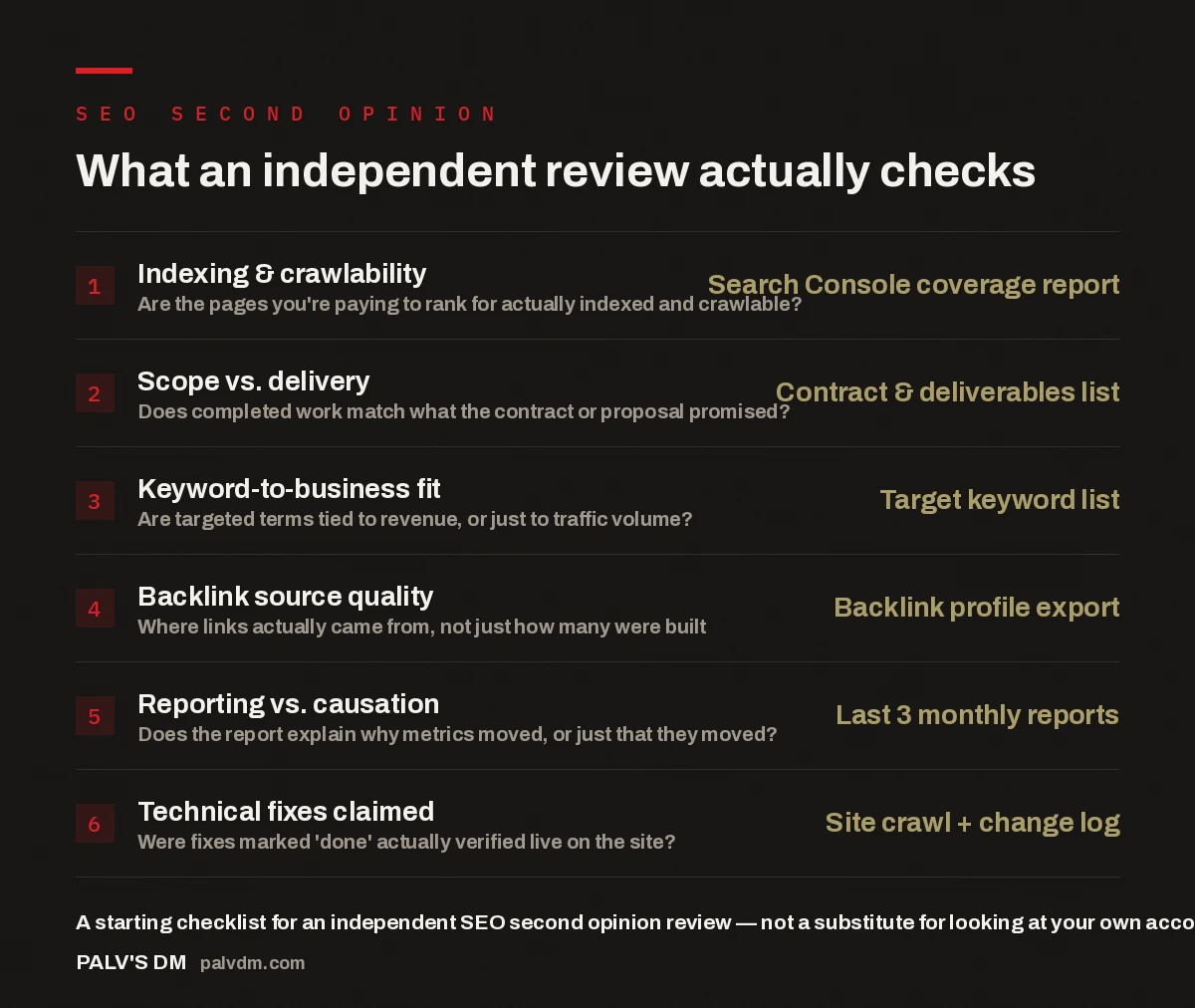
What an independent review actually checks
- Indexing & crawlability — Search Console coverage report. Are the pages you’re paying to rank for actually indexed and crawlable?.
- Scope vs. delivery — Contract & deliverables list. Does completed work match what the contract or proposal promised?.
- Keyword-to-business fit — Target keyword list. Are targeted terms tied to revenue, or just to traffic volume?.
- Backlink source quality — Backlink profile export. Where links actually came from, not just how many were built.
- Reporting vs. causation — Last 3 monthly reports. Does the report explain why metrics moved, or just that they moved?.
- Technical fixes claimed — Site crawl + change log. Were fixes marked ‘done’ actually verified live on the site?.
When is the right time to get a second opinion on agency work?
In practice, a second opinion tends to get requested at a handful of predictable points, and none of them require ending the current contract first — a second opinion is meant to run alongside it, not instead of it.
- Around the six-to-twelve-month mark. The initial “settling in” period has passed, rankings should show some directional movement, and the reports keep repeating the same language about algorithm volatility without pointing to specific pages or fixes.
- Right before a renewal decision. Reviewing the last quarter’s work independently, before signing another six or twelve months, is a lower-risk moment to ask hard questions than doing it mid-contract.
- When a report raises more questions than it answers. A traffic chart with no explanation of a dip, a list of “completed” tasks with no way to verify them, or metrics that don’t match what you’re seeing in your own CRM or sales numbers.
- When ownership of the relationship changes. A new marketing manager inheriting a vendor they didn’t choose, or a founder who’s been managing the agency directly and wants someone else to sanity-check what they’ve been told.
What does an independent reviewer actually check?
The checklist above is the working list a review starts from, but each item needs actual evidence, not a client’s word for it. Indexing and crawlability come first because they’re the fastest thing to check and the easiest to get wrong — a site can be publishing content every week while a chunk of those pages sit outside Google’s index entirely, something you can only confirm by pulling the coverage report directly, not by asking. Scope versus delivery means lining up the contract or proposal against what was actually done: if the agreement mentions monthly technical audits, ask to see them, dated.
Keyword-to-business fit checks whether the terms being tracked and reported on are the ones that actually drive revenue, or whether the agency has quietly optimised for volume because volume is easier to show growth on. Backlink quality means looking at where the links in the profile actually came from — not the count, which is the number most reports lead with, but the sites themselves, since a profile built on the wrong sources can do more harm than good. And reporting-versus-causation is the check most business owners never get around to, because it means asking “why” a second time when a report says a metric moved, instead of accepting the number on its own.
Most second opinions aren’t about proving the current agency wrong. They’re about giving you enough independent evidence to make a call you can actually defend to your own boss.
Palash, Founder, PalV’s DM
How is a second opinion different from just switching agencies?
A second opinion is a diagnostic, not a hiring decision. Ideally, the person reviewing the work is a different person from anyone proposing to take it over, because the incentives conflict — when the same firm reviewing your SEO also wants your retainer, every finding starts to look like a sales pitch dressed up as an audit. That’s why an independent second opinion is worth paying for on its own terms, decoupled from any proposal to take over the account: the deliverable is a written finding, not a quote.
Some businesses use the findings to fix the relationship they already have rather than end it — asking for a missing deliverable to actually be delivered, or for a report that explains cause and effect instead of just listing numbers. Others use it as the brief for a proposal review with a prospective new agency, so the evaluation isn’t starting from zero; if that’s closer to your situation, the same independent-review logic applies to vetting an agency proposal with an independent consultant before you sign anything.
What should you bring to make the review useful?
The review is only as good as the access and history behind it. At minimum, that means read-only access to Search Console and Analytics going back as far as the platforms allow, the current contract or proposal with the exact scope of work written out, and a record of what’s actually been delivered — status emails, task lists, dated screenshots, anything that shows work happening rather than being claimed. It also helps to flag anything else that changed in the same period: a redesign, a migration, a rebrand, or a shift in ad spend, since those explain traffic changes on their own and shouldn’t get pinned on the agency by mistake.
This is close to the standard prep list for any consulting engagement, not just a second opinion — see what to bring to a consulting call to make it worth it for the fuller version, including what to have ready before the call itself rather than just for the written review.
What do you do with the findings?
A second opinion produces a written finding, not a verdict of “good agency” or “bad agency.” Most reviews land somewhere in between — real work getting done in some areas, gaps or drift in others — and the findings tend to repeat certain patterns across accounts; see the three findings that show up in almost every audit for what those patterns usually look like. What you do next depends on what the review actually turns up:
- Renegotiate scope. Ask for specific missing pieces to be added or fixed, with a deadline attached, not a vague promise to “look into it.”
- Request evidence for claimed work. If a task is marked complete, ask to see it live — a screenshot, a crawl, a before/after.
- Switch agencies. Use the review’s findings as the brief for the next agency, so the new engagement doesn’t start from zero.
- Bring work in-house. Worth considering if the gap is mostly about accountability rather than missing expertise.
- Confirm the agency is doing fine. Sometimes the concern was really about unclear reporting, not underperformance — the fix is a better report, not a new vendor.
Whatever direction you take, ask what you’ll walk away with in writing. A verbal opinion doesn’t hold up well when someone — a co-founder, a board, your own future self — questions the decision six months later; see what you walk away with in writing for what a usable written deliverable should actually contain.
Get a second opinion
If your reports have stopped explaining anything, an independent SEO consultant can review the account against your own data and tell you plainly what’s working and what isn’t.
What’s the difference between a second opinion and a full SEO audit?
A second opinion checks the work already being done against the results it’s producing — it’s built around your current agency’s scope, reports, and access. A full audit starts from zero and reviews the site on its own, regardless of who’s managing it or what they’ve claimed. Many second opinions include audit-style checks, but the framing and the deliverable differ: one evaluates a relationship, the other evaluates a site.
How long does a second opinion on agency work take?
Once access is provided — Search Console, Analytics, the contract, and a record of delivered work — a working review typically takes one to two weeks, depending on how much history there is to check and how many pages need crawling. A short call to walk through the findings usually follows once the review itself is done.
Will my current agency find out I got a second opinion?
Not unless you tell them. A second opinion runs on read-only access to your own Search Console, Analytics, and site — none of which requires the agency’s knowledge or involvement. Some businesses do loop their agency in afterward, using the findings as the basis for a scope conversation, but that’s a choice, not a requirement.
Does a second opinion have to end in switching agencies?
No. In practice, a meaningful share of second opinions end with the business staying put and using the findings to ask for specific changes — clearer reporting, missing technical fixes, or a scope adjustment. Switching is one possible outcome among several, not the default one.
What if the second opinion contradicts what my agency has been reporting?
That’s the point of getting one. A written, independent finding — backed by the same data your agency has access to — gives you something concrete to raise instead of a vague feeling that something’s off. Bring the specific discrepancy to your agency directly; a good one will engage with it, and how they respond tells you a lot on its own.