Service Support — Consulting & Audit
Advisory for In-House Teams: How It Works
How an SEO advisory retainer works for in-house teams: fixed monthly scope, flat pricing, and outside review of key decisions without an agency handoff.

An SEO advisory retainer is a fixed monthly arrangement where an outside consultant reviews your team’s decisions, unblocks technical and strategic questions, and sits in on planning — without touching your CMS or owning execution. Your in-house team still writes the content, ships the code, and runs the roadmap. The advisor’s job is to catch mistakes before they go live, give you a second opinion when the internal debate is split, and keep the SEO thinking sharp between the moments you’d normally only get outside input during a crisis. For companies that already have SEO or content capacity in-house, it’s usually cheaper and faster than a full agency retainer, and it doesn’t create the dependency that comes with handing execution to someone else.
Key takeaway
- An advisory retainer gives an in-house team outside judgment on demand — reviewing decisions, not doing the work itself.
- It only makes sense once someone internal can actually execute; advisory without an owner just produces advice that goes nowhere.
- Scope, hours, and access (Slack, tickets, calls) are usually fixed at the start, which is what keeps the retainer predictable and the advisor’s incentives clean.
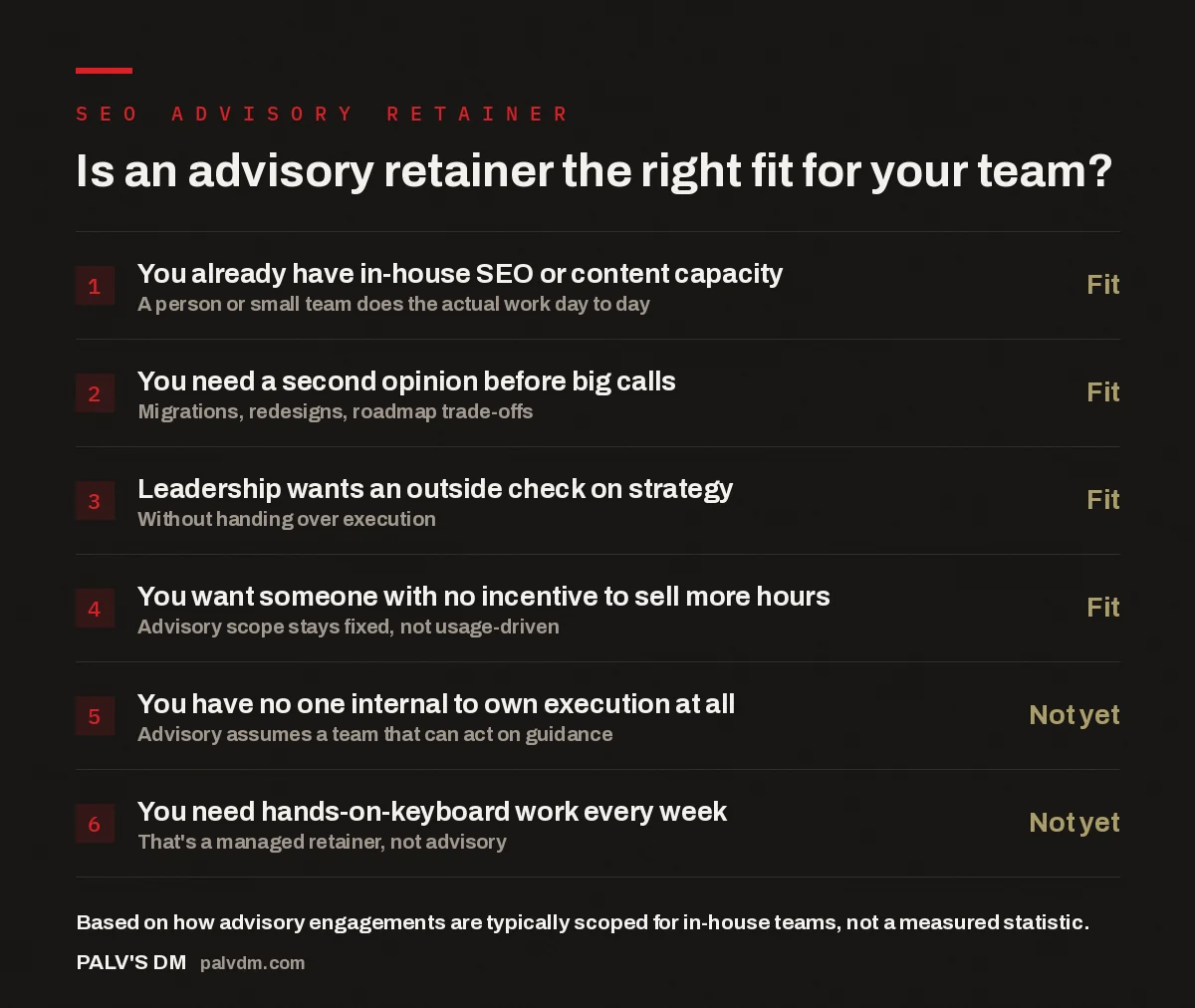
Is an advisory retainer the right fit for your team?
- You already have in-house SEO or content capacity — Fit. A person or small team does the actual work day to day.
- You need a second opinion before big calls — Fit. Migrations, redesigns, roadmap trade-offs.
- Leadership wants an outside check on strategy — Fit. Without handing over execution.
- You want someone with no incentive to sell more hours — Fit. Advisory scope stays fixed, not usage-driven.
- You have no one internal to own execution at all — Not yet. Advisory assumes a team that can act on guidance.
- You need hands-on-keyboard work every week — Not yet. That’s a managed retainer, not advisory.
What does an SEO advisory retainer actually involve?
In practice, an advisory retainer is a mix of scheduled and on-demand access. There’s usually a recurring call — weekly, biweekly, or monthly depending on how fast the team is moving — where the advisor reviews what shipped, what’s queued, and what’s stuck. Outside that call, there’s an async channel (Slack or email, most commonly) for questions that can’t wait: “does this canonical setup look right,” “is this dev estimate realistic,” “should we deprioritise this campaign for the migration.” The advisor also reads what the team already produces — briefs, audits, roadmap docs, dev tickets — and flags problems before they turn into six months of wasted work.
What it doesn’t involve is the advisor logging into your CMS, writing your content, or building your links. That distinction matters more than it sounds. The moment an advisor starts doing hands-on work, the retainer has quietly turned into a managed engagement with an advisory label on it, and the pricing and incentives that made advisory attractive in the first place stop applying.
How is advisory different from a managed SEO or agency retainer?
The difference isn’t the topics covered — both models touch technical SEO, content, and strategy. The difference is who does the work and who carries the pressure to fill hours.
| Question | Managed SEO / agency retainer | Advisory retainer |
|---|---|---|
| Who does the execution? | The agency’s team | Your in-house team |
| Who owns the CMS and dev access? | Usually the agency, at least partially | Stays entirely with your team |
| What’s the advisor’s incentive? | Often tied to selling more scope or hours | Fixed scope — no upside in you needing more |
| How fast can decisions get reviewed? | Depends on the agency’s queue and account load | Direct access to a senior person, usually same-day |
| Best fit for | Teams with no internal SEO capacity at all | Teams with capacity that want outside judgment |
Neither model is objectively better. A company with no internal SEO or content resourcing generally needs execution, not a second opinion — a consultant makes more sense than an agency once there’s someone internal to act on the advice, and until that’s true, advisory alone will just produce a stack of recommendations nobody implements.
Who on the team actually uses the advisory retainer?
Usually three different people, for different reasons. The marketing manager or SEO lead uses it as a sounding board — someone senior enough to catch a bad plan before it’s presented upward, and someone who isn’t in the room politics enough to just agree with whatever’s already been decided. This shows up often with a marketing manager who has just inherited an existing SEO program and needs an outside read on what’s actually working versus what’s just been running on autopilot.
The content or dev team uses it more tactically — a quick check before a template change ships, a sanity check on a migration plan, a review of whether a proposed URL structure will cause problems six months out. And leadership uses it less often but for higher-stakes moments: is the SEO roadmap realistic, is the team’s reporting telling the full story, does this budget request hold up.
The advisory relationships that work best aren’t the ones where we’re brought in for a big quarterly review. They’re the ones where someone pings us mid-week with “does this look right before we ship it” — that’s the moment advice is actually worth something, not three months after the mistake is already live.
Palash, Founder, PalV’s DM
What does a typical month of advisory work look like?
- One recurring call to review what shipped, what’s blocked, and what’s coming up on the roadmap — usually 30 to 60 minutes.
- Async reviews of anything the team flags in between — a content brief, a redirect map, a proposed page structure, a competitor move worth reacting to.
- At least one item that would have quietly gone wrong without a second set of eyes — a canonical pointing the wrong way, a category restructure that would’ve orphaned ranking pages, a campaign built on a keyword that doesn’t match commercial intent.
- A short written note or update after the call, so decisions and reasoning don’t live only in someone’s memory of a Zoom conversation.
That last point matters more than it looks. The value of an advisory retainer compounds when there’s a written trail — you can see what you were told and check it against what actually happened three months later. Teams that treat every call as verbal-only tend to relearn the same lessons repeatedly, because nobody wrote them down. If you want a clearer sense of what that written output should look like, what you actually walk away with in writing after a consulting engagement covers the format most teams find useful.
How is an advisory retainer scoped and priced?
Most advisory retainers are scoped in three parts before the first call happens: a fixed number of hours per month (call access plus async review time), a defined channel for questions in between (Slack, email, or both), and a response-time expectation so “on demand” doesn’t quietly turn into “whenever.” Pricing is usually a flat monthly fee tied to that hour allocation, not a per-project rate — which is the whole point. A flat fee removes the incentive for the advisor to stretch a small question into a billable project, and it removes the awkwardness of the team hesitating to ask a quick question because it might trigger an invoice.
The scoping conversation is also where access gets defined — read-only access to analytics and Search Console is standard, but CMS or dev access generally isn’t part of advisory, precisely because the advisor isn’t the one shipping changes. If your team is heading into that first scoping call, it helps to walk in prepared: what to bring to a consulting call to make it worth it is worth reading beforehand so the first session goes toward real decisions instead of background explanation.
When does an advisory retainer make sense — and when doesn’t it?
It makes sense when a team has the people to execute but not always the confidence, bandwidth, or seniority to catch every mistake before it ships. That’s a common situation in mid-sized companies where SEO sits with one or two people who are competent but stretched thin, or where a content team is strong on production but light on technical judgment. It’s also common ahead of high-stakes moments — a migration, a redesign, a rebrand — where the cost of a mistake is high enough that a second opinion pays for itself many times over just by catching one bad call.
It doesn’t make sense in two situations. First, when there’s genuinely no one internal to act on the guidance — advisory assumes an owner on your side, and without one, the retainer just produces recommendations that pile up unread. Second, when what the team actually needs is hands-on-keyboard capacity, not judgment — if there’s nobody available to write the content, fix the technical issues, or build the links, that’s an execution gap, and no amount of advisory input closes it. In both cases, a managed retainer or a project-based engagement is the more honest starting point, with advisory becoming useful later once internal capacity catches up. If you’re trying to decide which of your existing engagements actually needs outside review right now, comparing notes against training an in-house team versus outsourcing the work entirely is a useful gut-check before committing either way.
Key takeaway
- If your team can execute but wants a senior second opinion before big calls, an advisory retainer is usually the cheaper, faster option compared to a full agency handoff.
- Fixed scope and flat pricing are what keep the arrangement useful — usage-based billing quietly turns advisory into something else.
- The written trail from each call matters as much as the call itself; it’s what stops the same mistakes from resurfacing later.
FAQ
How many hours does a typical SEO advisory retainer include?
It varies by team size and pace, but most retainers are built around a fixed monthly hour block covering one recurring call plus a set amount of async review time. The exact number gets set during scoping based on how many decisions the team expects to bring for review, not a standard industry figure.
Can an advisory retainer turn into a managed retainer later?
Yes, and it’s a common transition — usually when internal capacity drops (someone leaves, priorities shift) or when the team decides execution should be outsourced permanently. The scoping conversation for that shift is different, since it involves handing over CMS access and ownership of deliverables, not just review.
Does an SEO advisor need access to our CMS or analytics?
Read-only access to analytics and Search Console is standard, since it lets the advisor form independent opinions rather than relying only on what’s reported to them. CMS or dev write-access generally isn’t included in advisory scope — the moment an advisor is making changes directly, the engagement has effectively become a managed retainer.
What happens if the in-house team disagrees with the advisor’s recommendation?
The team makes the final call — that’s the point of the model. Advisory input is a second opinion, not an approval gate. A good advisor will push back and explain the reasoning clearly, but decision ownership and execution stay entirely with the in-house team throughout.
Is an advisory retainer worth it for a team with only one SEO person?
Often, yes — a single in-house SEO person rarely has anyone senior to check their thinking against, and advisory fills exactly that gap without adding headcount. It works best when that person has enough bandwidth to act on the guidance; if they’re already stretched too thin to implement anything new, the bottleneck is capacity, not judgment.