Service Support — Consulting & Audit
Consulting for a Marketing Manager Inheriting SEO
A new marketing manager SEO handover goes wrong fast. Here is what to check first, what to ask before the old team leaves, and how to plan the 90 days.

If you’ve just taken over marketing and inherited an SEO program you didn’t build, the first move isn’t to change anything — it’s to find out what’s actually there. Before you touch a page, a ranking report, or a retainer invoice, get direct access to Search Console, GA4, the CMS, and at least twelve months of performance history, then get an independent read on what you’re looking at. A new marketing manager SEO handover tends to go wrong for one repeatable reason: the incoming person makes decisions — keep the agency, cut the budget, promise a number to the CEO — before anyone outside the previous setup has looked at the account. This guide covers what to check first, what to ask, and how a short consulting engagement fits into your first 90 days.
Key takeaway
- Get full access and 12+ months of history before making any vendor decision — not just the current month’s report.
- The three questions that reveal the most — what’s ranking, what’s been built, what’s actually being paid for — rarely match what the handover deck says.
- An independent second opinion in week one is cheaper than a wrong call made in month three.
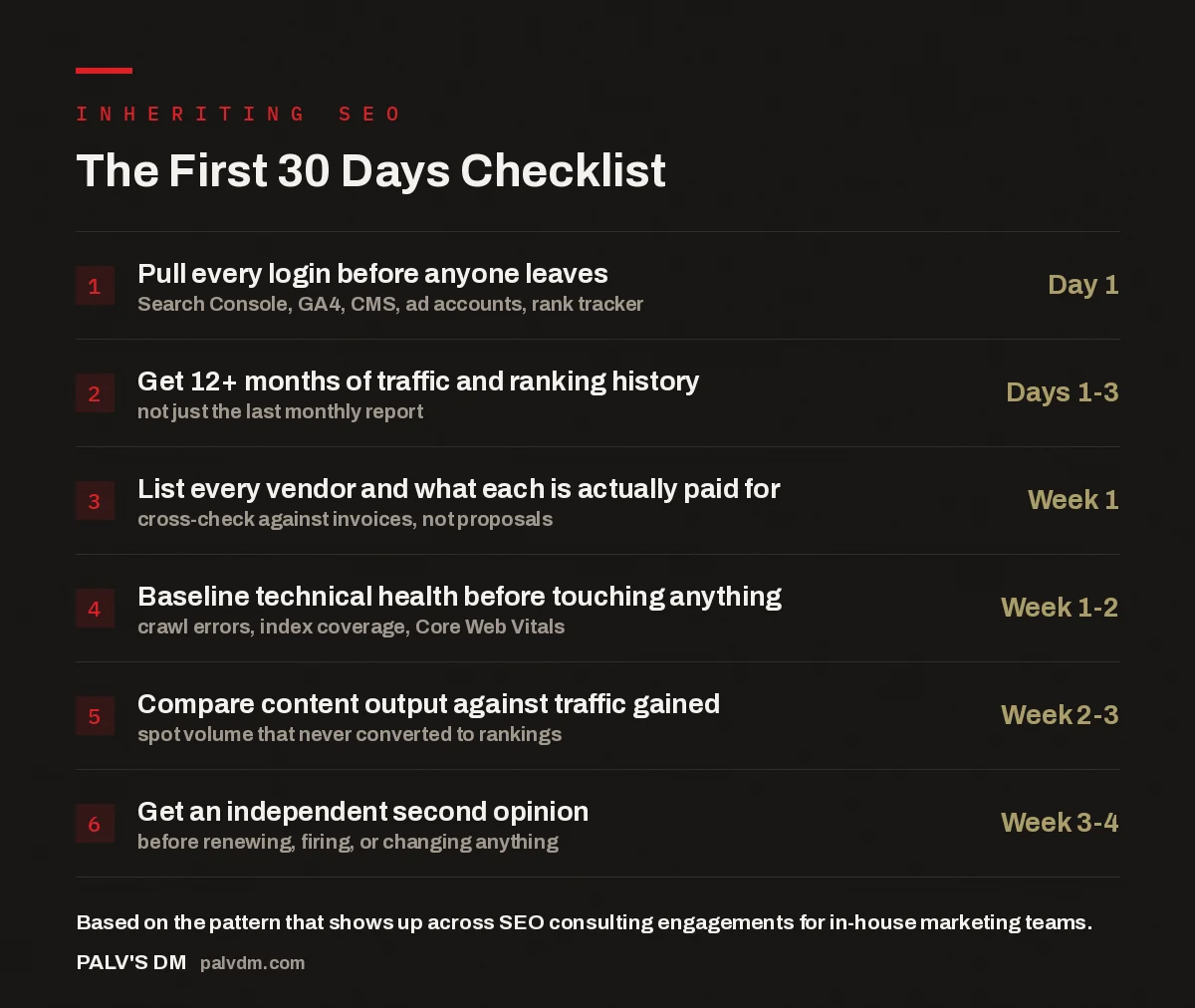
The First 30 Days Checklist
- Pull every login before anyone leaves — Day 1. Search Console, GA4, CMS, ad accounts, rank tracker.
- Get 12+ months of traffic and ranking history — Days 1-3. not just the last monthly report.
- List every vendor and what each is actually paid for — Week 1. cross-check against invoices, not proposals.
- Baseline technical health before touching anything — Week 1-2. crawl errors, index coverage, Core Web Vitals.
- Compare content output against traffic gained — Week 2-3. spot volume that never converted to rankings.
- Get an independent second opinion — Week 3-4. before renewing, firing, or changing anything.
What’s the first thing to do when you inherit an SEO program?
Get access before you get opinions. That means admin-level logins to Search Console, GA4 (or whichever analytics platform is in use), the CMS, the rank tracker if one exists, and any ad accounts that touch the same landing pages. If the previous marketer, agency, or freelancer is still reachable, lock this down now — access has a way of quietly disappearing once a contract ends, and requesting it three months later is a much harder conversation.
Once you’re in, pull at least twelve months of history, not just the most recent report you were handed. A single month tells you almost nothing — it can look great because of a seasonal spike or terrible because of a one-off Google update. Look at organic traffic trend, rankings for the keywords tied to revenue (not vanity keywords), and how those numbers moved around any major changes: a redesign, a migration, a new content push, a change of vendor.
Alongside the numbers, build a plain inventory: every vendor currently being paid, what each is actually delivering, and where the money is going relative to the invoices. It’s common to find a retainer scoped for one thing years ago that has quietly drifted into something else, with nobody re-checking whether the original brief still matches current spend.
How do you tell if the previous SEO work was actually working?
Traffic going up isn’t proof the strategy was sound, and traffic going down isn’t proof it was bad — look at what’s underneath the line. Start with rankings for the pages that are supposed to drive business, not the blog posts that happen to rank for something unrelated. If the money pages haven’t moved in a year despite a steady stream of new content, that’s a pattern worth flagging.
Next, check content output against outcomes. Pull everything published in the last year and see how much of it actually earned rankings, links, or traffic worth mentioning. In the accounts we review, it’s common to find a large volume of content produced to hit a monthly quota rather than to answer a real query — technically published, structurally sound, and functionally invisible in search.
It’s also worth asking whether the existing strategy accounts for how search itself has shifted. AI-generated answers and assistant-style search behaviour have changed what “ranking well” means for a growing number of queries — our roundup of where search is heading in 2026 is a useful reference point for judging whether the inherited plan is current or a few years out of date.
Finally, get a technical baseline: crawl errors, index coverage, Core Web Vitals, and whether the site’s structure is even set up to be crawled efficiently. This isn’t about finding fault — it’s about having a number to compare against three months from now.
What should you ask before the outgoing team is gone?
If there’s a handover window — even a short one — use it deliberately. A rushed exit interview with the outgoing agency, freelancer, or predecessor beats months of piecing things together afterward. Ask directly:
- What’s the single biggest unresolved issue on this site right now, technical or content-side?
- Which pages or keywords were the actual priority, and why those and not others?
- Is there anything mid-flight — a migration, a disavow, a manual action, a redirect cleanup — that isn’t finished?
- Which external accounts or subscriptions (rank tracker, backlink tool, hosting, plugins) will lapse without you, and who’s paying for them?
- What’s already been tried and didn’t work, so you don’t repeat it and lose another quarter finding out the same way?
Write the answers down. Institutional knowledge about a site — why a page structure exists, why a vendor was chosen, what was already tested and dropped — walks out the door with whoever leaves, and it rarely gets documented anywhere formal.
Should you keep the existing vendor or get a second opinion first?
This is usually the decision a new marketing manager feels the most pressure to make quickly, and it’s the one worth slowing down on the most. Firing a vendor in week one, before you’ve verified anything, risks cutting something that was actually working. Renewing a vendor in week one risks locking in another year of a pattern you haven’t yet diagnosed. An independent second opinion — someone with no stake in either outcome — is what breaks that deadlock.
| Question | Deciding on your own, week one | Getting an independent read first |
|---|---|---|
| What you’re judging the vendor against | A handover deck and your first impression | Verified access, real history, and a technical baseline |
| Risk of cutting something that was working | Higher — no outside check on the data | Lower — findings are cross-checked before any call is made |
| Risk of renewing a weak setup | Higher — the deck and the reality can differ | Lower — a second set of eyes has no reason to be diplomatic |
| What you can show leadership | Your opinion of the situation | A written assessment you didn’t author yourself |
| Time cost | Fastest on paper, slowest if the call is wrong | A few days to a couple of weeks upfront |
None of this means the incumbent vendor is automatically wrong — plenty of handovers turn out fine, and the right move is simply to keep going with a clearer brief. The point of the second opinion isn’t to build a case against anyone; it’s to make sure the decision you make in month one is based on what’s actually in the account, not on how confident the last presentation sounded. If you want to understand what that kind of engagement involves before booking one, how advisory works for in-house teams covers what to expect.
Most marketing managers we talk to inherited someone else’s roadmap, not a strategy. The two aren’t the same thing, and the fastest way to find out which one you actually have is to let someone outside the previous setup look at it before you commit to anything.
Palash, Founder, PalV’s DM
What does a realistic first 90 days look like?
The exact plan depends on what the access-and-history pull turns up, but the shape holds across most handovers:
- Days 1-14 — assessment. Access, history, vendor inventory, and a technical and content baseline, plus the independent audit or consulting call, done before any vendor decision is made.
- Weeks 3-6 — triage. Fix what’s clearly broken (indexing issues, technical errors, content actively hurting more than helping) and decide, with evidence, whether to keep, renegotiate, or replace the current setup.
- Weeks 7-10 — plan. Set a small number of priority pages and keywords for the quarter, based on the money-page rankings checked earlier, not on whatever’s easiest to write about.
- Weeks 11-13 — report and reset expectations. Show leadership what changed against the week-one baseline, and set a realistic cadence for next quarter instead of promising a number nobody fully controls.
A short, scoped audit at the start of this timeline is what most of that plan depends on — you can’t triage what you haven’t measured. If you want to know what that kind of assessment typically turns up, the three findings that show up in almost every audit and what we look at in the first 30 minutes of any audit cover the process, and what you walk away with in writing covers what a finished assessment should hand you.
Key takeaway
If you’ve just inherited an SEO program and need a clear, independent read on where it actually stands before you make any vendor call, that’s exactly what a consulting engagement is for.
FAQ
How long should a new marketing manager wait before making SEO vendor decisions?
Give yourself two to four weeks before renewing, firing, or restructuring anything. That’s enough time to pull twelve months of history, inventory vendors and spend, and get an independent read on the technical and content baseline. Deciding faster usually means deciding on impressions rather than evidence.
What access do I actually need on day one?
Admin-level access to Search Console, your analytics platform, the CMS, and any rank tracker or backlink tool in use. If a vendor manages any of these, request the transfer in writing before the contract ends — access requested after someone has left is far harder to recover than access secured during the handover.
Is it normal to bring in an outside consultant even though there’s already an in-house or agency team?
Yes — it’s one of the most common reasons a new marketing manager brings one in, specifically because they have no stake in whether the existing setup looks good. It isn’t a replacement for the current team; it’s a way to get an unbiased read before deciding whether that team’s approach still fits.
What if the previous SEO work looks fine on the surface?
Check anyway. “Fine on the surface” often means overall traffic held steady while the pages that drive revenue didn’t move, or content output stayed high while rankings for competitive terms stagnated. A short assessment either confirms the program is genuinely healthy, which is worth knowing with confidence, or surfaces the gap before it costs a quarter.
What should I report to leadership in the first 90 days?
Report the baseline established in the first two weeks, what changed against it, and a realistic cadence for the quarter ahead — not a specific ranking or traffic promise, which nobody fully controls. Leadership generally responds better to “here’s what we found and here’s the plan” than to an early number that may not hold.
Short version: inheriting an SEO program isn’t a reason to overhaul everything in week one. Get access, pull the real history, inventory the vendors, and get an independent read on the baseline before deciding what to keep. That sequence — assess, then decide — is what separates a new marketing manager who fixes the right things from one who spends the first year undoing their own early calls.