Service Support — Consulting & Audit
The Three Findings That Show Up in Almost Every Audit
The most common SEO problems we find in a free audit fall into three patterns: keyword cannibalization, orphaned money pages, and unanswered search intent.

The common SEO problems we find in a free audit almost always sort into three patterns, no matter the industry: pages competing against each other for the same keyword instead of one page winning it, the page you actually want to rank getting almost no internal links, and content that’s built around a keyword but never gets around to answering the question. Everything else we flag — slow pages, missing schema, thin metadata — tends to be a symptom of one of those three, not a fourth category on its own.
That’s the short version. The rest of this is what each of those three actually looks like on a real site, why they keep showing up regardless of how experienced the team running the site is, and what to check first if you suspect your own site has one of them.
Key takeaway
- Most common SEO problems reduce to three patterns: keyword cannibalization, orphaned money pages, and content that doesn’t answer the question it targets.
- These patterns show up on sites of every size and age — they’re not a sign of neglect, they’re a natural side effect of how sites grow.
- Fixing the pattern (consolidating pages, rerouting internal links, rewriting for intent) usually matters more than fixing any single page in isolation.
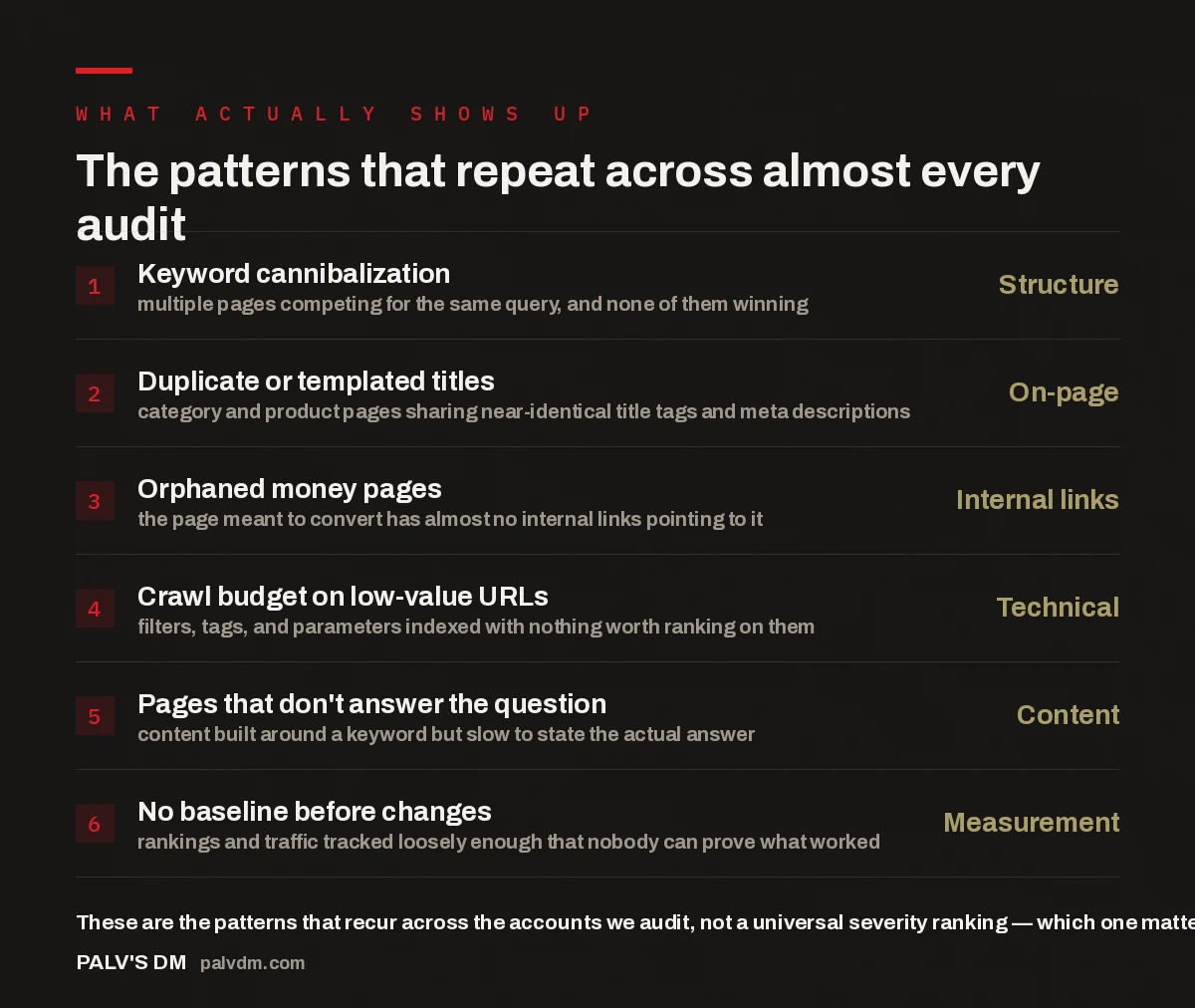
The patterns that repeat across almost every audit
- Keyword cannibalization — Structure. multiple pages competing for the same query, and none of them winning.
- Duplicate or templated titles — On-page. category and product pages sharing near-identical title tags and meta descriptions.
- Orphaned money pages — Internal links. the page meant to convert has almost no internal links pointing to it.
- Crawl budget on low-value URLs — Technical. filters, tags, and parameters indexed with nothing worth ranking on them.
- Pages that don’t answer the question — Content. content built around a keyword but slow to state the actual answer.
- No baseline before changes — Measurement. rankings and traffic tracked loosely enough that nobody can prove what worked.
Why do multiple pages end up competing for the same keyword?
Keyword cannibalization is the single most consistent finding across the audits we run, and it’s rarely intentional. It happens gradually: a blog post gets written about a topic, then six months later a service page or landing page targets a near-identical phrase because whoever wrote it didn’t check what already existed. Neither page loses outright — Google just splits relevance between them, so both rank somewhere in positions eight through twenty instead of one of them holding position three. From the outside this looks like “we’re stuck,” when the real problem is the site arguing with itself over which page should win.
The pattern is easiest to spot on sites that have been publishing for a few years without a content inventory — new writers, new agencies, or a founder who “just wrote something” tend to duplicate intent without realizing an older page already covers it. The fix is rarely to delete either page; it’s usually to pick a clear primary page, redirect or consolidate the weaker one into it, and make sure every internal link pointing at that topic goes to the same URL instead of splitting between two.
Why does the page you most want to rank get so few internal links?
The second recurring finding is a money page — the service page, the pricing page, the page that’s actually meant to convert a visitor into a lead — sitting with almost no internal links pointing to it from the rest of the site. It’s usually reachable from the main navigation, which feels sufficient, but navigation links carry a fraction of the contextual signal that an in-body link from a relevant blog post does. Meanwhile the blog, which often has dozens of posts, links heavily to other blog posts and rarely back to the pages that actually generate revenue.
This is a structural blind spot rather than a content problem, and it’s why it survives even careful content teams: writers optimize each post for its own topic and forget the internal-linking job is a separate pass, not something that happens automatically. In the accounts we work on, this is often the single highest-leverage fix in a technical seo audit — no new content required, just routing existing authority to the page that’s supposed to receive it.
Why does content rank on the keyword but still fail to perform?
The third pattern is content that was clearly built with a keyword in mind but never actually answers the question implied by that keyword — at least not near the top. It opens with a definition, some throat-clearing context, maybe a paragraph on “why this matters,” and only gets to the actual answer three or four paragraphs in. That structure used to be tolerable because a reader would scroll. It’s increasingly costly now: both impatient human readers and AI answer engines pulling content into summarized results reward pages that state the answer early and penalize pages that make you dig for it.
This finding overlaps with the first two but is distinct — a page can have zero cannibalization issues and plenty of internal links pointing to it and still underperform because it never directly answers “how does X work” or “what does Y cost.” Rewriting the opening to answer the core question in the first fifty to a hundred and fifty words is usually a bigger lift in outcome than adding more sections to the bottom of the page.
Almost nobody has a fourth, exotic SEO problem. Sites that feel stuck are usually dealing with one of these three, and the audit’s real job is figuring out which one is doing the most damage.
Palash, Founder, PalV’s DM
Why do these same three patterns show up on sites that look nothing alike?
The pattern repeats across small local business sites, mid-size e-commerce catalogs, and B2B SaaS blogs alike because all three findings are side effects of a site growing over time, not signs of a specific mistake. Content gets added faster than it gets reorganized. New pages get written without checking what already exists. Internal linking gets treated as an afterthought because it doesn’t show up as a visible task the way “write ten blog posts” does. None of this requires bad SEO work to happen — it happens by default, on a long enough timeline, unless something actively counteracts it.
That’s also why a fresh set of eyes tends to catch these findings faster than the team living inside the site every day. We’ve written about what we actually look at in the first 30 minutes of any audit, and cannibalization, orphaned pages, and intent mismatch are almost always visible within that first pass — before we’ve touched a single technical crawl report. The technical layer (crawl budget waste, slow pages, missing schema) tends to be secondary; it makes the three core findings worse, but it’s rarely the root cause on its own.
What should you check first if this sounds like your site?
Start with a simple search of your own site — site:yourdomain.com "your main keyword" — and see how many URLs come back. More than one or two live pages targeting the identical phrase is a strong signal of cannibalization worth investigating. Next, open your top three revenue-driving pages in an incognito window and count how many links from your blog point to each one; if the answer is zero or one, that’s the orphaned-money-page pattern showing up on your own site. Finally, reread your best-trafficked blog post and time how long it takes to reach the actual answer to its own headline — if it’s more than a couple of paragraphs, that’s the third pattern.
None of these checks require specialist tools, but they only tell you that a pattern exists, not how badly it’s costing you traffic or leads, or which fix to prioritize first. That prioritization is most of what a proper audit is actually for. If you’d rather have someone walk through your specific site instead of guessing from these checks alone, it helps to know why we give free audits away and what it actually costs us to do that — it explains why there’s no catch attached to asking for one.
If you already suspect which of the three findings applies and want the conversation to go straight to fixes rather than discovery, it also helps to know what to bring to a consulting call to make it worth your time — access to analytics, a list of your top pages, and a rough sense of what’s changed recently turns a generic audit into a specific action list much faster.
See which pattern applies to your site
A free audit checks your site against these three patterns directly — cannibalization, internal linking, and intent match — and tells you which one is costing you the most.
Frequently asked questions about common SEO problems
What’s the single most common SEO problem you find in audits?
Keyword cannibalization — two or more pages on the same site targeting the same phrase, splitting rankings between them instead of one page holding a strong position. It shows up on almost every site that’s been publishing content for more than a year or two without a regular content inventory.
Can these three findings apply to a brand-new site with very little content?
Less often, but not never. A new site is less likely to have cannibalization simply because there’s less content to compete with itself, but orphaned money pages and content that buries its own answer both show up early — sometimes from launch — because they’re about structure and writing habits, not accumulated history.
Is fixing internal linking really higher priority than writing new content?
Often, yes, when the finding is an orphaned money page. Redirecting existing authority to a page that’s already live and already relevant tends to move faster than producing new content from scratch, since you’re not waiting on a new page to get crawled, indexed, and trusted before it can compete.
Do technical issues like site speed matter less than these three findings?
They matter, but they usually amplify the three core findings rather than causing the underlying ranking problem on their own. A slow, poorly crawled site makes cannibalization and orphaned pages worse because search engines spend less effort discovering and re-evaluating your pages — but fixing speed alone rarely resolves a cannibalization or intent-mismatch problem underneath it.
How do I know which of the three findings is hurting my site the most?
Run the three quick checks in this article — a site search for your main keyword, an internal-link count to your top revenue pages, and a read-through of how fast your best post answers its own question. Whichever check turns up the clearest problem is usually the one worth fixing first, though a full audit will confirm which is actually costing the most traffic.
Short version: the common SEO problems that show up in almost every audit sort into three patterns — keyword cannibalization, orphaned money pages, and content that doesn’t answer its own question fast enough. They’re not signs of a badly run site; they’re what happens by default as any site grows, unless someone actively checks for them. Knowing which of the three applies to your site is most of the way to knowing what to fix first.