Service Support — Consulting & Audit
Why the Free Audit Exists and What It Costs Us
What's the catch with a free SEO audit? Here's exactly why PalV's DM gives away free SEO audits, what they truly cost us, and what you get before you pay.
The free SEO audit exists because it’s the fastest way to find out whether we can actually help you — before either side spends real money finding out the hard way. The catch with a free SEO audit, if there is one, is that it costs us real analyst hours and gets nothing back most of the time. We run it anyway because it filters out mismatched projects early, and because a prospect who’s seen exactly what we’d find is a far better client than one who signs on trust alone.
Key takeaway
- A free audit is a scoped, time-boxed check — indexation, on-page health, competitor position, and AI-visibility — not the full roadmap or ongoing work.
- It costs us genuine analyst time with no guarantee of a signed client, which is exactly why we keep the scope narrow and consistent.
- The trade-off works because it screens out sites we can’t help and gives serious prospects something concrete to evaluate us on.
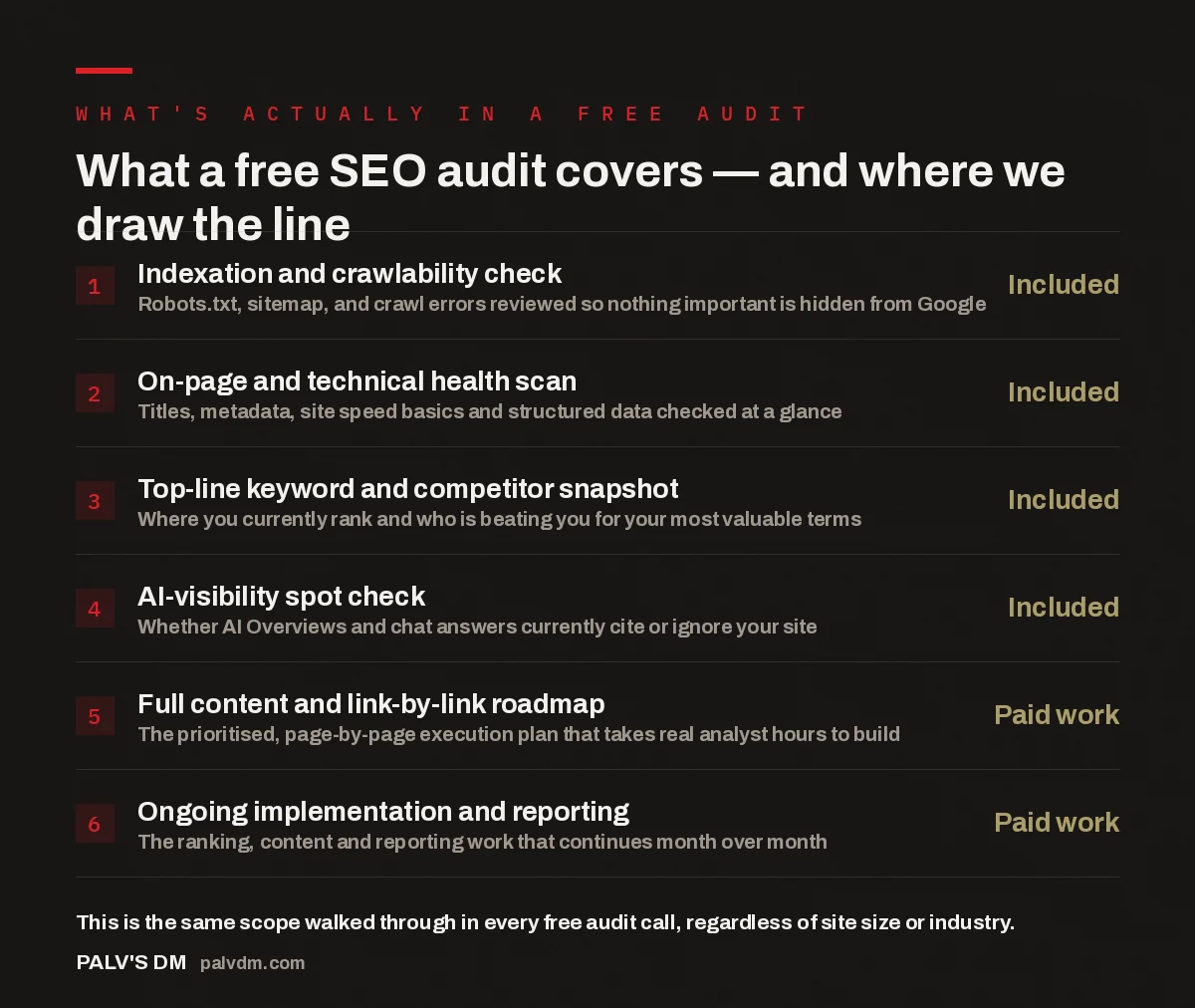
What a free SEO audit covers — and where we draw the line
- Indexation and crawlability check — Included. Robots.txt, sitemap, and crawl errors reviewed so nothing important is hidden from Google.
- On-page and technical health scan — Included. Titles, metadata, site speed basics and structured data checked at a glance.
- Top-line keyword and competitor snapshot — Included. Where you currently rank and who is beating you for your most valuable terms.
- AI-visibility spot check — Included. Whether AI Overviews and chat answers currently cite or ignore your site.
- Full content and link-by-link roadmap — Paid work. The prioritised, page-by-page execution plan that takes real analyst hours to build.
- Ongoing implementation and reporting — Paid work. The ranking, content and reporting work that continues month over month.
What’s the catch with a free SEO audit?
There isn’t a hidden catch in the sense of a bait-and-switch — but there’s a real business trade-off, and it’s worth naming plainly. We’re not going to pretend a free audit is charity. It’s a lead-qualification tool that happens to be genuinely useful to the person receiving it, and both of those things are true at once. The scope is fixed on purpose: we check indexation, on-page fundamentals, a competitor snapshot, and how your site currently shows up in AI-generated answers. What we don’t do for free is build the full, prioritised roadmap or start doing the work — that’s where the paid relationship begins.
The honest version of “what’s the catch” is this: we’re using a real deliverable to have a real conversation. If your site is in reasonable shape and the fixes are mostly cosmetic, we’ll tell you that directly, even if it means the call ends without a next step. If the account isn’t a fit — wrong budget, wrong industry, wrong timeline — we’ll say that too. The audit isn’t a sales script disguised as analysis; it’s analysis that happens to double as a sales conversation, and we try hard to keep those two things from contaminating each other.
Why does PalV’s DM give audits away for free?
Three reasons, in order of how much they actually matter to us. First, it’s the fastest way to know if we can help. Some sites have deep structural problems that no amount of content or link-building will fix quickly — a migration gone wrong, a platform that can’t be crawled properly, or a business model where organic search was never going to be the right channel. Spotting that in thirty minutes of screen-share is far cheaper for everyone than discovering it three months into a retainer.
Second, it sets the tone for how we work afterward. A prospect who’s watched us walk through their site — pointing at specific pages, specific errors, specific competitors — has a much better sense of what working together actually looks like than someone who read a pitch deck. That matters more in consulting than in most services, because the product is largely judgment, not a fixed deliverable.
Third, and least glamorously: it’s a filter. Anyone can request a call. Not everyone shows up prepared, and not every business that shows up is one we’re positioned to help well. The audit format forces a real look at the site before either side commits, which quietly does a lot of the qualifying work that a sales call alone wouldn’t.
We give the audit away because a bad-fit client costs more than a free hour ever will — for them and for us. Filtering that out early is the whole point.
Palash, Founder, PalV’s DM
What does the free audit actually cost us?
Real time, mostly. An analyst has to pull a crawl, check indexation and Search Console data, run a competitor comparison, and put together enough of a narrative to walk through on a call — that’s not a template you fill in blanks on, because every site’s problems sit in different places. In the accounts we work on, that preparation typically takes longer than the call itself, and none of it is billable until a prospect decides to move forward.
The pattern that shows up repeatedly is a straightforward conversion gap: a meaningful share of audits don’t turn into paid work at all. Some prospects were never going to buy and used the audit as a free consultancy hour, which is a known and accepted cost of running this model. Others get the audit, decide to fix the obvious issues themselves, and never come back — which is fine; that’s a legitimate outcome of giving someone real information instead of a teaser.
What keeps the economics workable is discipline about scope. We don’t build the full roadmap for free, we don’t hand over a written report with every fix spelled out, and we cap the call at a fixed length. Loosen any of those constraints and the free audit stops being a qualification tool and starts being unpaid consulting at scale — which isn’t sustainable for us, and honestly wouldn’t be fair to the clients who do pay for ongoing work.
What do you actually walk away with from a free audit?
Concrete findings you can act on regardless of whether you hire us. That typically includes a short list of technical issues worth fixing, a sense of where you stand against two or three real competitors, and a direct answer on whether AI-generated answers currently mention your site at all. None of this is padded with vague advice like “publish more content” — if a finding can be pointed at a specific page or a specific competitor, we point at it.
What you don’t get is the full execution plan — the page-by-page content calendar, the link-building sequence, the technical fix list ordered by effort and impact. That’s the part that takes an analyst days rather than hours to build properly, and it’s also the part that’s genuinely worth paying for, because a prioritised, sequenced plan is a different thing from a list of problems. For a closer look at what that document looks like once you’re a client, see what you walk away with in writing from a paid engagement.
If you want to see exactly what gets covered before you book a call, what we look at in the first 30 minutes of any audit walks through the sequence we follow on every account, and the three findings that show up in almost every audit covers the issues we run into most often, so you can gauge in advance whether your site probably has them.
How should you prepare so the free audit is actually worth your time?
The single biggest variable in how useful an audit is to you is how much access and context you bring. Analytics access, Search Console access, and a straight answer about what’s actually changed on the site recently (a redesign, a migration, a drop in publishing) let us skip the guesswork and spend the call on findings instead of discovery. Coming in with none of that isn’t disqualifying, but it does mean more of the limited time goes toward figuring out the baseline rather than diagnosing it.
It also helps to know what you’re actually trying to solve. “Traffic dropped last quarter” and “we’ve never really done SEO and want to know where we stand” are both legitimate reasons to book an audit, but they lead to different conversations. Being clear about which one you’re in lets the call go deeper on the part that matters to you instead of covering everything shallowly. A fuller checklist of what to bring is covered in what to bring to a consulting call to make it worth it.
Key takeaway
- The audit is free; the roadmap and the ongoing work are not — and that line is intentional, not a bait-and-switch.
- Bringing analytics access and a clear question in advance makes the free 30-45 minutes far more useful to you.
- If it’s not a fit, we’ll say so on the call — the audit is built to filter honestly, in both directions.
FAQ: Free SEO audits
Is a free SEO audit really free, or is there a hidden fee?
It’s free with no fee attached at any point. What’s limited is scope, not price — you get a diagnostic review covering indexation, on-page health, competitor position, and AI-visibility, not the full execution roadmap or any implementation work. Those remain paid, separate offerings.
How long does a free audit take?
The call itself typically runs 30-45 minutes. Preparation on our side usually takes longer than that, since an analyst has to pull a real crawl and competitor data beforehand rather than working from a generic template.
Will you tell me if my site doesn’t need SEO help?
Yes. If the audit shows your fundamentals are solid or your issues are minor, we say so directly, even when it means the call doesn’t lead to a next step. A false diagnosis costs us credibility for a short-term booking, which isn’t a trade we’re willing to make.
Do I have to give you access to my analytics before the audit?
No, it’s not required, but it changes what we can find. With Search Console and analytics access we can point to specific pages and specific drops; without it, the audit leans more on public data like crawlability and competitor rankings, which is still useful but less precise.
What happens to the data you look at during the audit?
Anything you share for the audit is used only to prepare and deliver that audit, whether or not you become a client afterward. The specifics of how access, screenshots, and notes are handled and retained are covered in what we do with your data after a free audit.
Short version: the free audit exists because it’s a better filter than a sales call alone, and it costs us real, unbilled analyst time on every request regardless of outcome. What you get is a genuine diagnostic — indexation, on-page health, competitor position, and AI-visibility — kept deliberately short of the full roadmap, which is where the paid relationship starts. If that trade-off sounds fair, the fastest way to see it in action is to book one.