Service Support — Consulting & Audit
Training Your Team vs Outsourcing Forever
SEO training vs agency: what it really costs to train an in-house team versus outsourcing SEO forever, and when each option genuinely pays off for you.
If SEO is going to matter to your business for years, not months, training an in-house person eventually costs less and builds an asset you keep. If SEO is one priority among many and you need results without adding headcount, a consultant or agency gets you there faster and with judgment a junior hire won’t have for a year or two. The seo training vs agency decision usually isn’t “which is better” — it’s “which matches how central SEO is to what you sell.”
Key takeaway
- Training a team pays off when SEO is core to the business for the long run and you can protect the time it takes someone to become genuinely good at it.
- Outsourcing wins when you need competent execution now, when the workload is uneven, or when the strategic calls are harder than a junior hire can safely make alone.
- The pattern that shows up most often in practice isn’t pure either/or — it’s a trained in-house person doing the day-to-day, backed by outside advisory for the calls that are expensive to get wrong.
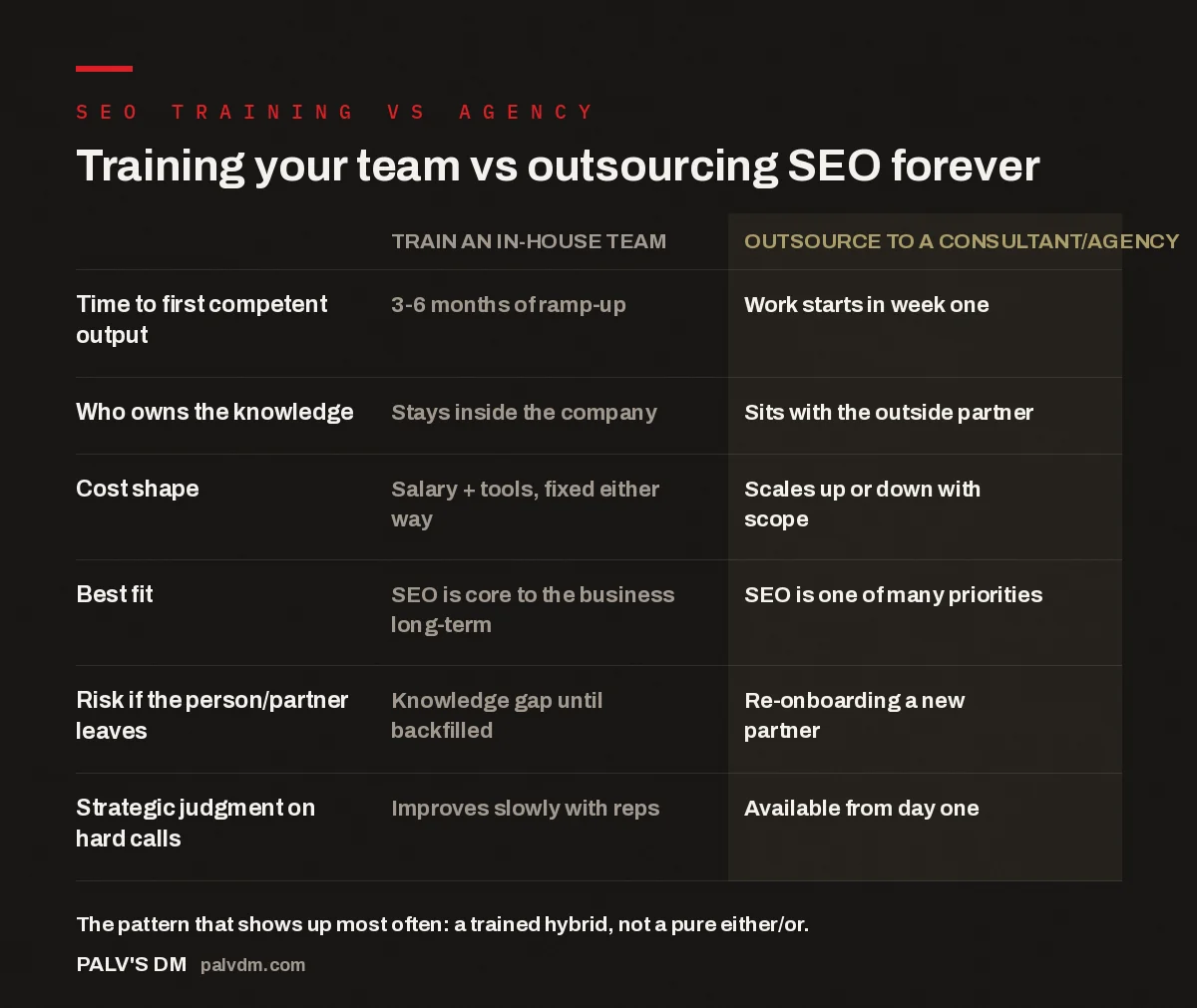
Training your team vs outsourcing SEO forever
| Train an in-house team | Outsource to a consultant/agency | |
|---|---|---|
| Time to first competent output | 3-6 months of ramp-up | Work starts in week one |
| Who owns the knowledge | Stays inside the company | Sits with the outside partner |
| Cost shape | Salary + tools, fixed either way | Scales up or down with scope |
| Best fit | SEO is core to the business long-term | SEO is one of many priorities |
| Risk if the person/partner leaves | Knowledge gap until backfilled | Re-onboarding a new partner |
| Strategic judgment on hard calls | Improves slowly with reps | Available from day one |
What does “training your team” actually involve?
Training an in-house SEO person is not a weekend workshop. It’s months of doing real work under review, getting it wrong in ways that don’t sink the site, and slowly building the judgment that separates “knows the checklist” from “knows which item on the checklist matters for this specific site.” The pattern that shows up repeatedly in accounts we’ve inherited: someone was sent to a course or handed a few guides, then left to run SEO solo within weeks. They can usually execute a checklist. They struggle when two best practices conflict, when a change doesn’t move the needle the way the guide said it would, or when a client or boss asks why rankings dropped and the honest answer is “we don’t fully know yet, here’s what we’re checking.”
Real training usually needs three things: a person with aptitude for pattern-matching and technical curiosity, a steady stream of real problems to work through, and someone more experienced reviewing decisions before they go live. That third piece is the one most companies skip, and it’s the one that determines whether the person becomes genuinely capable or just experienced at looking busy.
What does outsourcing actually buy you?
Outsourcing buys you two things a fresh hire can’t offer on day one: pattern recognition from having seen the same problem across many different sites, and the ability to say “this is a bad idea” with the confidence that comes from having watched it fail elsewhere. An in-house junior hire is working through their first version of every problem. A consultant who’s audited dozens of accounts has usually seen this exact symptom before — a traffic drop that looks like a penalty but is actually a template change, a “content problem” that’s really an internal linking problem. That recognition is hard to shortcut, and it’s the main thing you’re paying for beyond hours worked.
What outsourcing doesn’t buy you, by default, is retained institutional knowledge. When the engagement ends, the strategic reasoning mostly leaves with the consultant unless someone made a deliberate effort to document it and have it explained, not just handed over as a spreadsheet. That’s the trade most companies underweight when they compare the two options purely on monthly cost.
How do the costs actually compare?
The honest answer is that the costs aren’t directly comparable, because they buy different things. A salaried in-house hire is a fixed cost whether SEO work is heavy that month or light — you’re paying for capacity, not output. An outsourced engagement can flex with scope, which matters if your SEO workload genuinely varies (a big content push before a launch, then a quieter maintenance phase). Where in-house usually wins on cost is the multi-year horizon: once someone is fully ramped, their fully-loaded cost per hour of good work tends to fall below what an ongoing outsourced retainer costs, because you’ve already absorbed the training cost as a sunk investment.
Where outsourcing usually wins on cost is the ramp period itself. Six months of a junior SEO hire producing mediocre, closely-supervised work is six months you’re paying a salary for output that a competent outside partner would have delivered from week one. If the business needs results in that window — a product launch, a funding milestone, a competitive threat — the ramp-up cost of in-house training isn’t just slower, it’s a real opportunity cost.
Most companies don’t actually face a choice between training and outsourcing. They face a choice about which mistakes they can afford while someone learns — and outsourcing is often the cheapest way to buy time for that person to get good.
Palash, Founder, PalV’s DM
When does training your own team make the most sense?
Training in-house makes sense when SEO is genuinely core to the business for the foreseeable future — a publisher, a marketplace, a content-driven SaaS company where organic search is the main acquisition channel, not a side project. It also makes sense when the company has enough scale that a full-time hire is clearly justified by workload, and when there’s someone senior enough on the team (or available externally on a lighter advisory basis) to review the junior hire’s decisions during the ramp period. Training without oversight tends to produce someone who’s confident but not actually correct, which is worse than having no in-house SEO person at all, because the mistakes look intentional.
It also makes sense when the company has domain knowledge that’s expensive to transfer to an outsider repeatedly — a regulated industry, a technical product, a niche where understanding the customer takes months regardless of SEO skill. In those cases, training someone who already understands the business is often faster than training an outside consultant on the business every time a new engagement starts.
When does outsourcing make more sense than training?
Outsourcing makes more sense when SEO is one priority among several for a small marketing team, and dedicating a full hire to it isn’t justified by workload. It also makes sense when the business needs results inside a timeframe that training simply can’t meet — a migration, a redesign, a recovery after a traffic drop — where getting the strategic calls right the first time matters more than building internal capability. It also makes sense structurally: a small in-house team often can’t absorb the variance in SEO demand across a year the way an outside partner can, scaling support up during a big push and down during quieter months.
There’s also a founder-specific version of this. A founder doing SEO themselves, or handing it to a generalist marketing manager, is effectively asking someone to get trained on the job with no one reviewing their decisions. Outsourcing at least the strategic layer — while the in-house person handles execution — closes that gap without requiring a full hire.
Is there a middle path that avoids the false choice?
Yes, and it’s the option most companies land on once they’ve tried the extremes. An in-house person handles day-to-day execution — content updates, technical fixes, reporting — while an outside consultant provides periodic strategic review: quarterly audits, sign-off on big decisions like migrations or redesigns, and a second opinion when something goes wrong. This hybrid gets you the cost efficiency of in-house execution and the pattern-recognition of an experienced outside eye, without paying full agency rates for routine work or asking a junior hire to make calls they’re not ready to make alone.
The hybrid model also solves the knowledge-retention problem from both directions. The in-house person builds real capability because they’re doing the work, not just receiving a monthly report. And because an outside advisor is reviewing the reasoning, not just approving finished work, some of that pattern-recognition transfers during the review conversations themselves.
Key takeaway
- Decide based on how central SEO is to the business long-term, not just this month’s budget line.
- If you go in-house, budget for real oversight during the ramp period — training without review just produces confident mistakes.
- If the choice feels forced, it probably is — most companies do better with in-house execution plus outside strategic review than with either option alone.
If you’re weighing this decision right now, a few related pieces are worth reading before you commit either way. When you need a consultant instead of an agency covers a related fork in the same decision. If you already have an in-house team and want outside advisory to fit alongside them without stepping on their work, how advisory for in-house teams actually works walks through that model. If you’re a founder currently doing SEO yourself and wondering whether training up is realistic given your time, consulting for a founder doing SEO themselves is the more specific version of this question. And if your team already has an agency and you’re weighing training on top versus a second opinion instead, vetting an agency proposal with an independent consultant is the closer fit.
FAQ
How long does it actually take to train someone to run SEO competently in-house?
Expect somewhere around three to six months before someone can be trusted with most decisions unsupervised, assuming they’re getting real work with review, not just courses. Full strategic judgment — knowing when to break a best practice — usually takes longer and keeps improving well beyond that point.
Is it cheaper to train someone in-house than to outsource SEO?
Over several years, in-house often ends up cheaper per hour of good output once someone is fully trained, because the training cost is sunk. In the first six to twelve months, outsourcing is usually the better value, since you’re paying for competent output immediately instead of subsidizing a learning curve.
Can you train an in-house team and still use an outside consultant?
Yes — this is the combination that works best for most mid-sized companies. The in-house person handles day-to-day execution while an outside consultant reviews strategy periodically, signs off on high-risk changes like migrations, and provides a second opinion when something isn’t working.
What’s the biggest risk of training someone without outside oversight?
The person becomes confident before they become correct. Without someone more experienced reviewing decisions, mistakes get repeated and reinforced rather than caught early, and by the time a problem surfaces in the numbers, it can take months to trace back to the original decision.
When should a company skip training entirely and just outsource long-term?
When SEO is a small part of overall marketing workload, when the business changes priorities often enough that a dedicated hire wouldn’t stay fully utilized, or when leadership doesn’t have the bandwidth to provide the oversight training requires. In those cases, an ongoing outside partner is usually the more reliable option.
Short version: train in-house if SEO is core to the business for years and you can genuinely oversee the ramp-up. Outsource if you need competent results now, if workload is uneven, or if the strategic calls are riskier than a new hire should make alone. Most companies that get this right eventually end up with both — a trained in-house person doing the work, and an outside consultant reviewing the decisions that are expensive to get wrong.