Why Anonymous Content Is Losing Ground
Google's first published self-assessment question asks who produced your content. Unbylined pages cannot answer it. What that costs, and how to fix it.
Google’s published self-assessment questions begin with “who” — who created the content, and does it demonstrate first-hand expertise. Content with no byline cannot answer that question at all. This is not a confirmed ranking factor in the sense of a named system, and Google has explicitly denied that any “AuthorRank” score exists. What is documented is that Google’s own guidance for evaluating content quality asks who produced it, that its search rater guidelines lean heavily on the reputation and qualifications of creators, and that anonymous content structurally fails the first question in that list. Over 2026, the sites that fared worst across core updates were disproportionately the ones publishing at volume with nobody’s name attached.
Two things are worth separating: what Google has confirmed, and what practitioners observed. Both matter, and conflating them is how the industry ends up asserting things it cannot support.
What Google actually documents
The “Who, How, Why” framework is real and published. Google’s guidance on creating helpful content asks creators to assess their own work against questions including:
- Who created the content — is it clear to a reader, and does the content demonstrate first-hand expertise and depth of knowledge?
- How was it produced — could you explain the process, including any use of automation, without embarrassment?
- Why does it exist — was it made to help people, or primarily to attract search traffic?
Google also states directly that content should include information about the author where a reader would reasonably expect it, and that self-identifying who is behind a site is something readers value.
What Google has not said is that it computes an author authority score. It has denied this repeatedly. So the mechanism is not “Google scores your author.” The mechanism, as far as anything is documented, is that quality assessment includes the question of provenance, and content that cannot establish provenance has a structural gap.
Why 2026 made this sharper
Three developments converged, and none of them required a new ranking system.
Generation cost collapsed. Producing plausible, competent, unattributed content became nearly free. When something becomes free, it stops being a signal of anything. Effort used to be an implicit proxy for care; it no longer is, so the remaining proxies — verifiable identity, demonstrable experience, real data — carry more weight by default.
Google’s assessment operates partly at site level. Google has confirmed this. A site publishing large volumes of unattributed content is not judged page by page in isolation; the pattern itself becomes part of how the site is assessed.
The February 2026 Discover update named expertise explicitly. Google said it would surface “more in-depth, original, and timely content from websites with expertise in a given area, based on our systems’ understanding of a site’s content.” That is a stated goal, not an inference — and note it is a site-level understanding of expertise, which anonymous publishing gives those systems nothing to work with. Detail in the February 2026 Discover update.
Neither 2026 core update came with new guidance, so what they rewarded is inference. But the observed direction — evidence over volume — is consistent with all three of the above.
The AI-answer dimension
This is where anonymity costs you twice, and it is the part most site owners have not priced in.
Generative engines cite sources. A citation needs something to point at, and “according to a blog post” is a weaker attribution than “according to a named practitioner with stated credentials.” Peer-reviewed research on generative engine optimisation (Aggarwal et al., KDD 2024) found that adding quotations from named sources — alongside statistics and citations to authoritative sources — raised a page’s visibility in generative answers by up to around 40%.
Anonymous content is harder to cite, and citation is the entire currency of the AI-answer surface. A page that ranks but cannot be attributed gets summarised without credit; a page with a named expert gets quoted. Ranking and being cited are different jobs.
What actually counts as attribution
A name at the top of a post is the start, not the thing. Most sites do the cosmetic version and wonder why nothing changes.
| Cosmetic | Substantive |
|---|---|
| “By Admin” or “By The Team” | A real person’s full name |
| Byline links to an empty archive page | Links to a substantive author page |
| “Passionate about digital marketing” | Specific, checkable credentials and experience |
| No presence anywhere else | Corroborating profiles a reader can verify |
| Same generic bio on 400 posts | Author writes within a defined area of expertise |
| No schema | Person schema linked to the Article and Organization |
The test is whether a sceptical reader could verify the claim of expertise in about thirty seconds. If they cannot, the byline is decoration. Building an author page that actually signals expertise covers the construction properly.
The objections worth taking seriously
“Plenty of anonymous sites still rank.” True, and worth being honest about. Attribution is not a switch. Wirecutter-style sites with strong brand authority, sites in low-competition niches, and pages answering purely factual queries where provenance matters less all continue to do fine. The argument is about direction and marginal advantage, not a rule.
“Our writers do not want to be public.” A legitimate constraint, and there are middle paths: attribute to a named editor or reviewer, publish a transparent methodology page describing how content is produced, or use a single named subject-matter expert who reviews and signs off. Something verifiable beats nothing.
“We use AI to draft.” Google’s position is that its focus is content quality rather than production method, and its “how” question asks whether you could describe your process without embarrassment. A named human who directs, verifies and takes responsibility for AI-assisted content can answer that. A pipeline publishing unreviewed output under no name cannot.
What to do
- Audit what is unattributed. Crawl your site and pull every URL without a real byline. On most sites that have been publishing a while, the number is higher than expected.
- Assign real authors retrospectively — but only honestly. Attribute to whoever actually wrote, edited or verified it. Inventing personas is worse than no byline, and it is the one move here that can genuinely backfire.
- Build one substantive author page before scaling to more. Credentials, specific experience, links that corroborate, and the topics that person genuinely covers.
- Add Person schema linked to Article and Organization, so the relationship is machine-readable as well as visible.
- Publish your methodology. How you research, test, verify and update. This answers “how” directly, and almost nobody does it.
- Narrow what each author covers. One person credibly writing across eighteen unrelated topics undermines the signal rather than building it.
The unifying idea is simpler than the tactics: search engines and AI engines are both trying to work out whether content came from someone who knows what they are talking about. Anonymity does not make that question harder to answer — it makes it impossible. And when a system cannot answer a question it is asking, it moves on to a source that lets it.
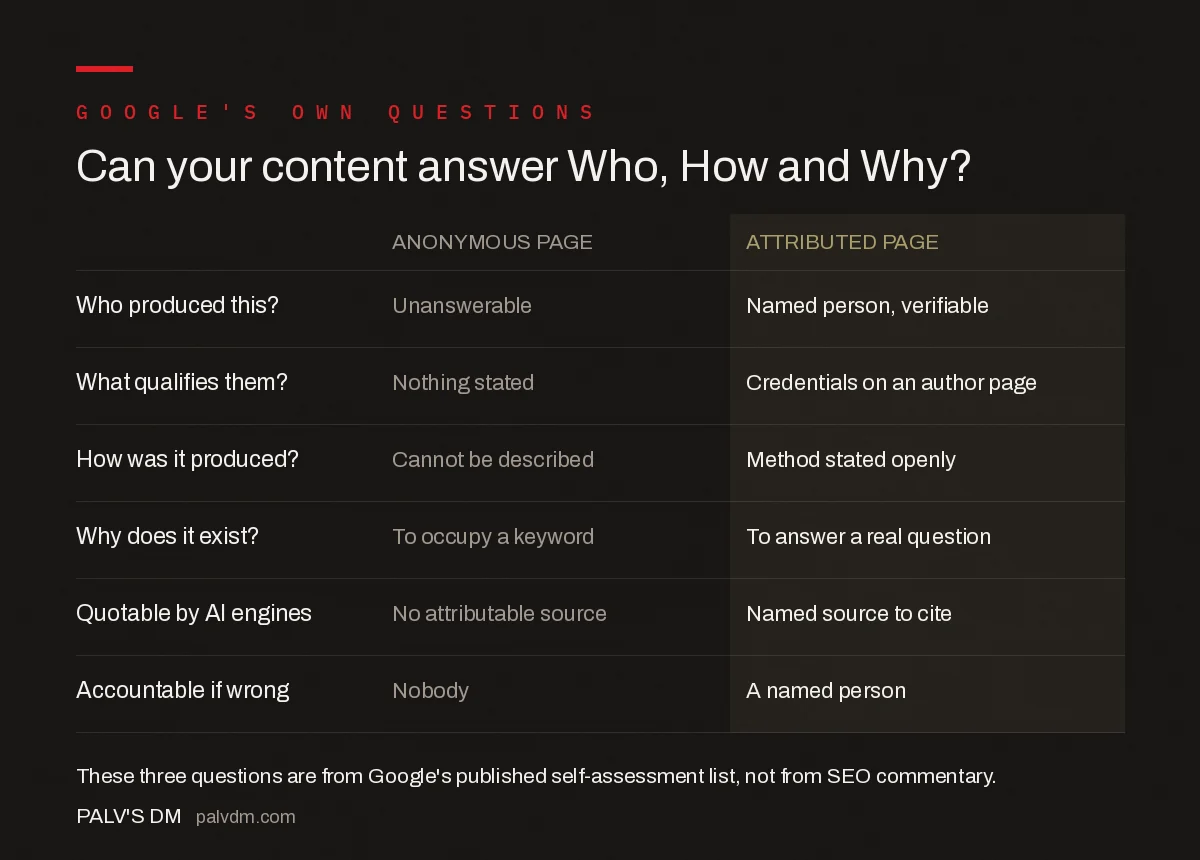
Can your content answer Who, How and Why?
| Anonymous page | Attributed page | |
|---|---|---|
| Who produced this? | Unanswerable | Named person, verifiable |
| What qualifies them? | Nothing stated | Credentials on an author page |
| How was it produced? | Cannot be described | Method stated openly |
| Why does it exist? | To occupy a keyword | To answer a real question |
| Quotable by AI engines | No attributable source | Named source to cite |
| Accountable if wrong | Nobody | A named person |
Frequently asked questions
Does Google rank anonymous content lower?
Google has not confirmed an author authority score and has denied that an AuthorRank exists. What is documented is that Google’s published self-assessment questions ask who created the content and whether it demonstrates first-hand expertise, and that anonymous content cannot answer that question. The effect is structural rather than a named ranking penalty.
What are Google's Who, How and Why questions?
They are part of Google’s published guidance on creating helpful content. Who created it — is that clear to a reader, and does it show first-hand expertise? How was it produced — could you describe the process, including any automation, without embarrassment? Why does it exist — to help people, or primarily to attract search traffic? Google points site owners to these after every core update.
Does an author byline actually help SEO?
A byline alone does very little. What matters is whether a sceptical reader could verify the expertise claim in about thirty seconds: a real full name, a substantive author page with specific checkable credentials, corroborating profiles elsewhere, a defined topic area, and Person schema linking it together. “By Admin” linking to an empty archive page is decoration rather than a signal.
Can I use AI to write content and still rank?
Google’s stated position is that it focuses on content quality rather than how content was produced. Its own “how” question asks whether you could describe your process without embarrassment. A named person who directs, verifies and takes responsibility for AI-assisted content can answer that honestly. An unreviewed pipeline publishing under no name cannot, and that is the distinction that matters.
Does author attribution affect AI search citations?
Yes, and this is where anonymity costs twice. Generative engines cite sources, and a named expert is a stronger thing to attribute a claim to than an unattributed page. Research published at KDD 2024 found that adding quotations from named sources, alongside statistics and citations to authoritative sources, raised visibility in generative answers by up to around 40%.
Sources
- Creating helpful, reliable, people-first content — Google Search Central
- Google Search Quality Rater Guidelines
- GEO: Generative Engine Optimization (Aggarwal et al., KDD 2024)
Want this done on your site?
Every PalV’s DM engagement starts with a free audit of your actual website — a 12-point
crawl covering what is blocking indexation, on-page gaps against your primary keywords, speed
findings, and the three to five fixes worth making first. Delivered in two working days. No
payment details, and the findings are yours whether you hire us or not.