A/B Testing With Low Traffic: Is Your Sample Size Big Enough?
Most sites do not get enough traffic for a valid A/B test. Here is the real sample size math, the peeking problem, and what to run instead.
If your site gets under 10,000 visitors a month, most A/B tests you run will not reach honest statistical significance in any reasonable timeframe, and calling an early “winner” is usually noise dressed up as a result. That’s not a reason to give up on testing. It’s a reason to be far more selective about what you test and how long you let it run.
The uncomfortable truth about A/B testing is that most of the tooling makes it look easy: install the script, set up two variants, wait for a green “significant” banner. What that banner doesn’t show you is the sample size math underneath it, and on lower-traffic sites, that math is often working against you long before you hit publish.
How much traffic do you actually need to run a valid test?
It depends heavily on your baseline conversion rate and how big a change you’re trying to detect, but the pattern holds across most calculators: the less traffic you have, the bigger the effect has to be before you can trust it. Sites under 10,000 monthly visitors generally need something in the neighbourhood of a 30% lift or larger to reach reliable significance without running the test for months. Sites between 10,000 and 100,000 visitors still typically need close to a 9% lift. That rules out a lot of the small, cosmetic changes CRO blog posts love to feature, a button colour swap is very unlikely to move the needle by 30%, so testing it on a low-traffic site is usually a waste of the traffic you do have.
Minimum Detectable Effect by Monthly Traffic
| Monthly visitors | Realistic minimum lift to detect | What this rules out |
|---|---|---|
| Under 10,000 | Roughly 30%+ | Micro-copy, colour, minor layout tweaks |
| 10,000 to 100,000 | Roughly 9%+ | Subtle wording changes, small form tweaks |
| 100,000+ | 5% or smaller, often testable | Fewer restrictions, but still requires a real hypothesis |
Those numbers are directional, not a formula you should plug your own conversion rate into blindly. Run your actual baseline conversion rate and target lift through a proper sample size calculator before committing traffic to any test; the shape of the pattern above holds, but your specific number will move around depending on how rare your conversion event is.
What happens when you call a winner too early?
This is the part most teams get wrong, and it’s not a traffic problem, it’s a discipline problem. Checking a test daily and declaring victory the moment the dashboard shows 95% significance is called peeking, and it dramatically inflates your false-positive rate. A test that would show significance for even a few hours during a noisy stretch of data gets treated as done, when a few more days of traffic would have pulled it back toward “no real difference.”
The fix isn’t complicated, it’s just unpopular: decide your sample size and test duration before launching, and don’t look at the result as a decision point until you hit that number. Most testing platforms will let you set this up as a fixed-horizon test rather than continuous monitoring. If your organisation genuinely can’t resist checking daily, at minimum commit to running every test for two full business cycles, typically two to four weeks, so weekday and weekend behaviour both get represented before anyone reads the scoreboard.
Marketing calendars make this worse than it needs to be. A launch gets scheduled, a test gets set up two days before, and by day nine someone on the leadership call asks for a result because the roadmap says the decision was due. Nine days of data on a site doing a few hundred conversions a month was never going to be enough, no matter how good the tooling is. The honest answer in that meeting is “not yet,” and saying it consistently is what actually builds trust in the testing program over time, not the alternative of shipping a confident-sounding number that turns out to be noise three weeks later.
How do you calculate sample size before starting?
Four inputs feed every standard calculator: your baseline conversion rate, the minimum lift you actually care about detecting, your significance level (95% is the near-universal default), and your statistical power (80% is standard, meaning you accept a 20% chance of missing a real effect that’s actually there). Plug those into any reputable free calculator and it will tell you the sample size per variant and, combined with your daily traffic, the number of days the test needs to run.
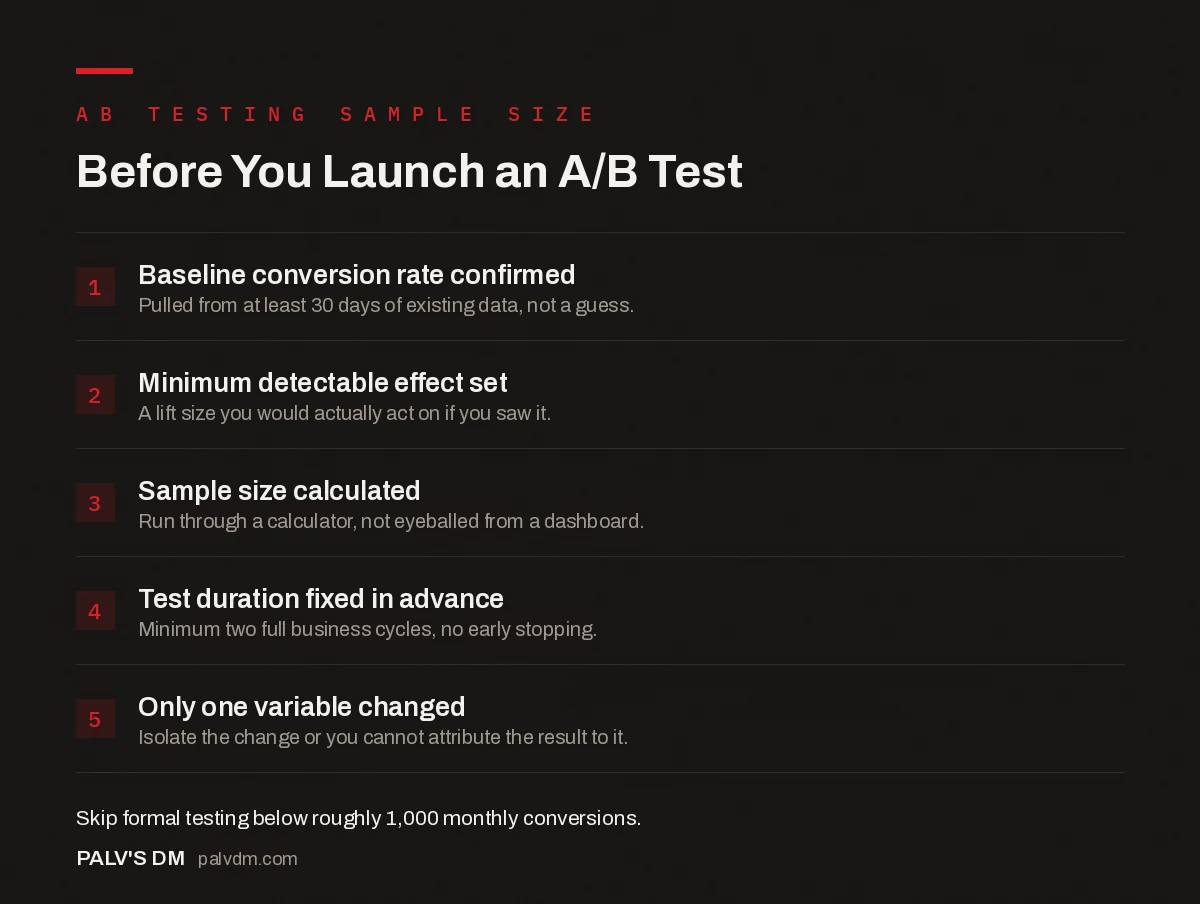
Before You Launch an A/B Test
- Baseline conversion rate confirmed. Pulled from at least 30 days of existing data, not a guess.
- Minimum detectable effect set. A lift size you would actually act on if you saw it.
- Sample size calculated. Run through a calculator, not eyeballed from a dashboard.
- Test duration fixed in advance. Minimum two full business cycles, no early stopping.
- Only one variable changed. Isolate the change or you cannot attribute the result to it.
On client accounts under a certain traffic threshold, I’ll flatly tell people to skip formal testing and act on qualitative evidence plus a clear hypothesis instead. Running a test you know can’t reach real significance and then reporting the result as if it can just trains a team to distrust data later.
What should you do instead if your traffic doesn’t support testing?
- Session recordings and heatmaps. Watching twenty real sessions on your checkout page will surface friction a split test would need thousands of visitors to detect statistically.
- On-site exit surveys. A single well-placed question (“What almost stopped you from completing this?”) on an exit-intent trigger gives you direct qualitative reasons, not just a percentage.
- Five-second and first-click usability tests. Cheap, fast, and they tell you whether visitors even understand what a page is asking them to do before you worry about conversion percentages.
- Direct customer interviews. Ten structured conversations with recent customers (or people who almost bought and didn’t) routinely surface bigger, more obvious problems than a marginal A/B test would have found anyway.
- Sequential or before/after analysis, held to a lower confidence bar. Make the change, watch the trend over a full business cycle, and treat it as informed judgment rather than proof.
Does Bayesian or sequential testing solve the traffic problem?
Partially, and it’s worth understanding what it does and doesn’t fix. Bayesian methods report a probability that variant B beats variant A, updated continuously, rather than a binary significant/not-significant flag, which handles the peeking problem far more gracefully than frequentist testing does. Sequential testing frameworks are built specifically to let you check results as they come in without inflating false positives the way naive peeking does.
Neither approach conjures visitors that don’t exist. If your underlying sample is small, a Bayesian read will honestly show you a wide, uncertain probability range instead of a false-confidence green banner, which is actually the more useful outcome: it tells you the truth about your uncertainty instead of hiding it behind an arbitrary p-value threshold. If your CRO platform supports it and your team understands how to read the output, it’s worth adopting. It’s not a shortcut around needing enough data.
Frequently asked questions
How many conversions do I need before trusting an A/B test result?
A common working minimum is around 300 conversions per variation, though the real number depends on your baseline conversion rate and how big a lift you’re trying to detect. Below roughly 100 conversions per variant, treat any result as a hypothesis to investigate further, not a decision to act on.
Can I stop a test early if it looks like a clear winner?
No, not based on a mid-test significance reading. Checking results daily and stopping the moment a variant crosses 95% significance is called peeking, and it inflates your false-positive rate substantially, sometimes to the point where a coin-flip test “wins” more often than chance alone would suggest.
What traffic level is too low for A/B testing?
Under roughly 10,000 visitors a month, you’d typically need a 30%+ lift for a test to reach reliable significance in a reasonable timeframe, which rules out testing subtle changes like button colour. Under 1,000 monthly conversions total across the funnel, formal split testing usually isn’t the right tool at all.
Does Bayesian testing fix the low-traffic problem?
It changes how results are interpreted, not the underlying data problem. Bayesian methods can give you a probability-to-be-best reading earlier and handle peeking more gracefully than classic frequentist significance testing, but they can’t manufacture visitors you don’t have. Low sample sizes still produce wide, unreliable estimates either way.
What should I do instead of A/B testing if my site gets under 1,000 visitors a month?
Lean on qualitative signals: session recordings, on-site exit surveys, five-second usability tests, and direct customer interviews. These won’t give you a statistically confident percentage lift, but they reliably surface the friction points worth fixing, which is usually the actual goal anyway.
Sources
- AB Testing Sample Size: The 4 Levels of Difficulty, Convertize
- How To Calculate A/B Testing Sample Size, Invesp
- Core Web Vitals: LCP, INP and CLS Explained Properly
- Conversion Rate Optimisation for Small Traffic Sites
- Heatmaps and Session Recordings: Reading Them Correctly
- SEO and CRO in Conflict: Resolving the Common Fights
Want this done on your site?
Every PalV’s DM engagement starts with a free audit of your actual website — a 12-point
crawl covering what is blocking indexation, on-page gaps against your primary keywords, speed
findings, and the three to five fixes worth making first. Delivered in two working days. No
payment details, and the findings are yours whether you hire us or not.
Get your free SEO audit
See Web Development plans and prices