Conversion Rate Optimisation for Small Traffic Sites: What Actually Works
CRO for low-traffic sites means fewer A/B tests and more customer conversations, usability checks, and high-impact fixes made without a split test.
CRO on a low-traffic site works by shifting away from split testing and toward qualitative research, high-impact changes, and fixing obvious friction that would help conversion at any traffic level. Most CRO advice online assumes a store or SaaS product pushing tens of thousands of monthly visitors through a funnel. Under a few hundred visitors a month, that playbook doesn’t just underperform, it can’t even finish running.
The instinct when conversions feel low is to reach for an A/B testing tool. That’s usually the wrong first move at this scale. A test that never reaches significance isn’t neutral, it’s actively misleading, because a “winner” declared on forty conversions per variant is closer to a coin flip than a finding.
Why doesn’t standard CRO advice work below a certain traffic level?
Statistical significance needs volume. A page converting in the low single digits typically needs somewhere around a thousand or more conversions per variant to reliably detect a 10 to 20% lift at a normal confidence level. A site doing 300 visitors and nine conversions a month would need years to reach that on one test, let alone the five or six a real CRO programme runs through in a year.
Run the test anyway and you’ll get an answer. It just won’t be a trustworthy one. Calling a variant a winner off a handful of extra conversions is how sites end up “optimising” their way into a worse layout, confident the data said so.
What should you do instead of A/B testing?
Talk to people. Five to ten short conversations with actual customers, or people who bounced without converting, will surface more useful insight than months of dashboard-watching at this traffic level. Ask what almost stopped them from buying or filling out the form. Ask what they expected to see and didn’t. That single activity routinely outperforms every quantitative tool available to a small site, because the sample doesn’t need to be statistically valid to be useful, it needs to be honest.
Pair that with a small, structured usability session: hand the site to five people who’ve never seen it and watch them try to complete the main action. Nielsen Norman Group’s long-standing research found that five test users typically surface around 85% of a site’s usability problems. That number holds up because most usability issues aren’t subtle; they’re obvious once you watch a real person hesitate at the exact same spot three times in a row.
What to do with limited traffic
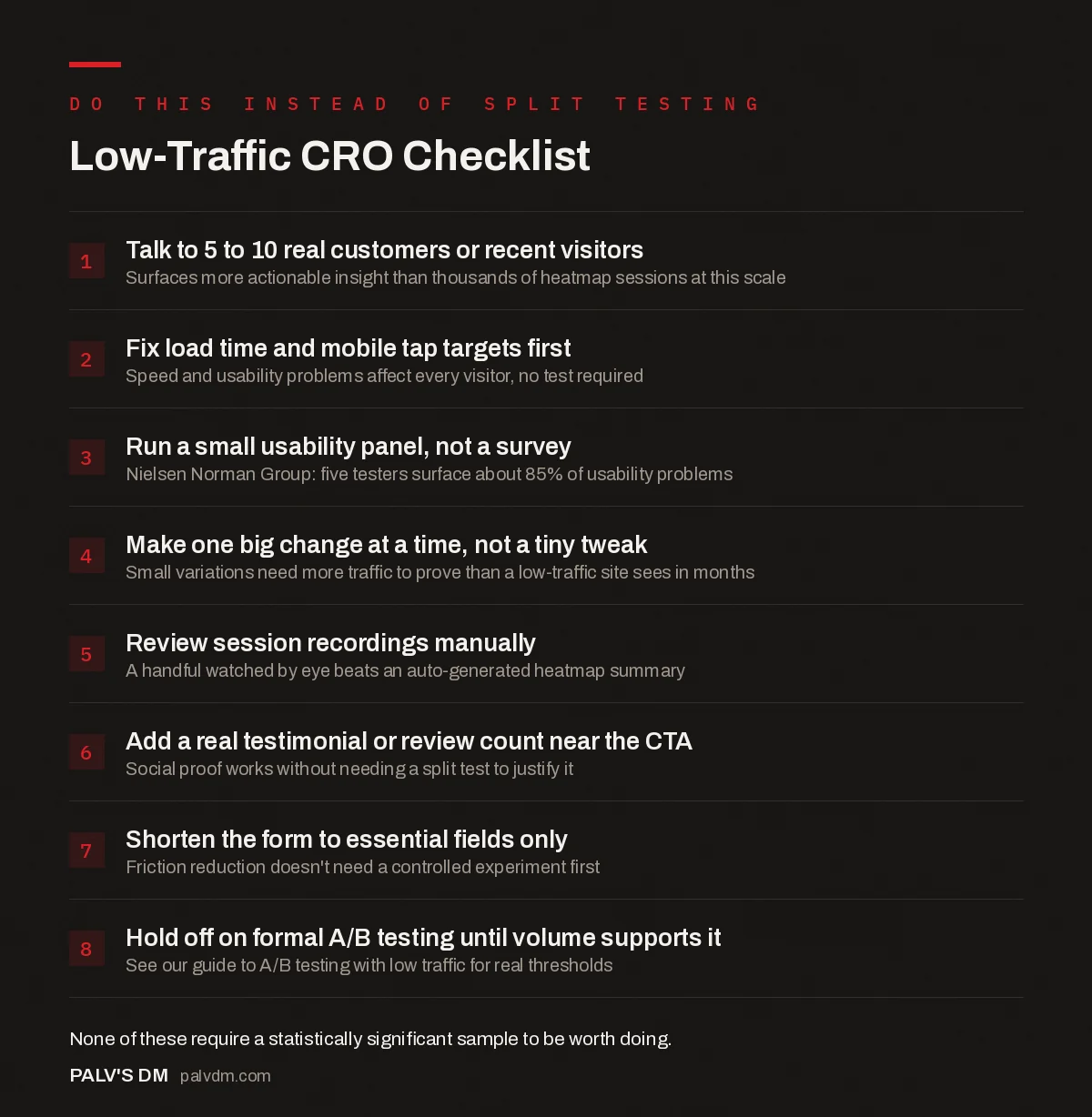
Low-Traffic CRO Checklist
- Talk to 5 to 10 real customers or recent visitors. Surfaces more actionable insight than thousands of heatmap sessions at this scale.
- Fix load time and mobile tap targets first. Speed and usability problems affect every visitor, no test required.
- Run a small usability panel, not a survey. Nielsen Norman Group: five testers surface about 85% of usability problems.
- Make one big change at a time, not a tiny tweak. Small variations need more traffic to prove than a low-traffic site sees in months.
- Review session recordings manually. A handful watched by eye beats an auto-generated heatmap summary.
- Add a real testimonial or review count near the CTA. Social proof works without needing a split test to justify it.
- Shorten the form to essential fields only. Friction reduction doesn’t need a controlled experiment first.
- Hold off on formal A/B testing until volume supports it. See our guide to A/B testing with low traffic for real thresholds.
Which changes are worth making without testing them first?
Anything that’s obviously broken doesn’t need a controlled experiment to justify fixing. Slow page load, a submit button that’s hard to tap on mobile, a form asking for a phone number before anyone’s decided to buy anything, these hurt conversion at any traffic level and the evidence for fixing them exists independently of your own site’s data. Our Core Web Vitals guide covers the speed side of this in detail, and it’s usually the biggest-impact fix on a small site because it costs nothing to visitors who were never going to notice an “improvement,” they just stop leaving.
The other category worth prioritising without a test is anything low-risk with strong prior evidence from elsewhere: a visible star rating or review count near the CTA, a shorter form, clearer above-the-fold copy that states what you do in the first sentence instead of the third paragraph. None of these need your own site to prove them from scratch. They’re well-established enough that testing them on 300 monthly visitors just delays a change you should make anyway.
How do you get real feedback from a small number of visitors?
Watch session recordings by eye rather than trusting an aggregated heatmap. On a low-traffic site, a heatmap tool averages together forty or fifty sessions and calls the result a pattern. It isn’t one yet. I’ve reviewed heatmap reports for clients doing under 500 monthly visitors that showed a lot of confident-looking red blobs and almost nothing that changed a real decision, because the underlying sample was individuals, not a trend. Watching ten actual recordings, start to finish, tells you more in twenty minutes than that report does in a glance. For more on reading these tools correctly, see our piece on heatmaps and session recordings.
Exit surveys and simple on-page polls also punch above their weight at low volume. A one-question popup asking “what almost stopped you from filling out this form” collects direct answers from the exact people you’re trying to convert, no statistical threshold required.
When does it make sense to start formal A/B testing?
Once you’re seeing enough monthly conversions to reach significance on a realistic timeline, usually a few hundred a month at minimum, and once you’ve already fixed the obvious friction points above. Testing before that stage isn’t wrong exactly, it’s just premature: you’re spending traffic you don’t have to spare on questions the qualitative work already answered. Our guide to A/B testing with low traffic covers the workarounds, like testing bigger changes, pooling traffic across similar page templates, and accepting a lower confidence threshold when a full 95% test genuinely isn’t achievable.
There’s also a quieter conflict worth naming here: CRO and SEO changes sometimes pull in different directions, a shorter page might convert better but rank worse. Our post on resolving SEO and CRO conflicts walks through how we prioritise when the two goals disagree.
What tools are actually worth paying for at this stage?
- A session recording tool with manual review. Hotjar or Microsoft Clarity’s free tiers are enough at low volume; the value is in watching recordings, not the automated summary.
- A simple one-question exit or on-page poll. Cheap, fast to set up, and produces direct customer language you can reuse in copy.
- Google Analytics 4 for funnel drop-off, not for testing. It tells you where people leave. It won’t tell you why, that’s what the conversations and recordings are for.
- A calendar reminder to talk to five customers this month. Not a tool, but the highest-return line item on this list by a wide margin.
Frequently asked questions
How much traffic do I need before A/B testing makes sense?
As a rough guide, a page converting at a few percent typically needs somewhere around a thousand or more conversions per test variant to reach reliable significance on a normal timeline. Below that, focus on qualitative research and fixing known friction instead of running formal split tests.
Is CRO even worth doing on a small site?
Yes, often more than on a high-traffic site. A store moving from a 1.5% to a 3% conversion rate doubles revenue from the same visitors, and fixing obvious friction costs nothing in traffic since it doesn’t require a test to justify.
What’s the single highest-ROI CRO activity for a low-traffic site?
Talking directly to five to ten recent customers or visitors who didn’t convert. It surfaces specific, actionable friction points faster and more reliably than any dashboard or heatmap tool can at this volume.
Can heatmaps still help if I don’t have much traffic?
They’re limited. An aggregated heatmap built from forty or fifty sessions can look like a pattern without being one. Watching individual session recordings by eye is more reliable at low volume than trusting the auto-generated summary.
Should I lower my statistical significance threshold to run tests sooner?
You can, and some low-traffic sites accept 80% confidence instead of 95% to move faster. Just be honest with yourself that a lower threshold means a real chance the “winner” isn’t actually better, so reserve it for low-risk changes. That’s fine for deciding between two button colours. It’s not fine for deciding whether to change your pricing.
Sources
- Why You Only Need to Test with 5 Users, Nielsen Norman Group
- How To Do A/B Split Testing on Low Traffic Sites, VWO
- How You Can Run A/B Tests on Low-Traffic Sites, Portent
- Core Web Vitals: LCP, INP and CLS Explained Properly
- A/B Testing With Low Traffic: Statistical Honesty
- Heatmaps and Session Recordings: Reading Them Correctly
- SEO and CRO in Conflict: Resolving the Common Fights
Want this done on your site?
Every PalV’s DM engagement starts with a free audit of your actual website — a 12-point
crawl covering what is blocking indexation, on-page gaps against your primary keywords, speed
findings, and the three to five fixes worth making first. Delivered in two working days. No
payment details, and the findings are yours whether you hire us or not.
Get your free SEO audit
See Web Development plans and prices