Trends & Industry Developments
AI Search Market Share: Who Is Actually Being Used
No verified ai search market share 2026 exists for ChatGPT, AI Overviews, Perplexity. Heres what usage patterns show and how to check your own site data.
There is no single trustworthy number for AI search market share in 2026, and anyone quoting you a precise percentage split between ChatGPT, Google’s AI Overviews, Perplexity, and Copilot is estimating, not measuring. Usage data lives inside each platform, most of it is never published, and the third-party panels that try to fill the gap disagree with each other by wide margins. What you can measure is which of these platforms actually sends traffic, crawls your pages, and cites your business — and that is a far more useful question than “who’s winning.”
Key takeaway
- No public, verified dataset breaks down AI search market share cleanly across ChatGPT, Google AI Overviews, Perplexity, Copilot, and Gemini — every figure you see quoted is a modelled estimate from a different methodology.
- The pattern that shows up consistently, based on distribution and access: Google’s AI Overviews reach the largest share of search queries by default, ChatGPT has the largest standalone consumer base, and Perplexity and Copilot serve narrower, more specific usage patterns.
- The actionable version of “market share” is your own referral logs, crawler logs, and citation checks — not an industry chart you can’t act on.
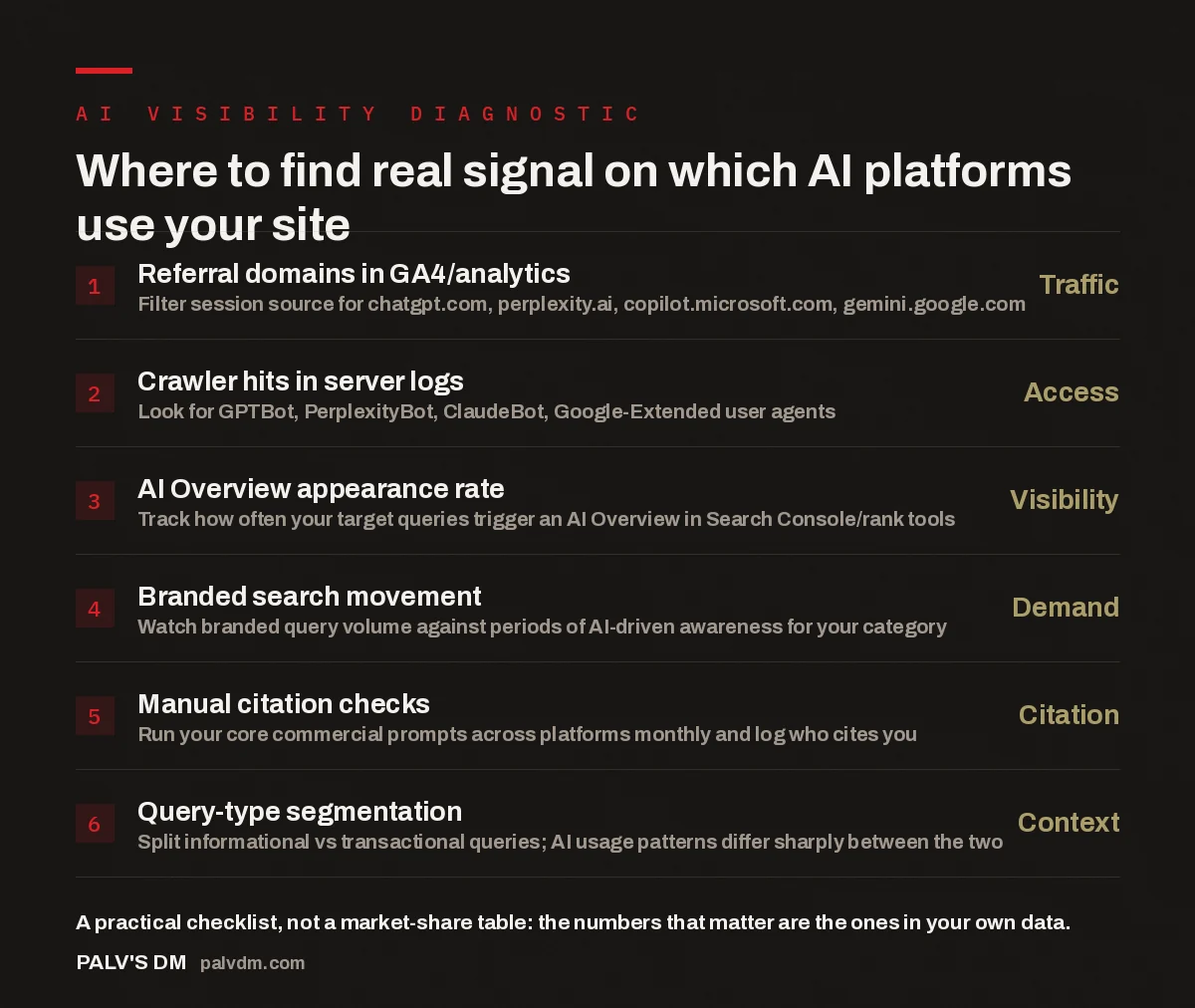
Where to find real signal on which AI platforms use your site
- Referral domains in GA4/analytics — Traffic. Filter session source for chatgpt.com, perplexity.ai, copilot.microsoft.com, gemini.google.com.
- Crawler hits in server logs — Access. Look for GPTBot, PerplexityBot, ClaudeBot, Google-Extended user agents.
- AI Overview appearance rate — Visibility. Track how often your target queries trigger an AI Overview in Search Console/rank tools.
- Branded search movement — Demand. Watch branded query volume against periods of AI-driven awareness for your category.
- Manual citation checks — Citation. Run your core commercial prompts across platforms monthly and log who cites you.
- Query-type segmentation — Context. Split informational vs transactional queries; AI usage patterns differ sharply between the two.
Why is there no single reliable AI search market share number?
Every AI platform measures usage differently, and almost none of them publish raw numbers. ChatGPT reports user counts in broad strokes at product events, not query volume by category. Google has never broken out how many searches trigger an AI Overview versus a classic result page, and it changes that rollout by query type, geography, and device without announcing it. Perplexity and Copilot are smaller, more specialised products with even less public reporting. When a research firm publishes a “market share” chart for AI search, it’s usually combining app-store estimates, web-traffic panels (which undercount mobile app usage badly), and self-reported surveys — three methodologies that don’t measure the same thing.
This isn’t a reason to ignore the question. It’s a reason to stop looking for one number and start looking at behaviour you can actually verify: what shows up in your analytics, what shows up in your server logs, and what happens when you run your own prompts against each platform.
What do we actually know about how AI search platforms are used?
A few things are well established, even without a precise percentage attached to them. Google’s AI Overviews reach the largest share of overall search queries by sheer distribution — switched on by default inside the world’s dominant search engine, appearing on top of results a user was already going to see, with no separate app to download. ChatGPT has the largest standalone consumer base of any AI assistant and is the product most people mean when they say “I asked AI” — it built that position as a destination in its own right, not bundled into an existing product. Microsoft’s Copilot rides distribution through Windows, Edge, and Microsoft 365, putting it in front of a large installed base in workplace contexts. Perplexity, despite far smaller absolute numbers, punches above its weight among people doing deliberate research — its positioning as an “answer engine” draws a self-selecting, research-heavy audience.
None of that tells you a market share percentage. It tells you where each platform’s usage is concentrated, which is the more useful thing for deciding where to invest your AI visibility effort.
| Platform | How people primarily access it | Where it shows up in your data |
|---|---|---|
| Google AI Overviews | Embedded automatically inside Google Search results | Rarely a referral domain — shows up as reduced organic CTR and impressions in Search Console |
| ChatGPT | Standalone app and site, increasingly a default assistant on some devices | Referral domain chatgpt.com; direct/brand traffic spikes after being cited |
| Perplexity | Standalone app and site positioned as a research-first answer engine | Referral domain perplexity.ai; disproportionately common on technical and comparison queries |
| Microsoft Copilot | Built into Windows, Edge, and Microsoft 365 | Referral domain copilot.microsoft.com or bing.com; skews toward work-context queries |
| Google Gemini | Standalone app plus embedded in Android and Workspace | Referral domain gemini.google.com; app-embedded usage is largely invisible to web analytics |
Clients keep asking us which AI platform matters most. The honest answer is: the one your buyers are actually using for your category, which you can only find out by checking your own logs, not by reading someone else’s market-share slide.
Palash, Founder, PalV’s DM
How can you tell which AI platforms are actually sending you traffic?
Start with referral traffic in whatever analytics platform you already use. AI platforms that route users out to source websites — ChatGPT, Perplexity, Copilot, Gemini — leave a referral domain behind, the same way any other website link does. Segment your traffic report by source and look specifically for chatgpt.com, perplexity.ai, copilot.microsoft.com, and gemini.google.com. In most accounts we work on, this traffic is small in absolute volume next to organic search, but it converts at a noticeably different rate — often higher, because the user arrives already having had their question partly answered.
Second, check your server logs for crawler activity, not just human visits. GPTBot, PerplexityBot, ClaudeBot, and Google-Extended each identify themselves in the user-agent string when they fetch your pages to build or refresh their models’ knowledge and retrieval indexes. A spike or steady presence from one of these tells you that platform is actively indexing your content, which is a leading indicator of whether it can cite you at all — a platform that never crawls you cannot cite you no matter how good your content is.
Third, run manual checks. Pick the five to ten questions your buyers are most likely to ask an AI assistant about your category, and ask them yourself, on each platform, on a recurring schedule. Log who gets mentioned, who gets linked, and how the phrasing changes over time. This is slower than pulling a report, but it is the only way to see the platforms — like Google AI Overviews and Gemini’s app-embedded usage — that don’t leave a clean referral trail in your analytics at all.
Does AI platform usage vary by query type and industry?
Yes, and this is where most generic “market share” commentary breaks down — it treats AI search as one undifferentiated activity, when the platform someone reaches for changes with what they’re trying to do. Broad informational and how-to questions are the queries most likely to surface a Google AI Overview, simply because they’re common enough for Google to have built confident coverage of them. Research-heavy, comparison-style questions — “best X for Y,” “how does A differ from B” — are where Perplexity shows up disproportionately often in the accounts we work on, matching its positioning as a tool built for exactly that. Work-context questions skew toward Copilot simply because that’s where people already are when the question comes up, inside Microsoft 365.
Industry matters too. B2B software and technical categories see more Perplexity and ChatGPT referral traffic than local services or e-commerce categories, where discovery still routes mostly through Google’s own surfaces. If you sell to a technical, research-inclined buyer, weighting your AI visibility work toward being citable on ChatGPT and Perplexity makes more sense than optimising narrowly for one surface. If your buyer is a local consumer comparing options quickly, Google’s AI Overviews still carry more of the weight.
What should this change about your AI visibility strategy?
Stop budgeting effort by market-share estimate and start budgeting it by evidence from your own data. If your logs show steady GPTBot and PerplexityBot crawl activity but almost no referral traffic from either domain, the fix is usually structural — your content isn’t being retrieved cleanly enough to be cited, even though it’s being read. If you see healthy AI Overview appearance rates for your target queries but falling organic clicks, that’s a zero-click pattern worth tracking on its own terms. Treat each platform as a separate, measurable channel, not as one line item called “AI search.”
This also means revisiting the question periodically rather than settling on an answer once. Platform usage shifts as products add features, change defaults, or expand into new regions — what was true about Copilot’s reach six months ago may not hold once a new default assistant ships on a major device line. Rerunning your referral, crawler, and citation checks on a set schedule keeps your view current instead of anchored to an old article.
Next step
If you don’t yet have a clean read on which AI platforms actually send you traffic and citations, that’s the starting point — not another market-share estimate.
For the broader shift behind these numbers, see our breakdown of what actually changed in search in 2026. For how often AI Overviews trigger across different query types, read how often AI Overviews appear, by query type. For how the traffic that does arrive from AI platforms behaves once it lands, see how AI referral traffic converts differently. To formalise the tracking approach above, our guide to building a multi-surface visibility scorecard walks through setting it up.
What is the actual AI search market share in 2026?
There is no single verified figure. No AI platform publishes raw query volume, and third-party estimates combine app downloads, web-traffic panels, and surveys using different methodologies that don’t agree with each other. The reliable answer for your business is what your own referral and crawler logs show, not a published percentage.
Which AI platform sends the most referral traffic to websites?
In most accounts we work on, ChatGPT and Perplexity are the two most common referral domains showing up in analytics, since both route users out to source pages more consistently than Google’s AI Overviews, which mostly keep the interaction inside the search results page.
Why don’t Google AI Overviews show up in my referral traffic?
AI Overviews are embedded directly in the Google Search results page rather than being a separate destination site, so a click-through (if one happens at all) still registers as organic Google traffic in most analytics setups, not as a distinct AI referral source. You need Search Console impression and click data, not referral reports, to see AI Overview impact.
How often should I recheck which AI platforms are using my content?
A quarterly check is a reasonable baseline for most businesses — enough to catch meaningful shifts without chasing every product update. If you operate in a fast-moving category or just launched a content push aimed at AI visibility, monthly checks for the first two quarters give you a faster read on whether it’s working.
Does AI platform usage differ between B2B and consumer categories?
Yes. Technical and B2B categories tend to see more ChatGPT and Perplexity referral activity, matching those platforms’ strength with research-heavy, comparison-driven queries. Local services and everyday consumer categories still route more heavily through Google’s own surfaces, including AI Overviews, because the buying decision is faster and less research-intensive.
Short version: nobody has a verified AI search market share number for 2026, and anyone giving you a clean percentage split is estimating. What’s well established is the shape of the usage — Google AI Overviews reach the broadest share of queries by default, ChatGPT leads standalone consumer usage, and Perplexity and Copilot serve narrower but distinct patterns tied to research and work contexts respectively. The number that actually matters for your business sits in your own referral logs, crawler logs, and manual citation checks — build the habit of reading those regularly instead of waiting for an industry report to tell you where to focus.