AI Visibility Tracking Tools: What Exists and What They Miss
Ahrefs Brand Radar, Profound, Otterly.ai and Peec AI compared on real features and pricing, plus the limitations none of them have solved yet.
AI visibility tools like Ahrefs Brand Radar, Profound, Otterly.ai and Peec AI track whether your brand gets mentioned and cited across ChatGPT, Gemini, Perplexity and Google’s AI features, but every one of them runs a sampled set of prompts, not a live feed of what any real customer actually sees. That distinction matters more than any feature comparison between them. Treat the numbers as directional signal, not as a rank tracker with decimal-point precision.
This category barely existed two years ago and it’s already crowded with venture-backed entrants making similar claims. Some of it is genuinely useful. Some of it is repackaged sentiment analysis with an AI label on it. Here’s what’s actually real, what it costs, and where the whole category still falls short.
What do these tools actually measure?
All of them work the same basic way: you (or the tool) define a library of prompts real customers might ask, the tool runs those prompts against AI platforms on a schedule, and it logs whether your brand shows up, how it’s positioned relative to competitors, and which sources the AI cited to generate the answer. The output is a visibility percentage, a position number, and often a sentiment score.
Where they differ is depth and honesty about limitations. Some tools distinguish a brand mention from a source citation, which matters because AI can pull from your content without ever naming your brand, and that distinction is invisible if a tool only reports one blended number. Others fold everything into a single visibility score, which is easier to read on a dashboard and harder to act on with any precision.
The tools worth knowing about
Ahrefs Brand Radar
Built on what Ahrefs calls the largest AI visibility database available, powered by 460 million-plus monthly search-backed prompts (not synthetically generated ones) across AI Overviews, AI Mode, ChatGPT, Copilot, Gemini, Perplexity and Grok. It also tracks sources on YouTube, TikTok and Reddit. Pricing runs $398/month for select platforms or $699/month for full access to all platforms plus 2,500 custom prompt checks monthly. This is the deepest data pool of the group, and priced accordingly.
Profound
Positions itself less as a tracker and more as a full AI marketing platform: Answer Engine Insights, Prompt Volumes, Agent Analytics (tracking how AI crawlers actually visit your site), and an “Aim” feature that surfaces prioritised work each week. It covers Perplexity, ChatGPT, Claude, Gemini, Grok, Microsoft Copilot, DeepSeek and Google AI Overviews. Pricing isn’t published; it’s a demo-and-quote enterprise sale, which tells you who it’s actually built for.
Otterly.ai
The most accessible entry point in this list. Pricing starts around $29/month with a 7-day free trial and no credit card required, tracking ChatGPT, Google AI Overviews, Google AI Mode, Gemini, Microsoft Copilot, Claude and Perplexity. It’s rated 4.8/5 on G2 and was named a Cool Vendor in Gartner’s 2025 AI in Marketing report. Otterly is also unusually upfront in its own FAQ about a limitation the whole category shares: AI platforms personalise results using account memory, so a neutral tool query won’t always match what an individual user sees.
Peec AI
Tracks ChatGPT, Perplexity and Gemini (with more models selectable), refreshing each tracked prompt once every 24 hours for consistent day-over-day trend data. It reports three core metrics: Visibility, Position and Sentiment, and separately distinguishes a “used” source (informed the answer) from a “cited” one (explicitly named), which is a more precise distinction than most competitors draw. Rated 4.9/5 on G2. Pricing sits on a separate page rather than the homepage, worth checking directly before committing.
Ahrefs AI Visibility Checker (free)
A free, one-off snapshot tool rather than an ongoing tracker, useful for a quick gut check on whether your brand shows up at all before paying for anything on this list.
Comparing the paid tools at a glance
| Tool | Platforms tracked | Starting price |
|---|---|---|
| Ahrefs Brand Radar | AI Overviews, AI Mode, ChatGPT, Copilot, Gemini, Perplexity, Grok | $398/mo |
| Profound | Perplexity, ChatGPT, Claude, Gemini, Grok, Copilot, DeepSeek, AI Overviews | Custom, sales-led |
| Otterly.ai | ChatGPT, AI Overviews, AI Mode, Gemini, Copilot, Claude, Perplexity | ~$29/mo |
| Peec AI | ChatGPT, Perplexity, Gemini, additional selectable models | See pricing page |
AI visibility tool evaluation checklist
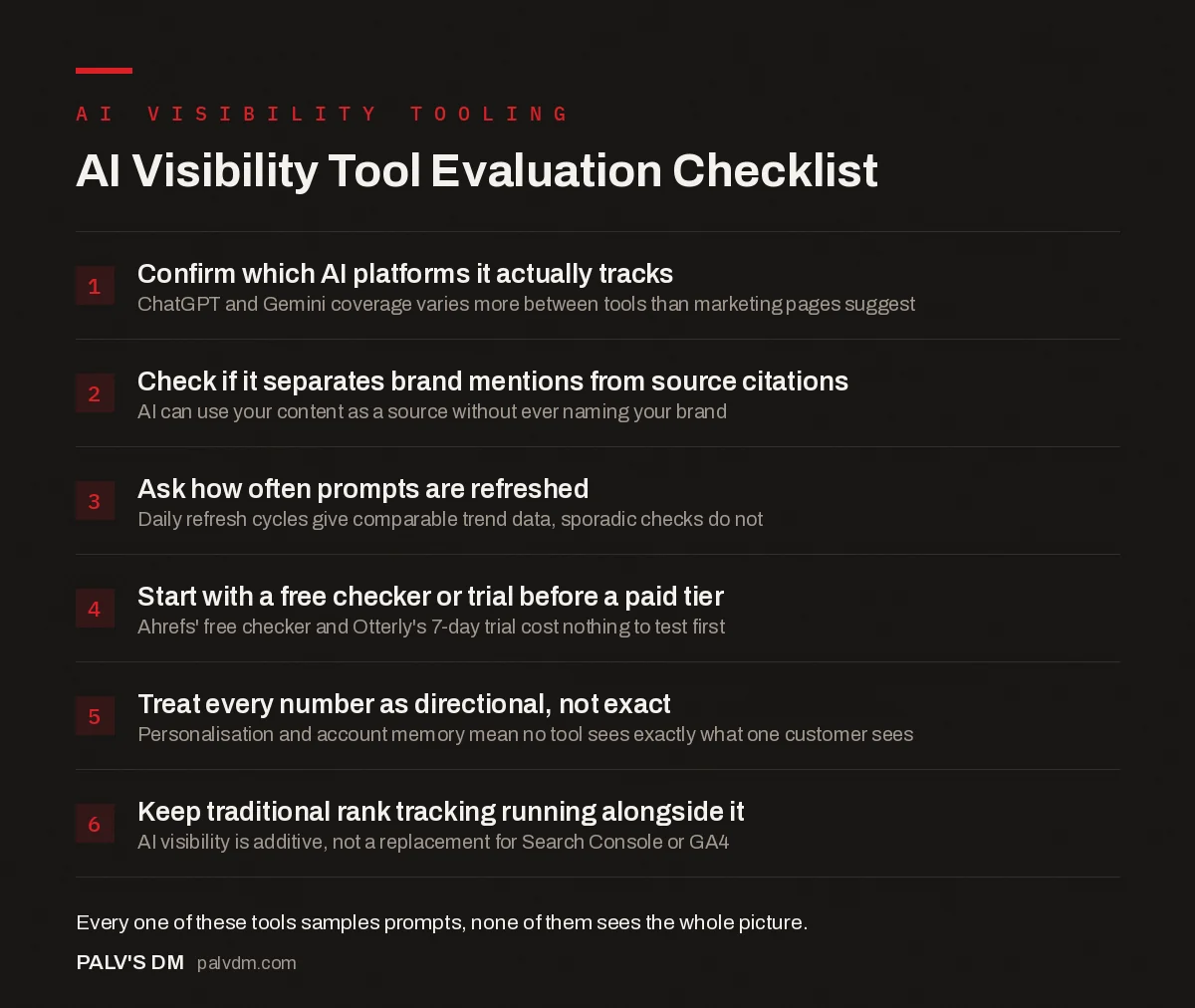
AI Visibility Tool Evaluation Checklist
- Confirm which AI platforms it actually tracks. ChatGPT and Gemini coverage varies more between tools than marketing pages suggest.
- Check if it separates brand mentions from source citations. AI can use your content as a source without ever naming your brand.
- Ask how often prompts are refreshed. Daily refresh cycles give comparable trend data, sporadic checks do not.
- Start with a free checker or trial before a paid tier. Ahrefs’ free checker and Otterly’s 7-day trial cost nothing to test first.
- Treat every number as directional, not exact. Personalisation and account memory mean no tool sees exactly what one customer sees.
- Keep traditional rank tracking running alongside it. AI visibility is additive, not a replacement for Search Console or GA4.
What does every one of these tools still miss?
- Personalisation and memory. Every major AI platform now uses conversation history and account-level context to shape answers. A logged-out, neutral prompt run by a tracking tool is a reasonable proxy, not a guarantee of what an actual logged-in customer sees.
- Cross-tool disagreement. Ask two of these tools about the same brand and expect different visibility percentages, because each one runs a different prompt library at a different sampling rate. This is the exact same problem backlink index tools have had for a decade, now applied to a newer data source.
- Weak causal link to revenue. A rising visibility score is encouraging, but almost none of these tools can currently draw a clean line from “AI mentioned us” to “this specific customer bought because of it.” Referral tracking from AI platforms to your site is still immature across the board.
- Category volatility. AI platforms change their retrieval and citation behaviour without warning far more often than Google changes its ranking algorithm publicly. A methodology that worked last quarter can silently produce different-looking results this quarter for reasons that have nothing to do with your actual visibility.
- Price that outpaces proven ROI for smaller businesses. $398 to $699 a month is a real commitment before you have evidence AI referral traffic matters to your specific business. Start with a free checker or a low-cost trial before scaling spend here.
None of this makes the category useless. It makes it young. Treat every number from every one of these tools as a trend indicator worth watching over months, not a precise measurement worth defending in a boardroom.
Do these replace traditional rank tracking, or sit alongside it?
Alongside, not instead of. Traditional rank tracking still tells you where you sit in classic blue-link search results, which is still where a large share of commercial searches land, whatever the AI Overview coverage headlines suggest this week. AI visibility tools answer a genuinely different question: does the AI itself recommend you when someone asks a conversational, often longer question instead of typing a keyword. Both matter. Neither one is a substitute report for the other, and a client asking to drop Search Console in favour of an AI visibility dashboard is optimising for the wrong risk.
We’ve watched clients get seduced by the newer, shinier dashboard and quietly stop checking the boring one that still drives most of their actual traffic. Don’t do that. AI visibility is additive budget and additive attention, not a replacement line item for the tools you already rely on.
How should you actually pick between them?
Match the tool to what you can act on, not to whoever has the biggest prompt database. If you don’t have a content or PR team ready to respond to what the data shows, Ahrefs’ free checker and Otterly’s low-cost trial tier will tell you everything you need for months. If you’re already running structured GEO work and need to prove it to a client or a board, the $398-plus tier tools earn their keep through data depth and reporting polish, not through some capability the cheaper tools lack outright.
Frequently asked questions
What do AI visibility tools actually track?
They run a set list of prompts against AI platforms like ChatGPT, Gemini, Perplexity and Google AI Overviews on a schedule, then record whether your brand gets mentioned, cited as a source, and how it’s positioned relative to competitors in the answer.
Is there a free AI visibility tracking tool?
Ahrefs offers a free AI Visibility Checker that gives a one-off snapshot, and Otterly.ai offers a 7-day free trial with no credit card required. Neither replaces ongoing paid tracking, but both are enough to see whether the category is worth investing in before committing.
Why do two AI visibility tools show different numbers for the same brand?
Different prompt libraries, different sampling frequency, and different definitions of a mention or citation. It’s the same problem backlink tools have always had: each one crawls and counts differently, so the number is directionally useful within one tool, not a universal fact to compare across tools.
Can these tools show me exactly what a specific customer sees in ChatGPT?
No, and this is the most important limitation of the whole category. AI platforms personalise answers using conversation history and account-level memory, so a tool’s neutral, logged-out query result can differ from what any individual user actually sees.
Are AI visibility tools worth the cost for a small business?
Often not at the enterprise price points. Tools like Otterly.ai starting around $29 a month are realistic for a small business testing the waters; the $398 to $699 a month tier some competitors charge makes more sense once AI-driven traffic is already a measurable part of your funnel.
Sources
- Ahrefs Brand Radar, official product page
- Otterly.ai, official product page and FAQ
- Generative Engine Optimisation (GEO): The Complete Guide
- Building Your Own AI Citation Tracker in a Spreadsheet
- How to Verify a Tool’s Data Before You Trust It
- SEMrush vs Ahrefs: Choosing Between Them
Want this done on your site?
Every PalV’s DM engagement starts with a free audit of your actual website — a 12-point
crawl covering what is blocking indexation, on-page gaps against your primary keywords, speed
findings, and the three to five fixes worth making first. Delivered in two working days. No
payment details, and the findings are yours whether you hire us or not.