Sites That Get Cited by AI Without Ranking Page One
Only around 17% of AI Overview citations came from organic top-ten results in early 2026, down from 76% in mid-2024. Why citation is a contest craft can win.
Sites get cited by AI engines without ranking on page one routinely — and the data on this is striking. Only around 17% of AI Overview citations came from organic top-ten results in early 2026, down from roughly 76% in mid-2024. That means the large majority of AI citations now go to pages that aren’t ranking at the top for the query. Ranking and citation have genuinely decoupled, which is simultaneously the biggest opportunity and the biggest measurement problem in AI visibility.
Key takeaway
- Only around 17% of AI Overview citations came from organic top-ten results in early 2026, down from roughly 76% in mid-2024.
- Most AI citations now go to pages that don’t rank at the top — citation is a separate contest you can win independently.
- This means rank tracking can’t tell you your AI visibility, and smaller sites can compete on citability rather than authority.
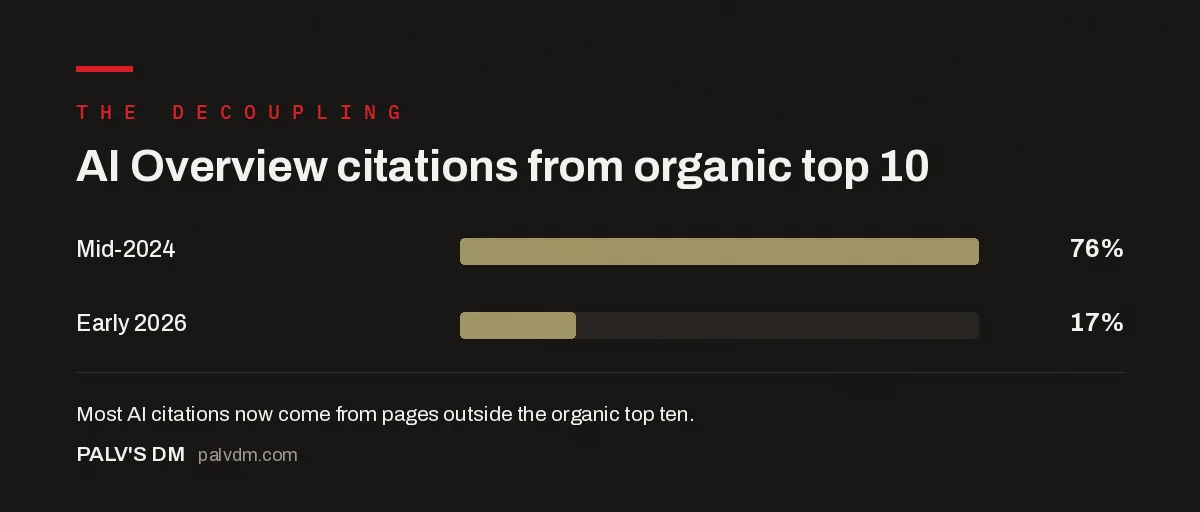
AI Overview citations from organic top 10
| Metric | Value |
|---|---|
| Mid-2024 | 76% |
| Early 2026 | 17% |
Source: BrightEdge analysis via industry reporting, 2026
The decoupling, in numbers
Analysis reported through BrightEdge and industry coverage tracked the share of AI Overview citations coming from organic top-ten results falling from roughly 76% in mid-2024 to around 17% by early 2026, with other analyses placing the current figure in a 17–38% range depending on methodology and vertical. Whichever end you take, the direction is unambiguous and the implication is the same: the majority of pages being cited in AI answers are not the pages ranking first for those queries.
76% → 17%
The share of AI Overview citations drawn from organic top-ten results, mid-2024 to early 2026. Ranking position has stopped being a reliable predictor of whether an AI answer cites you.
Source — BrightEdge analysis via industry reporting, 2026
Why a lower-ranked page gets picked
Ranking and citation optimise for different things. Ranking weighs authority, links, overall page relevance and dozens of other signals to order whole pages. Citation asks a narrower question: which passage best and most confidently answers this specific sub-question? A page ranking eleventh may contain one section that directly, cleanly and credibly answers exactly what the engine needs — a specific figure with a source, a self-contained explanation — while the top-ranked page buries the same point in three hundred words of preamble. Passage quality beats page authority in that contest.
Two consequences worth internalising
Rank reports can’t measure AI visibility. If most citations come from outside the top ten, your ranking dashboard tells you almost nothing about whether AI engines name you. You need prompt-based measurement — share of citation against a fixed set — as a separate instrument.
Smaller sites can compete. Out-ranking an established competitor may take years of authority building. Writing a better, clearer, better-sourced passage on a specific question is achievable now. Citation is a contest where craft can beat scale.
What to do with the opportunity
Target the specific questions where you can genuinely produce the best passage, rather than only chasing high-authority head terms. Structure each answer to be extractable — direct opening, self-contained, no orphan pronouns — and back it with a sourced statistic or named quotation so the engine can ground on it confidently. Then measure by citation rather than rank, so you can see wins your ranking reports would miss entirely. Ranking still matters for traditional traffic and shouldn’t be abandoned; the point is that it’s no longer the only board you’re playing on.
Frequently asked questions
Can you get cited by AI without ranking on page one?
Yes, and it’s now the norm. Only around 17% of AI Overview citations came from organic top-ten results in early 2026, down from roughly 76% in mid-2024, meaning most cited pages don’t rank at the top for the query. Citation asks which passage best answers a specific sub-question, which a lower-ranked page can win.
Why do lower-ranked pages get cited over top results?
Because ranking and citation optimise for different things. Ranking orders whole pages by authority, links and overall relevance. Citation asks which passage most clearly and credibly answers a specific question. A page ranking eleventh with a direct, self-contained, well-sourced section can beat a top-ranked page that buries the same point in preamble.
Does this mean rankings don’t matter anymore?
No — rankings still drive traditional organic traffic and remain worth pursuing. What’s changed is that rankings no longer predict AI citation, so you can’t use rank reports to measure AI visibility. Treat them as two related but separate contests, tracked with different instruments: rank tracking for organic position, share of citation for AI presence.
How can a smaller site compete for citations?
By competing on passage craft rather than domain authority. Out-ranking an established competitor can take years; writing a clearer, better-sourced, more directly-answering passage on a specific question is achievable now. Target questions where you can genuinely produce the best answer, make it extractable and concretely sourced, and measure by citation rather than rank.
The bottom line
Most AI citations now go to pages outside the organic top ten, a reversal from mid-2024. That breaks rank tracking as a proxy for AI visibility and opens a contest where the best-written, best-sourced, most extractable passage wins regardless of domain authority. Target specific questions, build passages engines can confidently lift, and measure citation directly.
We win citations on passage quality, not just domain authority — and measure them properly. Part of our AI Visibility service.