Content Governance for a Team of Five or More
A practical content governance framework: roles, workflow stages, and a document template for teams that have outgrown ad hoc coordination.
Content governance is the set of rules that decide who can create, approve, publish, and retire content once more than a handful of people touch your blog or website. Below five contributors, most teams manage fine with a shared doc and a Slack thread. Above that, informal coordination breaks down: posts go live without review, style drifts between writers, old pages sit unowned for years, and nobody can say who’s responsible when a page is factually wrong. Governance fixes this with defined roles, a documented workflow, and a standard for what “ready to publish” actually means.
Published August 2026.
Why does content governance start to matter at five people?
At four people or fewer, everyone usually knows what everyone else is working on. One person can hold the whole content calendar in their head, catch a style inconsistency in passing, and remember why a particular page exists. That informal oversight stops scaling around the fifth regular contributor, whether that’s five in-house staff, or two staff plus three freelancers, because no single person is still reading everything before it goes live.
The failure mode isn’t dramatic. It’s usually a slow accumulation: three different writers using three different terms for the same product feature, a guest contributor publishing a post that contradicts a claim on the pricing page, an old blog post still live three years after the product it describes was discontinued. None of these individually is a crisis. Together, across fifty or a hundred posts, they erode trust in the site faster than any single bad post could.
What roles does a content governance framework actually need?
Most teams need four functions covered, though one person can hold more than one role in a smaller org. The point isn’t headcount, it’s making sure each function has a named owner rather than being everyone’s job and therefore nobody’s.
| Role | Responsible for | Typical owner |
|---|---|---|
| Content strategist | What gets made, in what order, tied to which keyword or business goal | Marketing lead or SEO manager |
| Writer / creator | Drafting to the brief, following the style guide | In-house writer or freelancer |
| Editor | Accuracy, tone consistency, structural quality before publish | Senior writer or content manager |
| Publisher / approver | Final sign-off, especially for claims, pricing, or legal-adjacent topics | Marketing manager or founder, depending on team size |
Smaller teams often merge editor and publisher into one role. The risk in merging is that the same person who wrote a weak section is also the one approving it, so if headcount allows, keep drafting and final approval separated by at least one person.
What a governance document should cover
- Ownership: who is accountable for the blog overall, and who owns each content pillar or cluster
- Workflow stages: brief, draft, edit, fact-check, approve, publish, with a named role at each gate
- Style and voice rules: a living style guide, not a one-time memo (see our content style guide post for what to include)
- Fact-checking standard: what needs a source citation, what needs legal review, what can ship on a writer’s judgment
- Review cadence: how often published content gets re-checked for accuracy and freshness
- Retirement criteria: when a page gets updated, merged, or taken down (see how to audit and score existing pages)
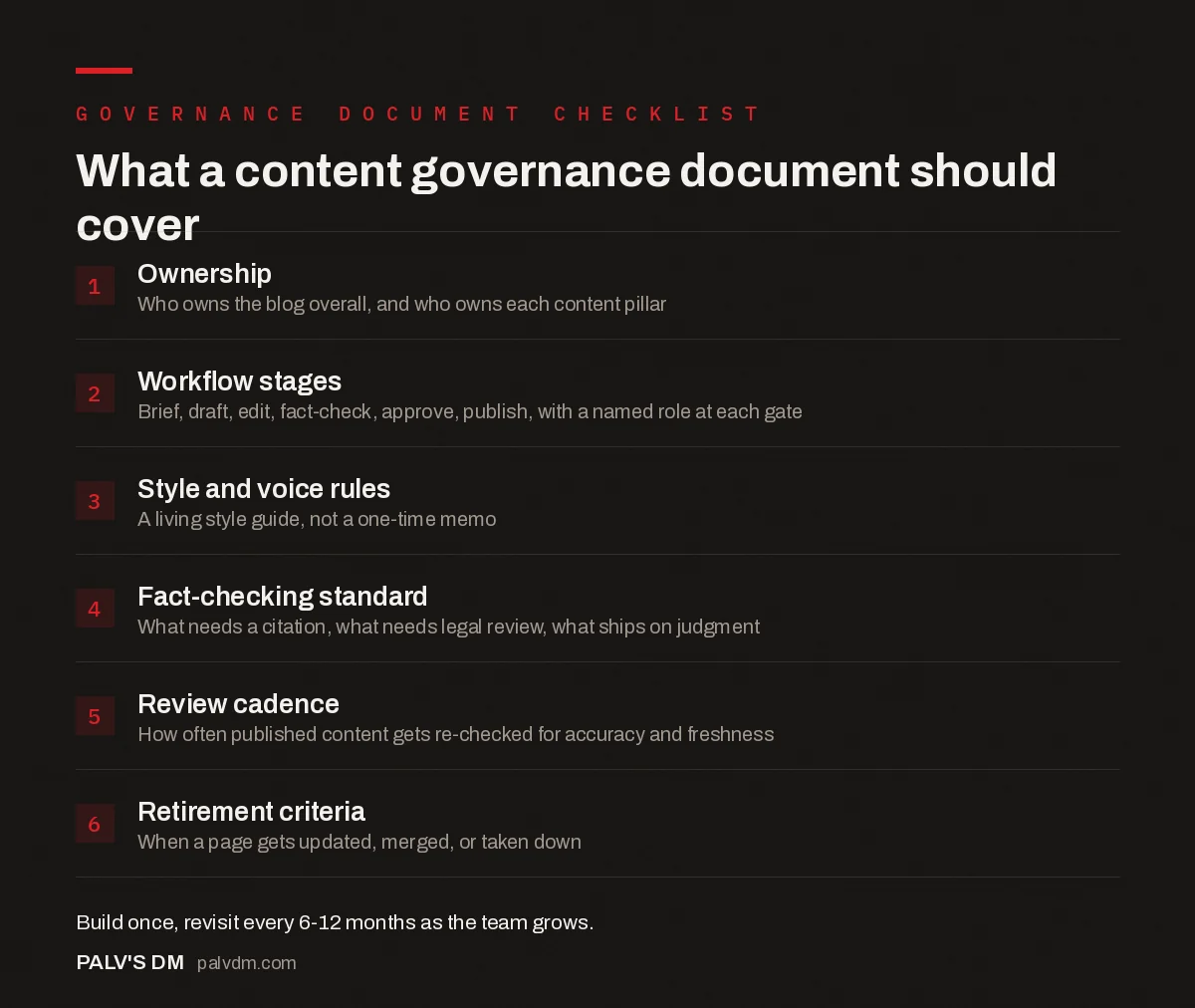
What a content governance document should cover
- Ownership. Who owns the blog overall, and who owns each content pillar.
- Workflow stages. Brief, draft, edit, fact-check, approve, publish, with a named role at each gate.
- Style and voice rules. A living style guide, not a one-time memo.
- Fact-checking standard. What needs a citation, what needs legal review, what ships on judgment.
- Review cadence. How often published content gets re-checked for accuracy and freshness.
- Retirement criteria. When a page gets updated, merged, or taken down.
How do you build a workflow that people actually follow?
A governance document that lives in a folder nobody opens isn’t governance, it’s a PDF. The workflow needs to live inside the tool the team already uses daily: a project management board, a shared content calendar, or the CMS’s own workflow states if it has them. WordPress, for instance, supports custom statuses beyond draft and published, which some teams use to mark “in review” or “fact-check pending” so nothing gets approved by accident.
The other practical requirement is that the workflow has to be faster than skipping it. If getting sign-off takes three days because the approver is slow to respond, writers will start publishing around the process, and the governance framework becomes theoretical. Set a service-level expectation for each stage, commonly 24-48 hours for an edit pass and a similar window for final approval, and hold to it.
What’s the difference between content governance and a style guide?
A style guide governs how content sounds and looks: tone, grammar preferences, formatting conventions, terminology. Content governance is broader: it governs who is allowed to do what, at which stage, and under what standard. A style guide is one input into governance, not a replacement for it. A team can have a perfect style guide and still publish factually wrong content if there’s no defined fact-checking or approval step in the workflow.
What happens without governance as a team grows?
Three problems show up reliably once a content team scales past a handful of contributors without a framework:
- Inconsistent claims across pages. Different writers state pricing, features, or statistics differently, and nobody notices until a customer does.
- Orphaned ownership. Posts written by someone who has since left the company sit unmaintained, sometimes for years, with no clear owner to update or retire them.
- Approval bottlenecks or approval theater. Either everything routes through one overloaded person, or “approval” becomes a formality nobody actually checks, which is arguably worse than no approval step at all.
None of these appear suddenly. They accumulate quietly across dozens of posts until an audit, a legal question, or a customer complaint forces the team to notice.
How do you introduce governance to a team that’s never had it?
Rolling out governance to an existing team works better as a staged change than a single memo. Start by documenting what’s already happening informally, since most teams have some version of a review process even without a name for it. Write that down first, then identify the actual gaps: usually fact-checking and ownership are the weakest links, not drafting quality. Introduce one new checkpoint at a time rather than a complete workflow overhaul in one week, and expect the first month to feel slower as people adjust to a step that used to happen in someone’s head.
Resistance is common and usually comes from writers who feel the new process implies their work wasn’t trusted before. Framing helps here: governance exists to protect the team from mistakes at scale, not to police individual writers. A workflow that catches a factual error before publish protects the writer’s credibility as much as the company’s.
Frequently asked questions
Do small teams need a formal governance document?
Below five regular contributors, a lightweight version usually suffices: a shared style guide plus a simple two-step review process (write, then one other person checks before publish). Formal role definitions and documented workflows earn their overhead once the team, or the content volume, grows past what one person can track informally.
Who should own content governance in a marketing team?
Usually the most senior marketing or content person, often the head of content or SEO manager, because governance decisions affect strategy, not just style. In smaller companies this can sit with a founder or marketing generalist, as long as they have the authority to enforce the workflow when someone tries to skip it.
How does content governance change when using freelancers?
Freelancers need the same governance rules as in-house writers, but the onboarding has to be more explicit since they lack the tacit context employees pick up. A written brief template, a style guide, and a clear fact-checking standard matter more with freelance or agency writers precisely because there’s no hallway conversation to fill the gaps.
Does content governance slow down publishing?
It adds defined steps, which adds some time per post, but a workflow with clear service-level expectations at each stage is usually faster than the ad hoc back-and-forth that happens without one. The bigger risk to speed is a governance process with no time limits on each approval stage, not the existence of the process itself.
Building governance that scales with the team
Content governance doesn’t need to be heavy to work. It needs four things: named roles, a documented workflow with time expectations at each stage, a style guide that’s actually used, and a periodic review cycle so old content doesn’t sit forgotten. Teams that put this in place before it’s urgently needed avoid the slow drift in quality and consistency that shows up once nobody’s tracking everything by memory. If your content operation has outgrown ad hoc coordination, our content writing service can help build and run a governance workflow alongside ongoing content production.
This post is part of our broader content strategy guide. For the editorial side of governance, see our post on building an editorial calendar that survives contact with reality, and for documenting the voice your writers should follow, see tone of voice documentation.