Service Support — AI Visibility
GEO for a Personal Brand or Consultant
How to build AI visibility for a personal brand: what AI engines need before they'll cite a consultant by name, and the structural fixes to make first.
AI visibility for a personal brand comes down to one thing: does an AI engine have enough clearly-attributed, corroborated content about you to quote you by name when someone asks a question in your field? Most consultants and founders fail this test not because they lack expertise, but because their expertise lives in the wrong places — a LinkedIn feed that isn’t crawlable in a useful way, a bio page written like a resume, or opinions that never got written down at all. Getting cited starts with fixing that, not with chasing rankings.
Key takeaway
- AI visibility for a personal brand depends on named, attributed content — generic advice under your byline doesn’t get cited, distinct points of view do.
- Consultants have an advantage over companies here: one consistent voice is easier for an AI engine to attribute than a brand with multiple authors and no clear “who said this.”
- The work is structural (bio pages, answer-first writing, cross-platform consistency, third-party corroboration) before it’s about producing more content.
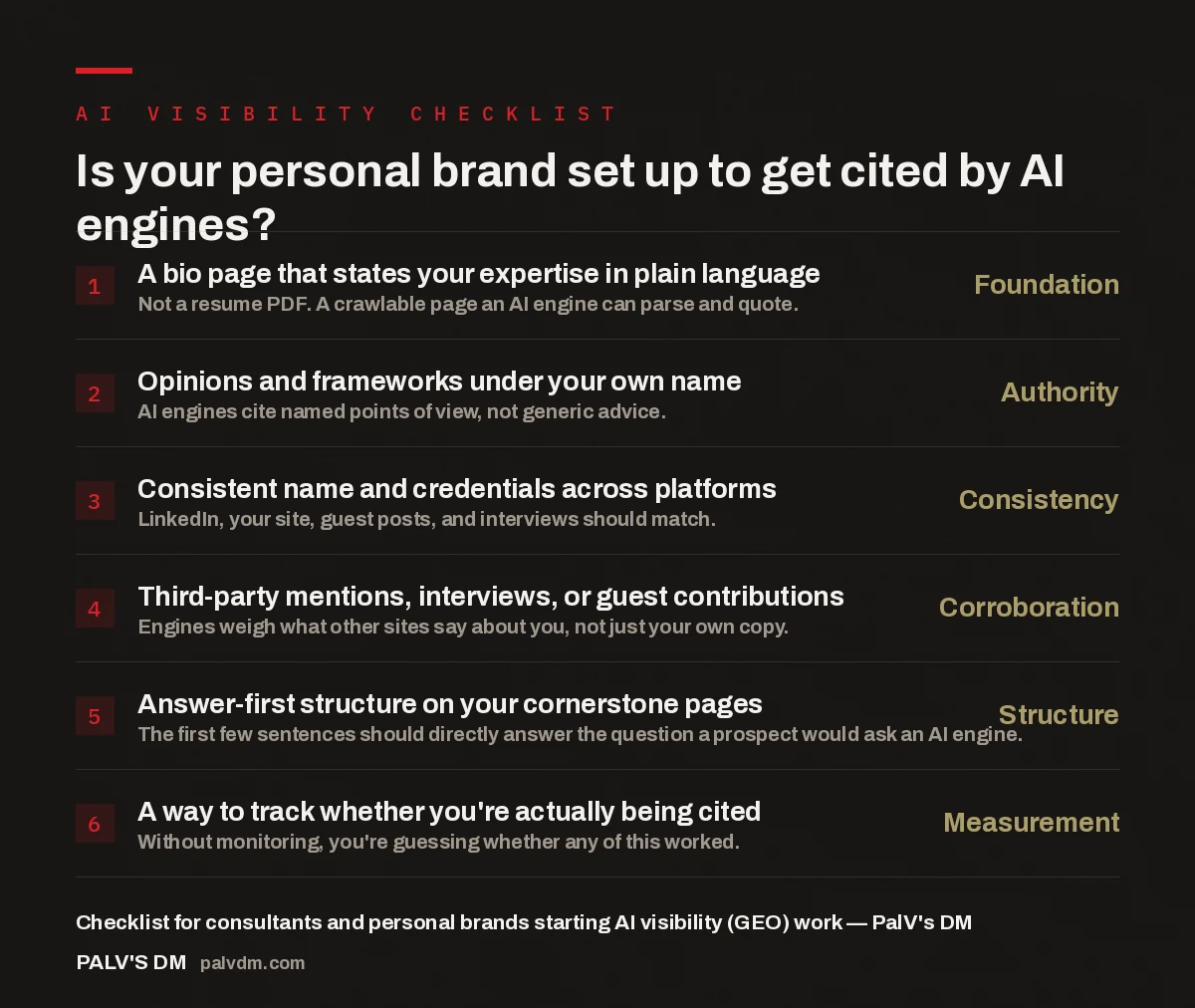
Is your personal brand set up to get cited by AI engines?
- A bio page that states your expertise in plain language — Foundation. Not a resume PDF. A crawlable page an AI engine can parse and quote.
- Opinions and frameworks under your own name — Authority. AI engines cite named points of view, not generic advice.
- Consistent name and credentials across platforms — Consistency. LinkedIn, your site, guest posts, and interviews should match.
- Third-party mentions, interviews, or guest contributions — Corroboration. Engines weigh what other sites say about you, not just your own copy.
- Answer-first structure on your cornerstone pages — Structure. The first few sentences should directly answer the question a prospect would ask an AI engine.
- A way to track whether you’re actually being cited — Measurement. Without monitoring, you’re guessing whether any of this worked.
What does AI visibility for a personal brand actually mean?
Ai visibility for a personal brand means showing up, by name, in the answers AI engines give when someone asks a question you’re qualified to answer. That’s a different goal from ranking a website in search results. A prospect researching “who should I hire for X” or “how do I approach Y problem” isn’t necessarily going to click through ten blue links anymore — increasingly they’re reading a synthesized answer that may or may not mention you. If it does, you get the credibility of a third-party recommendation without the prospect having done a formal comparison. If it doesn’t, you’re invisible at exactly the moment someone was deciding who to trust.
For a consultant or solo operator, this matters more than it does for a large company, because your entire pitch usually rests on being the recognized expert. A company can survive being generic in an AI answer because it still has brand recognition, ad spend, and a sales team. A personal brand doesn’t have those fallbacks — being cited (or not) is closer to the whole game.
How is GEO for a consultant different from GEO for a company?
The mechanics are the same — AI engines still favour clear, well-structured, corroborated content over vague marketing copy. But three things change when the “brand” is a person rather than an organisation.
- Attribution is simpler, if you set it up correctly. There’s only one author, one voice, one set of credentials to keep consistent — which is an advantage over multi-author company blogs, provided you actually use your name consistently instead of publishing under “Admin” or a generic company byline.
- Corroboration has to come from outside your own site. A company can point to case studies, client logos, and press coverage. A consultant’s version of that is being quoted in other people’s content — podcasts, guest posts, panel write-ups, interviews — because AI engines weigh what other sources say about you more heavily than what you say about yourself.
- Volume matters less than distinctiveness. A company can sometimes out-publish its way to visibility. A solo consultant usually can’t compete on volume, so the content that exists has to carry a genuinely specific point of view rather than restating conventional wisdom.
What do AI engines need to see before they’ll cite you by name?
In the accounts we’ve worked on, a few structural elements show up consistently before a personal brand starts getting picked up in AI answers.
- A dedicated bio or “about” page that reads like a source, not a résumé. It should state, in plain sentences, what you do, who you do it for, and what specific claim or method you’re known for — written so a machine can lift a sentence out of it and have that sentence make sense on its own.
- A small set of cornerstone pieces that stake out an actual opinion. “5 tips for better marketing” doesn’t get cited because it says nothing an AI engine can’t already synthesize from a thousand other sources. A named framework, a contrarian take you can defend, or a specific process you use does.
- Consistent identity signals across platforms. The same name, the same one-line description of what you do, and the same credentials on your site, LinkedIn, any guest bylines, and podcast appearances. Inconsistency here doesn’t just look sloppy — it makes it harder for a crawler to confidently connect the dots between “this person” and “this expertise.”
- Third-party mentions that exist independently of you. Being interviewed, quoted, or referenced on someone else’s site is worth more for citation purposes than another post on your own blog saying the same thing, because it’s independent corroboration rather than self-description.
- Answer-first structure. If your cornerstone pages bury the actual point three paragraphs into a story about how you got into the industry, you’re making an AI engine do extraction work it usually won’t bother doing. Lead with the direct answer, then explain.
The consultants who get cited aren’t the ones who publish the most. They’re the ones who’ve written down an opinion clearly enough, and had it repeated by enough other people, that a machine can confidently say “this person’s view is X.”
Palash, Founder, PalV’s DM
What should a consultant do first, before producing more content?
The instinct is usually to write more. In our experience, the higher-leverage move for a personal brand is to fix the foundation first, in this order.
- Rewrite your bio page as a source document. State your specialty, your method or point of view, and your track record in direct sentences. Avoid vague positioning language that could describe anyone in your field.
- Audit what you’ve already published for a genuine point of view. Most existing content restates common advice. Identify the handful of pieces (or ideas) that are actually yours, and rewrite or expand those first rather than adding volume to the generic pile.
- Align your identity across platforms. Same name format, same one-line description, same credentials, on your site, LinkedIn, and anywhere you’re published as a guest.
- Pursue a small number of third-party placements deliberately. A podcast appearance, a guest post on a site your prospects already read, or a quote in someone else’s article does more for corroboration than another post on your own domain.
- Set up a way to check whether any of this is working. Ask AI engines directly about topics in your field and see whether you’re named. Without that check, you won’t know if the work is paying off or if you’re just publishing into the void.
None of this replaces solid search fundamentals. A personal brand still benefits from the structural and technical groundwork covered in our broader look at where search is heading in 2026 — the same pattern showing up across the industry is that visibility increasingly depends on how citable your content is, not just how well it ranks.
How long does it take to get cited as a personal brand?
There’s no fixed number we’ll put on this, and anyone who gives you a precise week count for AI citation is guessing. Directionally: consultants who already have a reasonably clear point of view and just need the structural fixes tend to see movement faster than those starting from a blank slate. If you’re earlier in that process, see how long it typically takes before AI engines start citing new content — the timeline depends heavily on how much corroborated, well-structured material already exists about you.
If your current footprint is thin — a handful of LinkedIn posts and not much else — that’s still workable, but it changes the starting sequence. It’s worth reading our guide to running GEO when you have almost no content, since the tactics for a thin personal brand differ from those for an established publisher.
Is AI visibility work worth doing before you’re sure you need it?
Not every consultant needs to prioritize this right now. The honest answer depends on where prospects actually look for recommendations — if your business runs almost entirely on referrals, AI visibility is a lower priority than if strangers regularly research “best X consultant for Y” before ever talking to you. See a straight answer on whether GEO is a priority for your specific situation before assuming it is.
Key takeaway
- Fix your bio page, your published point of view, and your cross-platform consistency before producing more generic content.
- Third-party corroboration (guest posts, interviews, mentions) matters more for a personal brand than for a company with other trust signals.
- Track whether you’re actually being cited — don’t assume the work is landing without checking.
FAQ
Do I need a large content archive for AI visibility as a personal brand?
No. A small number of clearly-written, opinionated pieces under your own name tends to outperform a large archive of generic advice content. Depth of point of view matters more than volume for a solo consultant, since you’re unlikely to out-publish larger competitors anyway.
Does LinkedIn activity count toward AI visibility?
It can contribute, but it isn’t a substitute for owned, crawlable pages on your own site. LinkedIn posts are useful for building the point of view and for third-party engagement, but your bio page and cornerstone content on a domain you control are what AI engines can most reliably parse and attribute to you over time.
How is this different from personal branding or PR?
Personal branding and PR focus on human audiences and reputation generally. AI visibility work specifically structures and corroborates your existing expertise so that AI engines can parse, attribute, and cite it accurately. The two overlap and reinforce each other, but AI visibility has its own technical and structural requirements that generic branding advice doesn’t cover.
Can I do AI visibility work myself without an agency?
Much of the foundational work — rewriting your bio page, tightening your point of view, aligning your identity across platforms — is something a consultant can do independently. Where it usually gets harder to DIY is ongoing citation tracking across multiple AI engines and diagnosing why specific pages aren’t getting picked up, which is where structured support tends to save the most time.
What’s the biggest mistake personal brands make with AI visibility?
Publishing more generic advice content instead of fixing the structural gaps first. A consultant with a thin but distinctive footprint — a sharp bio page, a couple of genuinely opinionated pieces, and some third-party mentions — is usually better positioned than one with dozens of posts that all restate the same conventional wisdom under a different headline.
Short version: AI visibility for a personal brand isn’t about publishing more — it’s about making sure the expertise you already have is stated clearly enough, attributed consistently enough, and corroborated by enough outside sources that an AI engine can confidently cite you by name. Fix the bio page, sharpen the point of view, align your identity across platforms, and get a handful of genuine third-party mentions before you worry about content volume.