Service Support — AI Visibility
GEO When You Have Almost No Content
Launching a new website? Here's how GEO for a new website with little content works: page order, technical setup, and realistic citation timelines.
You can start GEO on a brand-new website with almost no content — you just build in a different order than an established site would. Instead of optimising fifty existing pages, you publish a small, deliberate set of answer-first pages (5-10 is usually enough to start), get the technical foundation right on day one, and let citation tracking tell you which pages AI engines are actually picking up. A new website with little content isn’t a disadvantage for GEO the way it is for traditional SEO — there’s no stale, half-answered content to unwind first.
Key takeaway
- A thin site isn’t disqualified from GEO — it just needs a small, deliberately sequenced set of pages instead of a large archive to fix.
- Technical access (robots.txt, llms.txt, clean server responses) has to be correct before you publish a single page — it’s cheaper to fix on a new site than a legacy one.
- Five to ten answer-first pages, each built around one real question your buyer asks an AI engine, beats twenty generic ones.
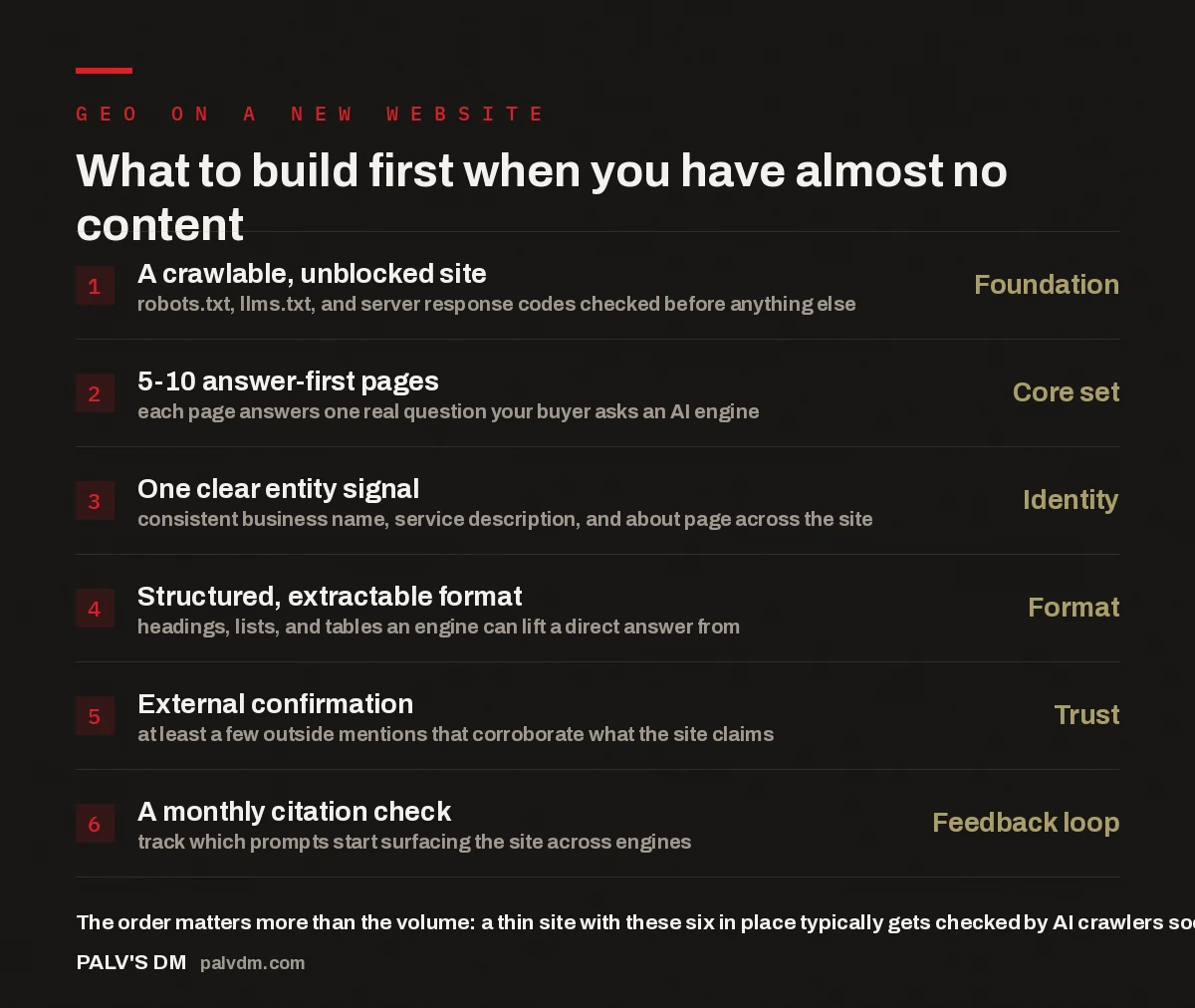
What to build first when you have almost no content
- A crawlable, unblocked site — Foundation. robots.txt, llms.txt, and server response codes checked before anything else.
- 5-10 answer-first pages — Core set. each page answers one real question your buyer asks an AI engine.
- One clear entity signal — Identity. consistent business name, service description, and about page across the site.
- Structured, extractable format — Format. headings, lists, and tables an engine can lift a direct answer from.
- External confirmation — Trust. at least a few outside mentions that corroborate what the site claims.
- A monthly citation check — Feedback loop. track which prompts start surfacing the site across engines.
Why is a new website actually a decent starting point for GEO?
Most of the GEO work we do on established sites is subtraction, not addition. There’s a decade of blog posts optimised for keyword density instead of answers, category pages that say nothing specific, and an about page that hasn’t been updated since a rebrand. None of that exists on a new site. A thin website has no baggage to unwind — every page can be built answer-first from the start, which is the single biggest advantage a legacy site doesn’t have. The pattern that shows up repeatedly in the accounts we work on: a small, tightly built set of pages on a new domain gets picked up by AI engines faster than a large, unfocused archive on an older one, simply because there’s less ambiguous content for the engine to sort through.
That doesn’t mean a new site is easy — it means the constraint is different. On an established site, the question is “what do we fix or consolidate first?” On a new site, it’s “what do we build first, and in what order?” Getting that sequence wrong — publishing volume before the foundation is solid — is the most common way a new site wastes its first few months.
How much content do you actually need before AI engines will cite you?
Less than most people assume. AI engines don’t have a page-count threshold — they cite whichever page directly answers the prompt they’re processing, regardless of how many other pages sit on the same domain. What matters is whether each page is a complete, self-contained answer to a question someone would actually ask an AI assistant.
In practice, we start new-site GEO engagements with five to ten pages, chosen deliberately rather than generated in bulk:
- One clear “what we do” or service-definition page written as a direct answer, not a sales pitch.
- Three to five pages that each answer one specific, recurring question a prospective buyer asks — the kind of question you already answer on sales calls.
- An about/entity page that states, in plain sentences, who runs the business, what it does, and where it operates.
- One or two comparison or “how it works” pages if the buying decision genuinely involves comparing options.
Ten well-built pages that each answer a real question outperform sixty pages padded with generic industry commentary. The sequencing approach below assumes GEO is already the right call for your business — if that’s still an open question, it’s worth settling first before investing in the first batch of pages.
How do you choose which pages to write first?
Start from the questions, not from the keywords. Keywords describe what people type into a search box; prompts describe what people actually ask a conversational AI. For a new site, that means writing out the real, specific questions your buyers ask — in sales calls, in support tickets, in the first email of a new inquiry — and building one page per question.
A useful filter for a thin site: would a specific human ask this exact question to a friend who works in your industry? “What does AI visibility cost per month” passes that test. “Top 10 benefits of AI visibility services” does not — nobody asks a friend for a listicle. Pages built around the second kind of prompt tend to sit uncited even after they’re indexed, because they don’t map to how people actually phrase questions to an AI assistant.
If you want to see the structured version of this exercise, our prompt research process, step by step, walks through how we turn a list of real buyer questions into a prioritised page list before any writing starts.
What technical groundwork has to be right before you publish anything?
Four things, checked before the first page goes live rather than after:
- Robots.txt isn’t blocking AI crawlers. Some default CMS installs and staging configurations block crawlers broadly, including the ones AI engines use — worth checking directly rather than assuming it’s fine.
- An llms.txt file exists and points to the pages you want surfaced. It won’t force citation, but it gives engines a clean, explicit map instead of making them infer structure from navigation.
- Server responses are clean. A quickly built new site sometimes has redirect chains, soft 404s, or inconsistent HTTPS left over from launch — all of which make a crawler’s job harder for no benefit to a human visitor.
- The entity is described consistently. The business name, what it does, and where it’s based should read the same way on the homepage, the about page, and anywhere else it’s mentioned.
This is the same technical work we’d do on an established site, but it’s far cheaper to get right from the start than to retrofit later. For the exact setup steps rather than the summary, see how we set up llms.txt and crawler access for clients.
A ten-page site with clean crawler access and answer-first content beats a hundred-page site an AI engine can’t parse cleanly. On a new site, you get to build it right the first time instead of untangling ten years of blog posts written for a different search engine entirely.
Palash, Founder, PalV’s DM
How long before a new, thin site starts getting cited?
There’s no fixed timeline we’d put a specific number of weeks on — it depends on how quickly the site gets indexed, how competitive the questions are, and how much external corroboration already exists for the business. What we can say directionally: a new site with clean technical access and a small set of genuinely answer-first pages tends to get evaluated by AI crawlers sooner than a large, unfocused site, because the signal-to-noise ratio on a deliberately built thin site is higher by design.
Citation isn’t binary or permanent, either. A page can be cited for one prompt phrasing and not a close variant of it, and that can shift month to month as engines update their models. That’s why we treat the first few months of GEO on a new site as a feedback loop rather than a one-time launch: publish a small batch, check what’s getting picked up, and let that inform the next batch. For a fuller picture of realistic timelines across different starting points, how long before AI engines start citing you goes into more detail than we can cover here.
What mistakes make a thin site invisible to AI engines?
The recurring one is publishing volume before checking the foundation — twenty or thirty pages go up in the first month, written to fill out a sitemap rather than to answer specific questions, on a site nobody has confirmed is actually crawlable by the engines that matter. The content work is wasted if the technical layer underneath it is broken, and that’s much harder to notice after thirty pages are live than before the first one is.
The second common mistake is writing pages that sound like marketing copy instead of answers — leading with a benefit statement instead of directly answering the question in the first sentence. An AI engine extracting an answer needs it near the top of the page, stated plainly, not buried under positioning. The third is skipping external corroboration entirely: a site that only talks about itself, with no outside mention anywhere, gives an engine less reason to trust its own claims. None of these are unfixable — they’re just easier to avoid from day one. If your site is already live and genuinely getting zero traction anywhere, what we do when a client is invisible in every AI engine covers the recovery version of this same problem.
Where to start
If you’re launching or relaunching a site with little to no content, the audit comes before the writing — we check crawler access, llms.txt, and entity clarity first, then sequence a small set of answer-first pages instead of a bulk content push.
FAQ
Can a brand-new website with no content history do GEO at all?
Yes. GEO doesn’t require an existing content archive or domain history the way some SEO tactics do. It requires a small set of pages that clearly answer real buyer questions, plus a technical setup that lets AI crawlers parse the site cleanly. A new site can build both from scratch without undoing anything first.
How many pages do I need before I start seeing any AI citations?
There’s no fixed number, but we typically start new sites with five to ten deliberately chosen pages rather than a larger batch. Each one is built around a specific, real question a buyer would ask, since AI engines cite based on how well a page answers a prompt, not how many pages sit on the domain.
Should I focus on GEO or traditional SEO first on a brand-new site?
They share most of the same foundation — clean crawlability, clear structure, a real entity signal — so you’re rarely choosing one over the other. The difference is in how you write: SEO content optimises for search phrases, GEO content optimises for direct, self-contained answers. Building pages the GEO way from the start doesn’t cost you traditional SEO value.
What’s the single biggest technical mistake new sites make for GEO?
Publishing content before confirming the site is crawlable by AI engines. A blocked robots.txt, a missing llms.txt, or messy redirect chains left over from launch can quietly make an otherwise well-written page invisible. Checking crawler access first avoids wasting that content work.
Does a thin site need outside mentions or backlinks before AI engines will trust it?
Not a large volume, but some external corroboration helps. A site that only describes itself, with nothing anywhere else confirming those claims, gives an AI engine less independent evidence to work with. A handful of genuine outside mentions — a directory listing, a press mention, a partner page — go a reasonable way toward closing that gap.
Short version: a new website with little content isn’t a GEO problem — it’s a sequencing question. Fix crawler access and entity clarity first, publish five to ten answer-first pages built around real buyer questions rather than keyword lists, and track citations monthly so the next batch of pages is informed by what’s actually getting picked up instead of guessed at. That order gets a thin site noticed by AI engines faster than a large site that skipped the foundation.