Organic vs Paid Search: How to Split a Limited Budget
Organic and paid search do different jobs. How each works, what each costs you in time and money, and how to split a limited budget between them.
Organic and paid search are not competing answers to the same question. Paid search buys attention now and stops the day you stop paying; organic search builds an asset that takes months to work and then keeps working. With a limited budget the right split is usually determined by one thing: how long you can survive before the channel has to produce revenue. If the answer is under three months, paid takes the majority. If you can fund six to twelve months of work before judging results, organic deserves the larger share, because that is where its cost per click starts falling instead of rising.
The two also interact in ways people get wrong in both directions. Google’s documentation states that it does not accept payment to crawl a site more frequently or rank it higher, so ad spend does not lift organic positions. But ads produce query-level conversion data within days, which is genuinely the fastest way to find out which organic pages are worth building.
What is the actual difference between organic and paid search?
Both appear on the same results page. Everything else differs.
| Paid search | Organic search | |
|---|---|---|
| How position is determined | Your bid, ad and landing page quality, ad rank thresholds, search context and expected impact of assets | Google’s ranking systems, programmatically, with no purchasable input |
| Time to first click | Same day | Typically months |
| Cost behaviour | Per click, rising as you push for volume in a competitive auction | Fixed monthly cost, falling per click as traffic compounds |
| If you stop spending | Traffic ends immediately | Traffic decays gradually over months |
| Predictability | High — volume and cost can be forecast | Low — no position can be guaranteed |
| What you own afterwards | Data and creative | Pages, links and topical coverage |
The row that decides most budget arguments is the cost curve. In paid search, buying more clicks means bidding into progressively less efficient inventory, so the marginal cost rises. In organic search, the cost is largely fixed regardless of how many clicks a page earns, so the marginal cost falls as the page matures. Two channels with opposite cost curves should not be compared on a single blended cost-per-lead figure — but they routinely are. Google Ads versus SEO works through the comparison properly.
Does running Google Ads improve organic rankings?
No. Google’s documentation on how Search works states that “Google doesn’t accept payment to crawl a site more frequently, or rank it higher”, and that ranking is done programmatically. Paid and organic results are produced by separate systems, and no amount of ad spend is an input to the organic one.
The reverse claim — that pausing ads causes organic rankings to fall — is equally unfounded and slightly more damaging, because it is used to justify indefinite spend. If organic traffic falls when ads pause, check whether you are measuring branded search correctly: ads suppress some branded organic clicks while running, so pausing them can make organic clicks appear to rise, not fall.
What ads do contribute is intelligence. Within a fortnight a modest campaign tells you which queries convert, what the actual cost of a lead looks like in your category, and which landing page angle works. That is a much better basis for choosing which twenty organic pages to build than keyword tool volume estimates. Whether you still need SEO if you are running Google Ads covers the overlap.
When should a limited budget go to paid first?
Paid deserves the larger share in four situations, and they are all about time or uncertainty.
- You need revenue inside a quarter. Organic cannot be compressed. If payroll depends on this channel producing in eight weeks, organic is not the answer regardless of its long-run economics.
- You have not validated the offer. Building thirty pages for a proposition nobody has bought yet is an expensive way to test demand. Paid tests it in a fortnight.
- The demand is seasonal or event-driven. A three-week festival window does not wait for a page to mature.
- Your site cannot yet support organic. If pages are not being indexed, or the site is a single-page brochure, organic spend goes into fixing prerequisites before it produces anything.
One discipline makes small paid budgets survivable: negative keywords. Uncontrolled match types spend a small budget on irrelevant traffic within days. Getting negative keywords right is the difference between a ₹30,000 test that teaches you something and one that teaches you nothing.
When should a limited budget go to organic first?
Organic deserves the larger share when the maths of paid stops working, which happens more often than agencies admit.
- Your average order value cannot support the auction. If a click costs ₹90 and converts at 2%, a customer costs ₹4,500 in media alone. For a ₹1,200 product that channel never works, at any spend level.
- Buyers research for weeks. High-consideration purchases involve many informational queries that rarely justify an ad but are exactly where organic content earns trust before the commercial query happens.
- You can fund six to twelve months. That is the horizon over which organic work becomes visible. How long SEO actually takes sets realistic expectations by site age and competition.
- You want an asset, not a tap. A paid campaign leaves nothing behind when it stops. Pages, links and topical coverage keep producing.
How do you actually split the budget?
Take a hypothetical ₹60,000 a month for search. Three defensible allocations, depending on the constraint:
- Runway under three months: roughly ₹45,000 paid, ₹15,000 organic. Paid carries the revenue. The organic spend goes to technical fixes and two or three commercial pages, so you are not starting from zero later.
- Runway six to twelve months: roughly ₹20,000 paid, ₹40,000 organic. Paid runs as a permanent test bed on your highest-intent queries — enough to keep learning what converts. Organic gets the majority because that is where the compounding happens.
- Established site, proven offer: roughly ₹15,000 paid, ₹45,000 organic. Paid covers gaps organic has not reached and defends brand terms. Organic carries the volume.
These are illustrations of a decision rule, not benchmarks — your category, margin and competition move them substantially. The rule underneath is what transfers: fund the channel that matches your time horizon, and keep a smaller permanent allocation to the other one so you retain either the learning or the asset. How to allocate a marketing budget and budget planning for Indian startups go into the wider split, and what an SEO budget buys at each level covers the organic side specifically. Published rates for reference sit in SEO pricing in India.
How do you measure them fairly?
Fair measurement is where most organic budgets are lost, and it is lost in a spreadsheet rather than in the results page. Badly measured, paid always looks better, because its conversions are attributed on the day they happen while organic’s are spread across an assisted path nobody reports on.
- Separate branded from non-branded queries. Branded conversions credited to paid are often demand that other channels created. Reporting them together flatters paid and hides what it is actually generating.
- Report assisted conversions, not just last click. Organic pages frequently do the convincing and paid takes the final click. Attribution between paid and organic covers how to see it.
- Use the right landing page for each. A page built to convert paid traffic and a page built to rank are usually different documents with different jobs — paid versus organic landing pages explains why one page rarely does both well.
- Calculate organic return over its lifetime, not the month. A page that costs ₹15,000 once and produces leads for three years is not comparable to a monthly ad spend on a single-month view. Calculating SEO ROI sets out a defensible method.
What changes now that AI answers sit above both?
AI Overviews and AI Mode occupy space above both the ads and the organic listings for a growing share of queries, and that changes the shape of the results page for everyone.
What it has not done, so far, is reverse the underlying position. Shopify reported in August 2026 that AI referrals were up 197% year on year while organic search still led total traffic. That is one company’s data on its own merchant base, not an industry benchmark, but it is a useful corrective to the sharper predictions — the growth rate and the absolute share are different claims.
The practical implication for a split budget is modest. Being cited in an AI answer depends heavily on being visible in the underlying results and on publishing content specific enough to quote, which is organic work by another name. Paid search remains a separate auction with its own economics. Whether SEO is actually dead handles the wider argument with the evidence attached.
One further wrinkle worth planning for: AI answers make impression and click data harder to read, so agree with stakeholders now which numbers you will judge each channel on. Conversions and revenue survive interface changes. Visibility metrics do not.
The honest summary: if you need results this quarter, buy them. If you want the cost per click to fall rather than rise over the next two years, build them. Most businesses with a limited budget need a little of the first to fund the patience for the second.
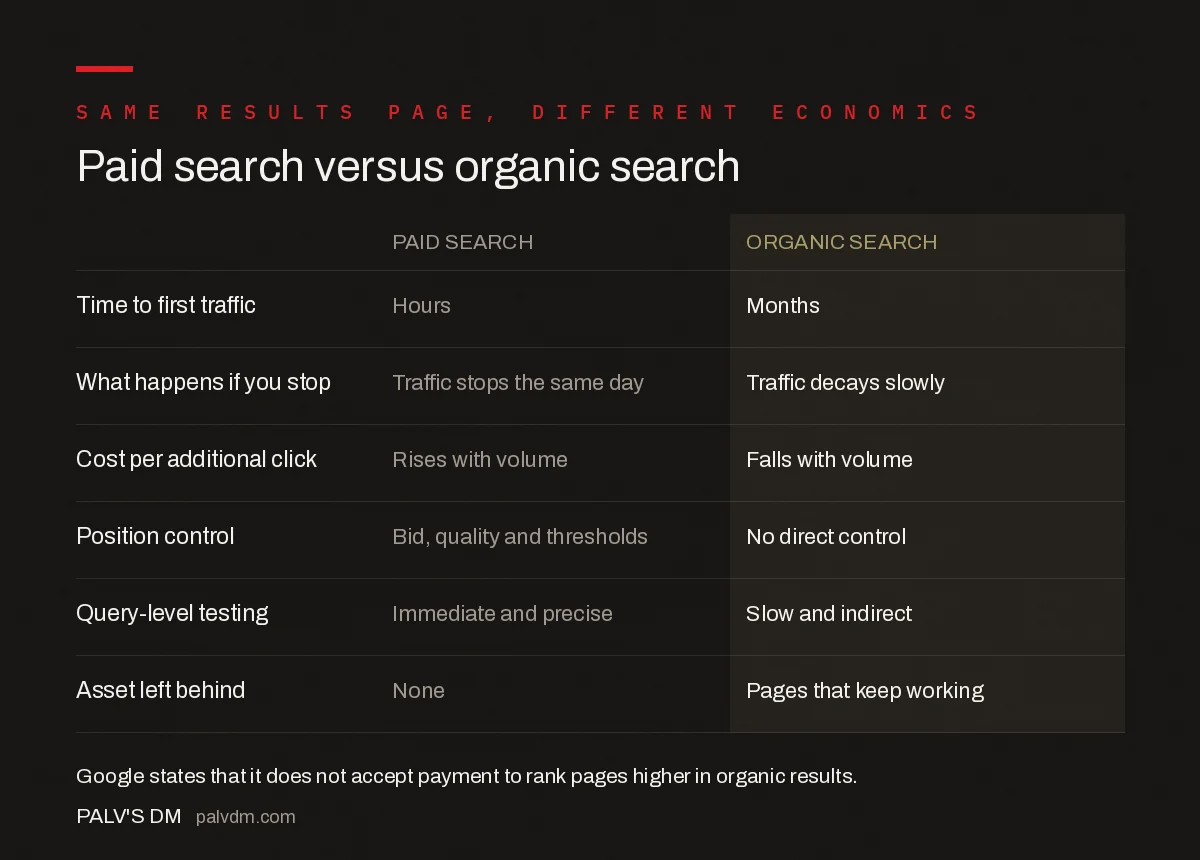
Paid search versus organic search
| Paid search | Organic search | |
|---|---|---|
| Time to first traffic | Hours | Months |
| What happens if you stop | Traffic stops the same day | Traffic decays slowly |
| Cost per additional click | Rises with volume | Falls with volume |
| Position control | Bid, quality and thresholds | No direct control |
| Query-level testing | Immediate and precise | Slow and indirect |
| Asset left behind | None | Pages that keep working |
Frequently asked questions
What is the difference between organic and paid search?
Paid search results are advertisements placed through an auction, where position depends on your bid, ad and landing page quality, ad rank thresholds and search context. Organic results are ranked programmatically by Google’s systems and cannot be bought. Paid traffic starts within hours and stops when spending stops; organic traffic takes months to build and decays slowly.
Does paying for Google Ads help your organic rankings?
No. Google’s documentation states that it does not accept payment to crawl a site more frequently or rank it higher, and that ranking is done programmatically. Paid and organic results come from separate systems. Ads do help SEO indirectly by producing fast, query-level data on which searches actually convert, which is useful for prioritising organic content.
Should a small business choose SEO or Google Ads first?
It depends on your time horizon. If revenue is needed within a quarter, or the offer has not been validated, paid search should take the larger share because it produces traffic the same day. If you can fund six to twelve months before judging results, organic deserves the majority, because its cost per click falls as traffic compounds.
How should I split a limited budget between SEO and paid search?
Match the allocation to your runway. Under three months of runway, weight heavily to paid and spend a small amount on technical fixes and a few commercial pages. With six to twelve months, weight to organic and keep a smaller permanent paid budget running on high-intent queries as a test bed for what converts.
Why does paid search always look better in reports?
Because last-click attribution credits the final touch, and paid frequently supplies it after organic content did the convincing. Branded search makes it worse: conversions from people who already knew the brand get credited to whichever channel they clicked. Separating branded from non-branded queries and reporting assisted conversions gives a fairer comparison.
Do AI Overviews change the organic versus paid decision?
Not fundamentally, so far. AI answers occupy space above both ads and organic listings for a growing share of queries. Shopify reported in August 2026 that AI referrals were up 197% year on year while organic search still led total traffic. Being cited in AI answers depends largely on organic visibility and specific, quotable content.
Sources
- In-depth guide to how Google Search works — Search Central
- About Ad Rank — Google Ads Help
- Do you need an SEO? — Search Central
- Shopify: AI referrals up 197%, but organic search still leads traffic — Search Engine Land
Want this done on your site?
Every PalV’s DM engagement starts with a free audit of your actual website — a 12-point
crawl covering what is blocking indexation, on-page gaps against your primary keywords, speed
findings, and the three to five fixes worth making first. Delivered in two working days. No
payment details, and the findings are yours whether you hire us or not.