Branded vs Non-Branded Search: Reading the Split Correctly
Branded and non-branded search measure different things. How to segment them in Search Console, what each series proves, and the ratio question nobody answers.
A branded search contains your company, product or domain name — “palvdm seo”, “zomato customer care”, “nike air max”. A non-branded search does not — “seo agency in ahmedabad”, “best running shoes for flat feet”. The two behave so differently that reporting them as a single organic traffic number hides almost everything worth knowing. Branded search measures demand that already exists: someone encountered you somewhere and came looking. Non-branded search measures discoverability: whether people who have never heard of you can find you at all. Blend them and a PR hit or an ad campaign can masquerade as SEO performance, while a genuine collapse in discoverability hides behind a growing brand.
This is where SEO reporting most often goes quietly wrong. “Organic traffic up 34%” is a sentence that can be entirely true and entirely misleading — if all 34% came from people typing the company name after a television campaign, the search channel did nothing except catch demand that another budget line created.
What is the difference between a branded and a non-branded search?
A branded query contains a token that only refers to one company: the brand name, a product name, the domain, sometimes a founder’s name. A non-branded query describes a category, a problem or an outcome without naming anyone. The distinction is about the searcher’s starting knowledge, not about commercial value.
Branded queries split further, and the sub-types are not interchangeable:
- Pure navigational. “Swiggy”, “palvdm”. The user wants your homepage and would have got there anyway. Cheap traffic, near-zero incremental value.
- Brand plus intent modifier. “Swiggy customer care number”, “palvdm pricing”, “X careers”, “X reviews”. These reveal what people want from you and where your site is failing to answer it. The most underused query set in most accounts.
- Brand plus category. “Nike running shoes”. Technically branded, commercially behaving like a mid-funnel non-branded query.
- Brand versus competitor. “X vs Y”. A person in active evaluation. Worth its own page and its own tracking, separate from targeting competitor brand keywords where your name never appears.
Non-branded queries cover everything else: category terms, problem terms, comparison terms, and — importantly — competitors’ brand names, which are non-branded from your point of view even though they are branded from theirs.
Why does the split matter more than total organic traffic?
Five specific failures happen when branded and non-branded traffic are reported as one number.
- Credit lands in the wrong place. Brand campaigns, funding announcements, a founder’s LinkedIn post and offline advertising all push branded search up. When SEO takes the credit, the next budget decision is made on false information.
- Blended averages stop meaning anything. Branded queries typically sit at far better average position and far higher click-through rate than non-branded — you can confirm this in your own property in about two minutes. An account-wide average CTR is therefore just a weighted measure of how branded your traffic mix is, and it moves whenever that mix moves.
- A discoverability collapse hides. Non-branded clicks can fall for months while branded growth keeps the headline flat. By the time the total moves, the pipeline of new-to-brand visitors has already gone. Diagnosing a traffic drop starts with the segment, not the total.
- New brands look like failures. A company launched this year has almost no branded volume, so its total organic traffic will look poor for months even while non-branded rankings climb steadily. Reporting the split rescues genuinely working programmes from being cancelled at month four.
- Brand defence and brand growth get confused. Protecting branded search — from competitors bidding on your name, from aggregator sites outranking you — is a different job with a different budget from winning non-branded terms.
How do you separate branded from non-branded in Search Console?
Google Search Console does not offer a branded toggle. You build the segment yourself with the query filter, and the whole exercise stands or falls on doing it identically every month.
- List every brand token. Brand name, domain with and without the extension, product and plan names, the founder’s name if it is used publicly, abbreviations, and the misspellings people actually type. Pull the misspellings from your existing query data rather than imagining them.
- Write one regular expression. A case-insensitive alternation covering every token. Keep it in a text file, not in your head.
- Filter the Performance report twice. Apply the query filter as “custom (regex)” matching your expression for branded, then as “doesn’t match” for non-branded. Regex filters in Search Console are the only practical way to do this at scale, and the Performance report is the only free source of query-level data you have.
- Export both series separately. Clicks, impressions, CTR and average position for each segment. Never average across the two.
- Freeze the regex and version it with the report. A definition that quietly gains a token each month produces a trend line that measures your definition rather than your traffic.
- State the anonymised-query gap. Search Console omits rare queries for privacy reasons, so branded plus non-branded will never sum to your total site clicks. Put the residual in the report as its own line rather than silently distributing it.
Google Analytics cannot do this job. Search query data has not been available in Analytics since Google moved to secure search, so GA4 sees the session but not the words that caused it. Anyone offering branded segmentation from GA4 alone is inferring it from landing pages, which is a guess. Segmenting branded traffic properly means starting in Search Console and joining outward.
Which brand names are hard to segment cleanly?
Some brands make the regex easy. Others make it a judgement call, and the judgement should be documented rather than improvised.
- Common-word brands. If your company is called Orange, Apex or Blue Star, a bare match on the word will sweep in enormous volumes of unrelated search. Anchor the pattern to modifiers — brand plus a category or intent word — and accept that the segment undercounts.
- Transliterated and Hinglish variants. Indian brands routinely receive queries in Devanagari, in Roman transliteration, and in mixed forms. If your brand is searched in more than one script, the regex needs both, or your branded segment will systematically understate demand. Hinglish and mixed-script search behaviour is a real segmentation problem, not an edge case.
- Founder-name brands. A consultancy trading under a personal name will collect queries for the person that are indistinguishable from queries for the business. Decide which bucket they belong in once and stay with it.
- Descriptive brand names. “Delhi Dental Clinic” is a brand and a category description simultaneously. There is no clean answer; there is only a consistent one.
- Acquired and legacy names. Old brand names keep generating searches for years. They are branded, and they belong in the regex even after the rebrand.
What does each side of the split actually tell you?
Branded and non-branded series answer different questions, and the same movement means opposite things in each.
| Question | Branded search says | Non-branded search says |
|---|---|---|
| What is being measured | Existing demand and how well you capture it | Discoverability among people who do not know you |
| A rise means | Awareness work is landing — PR, ads, word of mouth, AI mentions | Rankings or coverage improved on category terms |
| A fall means | Awareness declining, or a competitor intercepting your name | A ranking loss, an algorithm update, or lost SERP real estate |
| Who really owns it | Brand, PR and paid media, with SEO defending the result | SEO and content, more or less alone |
| Typical shape in the data | Short position range, high CTR, spiky around campaigns | Wider position range, lower CTR, moves in slow trends |
| What it justifies | Protecting the brand SERP, fixing brand-plus-modifier gaps | New content, keyword gap work, technical fixes |
One practical consequence: a competitor bidding on your brand name shows up in branded organic CTR before it shows up anywhere else, because the ad pushes your own result down the page. That is an organic versus paid interaction which no organic-only report will explain.
Is there a correct branded to non-branded ratio?
No, and any benchmark quoted to you should be treated with suspicion. The ratio depends on brand age, category, advertising spend, whether people search the category at all, and how distinctive the brand name happens to be. A twenty-year-old consumer brand and a six-month-old B2B tool will sit at opposite extremes while both are performing well.
Two readings are more useful than any ratio. First, the direction of each series independently — branded and non-branded both rising is healthy growth; branded rising while non-branded falls is a brand carrying a failing search programme. Second, the share of conversions from each, because non-branded traffic converting at a fraction of branded is normal and expected, and pricing your SEO investment against a blended conversion rate will always undervalue new-audience work. That is a specific case of the wider problem with choosing SEO KPIs that survive contact with reality.
How does AI search change the branded picture?
Assistants have added a discovery path that produces almost no measurable referral. Someone asks ChatGPT or Perplexity for options in your category, reads a summary that names three companies, and then searches one of those names in Google — or types the domain directly. The visible consequence of that AI mention is a branded search, arriving with no evidence of where it came from.
Treat that mechanism as a reasonable interpretation rather than an established fact, because no public dataset cleanly attributes branded search lift to AI mentions. What is documented is that AI referral traffic is growing fast from a small base: Shopify reported in August 2026 that AI referrals to its merchants were up 197% year on year while organic search still led total traffic. If AI-driven discovery mostly converts into branded search and direct visits rather than into referrals, referral reports will keep understating it.
The practical response is to stop treating branded search as a vanity metric and start treating it as a lagging indicator worth instrumenting. Pair it with direct measurement: logging AI citations on a fixed prompt set, tracking how your brand is described in AI answers, and chasing unlinked brand mentions that feed the corpus those answers are built from. On the non-branded side, zero-click behaviour is compressing informational clicks, which makes a falling non-branded click count harder to interpret than it used to be — check impressions and position before concluding you lost rankings.
How should you report the split?
Five rules make a branded and non-branded report honest.
- Two lines on every chart, never one. Total organic traffic as a single series is the least informative number in SEO reporting.
- Never average CTR or position across the segments. Report them separately or not at all.
- Publish the regex. Put the actual expression in an appendix of the monthly report so the client can see what was counted.
- Annotate the branded line with brand events. Campaign launches, funding news, a viral post, a television spot. Unannotated branded spikes get attributed to whoever is presenting.
- Set targets on non-branded only. Branded growth is a shared outcome. Non-branded growth is the part a search programme can be held to, alongside share of voice against named competitors and a deliberate branded keyword strategy for the terms you must defend.
The short version
Branded search tells you whether people who already know you can reach you. Non-branded search tells you whether anyone new can find you. Split them with a frozen regex in Search Console, report them as two lines, set targets only on the non-branded one, and annotate the branded one with the brand events that actually caused its movement. There is no correct ratio to hit — only two trends to read independently, and one common mistake to avoid, which is letting a healthy brand disguise a search programme that stopped finding new people months ago.
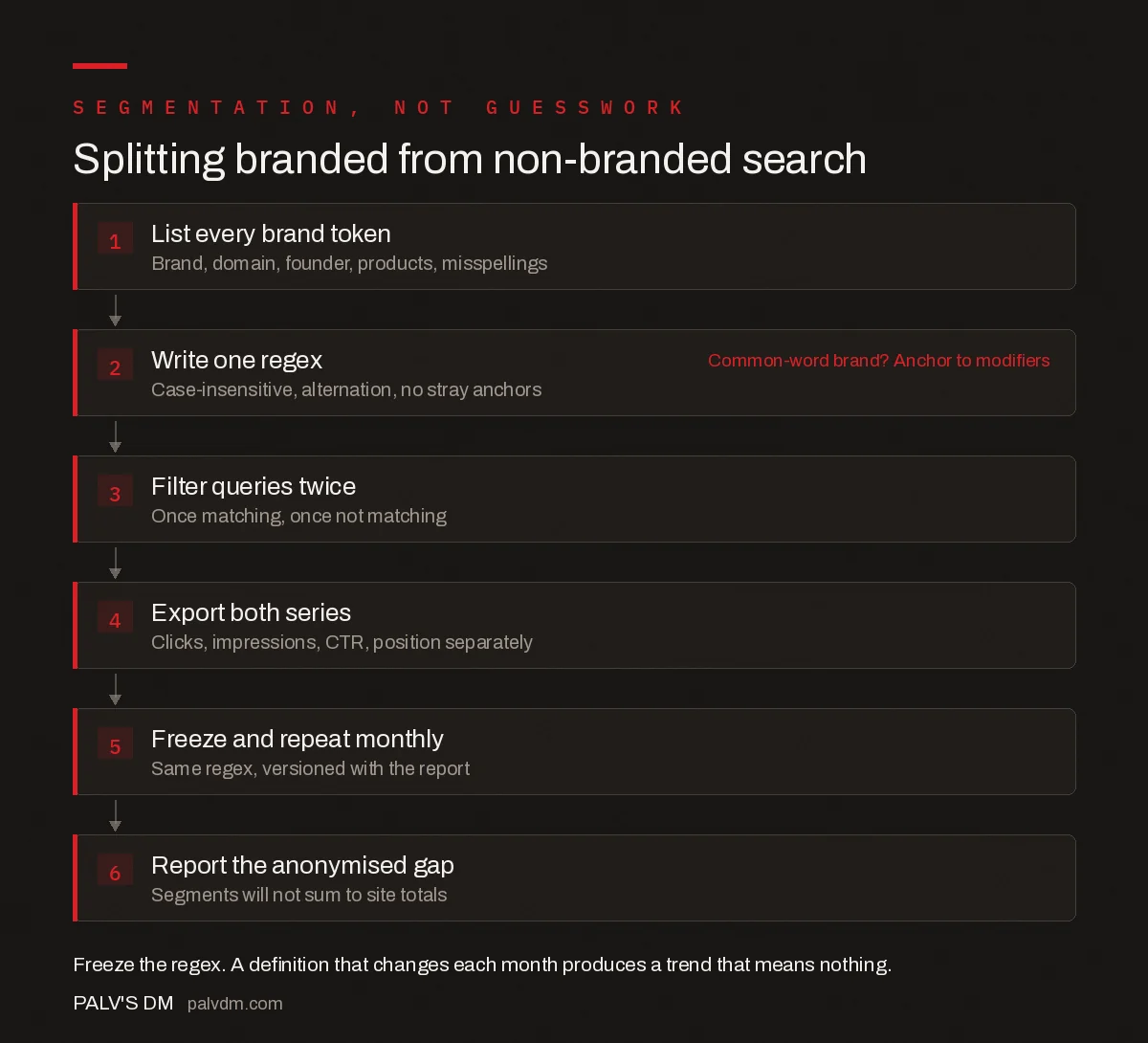
Splitting branded from non-branded search
- List every brand token. Brand, domain, founder, products, misspellings.
- Write one regex. Case-insensitive, alternation, no stray anchors. Common-word brand? Anchor to modifiers
- Filter queries twice. Once matching, once not matching.
- Export both series. Clicks, impressions, CTR, position separately.
- Freeze and repeat monthly. Same regex, versioned with the report.
- Report the anonymised gap. Segments will not sum to site totals.
Frequently asked questions
What is a branded search?
A branded search is a query containing a term that refers to one specific company: the brand name, a product name, the domain, a common misspelling, or sometimes a founder’s name. Examples include “nike air max” and “zomato customer care”. Branded searches indicate demand that already exists, because the searcher learned the name somewhere before searching.
What counts as a non-branded keyword?
A non-branded keyword describes a category, problem or outcome without naming a specific company — “seo agency in ahmedabad”, “best running shoes for flat feet”, “how to fix a slow website”. Competitor brand names count as non-branded from your point of view, since a searcher using them has not heard of you or has not thought of you.
How do I separate branded and non-branded traffic in Google Search Console?
Use the query filter in the Performance report. Build one case-insensitive regular expression covering every brand token, apply it as a custom regex filter matching your expression for branded traffic, then apply the same expression as “doesn’t match” for non-branded. Export both series separately and keep the regex frozen so month-to-month comparisons stay valid.
What is a good ratio of branded to non-branded search traffic?
There is no benchmark worth trusting. The ratio depends on brand age, category, advertising spend, how distinctive the brand name is, and whether people search the category at all. Read the direction of each series independently instead: both rising is healthy, while branded rising as non-branded falls means a strong brand is masking a failing search programme.
Should I bid on my own brand name in Google Ads?
It depends on whether competitors are bidding on it and what the clicks cost. If a rival ad appears above your organic result, an ad defends the position. If nothing else appears, brand ads can simply buy clicks you would have received free. The honest test is to pause brand campaigns for a fixed period and measure the change in total branded clicks.
Does growth in branded search mean my SEO is working?
Not on its own. Branded search rises when awareness rises, which advertising, PR, social posts, word of mouth and AI mentions all drive. Search work usually defends and captures that demand rather than creating it. Judge a search programme on non-branded clicks, non-branded impressions and non-branded conversions, and treat branded growth as evidence about awareness instead.
Sources
- Performance report (Search results): Overview and basic setup — Search Console Help — metrics and dimensions available for query segmentation
- Performance report: Advanced filtering and comparison — Search Console Help — custom regex query filters
- Shopify: AI referrals up 197%, but organic search still leads traffic — Search Engine Land — 13 August 2026
- Debug drops in Search traffic — Google Search Central
Want this done on your site?
Every PalV’s DM engagement starts with a free audit of your actual website — a 12-point
crawl covering what is blocking indexation, on-page gaps against your primary keywords, speed
findings, and the three to five fixes worth making first. Delivered in two working days. No
payment details, and the findings are yours whether you hire us or not.