How Long a Core Update Rollout Takes, Historically
The median Google core update rollout is about 14 days, but the range runs from 6 to 45. Every logged duration since 2021, and what the numbers do not mean.
The median Google core update rollout has taken about 14 and a half days. Across the sixteen core updates Google has logged on its Search Status Dashboard since November 2021, the shortest ran 6 days and 4 hours (December 2024) and the longest ran 45 days (March 2024). Exactly half of them ran longer than the two weeks Google usually estimates. Google publishes a start time and a completion time for every one, so this is a measured record rather than an estimate.
The number that matters more than the median is the spread. A site owner planning around “about two weeks” was right roughly half the time and wrong by a factor of three in March 2024. Rollout length is not predictable, and Google has never explained why it varies.
How long does a Google core update take to roll out?
Google’s launch notice on the dashboard normally reads: “The rollout may take up to 2 weeks to complete.” That is an estimate Google itself has missed in both directions. It said three weeks for the December 2025 core update and finished in 18 days and 2 hours. It said two weeks for the February 2026 Discover core update and took 21 days and 17 hours.
Across the full logged record since November 2021, core update rollouts have averaged roughly 17 days with a median of about 14 and a half. The average is dragged upward by a single outlier: the March 2024 core update at 45 days, which was also the update that folded the standalone helpful content system into Google’s core ranking systems.
The full core update rollout record
Every duration below is Google’s own, taken from the Ranking history on the Search Status Dashboard. Times are US/Pacific.
| Core update | Started | Duration |
|---|---|---|
| November 2021 | 17 Nov 2021 | 13 days |
| May 2022 | 25 May 2022 | 15 days |
| September 2022 | 12 Sep 2022 | 14 days |
| March 2023 | 15 Mar 2023 | 13 days, 7 hours |
| August 2023 | 22 Aug 2023 | 16 days, 3 hours |
| October 2023 | 5 Oct 2023 | 13 days, 23 hours |
| November 2023 | 2 Nov 2023 | 25 days, 21 hours |
| March 2024 | 5 Mar 2024 | 45 days |
| August 2024 | 15 Aug 2024 | 19 days, 4 hours |
| November 2024 | 11 Nov 2024 | 23 days, 13 hours |
| December 2024 | 12 Dec 2024 | 6 days, 4 hours |
| March 2025 | 13 Mar 2025 | 13 days, 21 hours |
| June 2025 | 30 Jun 2025 | 16 days, 18 hours |
| December 2025 | 11 Dec 2025 | 18 days, 2 hours |
| March 2026 | 27 Mar 2026 | 12 days, 4 hours |
| May 2026 | 21 May 2026 | 11 days, 21 hours |
Three things stand out in the record and only one of them is safe to interpret. The March 2024 outlier is real and enormous. The December 2024 rollout at 6 days and 4 hours is the only one that finished inside a week. And the two 2026 core updates are the shortest consecutive pair since 2021, at 12 days 4 hours and 11 days 21 hours — a reversal of the 2025 sequence, which lengthened from 13 days 21 hours to 18 days 2 hours across the year.
Only the first of those is safely interpretable, because Google described what the March 2024 update contained. For the other two, any explanation you read is inference. The full update history sets the durations in context against what each update was for.
Why do Google’s own estimates miss?
Google has never published an explanation, and that is the honest answer. What can be said is narrower and still useful.
Google’s dashboard wording is consistently conditional — “may take up to” — which is a ceiling, not a schedule. Rollouts have finished well inside it (December 2024, and both 2026 core updates) and well outside it (November 2023, March 2024, and the February 2026 Discover core update). Treating the estimate as a deadline for a client report is how SEO teams end up explaining why the “finished” update kept moving.
There is also a documented staging dimension in at least one case. Google released the February 2026 Discover core update to English-language users in the US only, saying it would expand to all countries and languages in the months ahead. That is an explicit, published example of a core update rolling out along a geographic and language axis. Whether the same happens with Search core updates, Google has not said. Why core updates roll out in stages goes through what is known and what is guesswork.
What happens to rankings during a rollout?
Rankings move more than usual, in bursts, and frequently end up somewhere different from where they sat mid-rollout. The May 2026 core update is the clearest recent illustration: Google announced it on the afternoon of Thursday 21 May, large movement was felt by Saturday 23 May, further large movements landed on Saturday 30 May, and there was more volatility in the final twenty-four hours before Google marked it complete on 2 June.
A site owner reading their position on 24 May was reading a state that no longer existed a week later. That is the single most expensive mistake in this whole topic: rewriting pages in response to a mid-rollout reading, then losing the ability to attribute any subsequent change to anything.
How do spam update rollouts compare?
Spam updates have a completely different and far wider distribution, and the 2026 pair are the fastest on record.
| Spam update | Started | Duration |
|---|---|---|
| October 2022 spam update | 19 Oct 2022 | 2 days |
| October 2023 spam update | 4 Oct 2023 | 15 days, 12 hours |
| March 2024 spam update | 5 Mar 2024 | 14 days, 21 hours |
| December 2024 spam update | 19 Dec 2024 | 7 days, 2 hours |
| August 2025 spam update | 26 Aug 2025 | 26 days, 15 hours |
| March 2026 spam update | 24 Mar 2026 | 19 hours, 30 minutes |
| June 2026 spam update | 24 Jun 2026 | 2 days, 1 hour |
The March 2026 spam update at 19 hours and 30 minutes is the shortest rollout of any kind in the dashboard record, and it followed the August 2025 spam update at 26 days and 15 hours. Rollout length therefore tells you nothing about the type of update either — a two-day event can be a spam update and an eighteen-day event can be a core update, or the reverse. Telling core updates and spam updates apart depends on what Google filed the incident as, not on how long it ran.
What should you do while a core update is rolling out?
- Record the start timestamp and do nothing else on day one. Note the incident ID and the Pacific-time start. That is your boundary for every comparison you will make later.
- Continue work already planned and committed. Pausing a content calendar because an update is running is superstition. Google has never advised it.
- Do not ship large structural changes. Not because Google punishes it, but because you will never be able to separate the effect of the update from the effect of your change.
- Wait for the completion notice before analysing. Then compare equal-length windows that both sit fully outside the rollout. Confirming update impact properly covers the method.
- Give it a further week after completion before acting. Positions continued to move in the final twenty-four hours of the May 2026 rollout, and settling is not instantaneous.
What rollout length does not tell you
Rollout duration is a measurement, not a signal. It does not indicate how large the update was, how many sites moved, whether the change was aggressive or conservative, or how likely you are to recover. The 45-day March 2024 core update and the 6-day December 2024 core update were both broad reassessments of the same kind.
It also has no bearing on your recovery timeline. Google’s standing guidance is that no specific actions guarantee recovery from a core update, that a drop does not necessarily mean anything is wrong, and that the largest changes tend to arrive with a subsequent core update rather than between them. On the 2026 cadence, that means a wait measured in months. The 30-day recovery plan is about using that wait well, and what a core update actually is covers why there is nothing to appeal in the meantime. Every confirmed 2026 date sits in the 2026 update timeline.
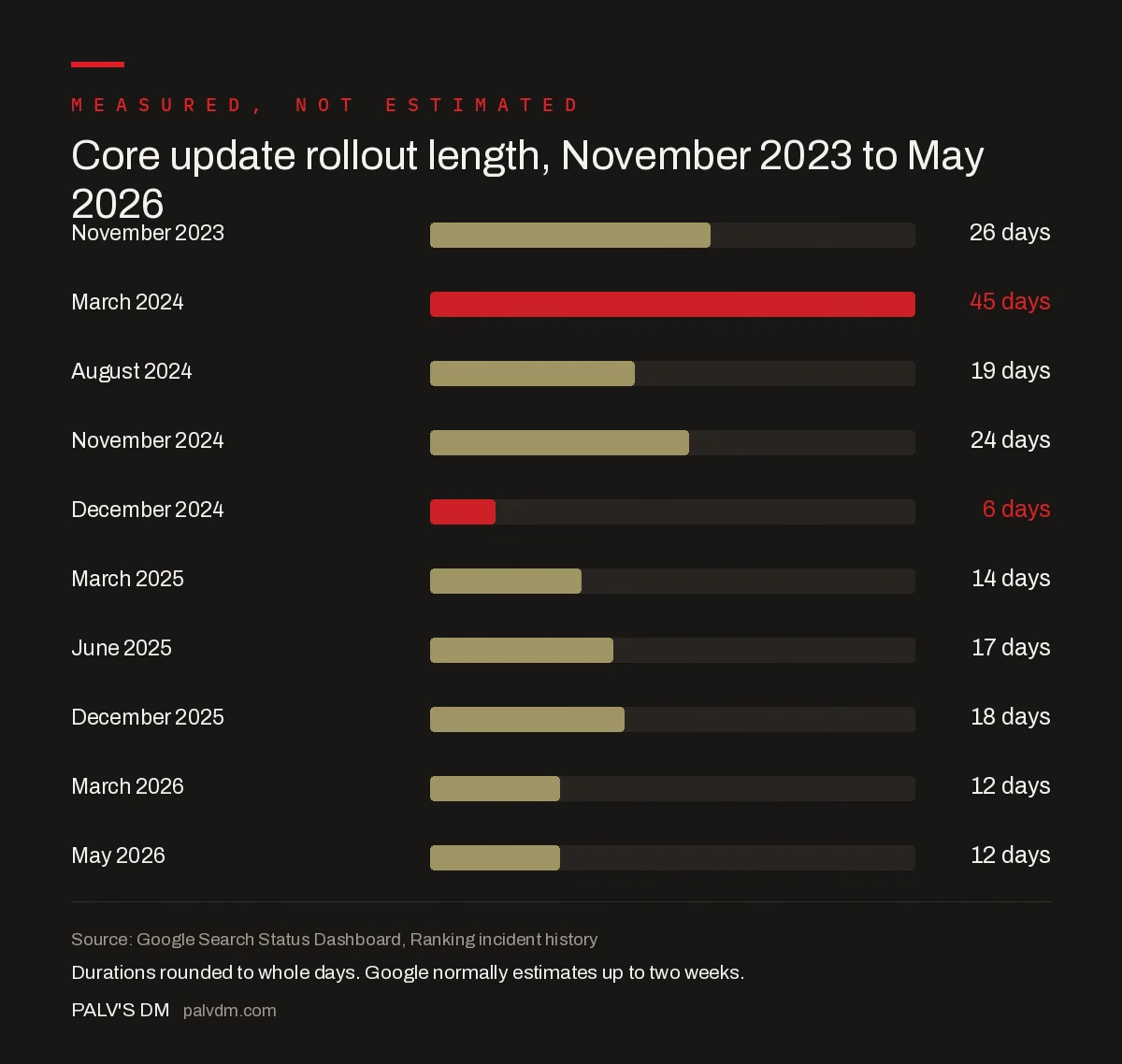
Core update rollout length, November 2023 to May 2026
| Metric | Value |
|---|---|
| November 2023 | 26 days |
| March 2024 | 45 days |
| August 2024 | 19 days |
| November 2024 | 24 days |
| December 2024 | 6 days |
| March 2025 | 14 days |
| June 2025 | 17 days |
| December 2025 | 18 days |
| March 2026 | 12 days |
| May 2026 | 12 days |
Source: Google Search Status Dashboard, Ranking incident history
Frequently asked questions
How long does a Google core update take?
The median core update rollout has taken about 14 and a half days. Across the sixteen core updates logged on Google’s Search Status Dashboard since November 2021, the shortest was December 2024 at 6 days and 4 hours and the longest was March 2024 at 45 days. Google normally estimates up to two weeks, and half of all rollouts have exceeded that.
What was the longest Google core update rollout?
The March 2024 core update, at 45 days. It started on 5 March 2024 and Google marked it complete on 19 April 2024. It was also the update that integrated the standalone helpful content system into Google’s core ranking systems, and Google published three new spam policies alongside it.
What was the shortest Google core update rollout?
The December 2024 core update, at 6 days and 4 hours, starting 12 December 2024. It is the only core update in Google’s dashboard record to finish inside a week. For comparison, the two 2026 core updates ran 12 days 4 hours in March and 11 days 21 hours in May, the shortest consecutive pair since 2021.
Should I make changes while a core update is rolling out?
Continue planned work, but avoid large structural changes. The reason is attribution rather than punishment: if you ship a redesign mid-rollout you will never separate the effect of your change from the effect of the update. Wait for Google’s completion notice, then compare equal-length periods that both sit fully outside the rollout window.
Do spam updates roll out faster than core updates?
Not reliably. Spam update durations range from 19 hours and 30 minutes for the March 2026 spam update, the shortest rollout of any kind on Google’s dashboard, to 26 days and 15 hours for the August 2025 spam update. Rollout length tells you nothing about which type of update ran; only Google’s dashboard classification does.
Why do Google's rollout estimates vary so much?
Google has never published an explanation, so any answer you read is inference. The dashboard wording is deliberately conditional, saying a rollout may take up to a stated period rather than committing to it. Google did document one staging dimension explicitly: the February 2026 Discover core update launched for English-language users in the US only.
Sources
- Google Search Status Dashboard — Ranking incident history
- Google core updates and your website — Search Central
- February 2026 Discover core update — Search Central blog
- What web creators should know about our March 2024 core update and new spam policies
Want this done on your site?
Every PalV’s DM engagement starts with a free audit of your actual website — a 12-point
crawl covering what is blocking indexation, on-page gaps against your primary keywords, speed
findings, and the three to five fixes worth making first. Delivered in two working days. No
payment details, and the findings are yours whether you hire us or not.