How to Prioritise SEO Tasks With ICE Scoring
Score every SEO task on Impact, Confidence and Ease, then order the backlog by the result. How to score each dimension, and where the model breaks down.

ICE scoring prioritises SEO tasks by rating each one from 1 to 10 on three dimensions — Impact, Confidence and Ease — and ordering the list by the average of the three. It takes about twenty minutes for a fifty-item audit backlog, and its value is not mathematical precision. It is that it forces three separate judgements to be made and written down, so the resulting order can be argued with on evidence rather than on who spoke last in the meeting.
The framework comes from growth experimentation, where it is commonly attributed to Sean Ellis, and it transfers to SEO well because SEO backlogs have the same structure: far more candidate actions than capacity, wildly varying certainty about outcomes, and effort estimates that span from ten minutes to a full quarter.
What is ICE scoring?
ICE is a scoring model with three inputs, each rated 1 to 10 by the people who will do or authorise the work.
- Impact — how much this moves a commercial outcome if it works.
- Confidence — how sure you are that it will work, based on evidence you can point to.
- Ease — how little effort, cost and dependency the task carries. High score means easy.
Average the three for the ICE score. Some teams multiply instead, which spreads the results more aggressively and punishes any single low score harshly; averaging is more forgiving and easier to explain to a stakeholder. Pick one method and use it consistently, because comparing scores calculated two different ways is meaningless.
ICE sits at a specific point in the workflow: after diagnosis, before scheduling. It is the mechanism that turns audit findings into an action plan, and it assumes the diagnostic work has already been done — an audit and a strategy answer different questions, and ICE prioritises the output of the first against the targets set by the second.
Score at the task level, never at the project level. “Improve site speed” cannot be scored usefully. “Compress and convert the twelve hero images on the top-traffic templates” can.
How do you score Impact for an SEO task?
Impact should be scored against a commercial outcome, not against a search metric. The question is how much closer this task brings you to enquiries or revenue, not how many keywords it touches.
Three anchors keep Impact scoring honest. Traffic potential of the affected pages — a fix on a page with 4,000 monthly impressions outranks the same fix on a page with 40. Commercial intent of the queries involved, since commercial queries convert and informational ones mostly do not. And whether the task unblocks other tasks, because a dependency carries the impact of everything downstream of it.
The most common Impact error is scoring by severity. A crawler flagging an issue as “critical” is describing a technical category, not a commercial consequence. Most audit findings are real and minor at the same time, and treating severity as impact fills your first quarter with tidy, worthless work.
How do you score Confidence?
Confidence is where SEO prioritisation differs most from product prioritisation, because in SEO the mechanism is often unverifiable. Score it against the evidence you can actually name.
| Score | Evidence standard | Example |
|---|---|---|
| 9–10 | Documented by Google, or observed on this site before | Removing a noindex tag from pages that should be indexed |
| 7–8 | Well-established practice with a clear mechanism | Adding internal links from strong pages to an orphaned one |
| 4–6 | Plausible mechanism, mixed evidence | Rewriting a title tag to raise click-through rate |
| 1–3 | Vendor claim, correlation study, or industry folklore | Chasing a third-party authority score |
Writing the evidence standard next to the score is the part that changes behaviour. A task nobody can justify above 3 is usually revealed, at that moment, to have been on the list because a tool suggested it.
How do you score Ease?
Ease is effort inverted: a ten-minute change scores 9 or 10, a task needing a quarter of developer time scores 1 or 2. Score the whole cost, not just your own part of it.
Three costs get forgotten. Dependency cost — a task requiring another team’s approval is harder than one you control, regardless of how long the work itself takes. Review cost — content that needs legal or clinical sign-off is far more expensive than its word count implies. And risk cost, because a change that could break something carries an implicit cost of care and testing.
Estimate Ease with the person who will do the work in the room. An SEO estimating a developer’s effort is guessing, and the guess is usually optimistic — which is one route into scope creep on an SEO engagement.
What does a scored backlog look like?
A worked example, using tasks that appear on most audits. The scores below are illustrative judgements, not measurements — the point is the ordering they produce, not the numbers themselves.
| Task | I | C | E | ICE |
|---|---|---|---|---|
| Remove noindex from 30 wrongly excluded product pages | 9 | 10 | 9 | 9.3 |
| Rewrite title tags on 8 pages ranking 11–20 | 7 | 7 | 9 | 7.7 |
| Merge four cannibalising blog posts into one | 6 | 7 | 6 | 6.3 |
| Add internal links from top pages to the service page | 6 | 8 | 9 | 7.7 |
| Replatform to a headless front end | 8 | 4 | 1 | 4.3 |
| Publish 20 new blog posts | 5 | 4 | 3 | 4.0 |
Pages sitting between positions 11 and 20 score unusually well across all three dimensions, which is why striking-distance keywords appear near the top of almost every scored backlog: the impact is measurable, the mechanism is understood, and the work is small.
Two things usually surprise people the first time. Indexation fixes dominate the top of the list because they score high on all three dimensions at once, which is why technical remediation belongs in the first quarter of any plan. And large content programmes score mid-table, not because content is unimportant but because impact is diffuse and confidence is genuinely lower than practitioners like to admit.
Where does ICE break down?
ICE is a heuristic, and treating its output as an instruction rather than a starting point causes four specific failures.
- Dependencies get ignored. A task that must happen first should be promoted regardless of score. Sequence beats score.
- Compounding work is undervalued. Building topical authority scores poorly on Ease and moderately on Confidence, yet it is often the highest-value programme available. Score a cluster as one item rather than as thirty separate posts, or the model will bury it.
- Risk is invisible. ICE has no field for downside. A high-scoring task that could damage the site — mass redirects, aggressive pruning — needs a separate check before it ships.
- Scores drift. Everyone’s scale differs, and the same person scores differently in January and June. Anchor with one or two reference tasks that everybody scores first.
How does ICE compare with RICE and PIE?
RICE adds a Reach dimension — how many people the change affects in a given period — and replaces Ease with Effort, usually measured in person-months. It was developed for product prioritisation at Intercom and is a better fit when candidate tasks vary hugely in audience size. For SEO, Reach and Impact tend to collapse into the same judgement, since a page’s traffic potential is already the main input to Impact.
PIE, used in conversion optimisation, scores Potential, Importance and Ease. It is functionally close to ICE with Confidence replaced by strategic importance, which makes it more subjective rather than less.
For SEO backlogs, ICE is usually the right level of ceremony: three fields, twenty minutes, defensible order. Use RICE only when tasks genuinely differ in audience size by an order of magnitude — a site-wide template change against a single landing page, for example.
How do you run a prioritisation session?
- Assemble the full backlog first, unfiltered — audit findings, content ideas, developer requests, competitor gaps. Filtering before scoring reintroduces exactly the bias the model exists to remove.
- Split anything larger than two weeks into scoreable tasks. Unsplittable items are projects and belong on the roadmap, not the backlog.
- Score two reference tasks together to calibrate the scale before anyone scores alone.
- Score independently, then compare. Gaps of three or more points signal a genuine disagreement about mechanism, and those conversations are the actual output of the session.
- Promote dependencies, then cut at capacity. Draw the line where the team’s real capacity ends. Sprint planning turns the surviving items into scheduled work, and the twelve-month roadmap holds everything below the line.
Rescore quarterly rather than continuously. Scores change when new evidence arrives — a completed task that worked raises Confidence for similar tasks, and a confirmed core update can change Impact across the whole list. The KPIs you agreed to report should be the same outcomes Impact is scored against, or the prioritisation and the reporting will describe two different businesses.
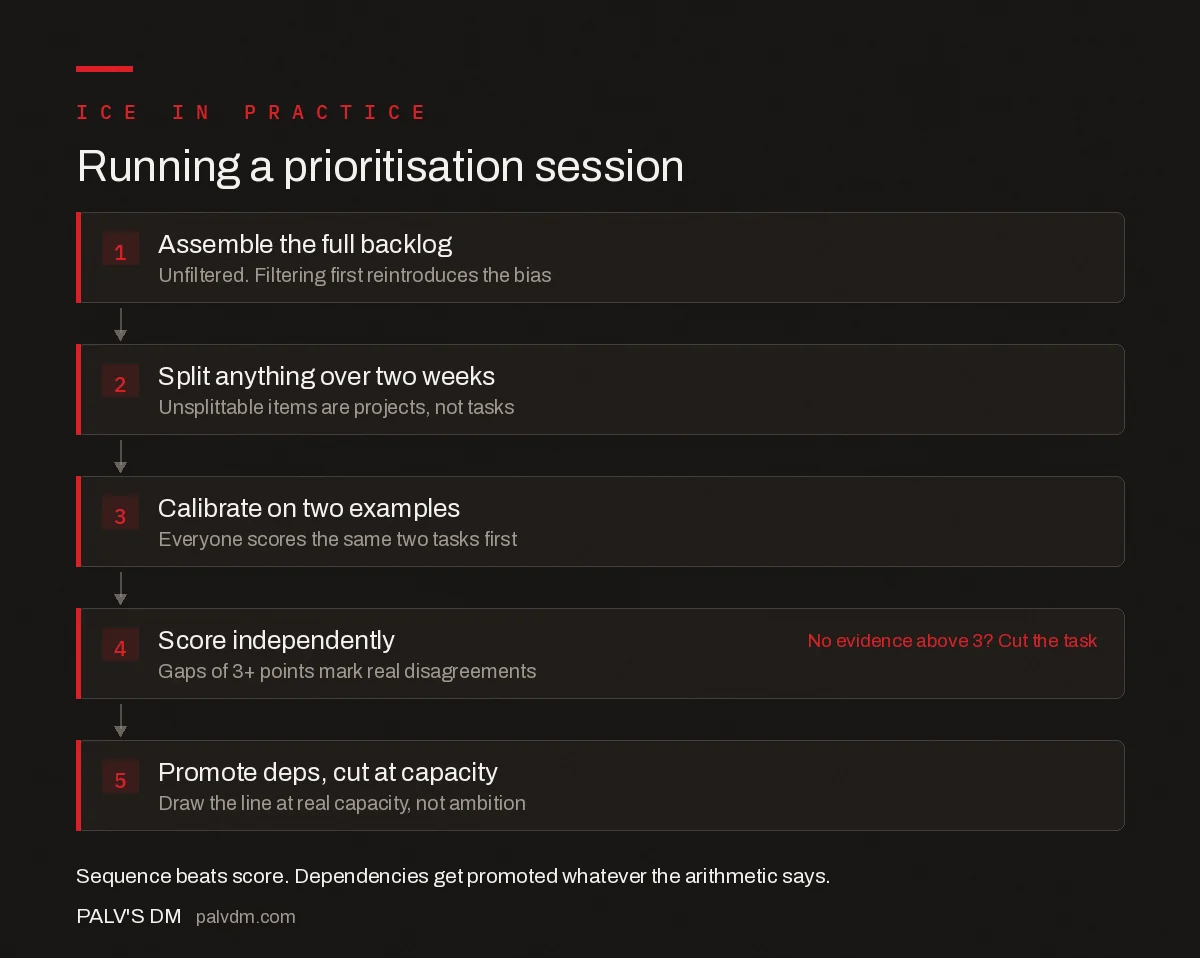
Running a prioritisation session
- Assemble the full backlog. Unfiltered. Filtering first reintroduces the bias.
- Split anything over two weeks. Unsplittable items are projects, not tasks.
- Calibrate on two examples. Everyone scores the same two tasks first.
- Score independently. Gaps of 3+ points mark real disagreements. No evidence above 3? Cut the task
- Promote deps, cut at capacity. Draw the line at real capacity, not ambition.
Frequently asked questions
What is ICE scoring in SEO?
ICE scoring rates each candidate SEO task from 1 to 10 on three dimensions — Impact on a commercial outcome, Confidence that it will work, and Ease of doing it — then orders the backlog by the average of the three. It comes from growth experimentation and suits SEO because backlogs always contain far more candidate actions than capacity.
How do you calculate an ICE score?
Rate Impact, Confidence and Ease from 1 to 10 each, then either average the three or multiply them. Averaging is more forgiving and easier to explain to stakeholders; multiplying spreads results more aggressively and heavily punishes any single low score. Choose one method and apply it consistently, because scores calculated two different ways cannot be compared.
What is the difference between ICE and RICE?
RICE adds a Reach dimension measuring how many people a change affects in a given period, and replaces Ease with Effort in person-months. For SEO work, Reach and Impact usually collapse into the same judgement, since a page’s traffic potential already drives Impact. RICE earns its extra field when tasks differ in audience size by an order of magnitude.
How should Impact be scored for an SEO task?
Against a commercial outcome, not a search metric. Use three anchors: the traffic potential of the affected pages, the commercial intent of the queries involved, and whether the task unblocks other work, since a dependency carries the impact of everything downstream. Scoring by a crawler’s severity label is the most common error and fills quarters with tidy, low-value work.
Where does ICE scoring fail?
In four places. It ignores dependencies, so tasks that must happen first need promoting regardless of score. It undervalues compounding work like topical authority unless a whole cluster is scored as one item. It has no field for downside risk, so damaging changes need a separate check. And scales drift between people and over time unless calibrated on reference tasks.
How often should an SEO backlog be rescored?
Quarterly. Scores change when new evidence arrives: a completed task that worked raises Confidence for similar tasks, and a confirmed Google core update can shift Impact across the entire list. Rescoring continuously wastes time and produces churn, because organic search rarely changes enough within four weeks to justify reordering a backlog.
Sources
- SEO Starter Guide — Google Search Central
- Google core updates and your website
- Performance report (Search results) — Search Console Help
Want this done on your site?
Every PalV’s DM engagement starts with a free audit of your actual website — a 12-point
crawl covering what is blocking indexation, on-page gaps against your primary keywords, speed
findings, and the three to five fixes worth making first. Delivered in two working days. No
payment details, and the findings are yours whether you hire us or not.