The Difference Between an SEO Audit and an SEO Strategy
An audit tells you what is broken. A strategy tells you where to compete and why you can win. What each deliverable contains, which to buy first, and why.

An SEO audit tells you what is wrong with the site you have. An SEO strategy tells you which searchers you intend to win, why you can win them, and what you will build to do it. The audit is diagnostic and backward-looking; the strategy is directional and forward-looking. They are different deliverables, produced from different inputs, and buying one when you needed the other is the most common reason an SEO engagement produces a thick document and no results.
The confusion is commercially useful to some suppliers, because an audit is cheap to produce, easy to automate and impressive to look at. A strategy requires understanding the business, and cannot be generated by a crawler.
What does an SEO audit actually produce?
An SEO audit is a structured inspection of an existing website against known technical, on-page and content criteria. Its output is a prioritised list of defects, each with a location, a severity and a fix.
A competent audit covers four layers. Crawling and indexing — whether search engines can reach and store your pages at all. On-page — titles, headings, internal links, and whether pages target the queries they should. Content — thin, duplicate, outdated or cannibalising pages. And off-page basics — the link profile’s shape and any obvious risk in it. The findings that recur across most audits are remarkably consistent, which is why the exercise is largely checklist-driven.
What an audit cannot produce is a reason to exist. It will tell you that forty pages have duplicate title tags. It will not tell you whether those forty pages should exist, or which twelve queries your business ought to be competing for this year. Reading an SEO audit properly means treating it as a list of constraints, not a plan.
What does an SEO strategy actually produce?
An SEO strategy is a set of decisions about where to compete. Its output is a target definition, a rationale, and a sequence — not a defect list.
A real strategy answers five questions. Which searchers are worth winning, defined by intent rather than by search volume. Why your site can plausibly beat what currently ranks for those queries, which requires an honest assessment of your authority and your genuine subject expertise. What has to be built — pages, evidence, tooling, credibility signals. In what order, given dependencies and capacity. And how success will be judged, agreed before the work starts rather than after a disappointing quarter.
The strategy is where topical focus is decided. A site that covers one subject deeply builds topical authority faster than a site publishing across six unrelated areas, and that choice is strategic — no audit will surface it, because it is not a defect in what exists.
How do the two compare directly?
| Dimension | SEO audit | SEO strategy |
|---|---|---|
| Question answered | What is wrong with this site? | Where should this business compete, and why? |
| Main input | Crawl data, Search Console, page inspection | Commercial goals, margins, expertise, competitor reality |
| Output format | Prioritised defect list with fixes | Target queries, rationale, build list, sequence |
| Time horizon | Current state | Six to twelve months |
| How often it is redone | Annually, or after a migration | Reviewed quarterly, rewritten yearly |
| Can it be automated? | Largely, for detection | No |
| Fails when | Nobody implements it | It ignores what the audit found |
Which one do you need first?
Audit first, in almost every case, for one reason: the audit changes what the strategy can promise. A strategy that targets competitive commercial terms is worthless if a third of the site is not indexed, and you cannot know that until someone has crawled it.
There are two exceptions. A brand-new website has nothing to audit, so it starts with strategy and a pre-launch checklist instead — the first 90 days of a new site is a build sequence, not a remediation sequence. And a business considering entering a new market or category needs the strategic question answered before it matters what the current site does.
For everyone else the order is: audit, then strategy shaped by what the audit found, then a dated plan. The twelve-month roadmap is the third document and the one people actually work from.
Why does an audit alone so often produce nothing?
Because a defect list is not a work plan, and the gap between the two is where most SEO spend disappears.
Four things go wrong. The findings are ranked by severity rather than by impact on your commercial goals, so a low-value fix outranks a high-value one. There is no owner attached to any item, so nothing is anyone’s job. The recommendations require developer capacity nobody has agreed to fund. And there is no success signal per item, so no one can tell whether the fix worked. An audit you cannot implement is a cost, not an asset, and converting audit findings into an action plan is a separate piece of work that is frequently not included in the price.
Ask before buying: does this include a prioritised action plan with owners, or only findings? The answer changes the value of the deliverable more than the number of pages in it.
Why does a strategy without an audit fail?
A strategy built without diagnostic data makes promises the site cannot keep. It selects keywords without knowing whether the pages targeting them are indexable. It plans a content programme on a site whose existing content is already cannibalising itself. It assumes authority the domain does not have.
The specific failure is usually invisible for months. Content ships on schedule, the plan looks like it is being executed, and nothing ranks — because the constraint was never in the content layer. Diagnosing why SEO is not working almost always leads back to a diagnostic step that was skipped at the start.
There is a third failure worth naming, because it is the expensive one. A strategy written without diagnostic data will often be right about the destination and wrong about the timeline, which is worse than being wrong about both. Targets get agreed, budgets get set against them, and the schedule slips by two quarters once the technical remediation nobody planned for turns out to be the first three months of work. Sequencing errors are far harder to explain to a board than target errors.
How do you tell which one you were actually sold?
Read the deliverable and check for four markers. If it names specific URLs and specific defects, it is an audit. If it names target queries and explains why you can win them, it is a strategy. If it contains a dated sequence with owners, it is a plan. If it contains none of those, it is a proposal.
Two warning signs are worth naming. An “audit” that is a tool export with no human interpretation is a report, not an audit — the value is in the prioritisation, which is the part automation cannot do. And a “strategy” that consists of a keyword list with volume and difficulty columns is research output, not strategy, because it contains no decision about where to compete. Red flags in SEO proposals cluster around exactly this substitution.
What should each one cost?
Audits and strategies are priced differently because the effort profiles differ. Detection in an audit is largely automated, so the cost is in interpretation and prioritisation. Strategy cost is entirely human time spent understanding the business.
PalV’s DM includes a free 12-point audit of your actual website with every engagement — what is blocking indexation, on-page gaps against your primary keywords, speed findings, and the three to five fixes worth making first, delivered in two working days. What a free audit should contain and where free audits genuinely stop being enough are worth reading before assuming a paid audit is automatically deeper. Beyond that, retainers start at ₹5,000 a month for SEO Foundation, and standalone services from ₹500 cover specific pieces of diagnostic or implementation work.
The decision rule: if you know what is wrong and cannot decide what to do about it, buy strategy. If you do not know what is wrong, buy diagnosis first — and insist that whatever you buy ends in a list of tasks with names and dates against them.
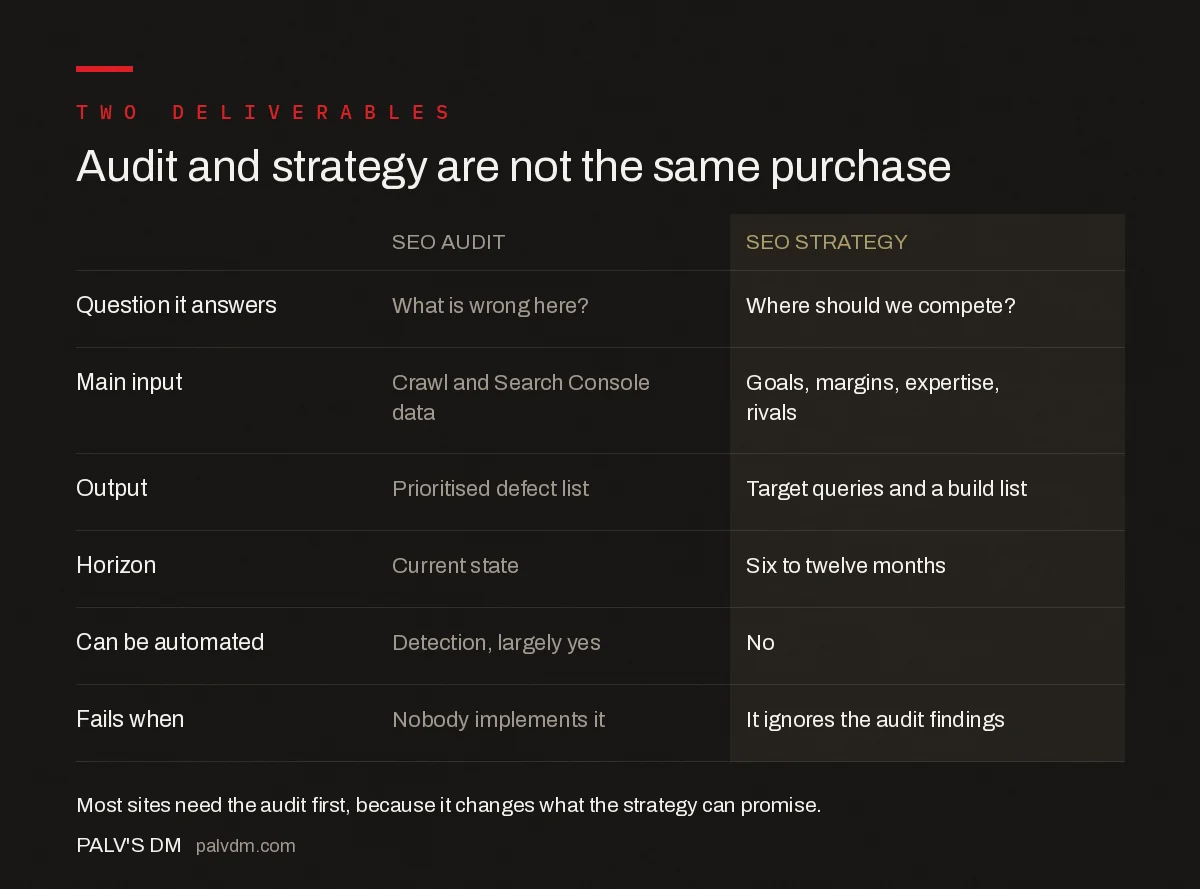
Audit and strategy are not the same purchase
| SEO audit | SEO strategy | |
|---|---|---|
| Question it answers | What is wrong here? | Where should we compete? |
| Main input | Crawl and Search Console data | Goals, margins, expertise, rivals |
| Output | Prioritised defect list | Target queries and a build list |
| Horizon | Current state | Six to twelve months |
| Can be automated | Detection, largely yes | No |
| Fails when | Nobody implements it | It ignores the audit findings |
Frequently asked questions
What is the difference between an SEO audit and an SEO strategy?
An SEO audit is a structured inspection of an existing site that produces a prioritised list of defects with locations and fixes. An SEO strategy is a set of decisions about where to compete, producing target queries, a rationale for why you can win them, a build list and a sequence. The audit is diagnostic; the strategy is directional.
Should I get an SEO audit or a strategy first?
An audit first in almost every case, because the findings change what a strategy can realistically promise. Targeting competitive commercial terms is pointless if a third of your pages are not indexed, and only a crawl will reveal that. The exceptions are brand-new websites, which have nothing to audit, and businesses evaluating entry into a new category.
Why does an SEO audit often lead to no results?
Because a defect list is not a work plan. Findings ranked by technical severity rather than commercial impact put low-value fixes at the top, no item has a named owner, the recommendations need developer capacity nobody funded, and no success signal is attached to any fix. Ask whether the price includes a prioritised action plan with owners, not just findings.
Can an SEO audit be automated?
Detection can be, and largely is — crawlers reliably find broken links, duplicate titles, redirect chains and indexation problems. Interpretation and prioritisation cannot be. A tool export with no human judgement attached is a report rather than an audit, and its value is limited because the ordering of the fixes is where most of the benefit lives.
How often should an SEO audit be repeated?
Annually for most sites, and immediately after any migration, replatform or major redesign, because those events reintroduce exactly the problems an audit finds. Strategy is reviewed quarterly and rewritten yearly. Repeating a full audit more often than annually usually surfaces the same unfixed findings rather than new information.
Is a free SEO audit worth having?
Yes, if it inspects your actual site rather than generating a generic score. A useful free audit names specific URLs, identifies what is blocking indexation, compares on-page elements against your real target keywords, and ends with a short ordered list of fixes. A numerical grade with no page-level detail is a lead-generation device rather than a diagnosis.
Sources
- SEO Starter Guide — Google Search Central
- Do you need an SEO? — Google Search Central
- Creating helpful, reliable, people-first content — Google Search Central
Want this done on your site?
Every PalV’s DM engagement starts with a free audit of your actual website — a 12-point
crawl covering what is blocking indexation, on-page gaps against your primary keywords, speed
findings, and the three to five fixes worth making first. Delivered in two working days. No
payment details, and the findings are yours whether you hire us or not.