Ranking Bugs vs Ranking Updates: Telling Them Apart
A ranking bug reverts on its own; an update persists. How to separate the two, and how to rule out a reporting bug before you change anything.
A ranking bug is an unintended failure in Google’s systems that Google usually acknowledges and reverses. A ranking update is a deliberate change that persists. The practical test is whether the movement reverts without you doing anything, and whether Google posts an incident rather than an update on its Search Status Dashboard. Both look identical in Search Console on day one — a sharp drop in positions, impressions or clicks — which is why so many sites rewrite content in response to something that fixed itself a week later.
There is a third possibility that gets mistaken for both, and it is more common than either: a reporting bug, where rankings never moved at all and only the numbers you are looking at broke. Diagnosing that first saves the most wasted work.
What does Google’s Search Status Dashboard actually publish?
Google’s Search Status Dashboard at status.search.google.com is the only authoritative record of both kinds of event. It covers four systems — crawling, indexing, serving and ranking — and publishes two distinct types of entry.
Updates are intentional. Core updates and spam updates are announced there with a start date and a completion date, and each carries an incident identifier. The March 2026 core update, for example, ran from 27 March to 8 April 2026 under identifier 7eTbAa2jWdToLkraZj5y.
Disruptions are failures. When a Google system is not behaving as designed, the dashboard records the affected system, the status, and a resolution once it is fixed. Google does not describe these as updates, and they do not come with guidance to site owners, because there is nothing for a site owner to do.
If neither type of entry exists for your date, then whatever moved was not something Google published. That is not proof nothing happened, but it does mean every explanation you are about to read online is inference. Confirmed versus unconfirmed updates covers where that line sits, and how to read the dashboard covers the mechanics.
How do bugs and updates behave differently?
| Ranking bug | Ranking update | |
|---|---|---|
| Intent | Unintended failure | Deliberate change |
| Duration | Hours to days, until fixed | Persists; rollouts run around 12 to 18 days |
| Reverts on its own? | Usually, completely | No |
| Dashboard entry | Logged as a disruption, if logged at all | Announced as an update with start and end dates |
| Pattern | Often indiscriminate or oddly shaped | Patterned by template, content type or query cluster |
| Correct response | Document it and wait | Diagnose after the rollout completes, then improve |
What did August 2026 look like?
August 2026 is the cleanest recent example of movement that was not an update, and it is worth walking through because almost every element of the confusion was present at once.
Google announced no algorithm update in August 2026. The Search Status Dashboard showed no ranking, indexing, crawling or serving incident between 1 and 6 August 2026. Third-party volatility trackers, however, registered elevated movement on 1 to 3 August and again on 5 to 6 August, with roughly fourteen tools showing spikes, following earlier spikes on 11, 18 and 24 July.
Three unrelated things landed in the same window: a GA4 reporting bug, disruptions in Google Ad Manager, and a decline in Google Discover traffic that had actually begun in mid-July, before the August window opened. None of those is a ranking change. Two of them are measurement or advertising problems, and the third belongs to a different surface entirely. The full August 2026 breakdown sets out the sequence.
The lesson generalises. When several systems wobble at once, the story that spreads is the simplest one — “there must have been an update” — and it is usually wrong.
How do you tell a reporting bug from a real ranking change?
Reporting bugs are the most common false alarm and the easiest to rule out, so start there.
- Split positions, impressions and clicks. A genuine ranking change shows up in average position first. Impressions falling while positions hold usually means demand or eligibility changed, not ranking. Clicks falling while impressions and positions hold points at the result itself or at measurement.
- Check a second data source. If Search Console shows a drop and your server logs and analytics show normal sessions, the ranking did not move. If analytics shows a drop and Search Console does not, suspect the analytics.
- Check whether the shape is physically plausible. Traffic that vanishes at midnight and returns at midnight is a data pipeline, not an algorithm.
- Spot-check the actual SERP. Search three or four of the affected queries manually. If your page is still ranking where it was, the numbers are wrong, not the rankings.
- Read your own release log before anything else. A deploy, a robots.txt edit, a canonical change or a plugin update explains more sudden drops than every algorithm update combined. Update or self-inflicted walks that check properly.
- Only then check the dashboard. Starting with “which update was it” guarantees you find one, because there is nearly always something to blame.
What should you do while a suspected bug is running?
Very little, deliberately. The correct response to a suspected bug is to document and wait, because the cost of acting is high and the cost of waiting is nearly zero.
Record the exact start time, the affected URLs and queries, and screenshots of the Search Console graphs. Note anything you shipped in the preceding fourteen days. Check the dashboard daily rather than hourly. If the movement reverses within days with no change on your side, you have your answer and a documented case for the next time someone asks.
Do not rewrite pages, do not remove content, and do not change internal linking during the window. If the cause was a bug, you have made permanent changes to fix a temporary problem and destroyed your ability to attribute anything afterwards. If it was an update, you have optimised against a moving target mid-rollout. Either way you lose the measurement. The mistakes that follow an update are mostly variations on acting too early, and confirming update impact sets out the evidence you actually need first.
How do you explain the difference to a client?
Clients rarely want the taxonomy. They want to know whether something is broken and whether anyone should be doing something about it. Three sentences usually cover it: what moved, whether Google published anything on the date, and what the next checkpoint is.
Say plainly when the answer is “we do not know yet, and here is when we will”. Attributing a drop to an unconfirmed update because it sounds more authoritative than uncertainty is how agencies end up defending a story the dashboard contradicts a fortnight later. Communicating with clients after an update covers the framing, and keeping a dated SEO update log means the next episode starts with evidence rather than memory.
The underlying discipline is the same one that governs every traffic drop diagnosis: establish what actually changed before deciding who changed it. Bugs revert. Updates do not. Your own deployments do neither until you notice them.
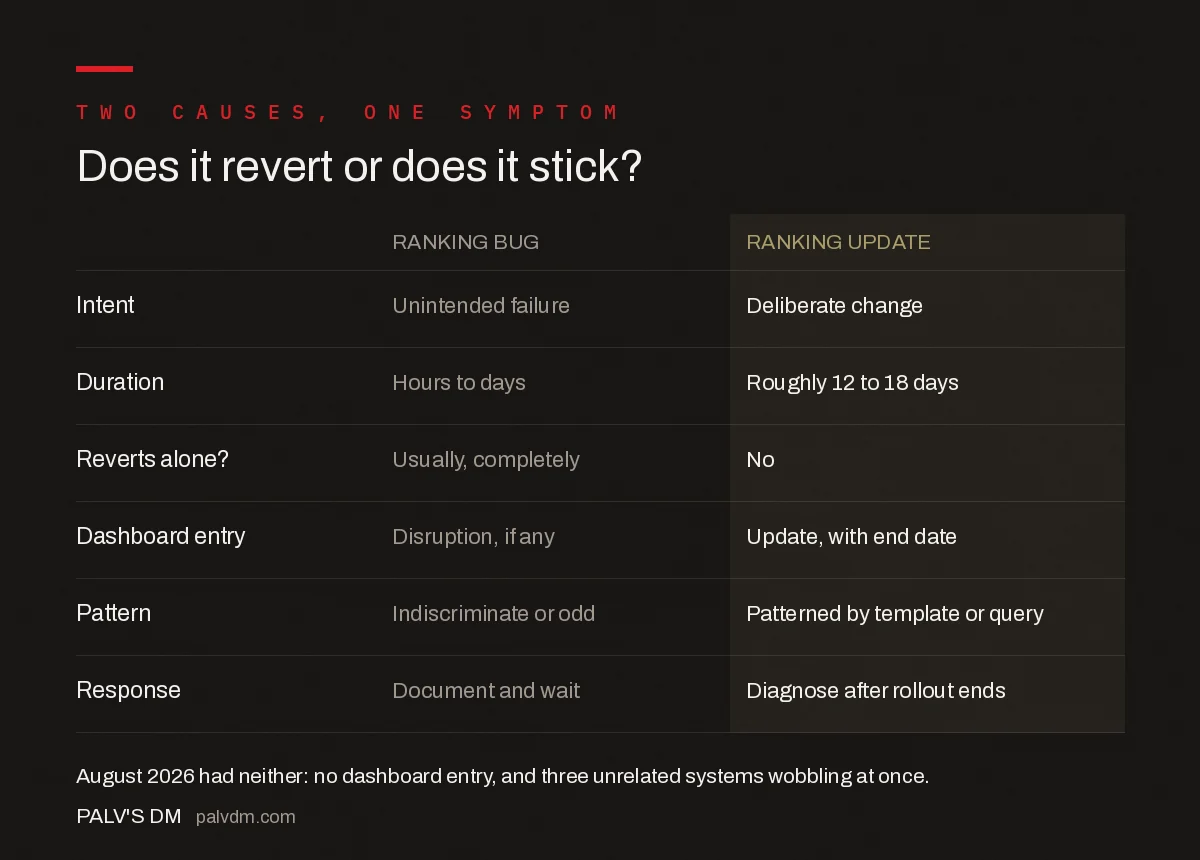
Does it revert or does it stick?
| Ranking bug | Ranking update | |
|---|---|---|
| Intent | Unintended failure | Deliberate change |
| Duration | Hours to days | Roughly 12 to 18 days |
| Reverts alone? | Usually, completely | No |
| Dashboard entry | Disruption, if any | Update, with end date |
| Pattern | Indiscriminate or odd | Patterned by template or query |
| Response | Document and wait | Diagnose after rollout ends |
Frequently asked questions
How do I know if a Google ranking drop is a bug?
Check Google’s Search Status Dashboard for a disruption entry covering crawling, indexing, serving or ranking on that date, then check whether the movement reverses on its own within a few days. A bug is an unintended failure that Google fixes, so rankings return without you changing anything. An update is deliberate and persists until the next reassessment.
Does Google announce ranking bugs?
Google publishes disruptions to crawling, indexing, serving and ranking on its Search Status Dashboard, separately from announced updates such as core updates and spam updates. Not every problem is published, and there is often a delay between site owners noticing something and Google confirming it. The absence of a dashboard entry is not proof that nothing happened, but it does mean nothing was confirmed.
Was there a Google algorithm update in August 2026?
No. Google announced no algorithm update in August 2026 and its Search Status Dashboard showed no ranking, indexing, crawling or serving incident between 1 and 6 August 2026. Third-party trackers did register elevated movement in that window, but three unrelated issues landed at the same time: a GA4 reporting bug, Google Ad Manager disruptions, and a Discover traffic decline that had begun in mid-July.
What is the difference between a ranking bug and a reporting bug?
A ranking bug means positions genuinely changed because a Google system misbehaved. A reporting bug means positions never moved and only the data you are looking at is wrong. Separate them by checking a second data source and by manually searching a few affected queries. If your page still ranks where it did, the numbers are broken, not the rankings.
Should I change my site during a suspected Google bug?
No. Document the start time, affected URLs and queries, and anything you deployed in the previous fortnight, then wait. Rewriting pages or removing content during the window makes permanent changes to fix a possibly temporary problem, and destroys your ability to attribute any later recovery to a specific cause.
How long do Google ranking bugs usually last?
Bugs are resolved once Google identifies and fixes them, so they typically last hours to days rather than weeks, and rankings return without site owner action. Announced ranking updates behave differently: recent core update rollouts have run between 12 and 18 days and the resulting positions persist until a later update reassesses them.
Sources
- Google Search Status Dashboard
- Google core updates and your website — Search Central
- Debugging drops in Google Search traffic — Search Central
- Performance report (Search results) — Search Console Help
Want this done on your site?
Every PalV’s DM engagement starts with a free audit of your actual website — a 12-point
crawl covering what is blocking indexation, on-page gaps against your primary keywords, speed
findings, and the three to five fixes worth making first. Delivered in two working days. No
payment details, and the findings are yours whether you hire us or not.