Why Recovery Usually Waits for the Next Core Update
Google says the biggest recoveries follow a subsequent core update. Recent gaps ran 43 to 88 days, and no schedule exists. How to plan against that.

Recovery from a core update usually arrives with the next core update because that is when Google reassesses, and Google says so directly: you may see some recovery between core updates, but the biggest changes tend to follow a subsequent one. That single published sentence is the whole reason recovery timelines are measured in months rather than weeks. Recent gaps between confirmed core updates have run from roughly six weeks to nearly three months, and Google has never committed to a schedule, so the honest answer to “how long will recovery take” is that the date is set by Google’s rollout calendar and is not knowable in advance.
That is a genuinely unpopular answer, and it is more useful than the alternative, because it changes what you optimise for. You are not racing to fix something before a deadline. You are trying to be substantially better whenever the next assessment happens.
What has Google actually said about recovery timing?
Google’s standing post-core-update guidance contains four claims, repeated after each rollout and reiterated around the May 2026 core update:
- There are no specific actions to take that guarantee recovery.
- A drop does not necessarily mean anything is wrong with your pages.
- Some recovery may occur between core updates.
- The largest changes tend to arrive with a subsequent core update.
What Google has not said is why. It has never published a mechanism for recovery timing, never explained why rollout durations vary, and never committed to how often core updates run. Anyone offering you an explanation of the internals is speculating, and the speculation is usually attached to a product.
How long are the gaps between core updates?
Long enough that planning around them is a strategic decision, not a scheduling one. Taking confirmed dashboard dates for recent core updates:
| Core update | Started | Completed | Rollout | Gap to next start |
|---|---|---|---|---|
| December 2025 | 11 Dec 2025 | 29 Dec 2025 | 18 days | 88 days |
| March 2026 | 27 Mar 2026 | 8 Apr 2026 | 12 days, 4 hours | 43 days |
| May 2026 | 21 May 2026 | 2 Jun 2026 | ~12 days | No core update confirmed since |
Two practical readings. The gap from the completion of one core update to the start of the next has ranged from 43 days to 88 days in this sample, so a site hit in early April could reasonably have expected its next assessment in mid-May, while a site hit at the end of December waited until late March. And as of mid-August 2026, no further core update had been confirmed after the May rollout completed on 2 June — already a longer wait than the one between the March and May updates. Gaps are not regular, and treating an observed cadence as a schedule is how teams end up promising dates.
Why does partial recovery between updates happen at all?
Small movement between core updates is normal and is rarely attributable to your recovery work. Google’s index churns continuously: pages are recrawled, competitors publish and remove content, query demand shifts, and SERP features appear and disappear. Some of that movement will run in your favour.
The problem is attribution, not existence. A five per cent improvement three weeks after a rewrite is indistinguishable from ordinary churn unless you have a control set of untouched pages and a dated record of what shipped when. Without both, “we recovered a bit” is a feeling. This is exactly why an update log earns its keep — it is the only thing that makes the next rollout interpretable.
Does that mean you should do nothing until the next update?
No, and the opposite mistake is just as common. There is a difference between doing nothing and doing nothing panicked. The work still has to be finished and indexed before the next assessment, and it takes longer than people budget for — genuine improvement to twenty pages, with original research or first-hand experience added, is a multi-week project even before Google recrawls anything.
What the timing does change is sequencing. Diagnose first, ship one class of change at a time so that whatever happens next is attributable, and stop optimising a page once it has genuinely improved rather than continuing to churn it. The operational calendar for that is the 30-day recovery plan, and the judgement about which pages qualify sits in core update recovery.
Does the work need to be crawled before it counts?
Yes, and this is the part of the timeline most people leave out. A rewritten page has to be recrawled and reprocessed before any reassessment can take it into account, and crawl frequency varies enormously between a well-linked page on an established site and a deep page on a small one.
That produces a practical deadline: finish the work several weeks before you expect the next core update, not the week it starts. Since you cannot know when it starts, the operational version is simply to finish and let it settle rather than shipping continuously. Where crawl coverage is genuinely slow, log file analysis will show it, and it is worth checking rather than assuming.
How do you plan work against an unknown date?
Treat the next core update as an event of unknown timing that you must be ready for at any point, which resolves into four rules.
- Front-load diagnosis. Segment the damage by page, query, device and country before writing anything — the shape of the loss names the cause.
- Sequence changes in classes. Content in one phase, internal structure in another, page inventory in a third, each dated.
- Keep a control set. Leave a comparable group of pages untouched, or the next rollout tells you nothing.
- Watch the dashboard, not the trackers. Only Google’s Search Status Dashboard confirms a rollout has started, which is when your measurement clock resets.
Does spam update recovery work the same way?
No, and conflating the two produces badly wrong timelines. A spam update algorithmically enforces Google’s published spam policies against specific practices, so there is a violation to remove, and removing it is the recovery work. A core update carries no violation, which is why the improve-and-wait pattern applies to core updates and not to spam enforcement.
The rollout speeds differ sharply as well. The March 2026 spam update completed in under 24 hours and the June 2026 spam update in roughly two days, against 12 days for each 2026 core update, while the August 2025 spam update ran nearly four weeks. Speed of rollout says nothing about speed of recovery in either case, but the mechanisms are different enough that the first diagnostic step is establishing which one you are dealing with — see core update versus spam update versus manual action.
What if the next core update comes and nothing improves?
Then you have learned something real, provided you kept the log and the control set. Three explanations are worth separating before assuming the work was wrong.
First, the work may not have been substantial enough. A competent rewrite does not pass Google’s comparative test of whether content provides substantial value compared with other pages in search results — that requires something the field does not have, which is the honest reading behind information gain. Second, the field may have improved as well; ranking is relative and standing still while competitors advance reads as a loss. Third, the original diagnosis may have been wrong, which is common and is why confirming the update actually hit you comes before any of this.
None of those three is a reason to start deleting pages or reversing improvements. They are reasons to go back to the diagnosis with better evidence than you had the first time, and the mistakes to avoid while waiting are catalogued in panic moves after an update.
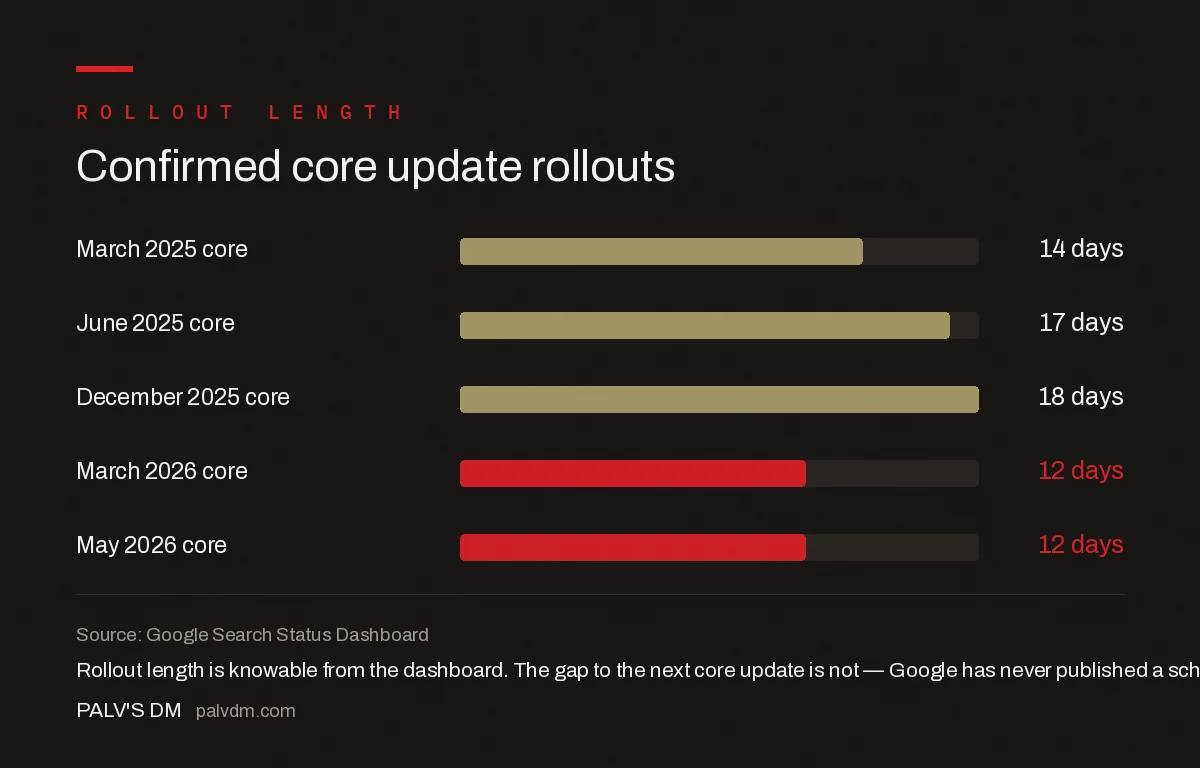
Confirmed core update rollouts
| Metric | Value |
|---|---|
| March 2025 core | 14 days |
| June 2025 core | 17 days |
| December 2025 core | 18 days |
| March 2026 core | 12 days |
| May 2026 core | 12 days |
Source: Google Search Status Dashboard
Frequently asked questions
How long does it take to recover from a Google core update?
There is no fixed period. Google states that some recovery may occur between core updates but that the largest changes tend to arrive with a subsequent core update. Recent gaps between the completion of one core update and the start of the next ran from 43 days to 88 days, and Google has never committed to a core update schedule.
Why does recovery wait for the next core update?
Because that is when Google reassesses broadly, and Google’s published guidance says the biggest changes tend to follow a subsequent core update. Google has never explained the mechanism behind that pattern, has never published a schedule for core updates, and has never explained why rollout durations vary between 12 and 18 days.
Can rankings recover between core updates?
Yes, partially. Google says some recovery may occur between core updates. In practice, small movement between rollouts is difficult to distinguish from ordinary index churn as pages are recrawled, competitors publish, and query demand shifts. Attributing it to your own work requires a dated change log and a control set of untouched pages.
Should I wait for the next core update before making changes?
No. Work has to be finished, published and recrawled before the next assessment can take it into account, and improving twenty pages substantially is a multi-week project. What the timing changes is sequencing: diagnose first, ship one class of change at a time with dates recorded, then stop and let it settle.
How often does Google run core updates?
Google has never committed to a frequency. Confirmed core updates ran in March 2025, June 2025, December 2025, March 2026 and May 2026, and as of mid-August 2026 none had been confirmed since the May rollout completed on 2 June. Treating an observed cadence as a schedule is how agencies end up promising dates they cannot keep.
What if the next core update comes and nothing improves?
Separate three explanations before concluding the work was wrong: the changes may not have been substantial enough to pass Google’s comparative value test, competing pages may have improved as well since ranking is relative, or the original diagnosis may have been incorrect. None of the three justifies deleting pages or reversing genuine improvements.
Sources
- Google core updates and your website — Search Central
- Google Search Status Dashboard
- Google May 2026 core update rollout is now complete — Search Engine Land
- Google March 2026 core update rollout is now complete — Search Engine Land
Want this done on your site?
Every PalV’s DM engagement starts with a free audit of your actual website — a 12-point
crawl covering what is blocking indexation, on-page gaps against your primary keywords, speed
findings, and the three to five fixes worth making first. Delivered in two working days. No
payment details, and the findings are yours whether you hire us or not.