The Compounding Math of SEO vs Paid Ads
Paid ads buy traffic; SEO buys an asset. The arithmetic of cost per visit over 24 months, when ads win outright, and what destroys the compounding.
Paid ads buy traffic; SEO buys an asset that keeps producing traffic after you stop paying for it. That is the entire difference, and it is why the two channels cannot be compared on a single month’s cost per acquisition. A Google Ads campaign delivers clicks on the day you fund it and zero clicks the day you pause it. An SEO programme delivers almost nothing in month one and then keeps delivering from work done a year earlier. Judge SEO on a monthly return and it looks expensive. Judge paid ads on a three-year return and the arithmetic reverses.
The honest complication: compounding is not automatic. It happens only when the pages you publish keep earning, which requires them to stay technically reachable, stay accurate, and cover a subject deeply enough that they attract links and internal traffic. Publish forty thin pages and you get forty pages that decay, not an asset.
What does compounding actually mean in SEO?
Compounding in SEO means each unit of work makes the next unit more effective, rather than producing an isolated result. Four separate mechanisms drive it, and none of them exist in a paid ads account.
- Pages accumulate. A page published in March still ranks in November. Traffic in month twelve is the sum of everything still working from months one to eleven, not the output of month twelve alone.
- Internal links get denser. Every new page is a new place to link from. A 200-page site can support a new page far better than a 20-page site can, so the same article ranks faster on the larger site.
- Topical coverage builds. Covering a subject completely improves how the whole cluster performs, which is the practical mechanism behind topical authority — depth in one area raises the ceiling for every page in it.
- Links arrive on their own. A page that ranks is a page people find and cite. Ranking earns links, and links improve ranking. It is the only genuinely self-reinforcing loop in the discipline.
Paid search has the opposite dynamic in one important respect. Nothing you spent last year lowers what you pay this year. The auction resets every time, and if a competitor raises bids, your cost per click rises regardless of how long you have been running.
How does cost per visit differ over time?
Work the arithmetic rather than arguing about it. The figures below are an illustration with stated assumptions, not measured results from a client — plug in your own numbers, because the shape matters more than the values.
Assume a ₹10,000-a-month SEO retainer producing 100 organic visits in month three, 600 in month twelve and 1,500 in month twenty-four, against a paid campaign spending ₹10,000 a month at a ₹20 cost per click.
| Point in time | Paid ads at ₹10,000/mo | SEO at ₹10,000/mo |
|---|---|---|
| Month 3 | 500 visits, ₹20 per visit | 100 visits, ₹100 per visit |
| Month 12 | 500 visits, ₹20 per visit | 600 visits, ₹16.70 per visit |
| Month 24 | 500 visits, ₹20 per visit | 1,500 visits, ₹6.70 per visit |
| Cumulative spend, 24 months | ₹2,40,000 | ₹2,40,000 |
| Month 25 if you stop paying | 0 visits | Traffic decays slowly, not instantly |
The paid row is flat by design: a fixed budget at a fixed cost per click buys the same volume every month forever. The SEO row is not a promise — it is what a working programme looks like, and it is exactly why the timeline question determines whether SEO is the right channel for a given business at a given moment.
What happens when you switch each channel off?
This is the cleanest test of whether you own an asset or are renting attention.
Pause Google Ads on a Tuesday and paid traffic is zero on Wednesday. There is no residual. Everything you paid for over three years leaves nothing behind except the data in the account and whatever brand memory the impressions created.
Stop SEO work and organic traffic does not stop. It decays, and the rate depends on the topic. Pages covering stable subjects hold position for a long time; pages covering fast-moving subjects, pricing or anything dated slip as competitors publish fresher material. Meanwhile Google keeps shipping core updates — five confirmed updates ran between February and June 2026 alone — and an unmaintained site eventually meets one it is not ready for.
So the accurate statement is not “SEO keeps working forever”. It is that SEO leaves a depreciating asset and paid ads leave nothing. A depreciating asset is still an asset.
When are paid ads genuinely the better choice?
Often, and pretending otherwise is how consultants lose credibility. Paid search wins in five specific situations.
- You need revenue this quarter. Nothing in SEO produces meaningful commercial traffic in four weeks. If the runway is short, buy the clicks.
- You are testing demand. Two weeks of paid search tells you whether anyone converts on a proposition before you commit six months of content to it. This is the single highest-value use of a small ads budget.
- The term is a bidding war you can win on margin. Some commercial terms have such high intent that paying for them is rational indefinitely.
- Seasonality is sharp and narrow. A three-week festive window does not wait for rankings, though planning organic content six months ahead is what stops you renting the same window every year.
- Your site cannot rank yet. A brand-new domain in a competitive category is not a twelve-week project. Ads carry the pipeline while the organic asset is built.
The strongest position for most businesses is running both, with the split moving over time: heavier on paid early, rebalancing towards organic as the asset starts producing. Running them together also improves both, which is the argument in how SEO and Google Ads inform each other — ads data tells you which keywords actually convert before you spend three months writing for them.
How do you compare the two fairly?
Most SEO-versus-PPC comparisons are rigged by the measurement window. Four rules make the comparison honest.
Use a 24-month window, not a monthly one. A channel with a three-to-six-month lag will always lose a one-month comparison. That is a property of the measurement, not of the channel.
Count cumulative visits against cumulative spend. Total organic sessions since start divided by total fees paid since start. Compare that with total paid clicks divided by total ad spend plus management fees. Both sides must include management costs or the comparison is dishonest.
Attribute properly. Organic and paid interact constantly — people click an ad, then search the brand, then arrive organically. Single-touch attribution will credit whichever channel happens to be last. Attributing across paid and organic is imperfect for everyone, so at minimum look at assisted conversions rather than last click.
Include the terminal value. At the end of the window, ask what each channel left behind. Paid leaves an account. Organic leaves pages that still rank. If you sold the business tomorrow, one of those appears in the valuation.
Does the compounding argument still hold with AI search?
It holds, with one adjustment: the asset being built is no longer only a set of blue-link rankings. Generative engines select passages from pages, so a well-sourced page can be cited in an AI answer without holding a top position in classic results. That is an additional return on the same content investment, and paid search has no equivalent — an ad does not become a citation.
Two things follow for the arithmetic. First, cost per visit understates the return, because AI citations often produce brand exposure without a click, which is why ranking and citation need measuring separately. Second, the inputs that earn citations are the same inputs that compound in classic search: original evidence, named sources and depth on a subject. Research presented at KDD 2024 found that adding statistics, quotations from named sources and citations to authoritative sources lifted a source’s visibility in generative answers by up to around 40%. Nothing about that work is wasted if AI search grows, and nothing about it is wasted if it does not.
What breaks the compounding?
Compounding is a property of a well-run programme, not of the channel. Four things reliably destroy it.
Publishing volume without depth. Pages that add nothing beyond what already ranks do not accumulate; they dilute. Google’s own self-assessment guidance asks directly whether content provides substantial value compared with other pages in search results.
Technical decay. A migration that breaks redirects can erase years of accumulated equity in a weekend. This is why migration planning is disproportionately valuable relative to how boring it is.
Never refreshing. Compounding assumes existing pages hold position. Pages containing 2023 pricing and dead links do not. A refresh cycle is maintenance on the asset, not new work.
Measuring on the wrong cadence. Reviewing a compounding channel monthly produces panic decisions and premature cancellation, which converts a two-year asset into a six-month expense. Set the KPIs and the review cadence before month one, not after a disappointing month three.
The summary a founder can act on: if you need customers this quarter, run ads. If you intend to still be trading in three years, run SEO alongside them and judge it on cumulative cost per visit across twenty-four months. Running the numbers yourself, using your own conversion rate and average order value, settles the argument far better than any agency’s chart.
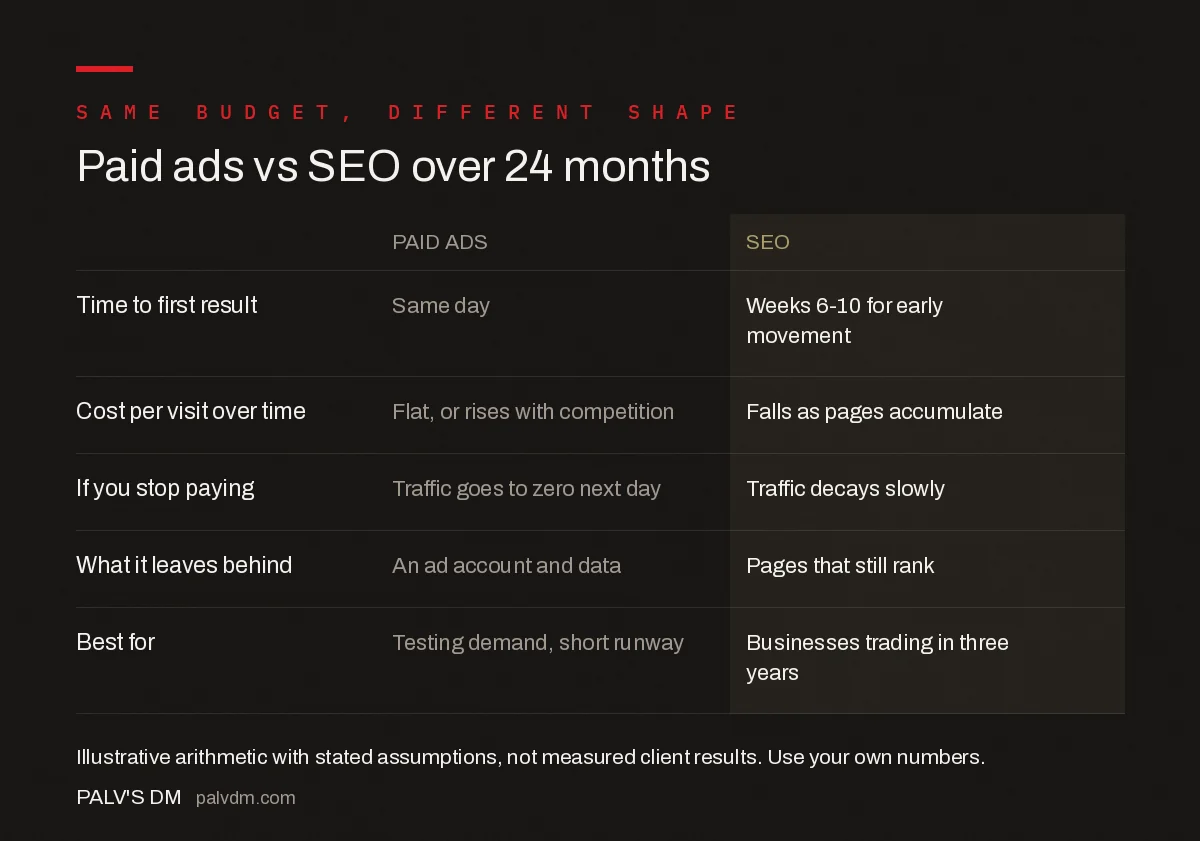
Paid ads vs SEO over 24 months
| Paid ads | SEO | |
|---|---|---|
| Time to first result | Same day | Weeks 6-10 for early movement |
| Cost per visit over time | Flat, or rises with competition | Falls as pages accumulate |
| If you stop paying | Traffic goes to zero next day | Traffic decays slowly |
| What it leaves behind | An ad account and data | Pages that still rank |
| Best for | Testing demand, short runway | Businesses trading in three years |
Frequently asked questions
Is SEO cheaper than PPC?
Not at first. In the early months SEO has a higher cost per visit because traffic has not arrived yet while fees have. The crossover usually happens somewhere between months nine and eighteen, after which organic cost per visit keeps falling while paid cost per click stays flat or rises. Compare cumulative spend against cumulative visits over 24 months, not one month.
What happens to organic traffic if I stop paying for SEO?
It decays rather than stopping. Pages on stable subjects hold position for a long time; pages covering pricing, dates or fast-moving topics slip as competitors publish fresher material, and an unmaintained site eventually meets a core update it is not ready for. Paid traffic, by contrast, goes to zero the day after you pause the campaign.
Should a startup run SEO or Google Ads first?
Usually ads first, for a short period, to test whether the proposition converts before committing months of content to it. Then run both, with the balance shifting towards organic as pages start producing. Ads also reveal which keywords genuinely convert, which is far better information than a keyword tool’s difficulty score.
How do you calculate SEO ROI honestly?
Divide cumulative organic sessions since the start of work by cumulative fees paid, and compare that against cumulative paid clicks divided by ad spend plus management fees. Include management costs on both sides. Then look at assisted conversions rather than last click, because paid and organic interact and single-touch attribution credits whichever channel happened to be last.
Does SEO really compound, or is that marketing language?
It compounds only in a well-run programme. Four real mechanisms drive it: published pages keep earning, internal linking gets denser as the site grows, topical coverage lifts every page in a cluster, and pages that rank attract links which improve ranking further. Publishing thin pages that add nothing beyond existing results produces decay instead.
Can you run SEO and paid ads at the same time?
Yes, and it is the strongest position for most businesses. Ads carry the pipeline while the organic asset is built, and ads data identifies which keywords actually convert before you invest months writing for them. The split should shift over time, heavier on paid early and rebalancing towards organic as rankings start producing traffic.
Sources
- Creating helpful, reliable, people-first content — Google Search Central
- Google core updates and your website
- Google Search Status Dashboard — Record of confirmed 2026 updates
- GEO: Generative Engine Optimization (Aggarwal et al., KDD 2024)
Want this done on your site?
Every PalV’s DM engagement starts with a free audit of your actual website — a 12-point
crawl covering what is blocking indexation, on-page gaps against your primary keywords, speed
findings, and the three to five fixes worth making first. Delivered in two working days. No
payment details, and the findings are yours whether you hire us or not.