SEO for a Brand-New Website: What to Do in the First 90 Days
A new site cannot rank for competitive terms in 90 days. Here is what to do instead, month by month, and the leading indicators that show it is working.

For a brand-new website, the first 90 days are not about rankings. They are about becoming fully crawlable and indexable, publishing a small number of pages that genuinely deserve to rank, and building the measurement setup that will tell you what is working in month six. Expect indexation within days of launch, first impressions on long-tail queries somewhere between weeks four and eight, and the first meaningful clicks around month three. Anything faster than that on a commercial term is unusual and worth investigating rather than celebrating.
The reason new sites feel slow is not a hidden penalty. A new domain has no links, no history and no established topical coverage, so the signals ranking systems rely on simply do not exist yet. The 90-day job is to create the conditions those signals attach to.
What should be done before the site goes live?
The cheapest SEO work on a new website happens before launch, because fixing structure after publication means redirects, lost equity and developer arguments. Three decisions are effectively permanent once traffic exists.
URL structure and site architecture. Decide the hierarchy before the first page is built. Every important page should be reachable from the homepage in three clicks or fewer, and URLs should be readable, lower-case and stable. Getting site architecture right at the start avoids the single most expensive category of retrofit, and URL structure decisions are near-impossible to reverse cleanly.
The technical stack. Hosting, theme and plugin choices determine your speed ceiling. A slow stack can be optimised, but only within limits set at build time.
Staging hygiene. Staging sites get indexed constantly, and a duplicate of your site in the index is a real problem. Password-protect staging rather than relying on robots.txt. The pre-launch website checklist covers the full set, and building SEO in at launch costs a fraction of adding it later.
What happens in days 1 to 30?
Month one on a new website is foundations and indexation. There is nothing to rank yet, so measuring rankings is a waste of attention. Measure coverage instead.
- Verify Google Search Console and set up GA4 on day one. Data you did not collect in week one cannot be recovered later. Search Console setup and the reports that matter is the first hour of work on any new site.
- Submit an XML sitemap and confirm it is being read. A correctly built sitemap is how a site with no inbound links tells Google what exists.
- Check robots.txt and meta robots tags. The most common launch disaster is a site-wide noindex left over from development. Check it on launch day, then check it again a week later.
- Confirm indexation page by page. Use the Pages report in Search Console. If pages sit in “Discovered — currently not indexed” for weeks, that is a signal about perceived value, not a bug to be fixed with resubmission.
- Finish keyword research and mapping. One primary query per page, written down. The keyword research process and mapping keywords to specific URLs together prevent two pages competing for the same term.
- Write the trust pages properly. A real About page with named people, a working contact route, and a physical location. New domains have no reputation, and these pages are the only evidence available.
What happens in days 31 to 60?
Month two on a new website is content and internal linking. The site is indexable; now it needs something worth indexing.
Publish narrow and deep rather than broad and thin. A new site with fifteen genuinely useful pages about one subject outperforms a new site with sixty shallow pages across six subjects, because topical authority accumulates around coverage of a single area rather than page count. Pick the one topic your business is most credible on and cover it properly first.
Prioritise commercial pages before blog posts. The pages that describe what you sell, to whom, and at what price are the ones that convert, and they are usually the ones a new site neglects while producing informational articles. Deciding what a new blog should publish first is a different question from deciding what your service pages should say.
Then link the pages together deliberately. On a new site with no inbound links, internal links are the only thing distributing signals between pages, and orphaned pages are effectively invisible. Internal linking done systematically is one of the highest-return activities available in month two, and it costs nothing but attention.
What happens in days 61 to 90?
Month three on a new website is external evidence and the first honest read of the data.
Start earning links, slowly and legitimately. A new domain with a sudden spike of links looks exactly like a domain buying them. The realistic first sources are supplier and partner sites, genuine industry directories, professional bodies you belong to, and coverage earned by publishing something worth citing. Link building for a site with no authority is a slower and narrower activity than general link building, and treating it otherwise creates risk rather than rankings.
At the same time, add evidence to what you have already published. Original screenshots, your own numbers where you have them, named sources for factual claims, and clearly attributed quotations. Research presented at KDD 2024 on generative engine optimisation found that adding statistics, quotations from named sources and citations to authoritative sources lifted a source’s visibility in generative engine answers by up to around 40% — which matters for a new site because those are page-level changes rather than domain-level authority changes.
Finally, read Search Console properly for the first time. Ninety days is enough data to see which queries the site is being shown for, even if clicks are still negligible.
What does a realistic 90-day plan look like?
| Period | Focus | What success looks like |
|---|---|---|
| Pre-launch | Architecture, URLs, staging protection, stack choices | Nothing to undo after launch |
| Days 1–30 | Search Console and GA4, sitemap, indexation, keyword mapping, trust pages | Core pages indexed; measurement running |
| Days 31–60 | Commercial pages, first content cluster, internal linking | First impressions on long-tail queries |
| Days 61–90 | First links, evidence added to existing pages, data review | Impressions growing; a handful of first clicks |
Is there a sandbox for new domains?
Google has never documented a “sandbox” that holds new domains back for a fixed period, and treating it as a confirmed mechanism is a mistake. What is documented is simpler and has the same practical effect: ranking systems rely on signals that a new site has not yet accumulated — inbound links, established topical coverage, and any track record of satisfying searchers.
The distinction matters because a sandbox implies waiting, while a signal deficit implies working. A new site that spends 90 days publishing evidence-backed pages about one subject and earning a handful of genuine citations exits the period in a materially different position from one that waited. The realistic SEO timeline applies to new domains at the slower end of every range.
What should a new site avoid in the first 90 days?
- Buying links. The fastest way to convert a clean new domain into a problem. Link schemes are a documented violation of Google’s spam policies.
- Publishing at volume with no depth. Scaled, low-value content is explicitly covered by Google’s spam policies, and a new site has no authority buffer to absorb the assessment.
- Chasing head terms. A three-month-old domain will not rank for a competitive commercial keyword. Aim at long-tail queries with clear intent.
- Obsessing over rank tracking. With no positions to track, the tool reports noise. Impressions in Search Console are the honest early signal.
- Redesigning in month two. Changing URLs before the site has settled destroys what little signal has accumulated.
How do you measure progress with almost no traffic?
Traffic is a lagging indicator on a new website and a useless one for the first quarter. Four leading indicators are available instead, and each is checkable in Search Console.
Indexed page count against published page count tells you whether pages are being accepted at all. Total impressions tell you whether the site is being shown for anything, and impressions rise well before clicks do. The number of distinct queries returning impressions tells you whether topical coverage is widening. And average position on your mapped keywords tells you the direction of travel, even at position 60. Choosing SEO KPIs a founder will accept matters more on a new site than anywhere else, because the honest numbers look unimpressive for months and someone has to have agreed in advance that this was expected. Budget accordingly — a realistic early-stage SEO budget assumes at least two quarters before the channel pays for itself.
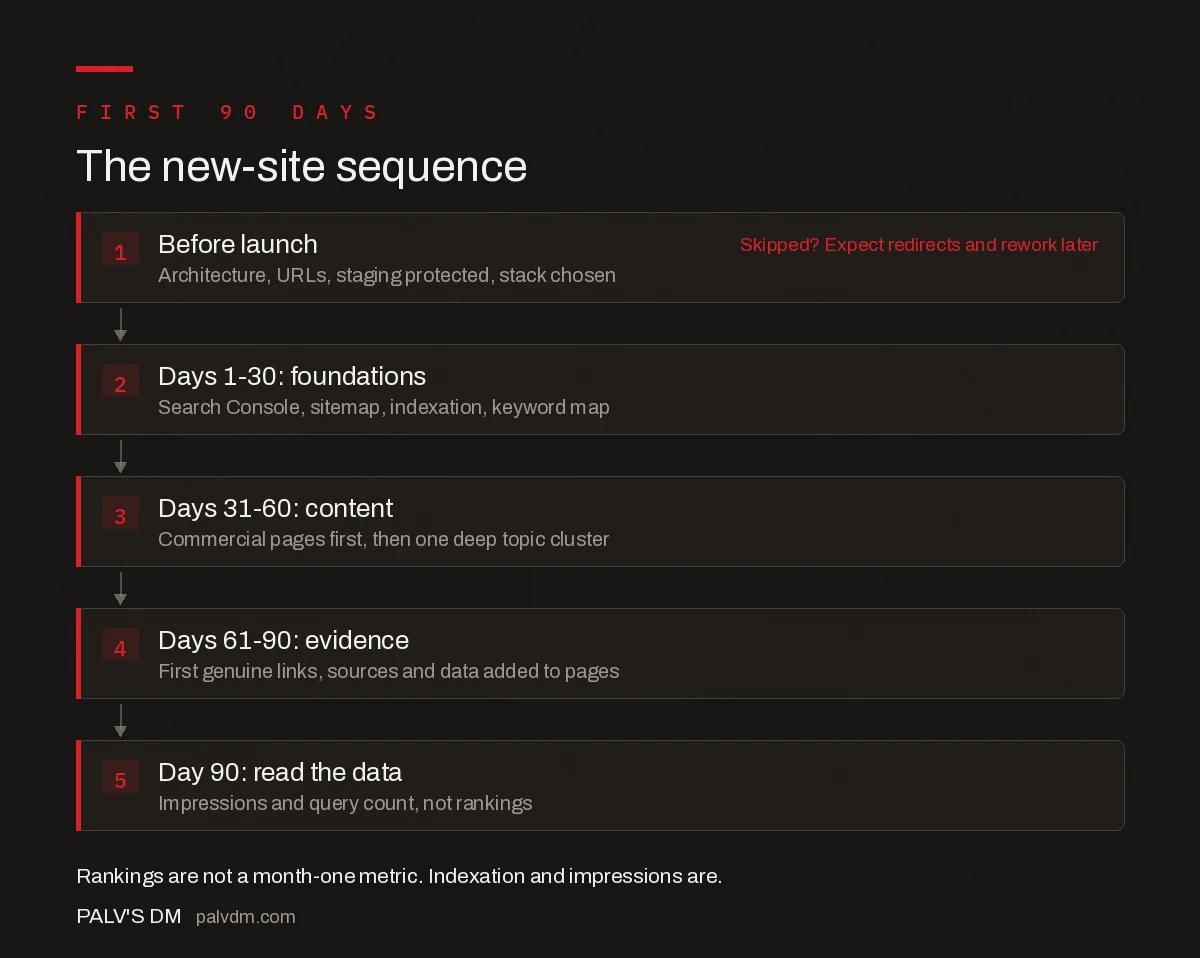
The new-site sequence
- Before launch. Architecture, URLs, staging protected, stack chosen. Skipped? Expect redirects and rework later
- Days 1-30: foundations. Search Console, sitemap, indexation, keyword map.
- Days 31-60: content. Commercial pages first, then one deep topic cluster.
- Days 61-90: evidence. First genuine links, sources and data added to pages.
- Day 90: read the data. Impressions and query count, not rankings.
Frequently asked questions
How long does it take a new website to rank on Google?
Indexation usually happens within days of launch. First impressions on long-tail queries typically appear between weeks four and eight, and first meaningful clicks around month three. Competitive commercial terms take a new domain the better part of a year, because ranking systems rely on links, topical coverage and track record that a new site has not accumulated yet.
Does Google have a sandbox for new websites?
Google has never documented a sandbox that holds new domains back for a fixed period. The observed slowness has a simpler explanation: a new site has no inbound links, no established topical coverage and no history of satisfying searchers, so the signals ranking systems use do not yet exist. That is a deficit you work through, not a timer you wait out.
What is the first SEO task on a brand-new site?
Verify Google Search Console and install analytics on day one, then confirm the site is not carrying a site-wide noindex tag left over from development. Data not collected in week one cannot be recovered later, and an accidental noindex will silently prevent every other thing you do from having any effect at all.
How many pages should a new website publish in 90 days?
Fewer than most people expect, and concentrated. Roughly fifteen genuinely useful pages covering one subject deeply will outperform sixty shallow pages spread across six subjects, because topical authority accumulates around depth of coverage. Prioritise the commercial pages that describe what you sell before writing informational blog content.
Should a new website buy backlinks to speed things up?
No. Link schemes are a documented violation of Google’s spam policies, and a new domain has no authority buffer to absorb the consequences. A sudden spike of links on a three-month-old site is also an obvious pattern. Realistic early sources are suppliers, partners, professional bodies and genuine industry directories.
What should I measure on a new site with no traffic?
Four leading indicators from Search Console: indexed pages against published pages, total impressions, the number of distinct queries returning impressions, and average position on your mapped keywords. Impressions rise well before clicks do, and a widening query count shows topical coverage is being recognised even while traffic is still negligible.
Sources
- SEO Starter Guide — Google Search Central
- Get started with Search Console — Google Search Central
- GEO: Generative Engine Optimization (Aggarwal et al., KDD 2024)
Want this done on your site?
Every PalV’s DM engagement starts with a free audit of your actual website — a 12-point
crawl covering what is blocking indexation, on-page gaps against your primary keywords, speed
findings, and the three to five fixes worth making first. Delivered in two working days. No
payment details, and the findings are yours whether you hire us or not.