Lead Magnet Ideas That Are Worth an Email Address
Generic ebooks convert at 4-8% in 2026. See which lead magnet formats actually convert, real conversion ranges by type, and how to pick the right one.
Published: August 2026
The lead magnets that actually convert in 2026 are specific, instantly useful, and deliver one clear outcome – not the generic 50-page ebook that used to be the default. Calculators and free tools convert at roughly 28-42% for SaaS-style offers, checklists and templates convert well for service businesses, and generic long-form ebooks have fallen to single-digit conversion rates because visitors correctly sense they won’t get through them. The format matters less than whether it solves one specific problem immediately.
What makes a lead magnet actually worth an email address?
Three things, consistently, across every high-performing format: it’s specific rather than broad (“a Diwali campaign checklist” beats “the ultimate marketing guide”), it delivers value the moment it’s opened rather than requiring hours of reading first, and it solves a problem the visitor already knows they have rather than one you’re trying to convince them they have. A lead magnet that requires persuasion to see its value has already lost against one whose usefulness is obvious from the title alone.
Which lead magnet formats convert best, and for which businesses?
| Format | Best for | Typical conversion range |
|---|---|---|
| Free tools / calculators | SaaS, financial services, anything with a quantifiable output | 28-42% |
| Checklists / cheat sheets | Service businesses, agencies, operational topics | 18-32% |
| Templates | Anyone whose audience does repeatable, structured work | 18-32% |
| Discount codes / free samples | Ecommerce and D2C | 22-35% |
| Industry reports / benchmarks | B2B, especially when data is genuinely original | 14-28% |
| Generic long-form ebooks | Rarely the best choice anymore | 4-8% |
What are the strongest lead magnet ideas by business type?
Here are specific, tested categories of lead magnets worth building, organised by who they work best for:
- ROI or savings calculators. A tool that takes a visitor’s own numbers and returns a personalised result feels custom, which builds trust faster than a generic claim. Works especially well for services with a clear, quantifiable value proposition.
- Audit checklists. A “17-point SEO audit checklist” or similar gives the reader an immediate, actionable artefact and doubles as a natural segue into offering the same audit as a paid service.
- Swipe files and templates. A content brief template, an email sequence template, or a social caption swipe file – anything that saves the reader from building something from scratch.
- Original data reports. A short benchmark report using data you actually have access to (industry pricing, typical timelines, category-specific figures) works well for B2B audiences and is genuinely hard for competitors to replicate.
- Quizzes with a personalised result. “Which content strategy fits your business” style quizzes convert well because the personalised output feels earned, not generic.
- Discount codes or free trial extensions. Straightforward and high-converting for ecommerce, though it trades margin for the lead rather than pure value exchange.
- Mini case study collections. A short, specific breakdown of how a particular problem was solved works better than a broad “success stories” page, especially for B2B service audiences evaluating whether to reach out.
Why do generic ebooks convert so poorly now?
Because visitors have been burned by them before. A 50-page PDF promising “the ultimate guide” usually delivers padded, generic content that could apply to any business, and audiences have learned to recognise the pattern from the landing page alone. The lead magnets replacing them succeed specifically because they’re narrow: a single calculator, a single checklist, a single template that does one job well. Specificity signals genuine usefulness in a way that breadth used to, before every category got flooded with interchangeable “ultimate guides.”
How does a lead magnet fit into the broader content and sales funnel?
A lead magnet works best as the middle step in a three-part sequence: content that builds awareness and demonstrates expertise, the lead magnet that captures contact information at the moment of highest interest, and a follow-up sequence that moves the new contact toward a sales conversation. Placed without that surrounding context – a checklist popup on a page with no relevant content around it – a lead magnet captures lower-quality contacts who converted on the offer alone rather than genuine interest in what the business does. The strongest-performing magnets sit naturally at the end of content that already established the problem the magnet solves, so the ask feels like a logical next step rather than an interruption.
How do you choose the right lead magnet for your business?
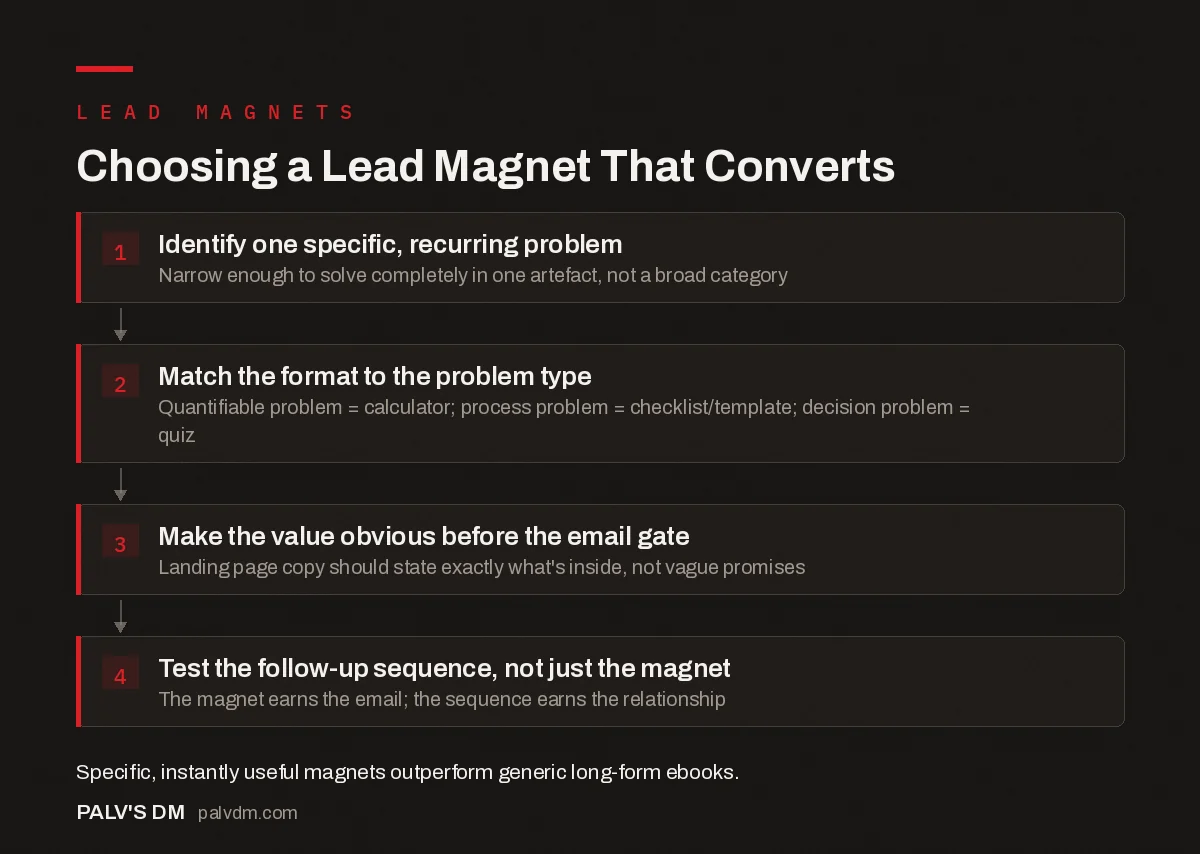
Choosing a Lead Magnet That Converts
- Identify one specific, recurring problem. Narrow enough to solve completely in one artefact, not a broad category.
- Match the format to the problem type. Quantifiable problem = calculator; process problem = checklist/template; decision problem = quiz.
- Make the value obvious before the email gate. Landing page copy should state exactly what’s inside, not vague promises.
- Test the follow-up sequence, not just the magnet. The magnet earns the email; the sequence earns the relationship.
What mistakes make an otherwise good lead magnet underperform?
- A landing page that undersells it. Vague copy like “download our free resource” instead of stating exactly what’s inside and what problem it solves loses visitors who would have converted with clearer messaging.
- Too many form fields. Asking for phone number, company size, and job title upfront for a simple checklist download adds friction disproportionate to what’s being offered. Match the form length to the value being exchanged.
- No immediate delivery. A magnet that arrives by email an hour later, rather than instantly, loses the momentum of the moment the visitor decided to convert.
- Mismatched promise and delivery. A “checklist” that turns out to be a 20-page PDF breaks the specific, instant-value expectation that got the conversion in the first place, and damages trust for any future offer from the same brand.
Should a lead magnet be gated behind an email form?
It depends on the goal. Gating trades reach for a qualified contact – useful when email nurture is genuinely part of your sales process. Ungating trades the contact for wider reach and better SEO value, since gated content typically can’t be indexed or shared as freely. A calculator or interactive tool often performs better ungated, because the tool itself is the marketing, and the value it demonstrates does more selling than a gated PDF would. A detailed original research report, by contrast, is often worth gating because it has clear standalone value people will trade an email for.
A worked example: building a calculator that actually converts
A digital marketing agency wants a lead magnet to pair with its content service pages. Rather than defaulting to an ebook, the team maps the one recurring question prospects ask before a first call: “how much revenue am I actually losing to slow-ranking content?” That question is quantifiable, so it becomes a calculator – visitors enter current traffic, conversion rate, and average order value, and get a personalised estimate of the revenue gap between their current content performance and a realistic improved scenario.
The landing page states exactly what the calculator does and what inputs it needs, before any email is requested. The result appears instantly and can be viewed without gating; only the detailed PDF breakdown of the calculation, with recommendations specific to the inputs entered, sits behind the email form. This structure – free instant value, deeper personalised output gated – converts at roughly double the rate of the agency’s previous ebook-style lead magnet, because visitors already know exactly what they’re getting before deciding whether to hand over an email address.
How do you actually build a lead magnet without a developer?
Most high-converting formats don’t require custom development. Calculators can be built with a simple JavaScript embed or even a well-designed Google Sheets template made public and duplicable. Checklists and templates need only a document design tool and a PDF export. Quizzes can run on dedicated quiz-building tools that handle the branching logic and personalised results without code. The technical barrier that made calculators feel out of reach for smaller teams has mostly disappeared – the harder part is still defining the one specific problem the magnet solves, not the build itself.
Where a genuinely custom interactive tool is worth the development cost, it’s usually because the calculation involves enough variables that a template can’t handle it cleanly, or because the tool itself becomes a standalone marketing asset independent of the gate.
FAQ
What’s the highest-converting lead magnet format?
Free tools and calculators typically convert highest, in the 28-42% range for SaaS-style offers, because they return a personalised result from the visitor’s own input rather than generic information. Checklists and templates follow closely for service businesses.
Do lead magnets still work in 2026?
Yes, but the format matters more than ever. Specific, instantly useful magnets like calculators, checklists, and templates convert well; generic long-form ebooks have fallen to single-digit conversion because audiences have learned to associate them with padded, low-value content.
Should a lead magnet be free or require payment?
Lead magnets are free by definition – the “payment” is the contact information exchanged. If you’re considering charging even a small amount, that’s a different offer (a low-ticket product), not a lead magnet, and it should be evaluated against different conversion benchmarks.
How often should a lead magnet be updated?
Any data-driven magnet (a report, a benchmark, pricing figures) needs review at least annually to stay accurate. Tools and templates need less frequent updates but should be checked whenever the underlying process or category they address changes meaningfully.
Can one lead magnet work for multiple audience segments?
Rarely well. A magnet built to serve everyone usually ends up too generic to convert any one segment strongly. Multiple narrow, segment-specific magnets typically outperform a single broad one, even though it means more to build and maintain.
If you need a lead magnet built and written to convert rather than just exist, PalV’s DM’s content writing service covers everything from the concept through the landing page copy. This post is part of our content strategy guide. Related reading: how to write a content brief writers can follow, attributing revenue to individual posts, and evergreen vs timely content.