HowTo Schema in 2026: Where It Still Earns Results (It’s Not the SERP)
Google deprecated HowTo rich results in 2023. Here's where HowTo schema still earns results in 2026 and how to implement it correctly.

HowTo schema stopped earning a visible result in Google Search on September 14, 2023, when Google removed the HowTo rich result from desktop after already pulling it from mobile the month before. If you’re implementing it hoping for the old step-by-step carousel in the SERP, that carousel doesn’t exist anymore, on any device, for any site. Where HowTo schema still earns something is different, and worth understanding before you spend a sprint marking up every tutorial on your site.
A lot of schema guides published before late 2023 never got updated, and they’re still telling people to implement HowTo markup for “rich results” that Google turned off. That’s the gap this post is trying to close.
What actually happened to HowTo rich results, and when?
Google announced the change on its Search Central blog in August 2023, framing it as an effort toward a “cleaner and more consistent search experience.” The rollout happened in two steps: HowTo rich results were restricted to desktop-only in early August 2023, then removed from desktop as well on September 14, 2023. FAQ rich results were cut back in the same announcement, though less completely: FAQ results still appear, but Google now largely limits them to authoritative government and health websites, not general business or blog content.
Google’s own guidance at the time was clear that this wasn’t a penalty: “you can drop this structured data from your site, there’s no need to proactively remove it. Structured data that’s not being used does not cause problems for Search.” In other words, the schema didn’t become harmful. The rich result it used to trigger just stopped existing.
Should you still bother implementing HowTo schema in 2026?
For the specific goal of getting a Google rich result, no, and it’s worth being blunt about that instead of hedging. There is nothing to earn there anymore. But “does it get me a rich result” was never the only reason to structure content clearly, and this is where I’d push back on anyone telling clients to skip HowTo schema entirely.
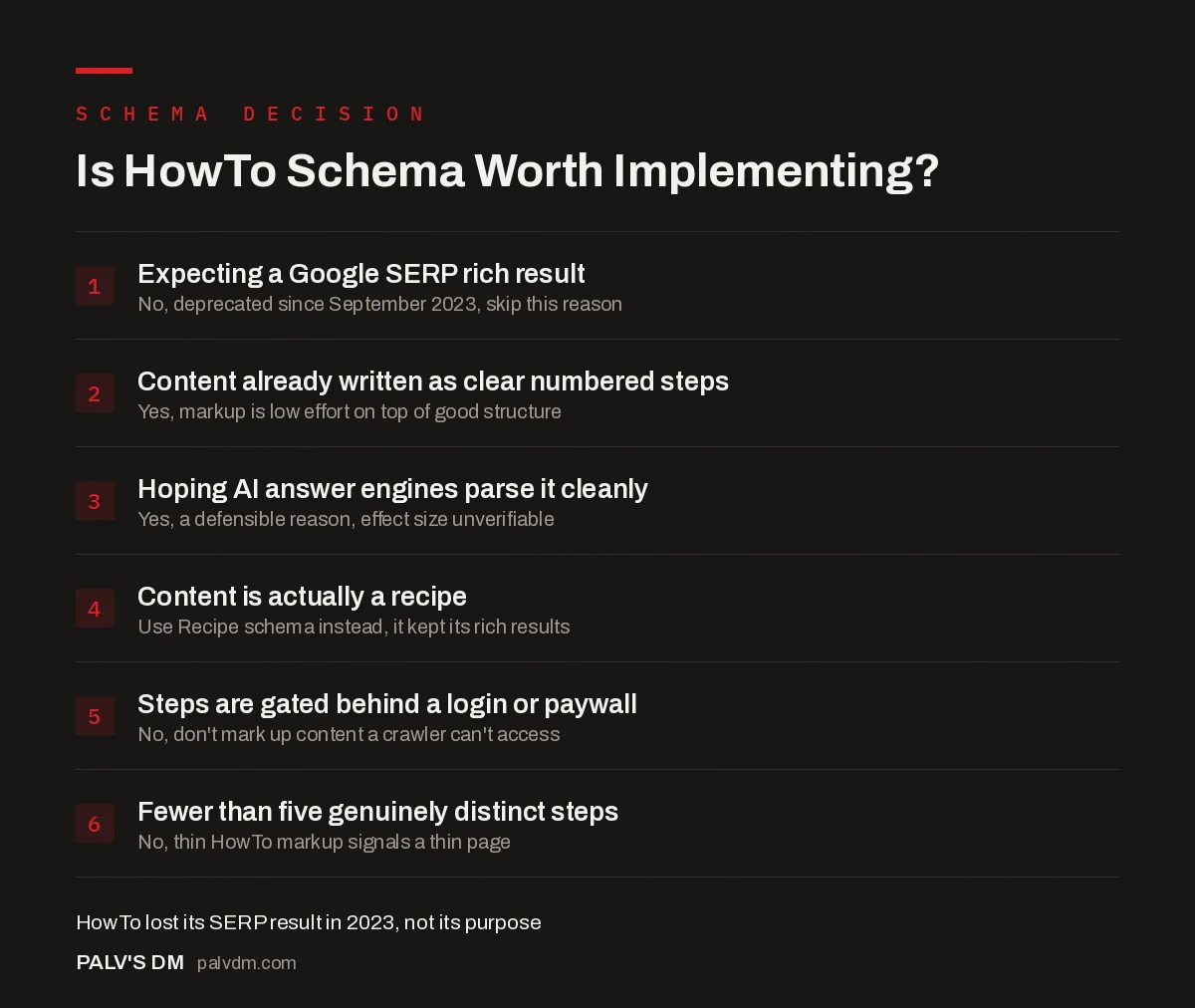
Is HowTo Schema Worth Implementing?
- Expecting a Google SERP rich result. No, deprecated since September 2023, skip this reason.
- Content already written as clear numbered steps. Yes, markup is low effort on top of good structure.
- Hoping AI answer engines parse it cleanly. Yes, a defensible reason, effect size unverifiable.
- Content is actually a recipe. Use Recipe schema instead, it kept its rich results.
- Steps are gated behind a login or paywall. No, don’t mark up content a crawler can’t access.
- Fewer than five genuinely distinct steps. No, thin HowTo markup signals a thin page.
Where does HowTo schema still earn results?
Three places, none of them the traditional SERP. First, AI answer engines: when a chatbot or AI overview is assembling a procedural answer (how to do something, in a specific order), a page with clean HowTo markup gives it an unambiguous structure to pull steps from, rather than having to infer step boundaries from prose. Nobody outside Google, OpenAI or Anthropic can measure exactly how much weight this carries in citation selection, and any specific multiplier you see quoted online should be treated skeptically. Directionally, though, structured procedural content is easier for these systems to lift cleanly, and that’s a real, defensible reason to keep the markup.
Second, non-Google platforms. Bing has historically supported HowTo and FAQ rich results independently of Google’s decisions, and other search and AI products that ingest schema.org markup don’t necessarily follow Google’s deprecation timeline.
Third, and this is the one people forget: clean HowTo markup forces you to actually write your steps as discrete, ordered items with names, rather than as a wall of prose that says “first,” “then,” and “after that” somewhere in the middle of a paragraph. That discipline improves the content for human readers regardless of what any search engine does with the schema.
One thing that hasn’t lost value: per-step images. Even without a visual rich result to populate, a genuinely illustrative image attached to each step gives an AI system a second signal to confirm it’s parsing the right content, and it still helps a human skimming the page find their place. I’d rather see a client keep three well-chosen step images than add five more optional schema fields nobody will use.
Why did Recipe schema keep its rich results when HowTo didn’t?
This comes up in almost every client conversation about this topic, because Recipe cards are still everywhere in Google Search, and Recipe schema is structurally similar to HowTo: both describe ordered steps toward completing a task. The 2023 announcement specifically named FAQ and HowTo. Recipe wasn’t touched, and recipe rich results, including the step-by-step card view, are still live. Google never published a detailed rationale for treating them differently, but the practical read is that recipe search has a much higher-intent, higher-volume use case (people actively cooking, following steps in real time on a phone propped against a counter) than the average HowTo page, which covers everything from tech support to craft tutorials to business processes with far more variable quality. If your content genuinely is a recipe, use Recipe schema, not HowTo, and you’ll have a real rich result to aim for.
How do you actually mark up a HowTo page correctly?
The schema.org HowTo type has more optional fields than most people use. Getting the required ones right matters more than filling in every optional field for the sake of it.
| Field | Status | What it’s for |
|---|---|---|
| name | Required | The task being completed, matching your page title closely |
| step (HowToStep) | Required | Each individual step, in order, ideally with its own short name |
| image | Recommended | Per-step images help both AI parsing and any platform still rendering visual steps |
| totalTime | Optional | ISO 8601 duration; useful context, not load-bearing for citation |
| tool / supply | Optional | What’s needed before starting; skip if the task genuinely needs neither |
| estimatedCost | Optional | Relevant mainly for physical or repair tasks with a real cost attached |
A HowTo with two vague steps is worse than no HowTo schema at all, since it signals a thin page without giving an AI system anything useful to extract. Five to ten genuinely distinct steps, each with a short, specific name, is the sweet spot we build to.
Is FAQPage schema in the same position?
Similar story, different severity. FAQ rich results weren’t removed entirely, they were restricted to sites Google considers authoritative in government and health contexts, which rules out the vast majority of business and agency sites regardless of markup quality. The schema itself is still worth implementing on genuine FAQ content for the same AI-parsing reason as HowTo: it tells a system exactly where a question ends and its answer begins, which matters when that system is deciding what to quote. We cover the current state of FAQ schema specifically, including what changed and what didn’t, in our guide to FAQPage schema.
What mistakes do we see most often in HowTo implementations?
- Marking up content that isn’t actually sequential. A listicle dressed up as a HowTo, where the “steps” are really independent tips in no particular order, doesn’t match the schema’s intent and won’t parse cleanly for anything reading it.
- Building HowTo schema for a paywalled or gated tutorial. Structured data has to describe content the crawler can actually access; if every step is behind a login, don’t mark it up as a public HowTo.
- Auto-generating schema from a page template without checking the output. Plugin-generated HowTo markup on pages that aren’t actually instructional (a product page, a blog roundup) creates invalid or misleading schema at scale, which the Rich Results Test will flag if you bother to check.
- Treating schema as a substitute for clear writing. The markup describes the structure. It doesn’t fix a step that’s vague, out of order, or missing information a reader actually needs.
Frequently asked questions
Does HowTo schema still show a rich result in Google Search?
No. Google deprecated the HowTo rich result on desktop on September 14, 2023, after restricting it to desktop only the month before. There is no step carousel or expandable rich result for HowTo content in Google Search today, on any device.
Should I remove HowTo schema from my site since it’s deprecated?
No, there’s no reason to. Google has stated that unused structured data doesn’t cause problems, and HowTo markup still gives AI answer engines a clean, machine-readable structure to work from when they’re pulling together a procedural answer. Removing it has no upside.
Is FAQPage schema also dead?
Reduced, not dead. Google restricted FAQ rich results to authoritative government and health websites in the same August 2023 change. Most business sites won’t get an FAQ rich result regardless of markup quality, but the schema still helps machine parsing the same way HowTo does.
Is it worth implementing new HowTo schema in 2026?
Only if the content is already structured as clear numbered steps. Adding HowTo schema on top of well-organised how-to content costs little and can help AI systems parse it accurately. Restructuring content specifically to justify HowTo markup is not worth the effort; clean H2 and H3 headings do most of the same job.
Does HowTo schema help with voice assistants?
Google Assistant historically used HowTo markup to read out steps, but this use case shrank alongside the broader deprecation and isn’t a reliable reason to implement the schema on its own. Treat any voice benefit as a minor bonus, not the justification for adding it.
Sources
- FAQ and HowTo Rich Results Changes, Google Search Central Blog
- HowTo type definition, Schema.org
- Schema Markup: A Practical Guide With Copy-Paste JSON-LD
- FAQPage Schema After Google Reduced Its Display
- Article Schema: Fields That Matter and Fields That Don’t
- Video Schema and Getting Into Video Carousels
Want this done on your site?
Every PalV’s DM engagement starts with a free audit of your actual website — a 12-point
crawl covering what is blocking indexation, on-page gaps against your primary keywords, speed
findings, and the three to five fixes worth making first. Delivered in two working days. No
payment details, and the findings are yours whether you hire us or not.