Trends & Industry Developments
EU AI Transparency Rules: What Marketers Outside the EU Should Note
EU AI Act marketing rules apply based on audience, not location. Here's what non-EU marketers must disclose about AI content, bots, and deepfakes.
If your marketing content reaches anyone located in the EU, the EU AI Act’s transparency obligations can apply to you even if your company has no office, entity, or server on the continent. That is the single fact most marketers outside the EU get wrong about eu ai act marketing compliance: it is about where your audience sits, not where your business is registered. The rules mainly cover disclosing AI-generated content, flagging chatbots as non-human, and labelling deepfakes — and most of it is manageable with a few workflow changes, not a legal overhaul.
Key takeaway
- The EU AI Act’s transparency duties are triggered by reaching EU users, not by where your company is headquartered — a marketer in Mumbai or Austin running EU-facing campaigns is in scope.
- The practical asks are narrow: disclose AI-generated media, tell users when they’re talking to a bot, and label deepfake-style synthetic content more explicitly.
- The bigger risk isn’t a fine — it’s finding out during an audit, a client review, or a platform policy change that nobody owns this internally.
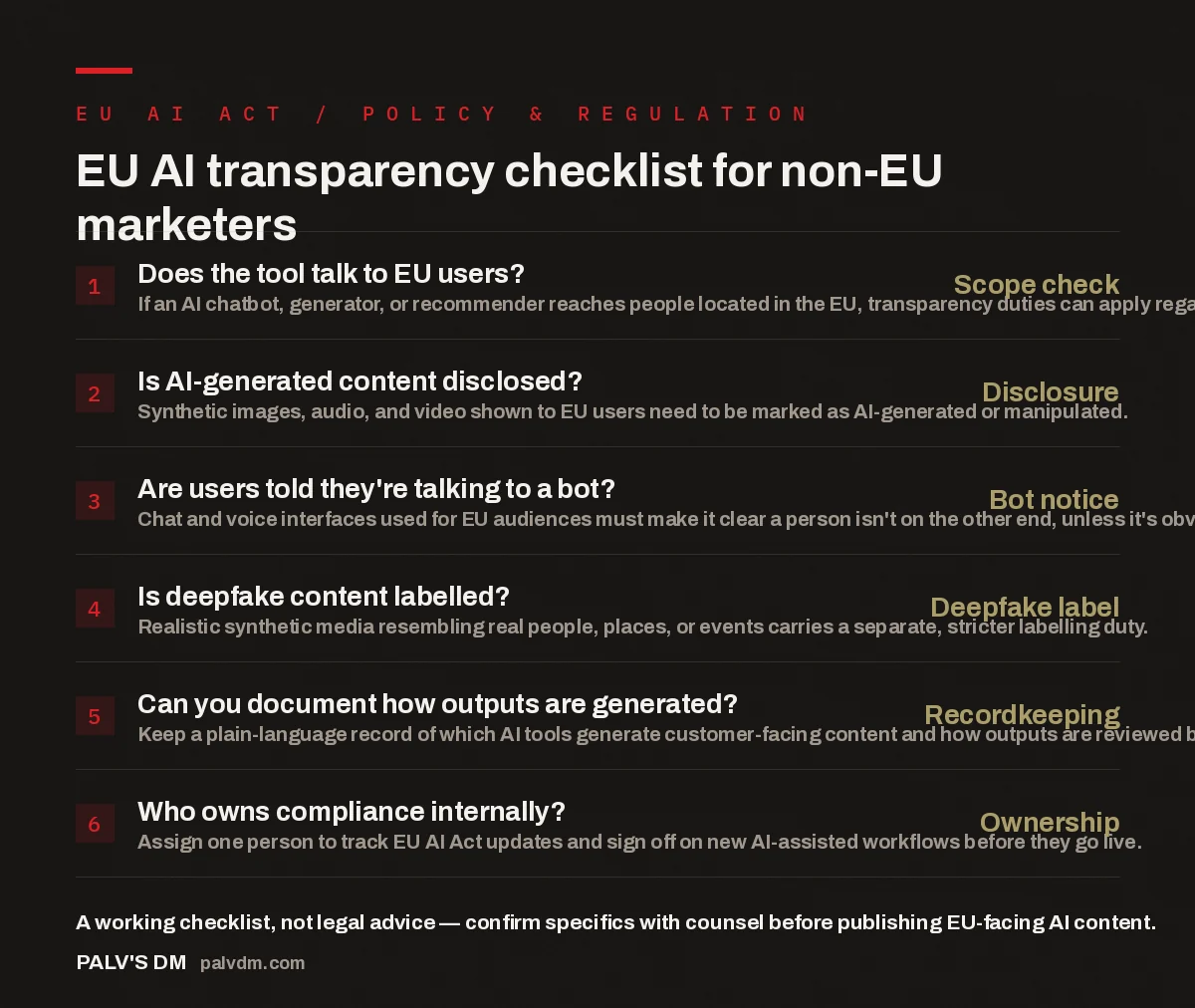
EU AI transparency checklist for non-EU marketers
- Does the tool talk to EU users? — Scope check. If an AI chatbot, generator, or recommender reaches people located in the EU, transparency duties can apply regardless of where your company is based.
- Is AI-generated content disclosed? — Disclosure. Synthetic images, audio, and video shown to EU users need to be marked as AI-generated or manipulated.
- Are users told they’re talking to a bot? — Bot notice. Chat and voice interfaces used for EU audiences must make it clear a person isn’t on the other end, unless it’s obvious from context.
- Is deepfake content labelled? — Deepfake label. Realistic synthetic media resembling real people, places, or events carries a separate, stricter labelling duty.
- Can you document how outputs are generated? — Recordkeeping. Keep a plain-language record of which AI tools generate customer-facing content and how outputs are reviewed before publishing.
- Who owns compliance internally? — Ownership. Assign one person to track EU AI Act updates and sign off on new AI-assisted workflows before they go live.
Why does a non-EU marketer need to care about the EU AI Act?
The EU AI Act follows the same logic as GDPR before it: it protects EU users, not EU companies, which means its reach extends to anyone marketing to those users. If you run paid social into EU markets, publish a chatbot that EU visitors can open, or localise landing pages for EU countries, the transparency provisions are relevant to that slice of your operation — even if your company is registered in India, the US, or anywhere else. This is not a hypothetical extraterritorial threat; it’s the same pattern EU privacy law already set, and most marketing teams that sell into Europe are used to thinking this way for data handling. AI content transparency is the next layer of the same conversation.
The scope question is worth answering honestly before anything else. A B2B SaaS company with no EU customers and no EU ad spend has very little to worry about here. A DTC brand running Meta and Google campaigns across European countries, or an agency managing chatbots for clients with EU traffic, has real exposure. The determining factor is audience reach, not brand nationality.
What does “transparency” actually require in practice?
Strip away the legal phrasing and the transparency obligations reduce to three marketing-relevant behaviours: disclose when content is AI-generated, disclose when a user is interacting with a bot rather than a person, and label synthetic media that could pass as real footage or a real person’s voice or likeness. None of these require you to stop using AI tools. They require you to be upfront about using them in customer-facing situations.
- AI-generated content disclosure — images, audio, or video created or substantially altered by AI and shown to EU audiences should carry a visible or machine-readable marker that it’s AI-generated.
- Bot disclosure — chat widgets, WhatsApp bots, and voice assistants used in EU-facing customer service or marketing need to make clear the user isn’t talking to a human, unless that’s already obvious from how the interaction is framed.
- Deepfake-style labelling — synthetic media that convincingly resembles a real person, place, or event carries a stricter, more explicit labelling duty than general AI-generated content, because the harm potential is higher.
In the accounts we work on, the content types that most often trigger this are AI-voiced video ads, AI-generated product photography used in EU-facing catalogues, and support chatbots deployed on websites without geofencing. None of these are unusual marketing tactics in 2026 — they’re mainstream — which is exactly why the disclosure requirement matters more now than it would have a few years ago.
Most clients who ask us about the EU AI Act aren’t worried about a fine. They’re worried about not knowing what they don’t know — which AI tools are already touching customer-facing content, and who in the org would even notice if a disclosure was missing.
Palash, Founder, PalV’s DM
How should marketing teams outside the EU actually respond?
The pattern that works for teams we’ve seen handle this well is not a legal sprint — it’s a short audit followed by a standing process. Start by mapping where AI touches customer-facing output: ad creative, product imagery, chatbots, voice content, email personalisation. Then check which of those touchpoints actually reach EU users, since a global campaign and an EU-targeted campaign carry different exposure. From there, the fix is usually a template change (adding an “AI-generated” tag to creative specs) plus a named owner who reviews new AI-assisted workflows before launch, rather than a one-time compliance project that goes stale the moment a new tool gets adopted.
- Inventory AI touchpoints. List every place AI generates or substantially edits customer-facing content — creative, copy, chat, voice, imagery.
- Segment by audience. Flag which of those touchpoints reach EU users specifically, since that’s what determines exposure.
- Build disclosure into templates. Add a standard AI-disclosure element to ad creative, video outros, and chatbot greeting scripts so it’s automatic rather than a manual afterthought.
- Name an owner. One person — often whoever already owns brand or legal-adjacent marketing decisions — should track EU AI Act updates and sign off on new AI tools before they go into EU-facing production.
- Revisit quarterly. AI tooling changes fast; a checklist that was accurate in January can miss a new AI feature your CRM or ad platform quietly turned on by summer.
Does this connect to the broader shift toward AI visibility and disclosure?
Regulatory transparency and AI search visibility look like separate conversations, but they share a root cause: AI systems are now sitting between brands and audiences, and every major institution — regulators, platforms, and AI engines themselves — is pushing for clearer signals about what’s AI-generated, what’s sourced, and what’s trustworthy. A brand that’s already disciplined about disclosure, sourcing, and clear attribution for compliance reasons tends to produce the kind of content that AI engines find easier to cite too. It’s not a legal requirement that happens to help SEO; it’s the same underlying shift toward machine-readable clarity showing up in two different domains at once.
This is also where the EU AI Act intersects with broader data protection frameworks marketers already juggle. Teams managing compliance for Indian audiences under the DPDP rules, for example, are already building the internal muscle — inventories, named owners, review checkpoints — that EU AI Act transparency also requires. Our DPDP compliance checklist for marketers covers the same operational pattern applied to a different jurisdiction, and the two are worth building together rather than as separate projects.
What other regulatory shifts should marketers be watching alongside this?
The EU AI Act isn’t happening in isolation. Publisher lawsuits over AI training data and content use are reshaping what “fair use” means for AI-generated marketing assets — our piece on publisher lawsuits and AI content use tracks where those cases currently stand and why they matter for anyone licensing or generating AI content commercially. Separately, antitrust scrutiny of search and AI defaults is a live thread that could reshape which AI surfaces dominate in a given market, covered in antitrust and search: what could change the default landscape. Neither directly overlaps with AI transparency law, but all three are part of the same regulatory tightening around how AI touches consumers, and a marketing team that tracks one usually benefits from tracking all three in the same quarterly review.
If you want the wider context for why 2026 has become the year regulation, AI search behaviour, and content strategy all started moving together, our pillar piece on the state of search in 2026 lays out the full picture beyond just the compliance angle.
Where PalV’s DM fits in
We help marketing teams build the same operational discipline — clear sourcing, visible attribution, machine-readable clarity — that both EU AI Act transparency and AI search visibility reward. If you’re not sure how your current AI-assisted content stacks up on either front, we’ll walk through it with you.
Does the EU AI Act apply to my company if I have no office in the EU?
Yes, if your marketing content reaches people located in the EU. The Act’s transparency provisions are tied to where your audience is, similar to how GDPR applies based on whose data you process rather than where your company is registered. A company with no EU customers or EU-targeted advertising has minimal exposure; one running EU-facing campaigns or chatbots does not.
What kind of AI content needs a disclosure label under the EU AI Act?
AI-generated or AI-altered images, audio, and video shown to EU users generally need some form of disclosure that they’re AI-generated. Content that convincingly resembles a real person, place, or event — the deepfake category — carries a stricter, more explicit labelling requirement than routine AI-generated marketing assets like product shots or background music.
Do chatbots need to tell EU users they’re not human?
Generally yes, unless it’s already obvious from the context that the user is interacting with an automated system. A chat widget clearly labelled “AI Assistant” with a bot icon likely satisfies this on its own, but a bot designed to feel indistinguishable from a human agent needs an explicit notice.
How is this different from labelling requirements on ad platforms like Meta or Google?
Platform-level AI disclosure tools, such as those some ad platforms have rolled out for synthetic media, are separate from and don’t automatically satisfy legal transparency obligations. A platform toggle can be a useful mechanism for compliance, but the underlying legal duty exists independently of whether a given ad platform offers a built-in label.
Who should own EU AI Act compliance inside a marketing team?
In practice, it usually sits with whoever already owns brand governance or legal-adjacent marketing decisions, working alongside legal counsel rather than replacing it. The key is having one named person accountable for reviewing new AI-assisted workflows before they launch, rather than treating it as a one-off audit nobody revisits.
Short version: if your marketing reaches EU users, disclose AI-generated content, flag bots as bots, and label deepfake-style media more explicitly — regardless of where your company is based. Build it into your content templates and assign one owner, and this stops being a recurring worry and becomes a five-minute checklist item on every new campaign.