Trends & Industry Developments
Antitrust and Search: What Could Change the Default Landscape
Google antitrust seo implications explained: what the US ruling and EU DMA restrict, what stays the same, and how to prepare your visibility strategy.

Search antitrust rulings are changing the terms Google can operate under, not handing the default search box to someone else overnight. In the US, a federal court found Google illegally maintained its search monopoly through exclusive default-placement deals, and ordered remedies that restrict exclusivity and force some data sharing — but stopped short of breaking up Chrome or Android. In the EU, the Digital Markets Act already requires choice screens and interoperability from designated gatekeepers. None of this replaces Google as the default. What it does is make the default less locked-in than it’s been in two decades, which is the part worth planning around if you work in google antitrust seo strategy rather than just reading headlines about it.
Key takeaway
- US remedies restrict exclusive default-placement deals and order some data sharing with rivals, but Google keeps Chrome, Android, and the ability to pay for default status under narrower terms.
- The EU’s Digital Markets Act already forces choice screens and interoperability on designated gatekeepers, which is a live, ongoing constraint rather than a future possibility.
- None of these rulings guarantee traffic will move to another engine. The practical response is the same regardless of outcome: build visibility that doesn’t depend on one platform’s default rules.
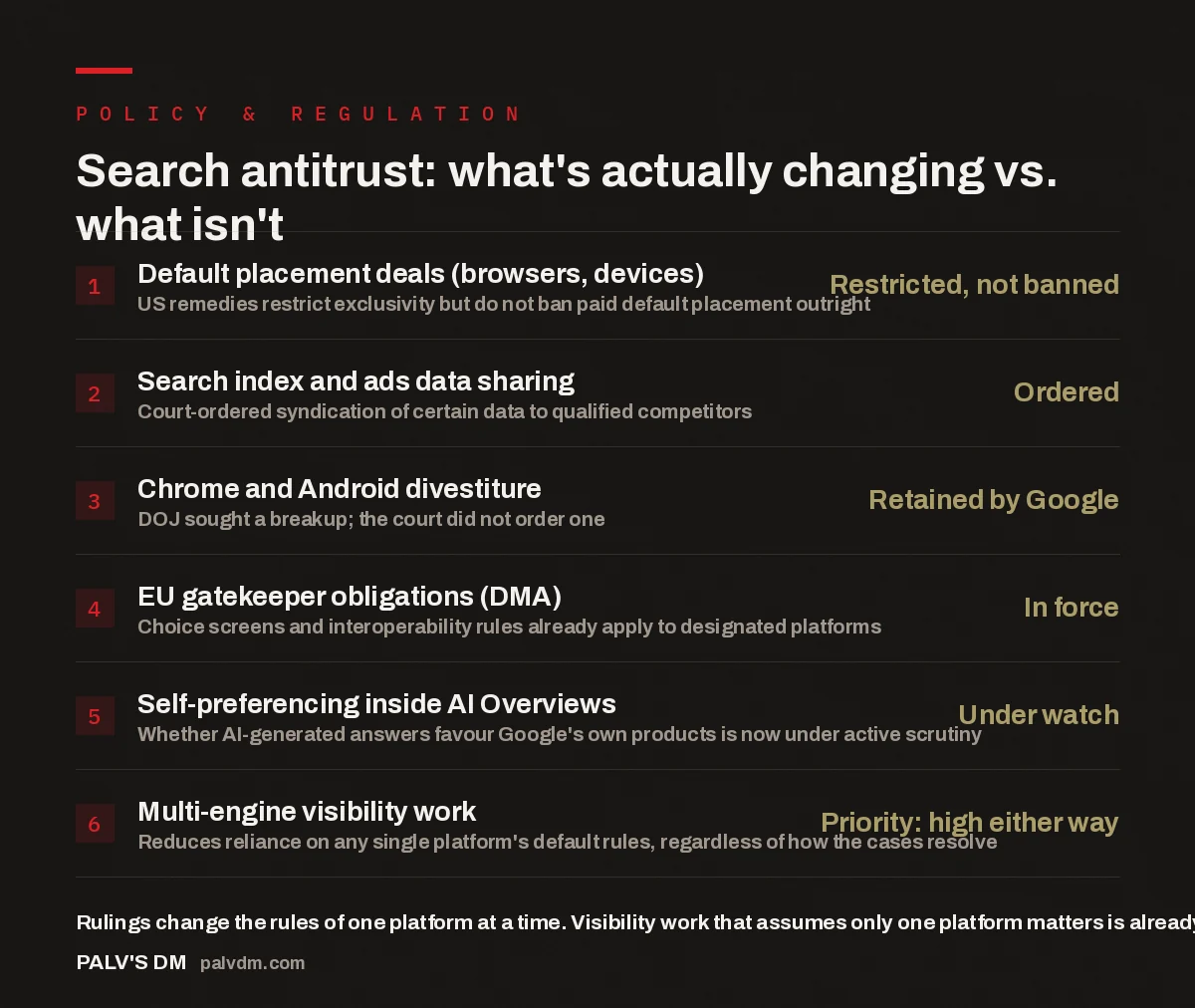
Search antitrust: what’s actually changing vs. what isn’t
- Default placement deals (browsers, devices) — Restricted, not banned. US remedies restrict exclusivity but do not ban paid default placement outright.
- Search index and ads data sharing — Ordered. Court-ordered syndication of certain data to qualified competitors.
- Chrome and Android divestiture — Retained by Google. DOJ sought a breakup; the court did not order one.
- EU gatekeeper obligations (DMA) — In force. Choice screens and interoperability rules already apply to designated platforms.
- Self-preferencing inside AI Overviews — Under watch. Whether AI-generated answers favour Google’s own products is now under active scrutiny.
- Multi-engine visibility work — Priority: high either way. Reduces reliance on any single platform’s default rules, regardless of how the cases resolve.
What did the US antitrust ruling against Google actually decide?
A US federal court found that Google violated antitrust law by paying browser makers and device manufacturers — Apple and Mozilla among them — to be the default search engine, and that these deals helped entrench a monopoly by making it structurally difficult for any rival to get comparable distribution. The liability finding came first; the remedies came later, in a separate phase where the judge weighed what to actually order. The Department of Justice had pushed for aggressive structural remedies, including a forced divestiture of Chrome. The court didn’t go that far. Instead, the remedies focus on behaviour: limiting exclusivity in default-placement agreements so Google can still pay to be a default option in some contexts, but competitors get a real shot at those same deals, and Google has to share certain search and ads data with qualified rivals under specific conditions.
That distinction — behavioural remedies instead of a breakup — matters for anyone trying to gauge how much of the search landscape is about to shift. A structural remedy like divestiture would have created an immediate, visible change in who controls distribution. A behavioural remedy changes incentives and opens doors gradually, over years of enforcement and compliance monitoring, not a single announcement date.
How does the EU’s Digital Markets Act change the search landscape?
The Digital Markets Act designates certain large platforms as “gatekeepers” and imposes obligations that don’t require a court case to trigger — they’re baked into the regulation once a platform is designated. For search, the practical effects include choice screens (users see alternative search engine options during device or browser setup rather than a single pre-set default) and interoperability requirements that limit how much a gatekeeper can favour its own services in its own results. This is already live in the EU, not a pending ruling. It’s a different mechanism from the US antitrust case — regulatory designation and ongoing compliance obligations, rather than a lawsuit with a remedies trial — but the direction is the same: reduce the structural advantage that comes purely from being the pre-installed, pre-selected option.
For marketers outside the EU, the DMA is worth tracking even if it doesn’t apply directly, because platform-wide product changes Google makes to satisfy EU obligations often ship globally rather than as an EU-only build. A choice-screen behaviour or interoperability change built for European compliance doesn’t always stay confined to European markets.
Will Google search defaults actually disappear?
No, not in the way the phrase “antitrust breakup” implies. Google is not being forced to sell Chrome or Android, and it can still pay for default placement — the constraint is on exclusivity, not on the practice of paying for distribution altogether. What changes is that the deals get less airtight. A browser maker that previously had one practical option now has more room to negotiate or diversify, and a portion of search query volume that used to flow through a single locked-in default channel becomes contestable again. Whether that contestability actually moves meaningful traffic to Bing, DuckDuckGo, or an AI-native search product depends on factors well outside the ruling itself — user habit, product quality, and whether any competitor makes a compelling enough case to switch. Antitrust remedies open a door; they don’t walk anyone through it.
The more immediate shift isn’t about a rival engine grabbing Google’s default position. It’s the erosion of certainty that Google’s distribution advantages are permanent. That erosion is already visible in how AI-native products like ChatGPT, Perplexity, and Google’s own AI Mode pull query behaviour away from the traditional ten-blue-links interface, independent of any court ruling. Antitrust pressure and AI-driven fragmentation are two separate forces pushing the same direction: less of the search market concentrated in one interface with one set of ranking rules.
Nobody is going to wake up to a press release saying Google search is no longer the default. What they’ll wake up to is a slow accumulation of smaller defaults — a browser, a device, an AI assistant — each with its own visibility rules, and a portfolio that was built for one platform starts underperforming in all of them at once.
Palash, Founder, PalV’s DM
What does google antitrust seo strategy actually look like in practice?
It looks less like reacting to a specific ruling and more like reducing single-platform dependency across the board, which happens to be good practice regardless of how the antitrust cases resolve. Three things we tell clients to prioritise:
- Stop treating “rank #1 on Google” as the whole scoreboard. If default placement deals loosen and query volume distributes across more entry points — other browsers’ default engines, AI assistants, device-level search — a strategy built entirely around one ranking algorithm has more exposure than one built around being genuinely findable and citable across formats.
- Invest in content structured for extraction, not just for ranking. Clear, well-labelled facts, defined terms, and direct answers get pulled into AI Overviews, AI Mode, and third-party AI assistants regardless of which company’s index sits underneath. That structural clarity survives platform-level shifts because it isn’t tied to one company’s ranking signals.
- Track visibility on more than one surface. If your only visibility metric is Google organic rank, you won’t see a shift coming until it’s already cost you traffic. Watching AI citation frequency and presence on at least one non-Google surface gives an early read on where the value dependent on Google’s default advantage.
None of this requires guessing which way the antitrust cases will go, and that’s deliberate. Betting a strategy on a specific court outcome or regulatory timeline is a bad bet — appeals, compliance delays, and slow-rolled implementation are the norm in cases like this, not the exception. Betting on reduced single-platform dependency is a good bet whether the remedies bite hard or get watered down on appeal.
How should you prepare for a less Google-centric search landscape?
Start with an honest audit of how concentrated your current visibility actually is, then diversify deliberately rather than reactively.
- Pull a breakdown of where your organic traffic and brand mentions currently come from — Google organic, Google AI Overviews, other search engines, AI assistants, direct/branded traffic. If one source accounts for nearly everything, that’s your exposure.
- Check whether your content answers questions directly near the top of the page, in plain language, before it goes into supporting detail. That format travels well across AI Overviews, AI Mode, and third-party assistants alike — it isn’t a Google-specific trick.
- Set up basic monitoring for how often your brand or content gets cited in AI-generated answers, not just where it ranks in blue links. This is the leading indicator for a fragmenting default landscape, well before traffic numbers move.
- Revisit technical fundamentals — structured data, clear entity signals, crawlability — that make your content legible to multiple engines and AI crawlers, not just to Googlebot.
- Reassess this quarterly, not annually. Antitrust remedies, DMA enforcement actions, and platform product changes are all moving on their own timelines, and a strategy built on last year’s landscape will lag.
Where this fits
Antitrust pressure and AI-driven fragmentation both point the same direction: visibility that only exists inside Google’s traditional results is carrying more risk than it used to. Building presence across AI surfaces alongside organic search is exactly the work our AI Visibility service does.
FAQ: search antitrust and SEO
Does the Google antitrust ruling mean Google will lose search market share soon?
Not automatically. The remedies restrict exclusive default-placement deals and require some data sharing, but they don’t force users onto a different search engine or reduce Google’s product quality. Market share shifts, if they happen, would come from competitors and AI-native products actually winning users over — the ruling just removes some of the structural barriers that made that harder to do.
Is Chrome being sold off because of the antitrust case?
No. The Department of Justice asked the court to order a Chrome divestiture as part of its proposed remedies, but the court’s remedies order did not require Google to sell Chrome or Android. The remedies that were ordered are behavioural — restricting exclusivity in default deals and mandating certain data sharing — rather than structural.
How is the EU’s Digital Markets Act different from the US antitrust case?
The US case is a lawsuit that went through a liability finding and a separate remedies trial in front of a judge. The DMA is a regulation: once a platform is designated a “gatekeeper” for a given service, ongoing obligations like choice screens and interoperability apply automatically, enforced by regulators rather than decided case-by-case in court. Both push toward reducing default-driven advantage, through different legal mechanisms.
Should I change my SEO strategy right now because of antitrust rulings?
Not because of a specific court date. The more useful move is reducing dependency on any single platform’s default rules generally — clear, well-structured content, technical fundamentals that work across engines, and visibility tracking that covers AI surfaces as well as traditional rankings. That work pays off whether the antitrust remedies expand, get narrowed on appeal, or stay exactly as ordered.
Could antitrust action affect how Google’s AI Overviews use publisher content?
It’s an area of active scrutiny rather than a settled outcome. Questions about whether AI-generated answers favour Google’s own products or services, and how they use third-party content without sending traffic back, sit adjacent to the core search antitrust case and to separate publisher lawsuits. Nothing here is finalised, so treat AI Overview behaviour as something to monitor rather than plan around as fixed.
Related reading
For more on how the wider landscape is shifting alongside these regulatory changes, see our overview of what actually changed in search in 2026, our guide to Google AI Mode and how to be visible in it, and the current picture of which AI search platforms people are actually using. On the legal side, our rundown of publisher lawsuits over AI content use covers a related but separate set of legal pressures.
Short version: the US antitrust ruling against Google restricts exclusive default-placement deals and orders some data sharing, but doesn’t break up Chrome or Android. The EU’s DMA already imposes choice-screen and interoperability rules on gatekeepers. Neither guarantees traffic will move away from Google, but both reduce how locked-in the current default landscape is. The practical response isn’t to bet on a court outcome — it’s to build visibility that doesn’t depend entirely on one platform’s default rules, which is worth doing regardless of how these cases resolve.