Trends & Industry Developments
Publisher Lawsuits and AI Content Use: Where Things Stand
AI publisher lawsuits explained: what publishers argue, why no verdict has settled the fair-use question yet, and how site owners should respond right now.
As of mid-2026, no AI publisher lawsuit in the US has produced a final, binding ruling on whether training a model on copyrighted articles counts as fair use. The New York Times’ case against OpenAI and Microsoft, Getty Images’ case against Stability AI, and several smaller suits from publishers and authors are still moving through discovery, motions, and appeals. What has changed is the fallback strategy: a growing number of publishers have stopped waiting on the courts and signed direct licensing deals with AI companies instead. If you run a website and are wondering whether any of this affects your content, the honest answer is: probably not directly yet, but the ground rules it eventually sets will shape how AI systems are allowed to use your work.
Key takeaway
- No US court has yet issued a definitive ruling on whether training AI models on copyrighted publisher content is fair use — the major cases remain unresolved.
- Licensing deals between publishers and AI companies are running in parallel to litigation, not as proof either side has won the legal argument.
- Regardless of how the lawsuits end, publishers are already using crawler controls, attribution demands, and content signals as practical defences — and those are things you can act on today.
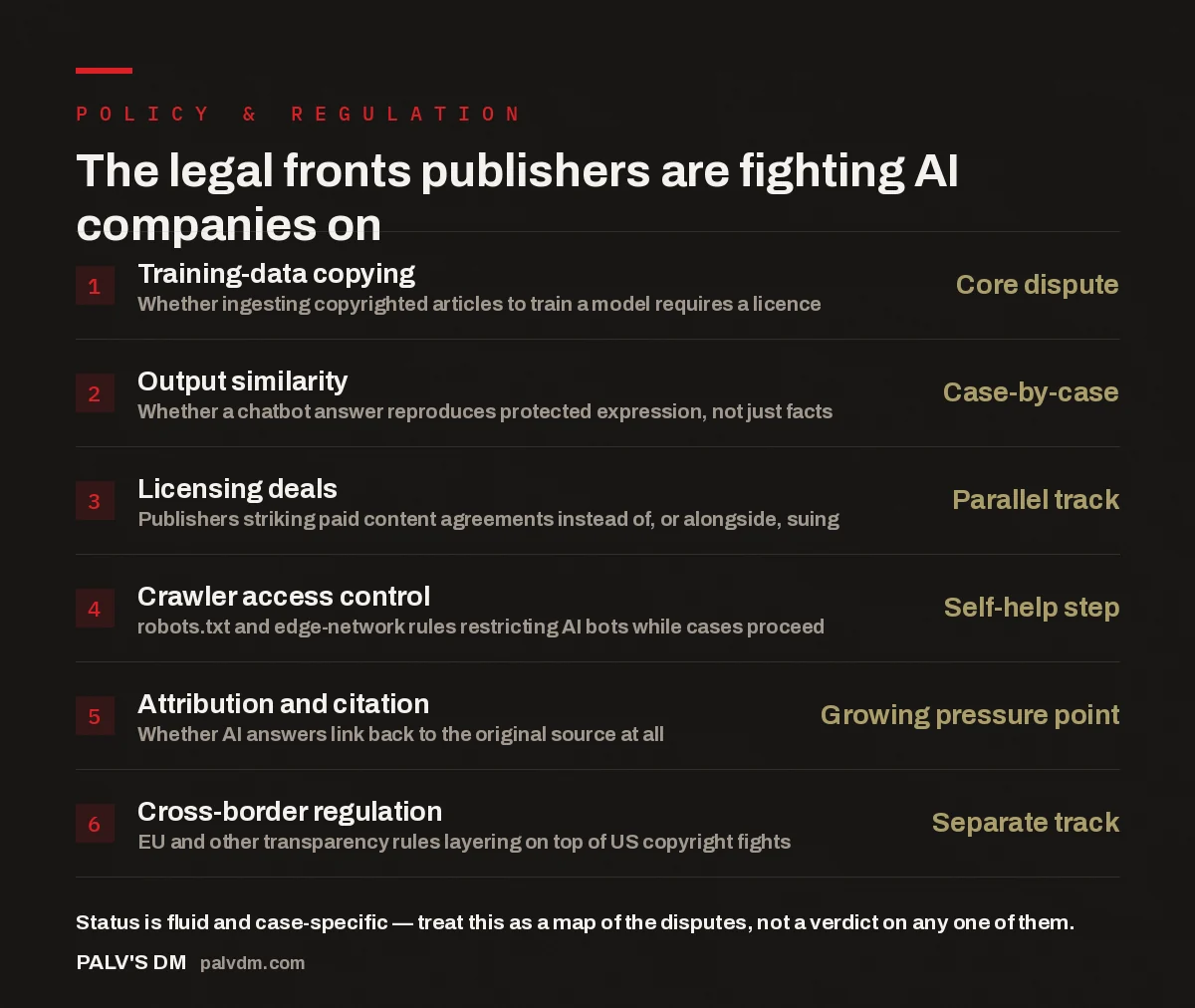
The legal fronts publishers are fighting AI companies on
- Training-data copying — Core dispute. Whether ingesting copyrighted articles to train a model requires a licence.
- Output similarity — Case-by-case. Whether a chatbot answer reproduces protected expression, not just facts.
- Licensing deals — Parallel track. Publishers striking paid content agreements instead of, or alongside, suing.
- Crawler access control — Self-help step. robots.txt and edge-network rules restricting AI bots while cases proceed.
- Attribution and citation — Growing pressure point. Whether AI answers link back to the original source at all.
- Cross-border regulation — Separate track. EU and other transparency rules layering on top of US copyright fights.
What are publishers actually suing AI companies for?
Strip away the case names and the AI publisher lawsuits filed so far cluster around two distinct claims often treated as one issue. The first is about training: did the AI company copy a publisher’s articles, without permission or payment, to build the model? The second is about output: does the model, when asked a question, reproduce a publisher’s actual sentences and structure closely enough to count as infringement, rather than just conveying the underlying facts?
This distinction matters because the two claims have different strengths in court. Copying text into a training set is a discrete, provable act — either it happened or it didn’t, and the fight is over whether that act needs a licence. Reproduction in outputs is messier to prove at scale: a model can be asked thousands of ways, and most answers it gives are paraphrased rather than lifted verbatim. Plaintiffs in cases like The New York Times’ suit against OpenAI and Microsoft have tried to demonstrate both, pointing to training on their archive and to instances where a chatbot produced passages close to the original. Getty Images’ case against Stability AI ran a similar playbook for images.
None of this has produced a single, sweeping precedent yet. Courts have mostly been working through narrower procedural questions — what counts as evidence of copying, which claims survive a motion to dismiss — rather than issuing a final verdict on fair use itself.
How does “fair use” become the central legal question?
In US copyright law, fair use is the defence AI companies lean on, and it turns on whether a use is “transformative” — different enough from the original that it doesn’t compete with it in the same market. AI companies argue training on text is transformative the way a search engine indexing the web is transformative: the model isn’t republishing the article, it’s learning patterns from it. Publishers argue the opposite — that a model trained on their reporting can now answer the same questions their articles were written to answer, without sending a reader their way. That’s the crux of it: not whether copying occurred, but whether the result substitutes for the original in the marketplace.
Fair use has historically been decided case by case, weighing factors like the purpose of the use, how much was used, and the effect on the market for the original. That case-by-case nature is exactly why a single ruling in one lawsuit won’t necessarily settle the question for every publisher and every AI company — a court could find in favour of one plaintiff’s specific facts without setting a rule that applies universally.
Every client asks us when the lawsuits will “settle the question.” They won’t, not cleanly. Fair use gets decided fact pattern by fact pattern, so what actually protects you isn’t waiting for a verdict — it’s controlling what you can control: your robots.txt, your licensing terms, and how citable your content is in the first place.
Palash, Founder, PalV’s DM
What options do publishers have besides suing?
Litigation is slow, expensive, and its outcome is genuinely uncertain — which is why a parallel track has developed alongside the lawsuits: direct commercial deals. Several major publishers and content platforms have signed licensing agreements with AI companies that pay for the right to train on, or surface content from, their archives. These deals aren’t an admission that licensing was legally required — AI companies structure them as commercial arrangements rather than settlements — but they show both sides see value in resolving uncertainty through a contract rather than a courtroom.
For publishers without the scale to negotiate a bespoke deal, the more accessible lever is technical: controlling crawler access. Robots.txt directives aimed at specific AI crawlers, and edge-network rules that block or rate-limit known bots, have become the default “opt out for now” mechanism while the legal questions remain open. It’s a blunt tool — it can’t undo training that already happened, and crawler names keep changing — but it’s the one lever a site owner can pull without a legal budget.
Our related piece on keeping your robots.txt current as AI crawler names keep changing and our breakdown of Cloudflare’s content signals for AI crawler control both go into the practical mechanics of this — worth reading if you want to actually implement access controls rather than just discuss them in the abstract.
What does this mean for publisher traffic and attribution?
Attribution — whether an AI answer credits and links back to the source it drew from — sits underneath a lot of this legal noise, because it’s the difference between an AI system being a competitor and being a referral channel. When an AI overview cites a publisher and links out, that publisher at least has a chance of capturing a reader. When it doesn’t, the content is used with none of the traffic benefit that used to come from ranking well. This is the commercial harm publishers keep pointing to in court filings, and it’s why attribution has become a negotiating point in licensing talks, not just a legal one.
We’ve written separately about what’s actually happened to publisher traffic as AI answers have grown — the lawsuits are, in large part, a legal response to that traffic pattern. The two are the same story told from different angles: one shows up in analytics, the other in court filings.
How should marketers and site owners respond right now?
If you’re not a major publisher with an archive worth litigating over, the direct legal exposure here is low. What’s more relevant to most businesses is the second-order effect: the rules AI companies eventually settle on for training data and attribution will shape how your content gets used and cited, whether or not you’re ever a party to a lawsuit. A few practical moves are worth making now regardless:
- Decide deliberately whether you want AI crawlers accessing your content, rather than leaving the default settings unexamined — this is a business decision, not just a technical one.
- If you do want AI visibility, structure content so it’s easy to cite accurately: clear claims, defined terms, and content that answers a specific question directly, rather than burying the answer in narrative.
- Keep an eye on regulatory movement outside the US too — the EU’s transparency requirements for AI training data are a separate track from the American copyright suits, and they’ll affect global platforms regardless of where a lawsuit is filed.
Our guide to the EU’s AI transparency rules and what marketers outside the EU should note covers that regulatory track in more detail — it’s a genuinely separate set of obligations from the US copyright litigation, and it moves on its own schedule.
What could change the landscape next?
Three things are worth watching. First, any appellate-level ruling in one of the major US cases — even a partial one — will get cited by every other pending case, so it’s likely to move the whole landscape rather than resolve just one dispute. Second, the licensing-deal trend could normalise into an industry standard, or stay a privilege reserved for publishers with enough scale to negotiate one, leaving smaller publishers with only the technical opt-out route. Third, regulatory pressure in the EU and elsewhere could end up setting disclosure and licensing norms faster than the courts do, since legislation doesn’t need a specific dispute to move forward.
For anyone tracking the broader shift in how search and AI surfaces work, our pillar piece on the state of search in 2026 puts this legal fight in the context of the other changes reshaping visibility — it’s one thread among several, but it’s the one most likely to set enforceable rules rather than just industry norms.
Where PalV’s DM fits in
You can’t control how the lawsuits resolve. You can control whether your content is structured to be cited accurately when AI systems do use it, and whether your crawler and licensing posture reflects a decision rather than a default. That’s the AI visibility work we do.
Have any AI publisher lawsuits actually been decided?
Not with a final, binding ruling on the core fair-use question, as of mid-2026. The major US cases — including The New York Times against OpenAI and Microsoft, and Getty Images against Stability AI — have moved through motions and discovery, but none has produced a sweeping precedent that settles the issue for every publisher and every AI company.
Is training an AI model on copyrighted content automatically fair use?
No — it’s contested, and that’s what the lawsuits are arguing over. AI companies claim training is “transformative” use similar to indexing; publishers argue the resulting product competes directly with their content in the same market. Fair use is decided case by case, so there’s no single automatic answer.
Should a small publisher or business block AI crawlers?
It depends on your goals, not on the lawsuits directly. If AI visibility and citation are part of your growth strategy, blocking crawlers works against you. If you’re primarily worried about content being used without benefit to you, robots.txt rules and edge-network controls are the practical lever available today, regardless of how the litigation resolves.
Do licensing deals between publishers and AI companies mean the legal question is settled?
No. Licensing deals run alongside the litigation, not as a substitute for a ruling. AI companies generally structure them as ordinary commercial agreements rather than settlements, and publishers who sign them aren’t conceding claims against other AI companies they haven’t licensed to.
How does this affect AI visibility strategy for a business that isn’t part of any lawsuit?
Indirectly but meaningfully. The norms these cases and licensing deals establish — around attribution, crawler access, and permitted use — will likely apply industry-wide once they settle, shaping how AI platforms cite and credit any website’s content, not just the plaintiffs’. Structuring your content to be accurately citable now is a reasonable hedge either way.
Short version: the AI publisher lawsuits haven’t produced a definitive ruling yet, and the core argument — is training transformative, or does it substitute for the original in the market — is still being fought case by case. Licensing deals and crawler-control measures run in parallel to the litigation as practical workarounds, not proof of who’s legally right. For most businesses, direct legal exposure is minimal, but the norms these cases and deals set will shape how AI systems treat, cite, and credit content across the web.