Trends & Industry Developments
India’s DPDP Rules in Practice: A Marketer’s Compliance Checklist
A practical DPDP compliance checklist for marketers: fix consent language, audit ad-tech scripts, enable real withdrawal, and document a breach process.

A DPDP compliance checklist for marketers comes down to five things: know what personal data you collect, get explicit itemised consent for each purpose, make withdrawal as easy as sign-up, clean up the third-party scripts firing before consent, and have a named contact for grievances and breaches. India’s Digital Personal Data Protection Act, 2023 doesn’t ban marketing — it bans marketing built on data you never had proper permission to use. Most marketing stacks in India today aren’t ready for that distinction, and the gap is rarely the big obvious thing. It’s the ad pixel firing on page load, not on consent.
Key takeaway
- DPDP compliance for marketing is mostly a consent-architecture problem, not a legal-language problem — bundled or pre-ticked consent doesn’t count, and most existing forms use it.
- The most common silent violation isn’t the signup form — it’s ad-tech and analytics scripts that fire before a user has consented to anything.
- Treat this as an ongoing operational checklist you revisit each quarter, not a one-time audit you file away.
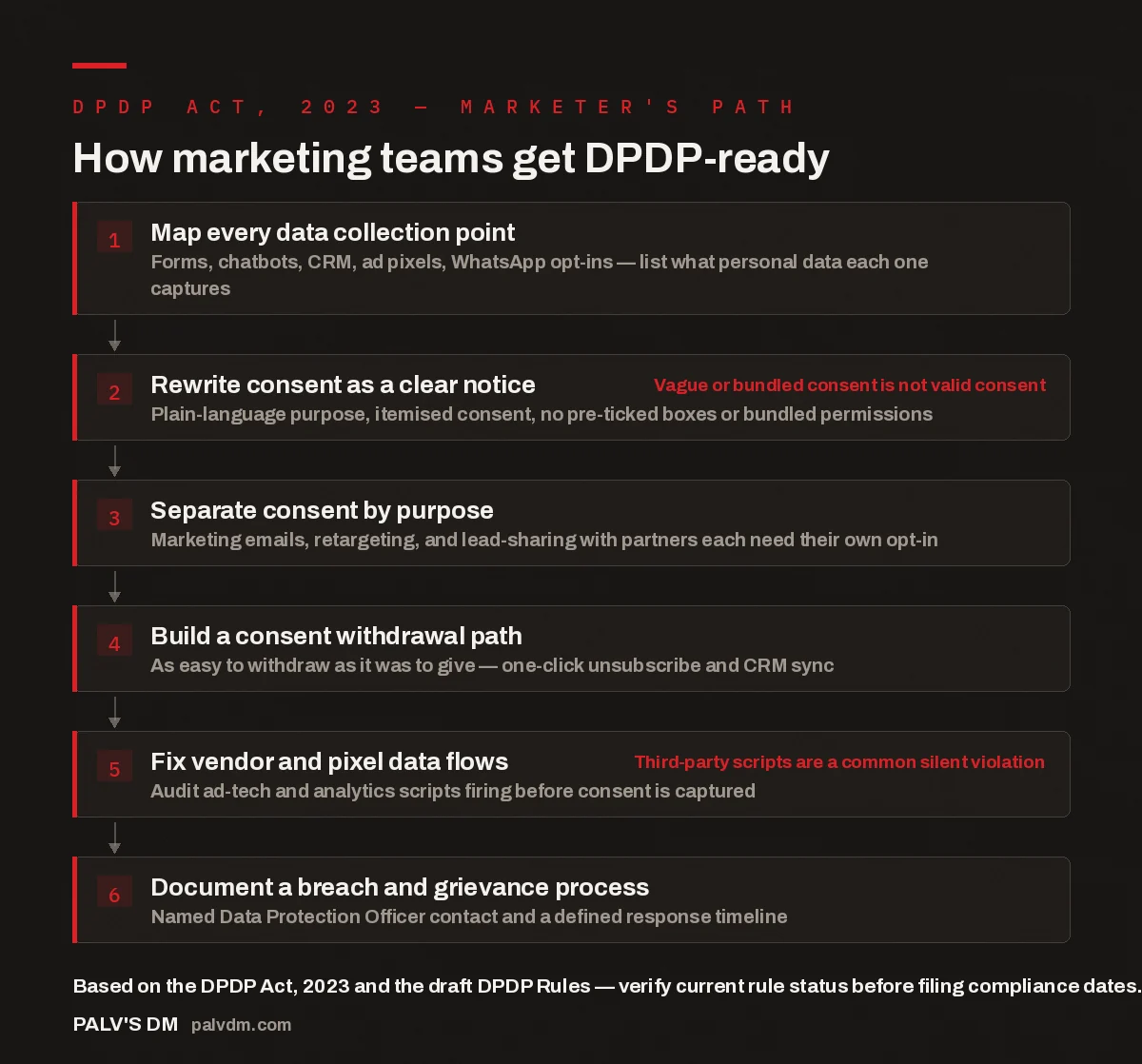
How marketing teams get DPDP-ready
- Map every data collection point. Forms, chatbots, CRM, ad pixels, WhatsApp opt-ins — list what personal data each one captures.
- Rewrite consent as a clear notice. Plain-language purpose, itemised consent, no pre-ticked boxes or bundled permissions. Vague or bundled consent is not valid consent
- Separate consent by purpose. Marketing emails, retargeting, and lead-sharing with partners each need their own opt-in.
- Build a consent withdrawal path. As easy to withdraw as it was to give — one-click unsubscribe and CRM sync.
- Fix vendor and pixel data flows. Audit ad-tech and analytics scripts firing before consent is captured. Third-party scripts are a common silent violation
- Document a breach and grievance process. Named Data Protection Officer contact and a defined response timeline.
What does the DPDP Act actually require of marketing teams?
The Digital Personal Data Protection Act, 2023 governs how any organisation processing the personal data of individuals in India must collect, use, store, and share that data. For marketing specifically, the parts that matter most are consent, purpose limitation, and the right to withdraw. Consent has to be free, specific, informed, unconditional, and unambiguous — which rules out most of the consent language currently sitting on Indian lead-gen forms. “By submitting this form, you agree to our terms and to receive communications from us and our partners” is exactly the kind of bundled, vague consent the Act is written to stop.
Purpose limitation means you can only use data for the purpose you stated when you collected it. If someone downloaded a whitepaper and consented to receive that whitepaper by email, you don’t automatically have the right to add them to a nurture sequence, retarget them on Meta, or hand their number to sales for cold calling. Each of those is a separate purpose and needs its own consent trail.
Why is consent language the first thing to fix?
Consent language is the first fix because it’s the cheapest one and it exposes every other gap in the process. When you sit down to rewrite a consent notice so it names the actual purpose in plain language, you’re forced to answer questions the marketing team usually hasn’t asked: what exactly happens to this data after submission, who else touches it, and for how long is it retained. That exercise alone tends to surface the retargeting pixel nobody remembered was on the thank-you page, or the lead list that gets synced to a partner CRM as a matter of habit rather than agreement.
Practically, this means breaking a single “I agree” checkbox into separate, specifically worded lines: one for the transaction itself (sending the requested content, confirming a booking), one for marketing communications, and one for sharing data with named third parties if that happens. None of these can be pre-ticked. None of them can be a condition of getting the thing the user actually wants, unless the data is genuinely necessary for that service.
How do you audit ad-tech and tracking scripts for DPDP compliance?
Auditing ad-tech scripts starts with a simple test most sites fail: load the page with no cookie or consent banner interaction and watch what fires. On the accounts we’ve reviewed, it’s routine to find Meta Pixel, Google Ads conversion tracking, and third-party analytics tags all loading on first page load, well before any consent decision has been made. That’s the gap between what the privacy policy says and what the browser is actually doing, and it’s one regulators and users can verify in seconds with browser dev tools.
Fixing this is a tag-management problem more than a legal one. Consent-gated tag firing — where marketing and analytics tags only load after explicit opt-in — is standard practice for GDPR-compliant sites in Europe, and the same pattern applies here. In Google Tag Manager, this means wiring consent state into tag triggers rather than firing everything on “All Pages.” If scripts are pasted directly into the header, it means moving them behind a consent gate instead. This is also where you find out how many vendors you’re actually sending data to — WhatsApp Business API integrations, CRM enrichment tools, heatmap software — because each is a separate data flow that needs accounting for, not just the ones marketing set up directly.
Every DPDP audit we’ve run starts the same way — not with the consent checkbox, but with the network tab open, watching what actually fires before anyone clicks agree.
Palash, Founder, PalV’s DM
How do you make consent withdrawal actually work?
The DPDP Act requires that withdrawing consent be as easy as giving it — not buried in a settings page three clicks deep, not requiring a support email that takes a week to action. For email, the standard one-click unsubscribe link is fine as far as it goes, but the harder part is what happens after the click. If unsubscribing doesn’t also stop the retargeting, pull the contact out of the WhatsApp broadcast list, and flag the CRM record, you haven’t actually withdrawn consent — you’ve just muted one channel.
The practical fix is a single source of truth for consent status that every downstream tool checks against, rather than each channel keeping its own opt-out list. This doesn’t need an expensive consent-management platform — a well-maintained field in the CRM that gates exports to ad platforms and email tools can do the job, as long as someone owns keeping it current.
What should the breach and grievance process look like?
The Act requires a named point of contact for data principal grievances and a process for handling personal data breaches, and marketing teams are frequently the first place a complaint or a leak surfaces — a customer replying to a campaign email asking how you got their number, or a misconfigured ad audience that exposes a customer list. A documented process means a named internal contact (a Data Protection Officer or designated grievance handler, depending on organisation size), a defined response timeframe, and a clear escalation path from “marketing person receives a complaint” to “the right people are informed and act.” This doesn’t need to be elaborate — it needs to exist, be written down, and be known to the people running campaigns, because the worst version of this process is the one improvised for the first time during an actual complaint.
Why does this matter for AI visibility and not just legal risk?
DPDP compliance and AI visibility look like separate problems, but they share the same underlying discipline: structured, accurate, trustworthy data about who you are and how you operate. AI systems that cite brands — in AI Overviews, in chat-based assistants, in agentic shopping flows — increasingly weight signals of legitimacy and trust, and a business that’s visibly sloppy about consent and data handling is not the kind of source those systems are built to prefer. As product and service data gets prepared for AI agents to read and act on directly, the same governance work DPDP forces — knowing exactly what data you hold, why, and under what permission — becomes the groundwork that makes that data usable and trustworthy for AI systems too.
There’s also a crawler-side parallel worth noting: just as marketers have had to get precise about which ad-tech scripts fire and why, the AI crawler landscape has been forcing similar precision — AI crawler names keep changing, and keeping your robots.txt current is its own version of the same discipline: know exactly what’s touching your data, and be deliberate about it rather than defaulting to “allow everything” or “block everything.”
How does India’s approach compare to what’s happening elsewhere?
Marketing teams running campaigns across markets should note that India isn’t unique in tightening this. Regulatory attention on data handling is a global pattern, not an isolated Indian development — teams also serving EU audiences should read how the EU’s AI transparency rules apply to marketers outside the EU, since a single consent and data-governance framework saves you rebuilding this checklist per jurisdiction. The direction across most major markets is the same: less tolerance for vague consent, more accountability for what happens to data after collection, and growing scrutiny of the invisible layer of trackers most marketing stacks accumulate without much oversight.
If you’re already tracking your visibility across search and AI surfaces, it’s worth folding data-governance status into that same operational rhythm rather than treating it as a separate compliance-only exercise — the kind of structured tracking discussed in building a multi-surface visibility scorecard applies just as well to consent and data-flow status as it does to rankings and citations.
Get this checked properly
A DPDP compliance checklist only helps if someone actually runs it against your live site, forms, and ad-tech stack — not just your privacy policy. We fold data-governance and consent-architecture review into our AI visibility audits, because clean, well-permissioned data is the same foundation both problems need.
Get an AI visibility audit that checks your data foundations
Frequently asked questions
Does the DPDP Act apply to small businesses and single-founder marketing teams?
Yes. The Act applies to any entity processing the personal data of individuals in India, regardless of company size, though some obligations scale with the volume and sensitivity of data handled. A small business collecting email addresses through a contact form is still processing personal data and still needs valid consent and a way to honour withdrawal requests.
Is a cookie consent banner enough to be DPDP compliant?
No. A cookie banner addresses one data collection point — browser cookies — but DPDP compliance covers every place personal data is collected and processed: forms, WhatsApp, CRM imports, event registrations, and third-party integrations. A banner that isn’t wired into actually gating tag firing until consent is given also doesn’t do much on its own.
Can we still run retargeting ads under the DPDP Act?
Yes, but retargeting needs its own specific consent rather than being bundled into a general “I agree to marketing” checkbox. Practically, this means your consent notice should name retargeting or interest-based advertising as a distinct purpose, and your ad pixels should only fire for users who’ve opted into that specific purpose.
Who should own DPDP compliance inside a marketing team?
Legal or a designated Data Protection Officer typically owns the overall compliance framework, but marketing operations needs day-to-day ownership of the parts that touch campaigns directly — consent form language, tag management, list hygiene, and withdrawal handling — because those are the systems marketing controls and changes most frequently.
How often should this compliance checklist be reviewed?
Treat it as a quarterly review at minimum, and re-run it any time you add a new form, launch a new campaign channel, or bring on a new ad-tech or CRM vendor. Consent architecture drifts quietly as new tools and scripts get added, which is exactly why a one-time audit isn’t enough.
The short version
A working DPDP compliance checklist for marketers isn’t a legal document in a drawer — it’s an operational habit built around five things: mapping every place you collect personal data, rewriting consent so it’s specific and unbundled, auditing the ad-tech scripts firing on your site, making withdrawal genuinely easy across every channel, and having a real process for grievances and breaches before you need one. None of this requires abandoning measurement or retargeting. It requires being deliberate about what data you collect, why, and with whose permission — which, done properly, makes your data cleaner and more trustworthy for AI systems reading your site as well as for the regulator reading your consent logs.