Trends & Industry Developments
Rank Tracking After &num=100: What Tools Can Still Tell You
Google's &num=100 SERP parameter broke, changing rank tracking accuracy in 2026. See what tools can still verify and what to trust instead.

Rank tracking accuracy in 2026 depends on where a keyword sits. Positions 1-20 are still measured the same way they always were: a tool loads the real results page and reads it. Positions below roughly 20, and everything that used to live in the old “top 100” view, are a different story. In late 2025, Google quietly stopped reliably returning results when a search request included the &num=100 parameter — the trick nearly every rank tracker used to pull 100 results in a single page load. That single change didn’t kill rank tracking. It changed what the number in your dashboard actually represents, and most teams haven’t adjusted how they read it.
Key takeaway
- The
&num=100parameter that let tools fetch 100 SERP results in one request is no longer reliable — positions inside the top 20 are still measured cleanly, deeper positions need paginated scraping most tools weren’t built to do at scale. - Visibility and share-of-voice scores calculated across a full “top 100” set may now be quietly built on partial data, depending on how your vendor adapted.
- Rank position was already an incomplete signal before this change; treat it as one input alongside Search Console data and AI citation tracking rather than the whole picture.
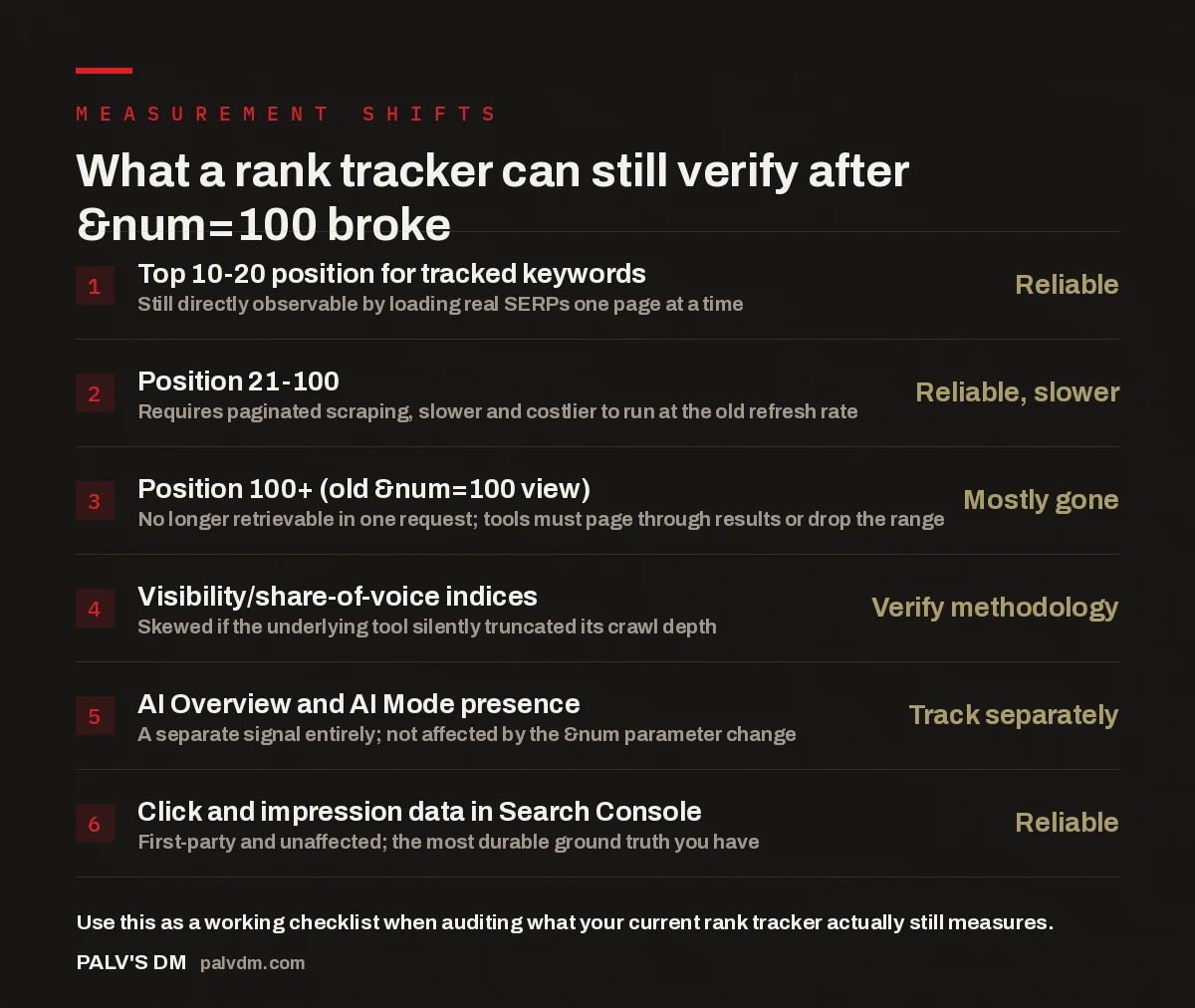
What a rank tracker can still verify after &num=100 broke
- Top 10-20 position for tracked keywords — Reliable. Still directly observable by loading real SERPs one page at a time.
- Position 21-100 — Reliable, slower. Requires paginated scraping, slower and costlier to run at the old refresh rate.
- Position 100+ (old &num=100 view) — Mostly gone. No longer retrievable in one request; tools must page through results or drop the range.
- Visibility/share-of-voice indices — Verify methodology. Skewed if the underlying tool silently truncated its crawl depth.
- AI Overview and AI Mode presence — Track separately. A separate signal entirely; not affected by the &num parameter change.
- Click and impression data in Search Console — Reliable. First-party and unaffected; the most durable ground truth you have.
What actually changed with &num=100?
For years, appending &num=100 to a Google search URL told Google to return up to 100 organic results on a single results page instead of the default 10. It was never an official, documented API — it was an undocumented URL parameter that happened to work, and the entire rank-tracking industry built its infrastructure around it because fetching 100 results in one request is dramatically cheaper than fetching ten pages of ten. When Google stopped honouring the parameter consistently, tools that depended on it lost their cheap route to deep-position data overnight. Some vendors switched to paginating through results the slow way. Others quietly narrowed their default tracking depth. A few said nothing and let customers find out on their own.
The practical effect: if you’re tracking keywords where your site sits in positions 1-20, you likely haven’t noticed anything different. If you were relying on visibility scores, share-of-voice indices, or “how many keywords do we hold in the top 100” reports, the underlying data collection for those metrics changed, and depending on your vendor, may now be incomplete, slower to refresh, or reconstructed through a different method entirely.
How does this affect rank tracking accuracy in 2026?
Rank tracking accuracy in 2026 is a split picture, not a uniform decline. Split it by depth and the picture gets clearer:
- Positions 1-20: largely unaffected. This is where most commercially meaningful traffic sits anyway, and tools fetch this range the same way they did before — by loading the first two results pages, which Google still serves normally.
- Positions 21-100: still trackable, but slower and more expensive to collect at scale. A vendor now has to make ten separate page requests instead of one to reconstruct the same range, which changes crawl economics for anyone tracking thousands of keywords.
- Aggregate visibility metrics: the most exposed. Any index or score computed as “share of keywords ranking in top 100” was almost certainly built on
&num=100data. If your vendor didn’t publicly explain how they rebuilt that collection, the pre- and post-change numbers in your historical trend line may not be measuring the same thing.
The honest version of this, in the accounts we work on: nobody’s top-10 tracking broke. What broke is the assumption that a “visibility score” trend line going back 18 months is one continuous, comparable series. For keywords that matter — the ones already inside the top 20 — the data hasn’t degraded. For the long tail past position 50, treat any tool’s numbers as directionally useful rather than precise until you’ve confirmed how that specific tool now collects them.
The keywords that actually drive revenue were never sitting at position 87. The &num=100 change is a real problem for reporting completeness, but it’s a smaller problem for decision-making than most dashboards make it look.
Palash, Founder, PalV’s DM
Which rank tracking metrics should you still trust?
Not every number in a rank tracking dashboard carries the same risk from this change. A useful way to sort them:
- Individual keyword position for tracked terms in the top 20: trust it. This is collected the same way it always was.
- Movement and trend for those same keywords week over week: trust it. The collection method for this range didn’t change, so relative movement is still comparable to itself.
- “Total keywords in top 100” or similar breadth counts: verify before trusting. Ask your vendor directly how they now collect positions past 20, and whether the method changed mid-history.
- Competitor visibility comparisons: treat cautiously if the comparison spans the change date, since your competitor’s deep-position data may have been collected under a different method than yours depending on when each tool adapted.
- Search Console average position and impressions: trust it — this has always been first-party data from Google itself and was never dependent on
&num=100scraping at all.
That last point is worth sitting with. Search Console’s own position and impression data was never affected by this change, because Google isn’t scraping its own search results — it’s reporting from its internal logs. For any keyword where you have real impression volume in Search Console, that’s a more durable source of truth than a third-party tracker’s simulated SERP, and it always was.
What should you do about your current rank tracking setup?
- Ask your rank tracking vendor directly how they now collect positions past 20. A vendor that has adapted well will have a public changelog or support article explaining the change; if they don’t have an answer, that itself is useful information.
- Re-baseline any visibility score or share-of-voice trend line from the date the change took effect. Comparing pre- and post-change numbers on the same chart without a note risks reading noise as a real ranking shift.
- Prioritise Search Console data for anything you report externally. It wasn’t affected by this change and it reflects real query volume rather than a simulated crawl.
- Narrow your tracked keyword set to positions that matter commercially. If a keyword has sat outside the top 30 for six months, deep-position tracking accuracy for it matters far less than whether it’s showing up in AI Overviews or being cited by AI answer engines at all, which rank position doesn’t measure in the first place.
- Treat this as a prompt to widen what you measure, not just patch what broke. Rank position was always a proxy for visibility, and it was an incomplete one even before
&num=100stopped working — it never captured AI Overview presence, zero-click outcomes, or whether an AI engine cites your page in a generated answer.
This is also a reasonable moment to ask a harder question about rank tracking generally: how much of your reporting time goes into a metric — deep-position rank — that was never a strong predictor of traffic or revenue, versus signals like AI citation presence that increasingly are? Our piece on the building a multi-surface visibility scorecard covers how to structure a measurement setup that doesn’t over-index on classic rank position in the first place.
Is rank position still worth tracking at all in 2026?
Yes, but as one input rather than the headline metric. Rank position tells you where a page sits in the traditional blue-link results for a given query, on a given day, from a given location — that’s still real, useful information, particularly for the queries where blue links still drive most of the click volume. What’s changed is the confidence you should place in it as a complete picture of visibility. Two things have moved independently of the &num=100 change and matter more to the trend: how much of a query’s answer AI Overviews and AI Mode now absorb before a user ever scrolls to organic results, and how the overlap between ranking well and being cited by an AI engine has been shrinking rather than staying constant.
Third-party SEO tool data more broadly has gotten less reliable over the past year for reasons beyond this one parameter change — sampling methods differ between vendors, refresh rates vary, and personalisation and localisation mean no two tools see quite the same SERP. If you want the fuller picture on compensating for that, see our breakdown of why third-party SEO data got less reliable and how to compensate. The short version: cross-reference any third-party rank data against your own first-party numbers before making a budget decision off it, and don’t let a single tool’s dashboard be the only source you check.
None of this means abandon rank tracking. It means recalibrating what a rank number is actually telling you in a search landscape where a growing share of queries get answered before a ranked list even appears. If you’re only measuring where you rank and not whether you’re being cited in AI-generated answers, you’re measuring half the visibility picture — and the half that’s shrinking as a share of total search volume.
Get a second opinion on your measurement setup
If your rank tracking dashboards and your actual AI visibility haven’t been compared side by side, that’s the gap worth closing first.
See how our AI Visibility service tracks what rank trackers miss
FAQ: Rank tracking after &num=100
What was the &num=100 parameter used for?
It was an undocumented Google Search URL parameter that requested up to 100 organic results on a single page instead of the default 10. Rank tracking tools relied on it to pull deep-position data efficiently, since one request could return what would otherwise take ten separate page loads to reconstruct.
Does this mean my rank tracker is now inaccurate?
Not for top-20 positions, which are collected the same way they always were. It mainly affects deep-position data (roughly position 21 and beyond) and any aggregate visibility score built on top of that deep data. Ask your specific vendor how they adapted before assuming either way.
Should I stop trusting my visibility score entirely?
No, but treat any trend line spanning the change date with caution, and re-baseline it going forward. The score itself isn’t invalid; the risk is comparing two periods that were measured with different underlying collection methods without accounting for that.
What’s a more reliable alternative to deep rank tracking?
Google Search Console’s own position and impression data, since it comes directly from Google’s logs rather than a simulated crawl and was never dependent on the &num=100 parameter. Pair it with tracking whether your pages are cited in AI Overviews and AI Mode, which rank position alone doesn’t capture.
Does the &num=100 change affect AI Overview tracking?
No. AI Overview and AI Mode presence are tracked through separate methods entirely, not through the classic organic SERP that &num=100 used to expand. A page can lose visibility in deep rank tracking data while its AI Overview citation tracking remains completely unaffected, and vice versa.